A trivia outing for Diva and Dad.
bookmark to:



A trivia outing for Diva and Dad.
by the Night Writer
A commenter on my last post, Uncle Raven — someone who has known my wife and I for some time — asked a great question in relation to my review of “Expelled”.
In the context of Evolution vs. ID or Big Science vs. Faith, do you believe the conception and birth of your girls was an event whose only adequate explanation is the extraordinary and direct intervention of God? Or do you allow for the possibility of Bad Science, i.e., that the RM’s physician misdiagnosed her condition? And, if that’s possible, how would it effect your beliefs?
Here’s my response (actually it should be my wife’s response because a great deal of it his her story, which I’m relating second hand because she’d gone to bed):
First, just to focus on our conception for the moment, my wife had had endometriosis several years before the two of us met. Her ob-gyn diagnosed it, treated it and performed surgery. Because of the place where she was in her life then and the things in her past that she was dealing with, she was sure she never wanted to have children anyway and told her doctor to tie her tubes as long as he was in there working on things. Which he did. Several years went by and the surgery was, well, shown to be effective at everything it was meant to do. During that time, however, she also found herself turning to God (since nothing else was working). Her heartfelt prayer eventually became, “God I want your will more than my own,” and “God, change me.”
She didn’t know what she was asking. We were married in October of 1987 (Uncle Raven was there) and pregnant in November. Did my wife fall to her knees, praising God for this miracle? No, she did not. She was not pleased, to say the least, because she was still of a mind that she didn’t want children. I won’t side-track into the things she (and I to some extent) went through over the next several months, but suffice it to say that she remembered what she had been praying — and we named our first daughter Faith. Five years later we deliberately set out to have a second child. We were very pleased with the way things had worked out with the first one and so we made a list of the sex (girl) and character traits and disposition we wanted in #2 and prayed together to become pregnant and for these traits to appear in her. At the very end of our prayer, and almost as a lark, my wife said, “Oh, and God, red hair and blue eyes would be really cute, Amen!” During the ensuing pregnancy we were often asked if we knew if “it” was a boy or a girl. We’d say, “Well, we asked God for a little girl.” The reaction was generally such that we didn’t feel encouraged to add, “and one with red hair and blue eyes.” Well, many of you know how that turned out, though I must confess my knees buckled when our second daughter was born with a full head of carrot-red hair. Not only that, but the other things we asked for, as well as a boatload of things we hadn’t even thought of, were deposited in her as well.
Now, I’m not saying that this should become anyone’s doctrine or that I think this “extraordinary and direct” intervention in any way means God loves my wife and I more than anyone else or has a special purpose for my daughters more special than the plans he has for everyone else. We take it simply as a sign God gave us to bolster our faith and to encourage us to look to him. If there’s more to it than that, we’re happy to wait and see.
Could the RM’s doctor have mis-diagnosed her extreme symptoms, or failed to perform the tubal ligation completely? Conceivably (pardon the pun). Perhaps we were just lucky, except there are dozens of other testimonies, maybe even hundreds if we could write them all down, in our lives where we know we have heard from and been directed by God and seen the result — and even some where we know we didn’t pay attention and missed out to our detriment and the detriment of others (sometimes I really wish we could have a burning bush or bolt of lightning something to tip us off but it hasn’t worked that way for us). Similarly, we have heard and even seen similar miraculous things happen in the lives of others we know. Quite often these results line up directly with how scripture describes the ways of God. Perhaps one day I’ll write a book about how all that works, but for now it’s time to get back to the question about Evolution and ID.
Because I’ve seen scripture come true in my life, it’s easier for me to believe that other scriptures about creation could also be true. Similarly, I’m not ignorant of science (the depth of my faith is a relatively recent development). I’m widely read in a number of genres, and I’ve swum in the waters of evolutionary theory throughout my schooling. I’ve done the fruit fly experiments in Science class, and I know that species can change and certain traits can be developed (as any animal breeder can tell you), but I don’t think I could ever so alter a fruit fly to where it could become say, a housefly or a dragonfly, let alone a chihuahua. Oh yeah, if you had biiilllliiioonnns of years well then anything could happen, right? Kind of like the old “an infinite number of monkeys with an infinite number of typewriters will eventually produce all the works of Shakespeare” theory (to which a dyed-in-the-wool evolutionist might say, “What makes you think Shakespeare wasn’t a monkey?”)
The thing is, the more “we” learn through science, the more complex the subject matter becomes. Scientists mapping the human genome have found that cells — thought to be the simplest of organisms — are really fantastically complex and the interactions within the cells and between cells are remarkably ordered. The odds that one cell could accidentally get the right combination of materials and events to come into existence, along with the ability to reproduce itself, is literally astronomical. That the cell could divide and multiply itself into an organism that could then meet up with some other organism and that these two would discover a lot more interesting way of reproducing than just cell division is, well, incredible. (Oh yeah, I still remember the stages of cell mitosis from lab class: interphase, prophase, metaphase, anaphase and telephase.)
Anyway, somehow or another — either by an incredibly fortuitous and accidental events or by someone or something lining the dominos up first — we’re here in all our wisdom and glory. The evolutionary model holds that order came out of chaos, but in everything else we see that something put in “order” (at least by man) quickly returns to disorder. Does Nature “know” something we don’t and if so, how? And does that “knowing” imply an intelligence at work? As scientists continue to delve deeper and deeper and learn more and more about how much it is they don’t know, couldn’t it be possible that many (who’s job after all is to hypothesize, test, record and try to replicate) might, even without a “Christian” or religious background, start to say, “Hmmmm?” Isn’t it reasonable that countless “reasonable” people might consider that life from random crystals, or space aliens “seeding” the earth or infinite monkeys typing out, not the works of Shakespeare, but infinite lines of DNA code sound just as mythic as Adam and Eve?
We went to see Expelled: No Intelligence Allowed as planned Friday night. We went to the 6:30 p.m. show and it looked like there were two dozen people in the theater. I hope the numbers increase because it was an interesting movie presented in a mostly respectful way, dealing with a subject that — while it may not occupy a lot of your thoughts or life — can certainly add meaning to these.
Frankly, however, I can see why people will stay away, regardless of their position on the topic of Evolution/Darwinism vs. Intelligent Design (or Creationism as some describe it). Most of us don’t regularly seek out controversy, especially in our recreation times. We don’t go out looking for a fight, yet the buzz around this film from both sides would lead you to think a fight is what you’re in for. If any thing was provoked in me, however, it was thought. So much so, in fact, that I’d like to see the film again because I’d often find myself pondering an interview I’d just watched and being distracted as the film moved to another scene or conversation. In this post I’ll give you my brief take on the movie based on one viewing, plus some thoughts I’ve had in the past couple of days about the nature of the controversy.
First, the movie. All in all it was very well done and, as I said before, respectfully handled. Ben Stein and his crew told the stories of several people on both sides of the Darwin/ID debate and did a great job of letting each side speak without interrupting or insulting the speakers. Stein, a phlegmatic but droll speaker and thinker, didn’t ambush anyone or resort to gimmicks to throw the people he disagrees with off balance, and even gave them opportunities to restate and clarify their beliefs and positions; whether this was a good thing for those people or not you can decide if you see the movie. All in all it was a very pleasant and stimulating experience, though the section dealing with the Nazi atrocities was (as always) difficult to watch and I know some of who have seen and liked the movie have complained that it was still a reach to draw a direct line from Darwin’s theories through the Eugenics movement to the Nazis.
They may have a point, in that the brutality that man has visited on his brothers throughout history is not limited to a particular doctrine or worldview. Atrocities in the name of faith can be documented as well. Hitler and the Nazis, however, could have been pure hatred and evil, but the scientific footing provided by Darwin and Eugenics supported the idea of inferior races and “useless eaters” and stripped the humanity — in the eyes of the Nazis — from their victims. A more effective analogy in the film was the comparison of the squelching of ID in science and academia to the Communist regimes that built walls, stifled dissent, assassinated (careers in this case) and ruthlessly intimidated those who didn’t go along.
Again, this is not a trait exclusive to Darwinists, though it is a mockery of the noblest principles of scientific exploration and curiosity. Faith, too, has squelched and scorned when it found itself threatened; the fact that the “new” faith does the same is sad and but not surprising, and is even ironic in how its disciples refer to ID proponents as “flat earthers”. Back in Galileo’s time, most people knew the world couldn’t be flat; practical experience with sight-lines over distances showed that and those who watched the stars (there wasn’t television then) could get an idea that maybe everything didn’t really revolve around us. Still, talking about this (in the Church’s eyes) threatened the status quo and social order. Today, if people stop to really think about it, they can sense at a gut-level that the complexity of life (not just the statistical improbability, but impossibility of even a single cell coming into existence randomly or spontaneously and then being able to replicate, mutate and evolve before being destroyed doesn’t make sense, even to those sworn to believe it, as the movie points out). The stakes for protecting the status quo today, however, are much the same, or even higher, as Brent Bozell noted in his review of the movie:
It is a reality of PC liberalism: There is only one credible side to an issue, and any dissent is not only rejected, it is scorned. Global warming. Gay “rights.” Abortion “rights.” On these and so many other issues there is enlightenment, and then there is the Idiotic Other Side. PC liberalism’s power centers are the news media, the entertainment industry and academia, and all are in the clutches of an unmistakable hypocrisy: Theirs is an ideology that preaches the freedom of thought and expression at every opportunity, yet practices absolute intolerance toward dissension. (HT Are We Lumberjacks?)
If one area can be questioned then what might happen to the other pillars of what passes for “intelligent” thought in our world today.
In either camp, it ultimately comes down to faith. Personally, I don’t dwell a lot on Genesis or Revelation in my faith. I know, beyond a doubt, that God is real and what he has done in my life through my faith in his son, Jesus. Exactly how it began and exactly how it will end don’t interest me as much as what God has done and is doing in my life today, and what I can do for others. I need go no further than the miraculous lives of my two daughters who, while they may be unusual, are certainly not mutants even though it was nigh on impossible for them to be conceived.
I would have liked to have seen more discussion of the tenets of ID in the movie in addition to the stories of the remarkable and consistent persecution of those who dared to try to follow the evidence where it leads. Certainly the part about the complexity of cells both boggles and fires the imagination, while the rhetorical contortions of the Darwinist scientists as they try every explanation but God (crystals, space aliens, lightning striking a mud puddle) to explain how life came to be inspire giggles, not boggles.
Make no mistake, Stein didn’t stack the deck when he lined up people to speak on camera for the movie. He had some of the best known names and noted intellects sit down in front of the camera and talk, even though their dismissals of ID theories or research were typically ad hominen attacks on their counterparts or insulting speculation of their opponents’ agendas, with little offered in terms of refuting the ID argument on anything other than its premise.
Toward the end of the movie Richard Dawkins, author of The God Delusion, reads an excerpt from his book describing God — if he exists — as a petty, violently jealous, homicidal tyrant (among other things). If Dawkins is correct in his description, perhaps there is no God because if there were Dawkins would surely have been struck down. Or, perhaps it means that God is real and is as loving and merciful as others say. If so, why wouldn’t Science want us to even consider the idea?
UPDATE:
Here’s a thoughtful take on the movie from Joe Carter at Evangelical Outpost:
The film doesn’t attempt to present the scientific case for ID (though Stein promises this will be included on the DVD version) nor does it attempt to undermine the credibility of neo-Darwinism (though the Darwinists in the film do a masterful job of that, albeit unintenionally). Stein’s primary focus is on the freedom of academics to merely consider an idea that is deemed verboten in the Ivory Towers. He uses a series of interviews, interspersed with Cold War imagery, in a way that that is both entertaining and enlightening. It is only when it veers off into the historical connection between Darwinism and Nazism that the film stumbles. The conjunction between the two is indisputable, though ultimately as irrelevant as the connection between religion and ID. Scientific theories must be judged on their merit, not on unfortunate outcomes that may result.
Another caution is that Expelled isn’t a fair movie. When Stein interviews advocates of ID he selects scientists and philosophers that are thoughtful and sober while the Darwinists tend to be either a bit nutty (Bill Provine) or unable to keep from damaging their own cause (PZ Myers). Likewise, he stacks the decks in ID’s favor by interviewing intellectual heavyweights like David Berlinski while allowing neo-Darwinism to be defended by Richard Dawkins, a man who is highly educated but of only modest intellect. The result is a film that isn’t balanced and isn’t fair. But it is both funny and infuriating. At least it is, as Stein would no doubt say, if you value freedom. Rating: B+
Here’s a really fun little video posted in honor of noted cat blogger Gino:
An Engineer’s Guide to Cats.
When you are finished watching the video you will know all about “corporal cuddling”, fun games to play with your cat (and – if you’re an engineer – with unsuspecting women), and experiments in renewable energy using static electricity. The clip also notes that no cats were harmed in the making of the video, though they were annoyed.
UPDATE:
Comments have been enabled! I’m not sure why they weren’t on initially.
Whoops! I almost forgot to post about cupcakes!
First of all, what is a cupcake?
The all-knowing Wikipedia says:
A cupcake (the common US term) or fairy cake (the common British term), is a small cake designed to serve one person, usually made in a small paper cup container. As with larger cakes, frosting and other cake decorations, such as sprinkles, are defining characteristics of modern cupcakes.
Cupcakes are often served during a celebration, such as children’s classroom birthday parties. Additionally they can be served as an accompaniment to afternoon tea. They are a more convenient alternative to cake because they don’t require utensils or dividing into pieces because they are smaller.
A simple cupcake uses the same fundamental ingredients as most other standard cakes: butter, sugar, eggs, and flour. Nearly any layer cake or loaf cake recipe can be used to make cupcakes.
Yep, I think that’s a pretty straightforward explanation of what cupcakes are. Fairy cake? heehee!
Let’s see if Noah Webster’s 1828 has anything to say on the subject…Nope. Nothing on cupcakes. Maybe fairy cakes? Nothing there either. Darn.
Well, in honor of British terms, I shall link to Airy Fairy Cupcakes.
And now, story time! Late in the afternoon on Wednesday I was at work rolling a perm for like the second hour in a row. It’s not because I’m slow, it’s because the lady was Chinese, and so, of course, was her hair. Meaning it was really super thick (it was also shoulder-length, but that’s not because she was Chinese). We were all talking about politics or some such thing that was doing a good job of putting us in a crabby mood. We unanimously decided that we needed to change the subject. Here was my chance…
“We could talk about cupcakes!”, I offered in my excited-to-talk-about-cupcakes way.
“I don’t like cupcakes”, said Carole, my boss’s client.
“*GASP*! Carole! What is wrong with you?”, I exclaimed. (Carole is a lovely lady who has been coming to the shop longer than I have, and knows I was joking.)
“Well,” she said, “I just think they’re too dry.”
“That is terrible. I am telling your mother.” (Carole’s mother is one of those wonderful little old ladies that comes to the shop every Thursday to get her hair set for the week.)
The next day when Virginia came to the shop (yes, I was done with the perm by that time, thank you), I asked what was wrong with her daughter. She laughed and said “How much time have you got?”
We watched a movie recently called The Jane Austen Book Club. It is very cute, and I would recommend it to ladies who love chick-flicks. The movie is about five ladies and one man (they all live in Cali) who decide to do a Jane Austen book club (surprise, surprise). They did one book a month for six months.
The characters:
Bernadette: An older lady who has been married six times and wants to get married one more time.
Sylvia: Just got a divorce from her cheating husband.
Allegra (Sylvia’s daughter): Lesbian. ‘Nuff said.
Grigg (not Greg): Very naive. He was invited into the club by Jocelyn.
Prudie: A French language teacher who has never been to France. A little stuck-up.
and Jocelyn: The lady who claims to ‘never want to fall in love’, so she raises dogs to fill that gap. She invited Grigg in hopes of hooking him up with Sylvia, but he has no intention of that and focuses his sights on Jocelyn.
The book club was started in February and ended in July. The first book they read was Emma, and they ended with Persuasion.
Grigg, who wonders why he’s in the club, buys all Jane Austen’s novel in one big book and thinks that they are all sequels to each other.
Allegra goes through a couple girlfriends throughout the movie. Prudie always happens to be just in time to see one of her students (that she falls in love with, despite the fact that she has a hubby) involved in questionable behavior with his girlfriend.
Jocelyn is generally blind to the fact that Grigg doesn’t want to hook up with Sylvia. Sylvia is very torn up for the first 30 minutes or so over the fact that her hubby was cheating on her. Bernadette almost always wears a crazy quilted jacket, which seems to match her personality perfectly.
I would probably give it three and a half stars out of four. I would definitely recommend it for a “girls night” some time. Very cute.
Ciao for now!
Is Ben Stein’s new movie, “Expelled: No Intelligence Allowed” a know-nothing polemic … or ahem, an inconvenient truth? I imagine the movie’s debut will stir up quite a lot of response from differing viewpoints, or it may just sink beneath a wave of apathy. Either way, our family is going to see it tonight while we can.
The trailer above certainly poses some interesting questions; among them Stein’s observation that every area of our society tolerates freedom of speech (even, or especially, if bizarre — such as the theory that life was “sown” by alien visitors) except when it comes to Intelligent Design, and nowhere is this more vigorously persecuted than in academia (I guess I’d at least question Stein’s view that free speech is tolerated in academia given the events at the University of St. Thomas in the last year).
Watching this movie should be an interesting counter-point to a show I happened to come across the other day on the History channel: Life After People. The show speculates on what the earth would be like if all humans suddenly disappeared, using CGI technology to illustrate conditions 30 to 10,000 years after “we’re gone.” The show was interesting, if somewhat snicker-inducing at how seriously it was taking itself. I found myself following along as each millenia rolled by, revealing what a wonderful place this could be. Somewhere around 1,000 to 2,000 years into the “future” I started to wonder if — with all this abundant life — the show would forecast the evolution of another human race.
In fact, the show did, toward the end, ask the question if whether tool-using primates would evolve into humans, capable of not only looking at the starry night sky but also viewing it with wonder and imagination. The conclusion offered, however, was that, though certain primates may become somewhat more advanced, it was extremely unlikely they would become humans. Soooo…I wonder how the producers of the show figure that humans ever showed up in the first place?
Maybe they could have asked Ben Stein….
UPDATE:
Rich Karlgaard posts his thoughts and encourages comments on a similar theme in his blog today.
The picture below may look a little unusual, but it’s really Tiger Lilly’s latest weapon in her ongoing war against the terrorist cows “Cow-spiracy”: Tactical Bovine Observation and Neutralization Equipment (T-BONE).
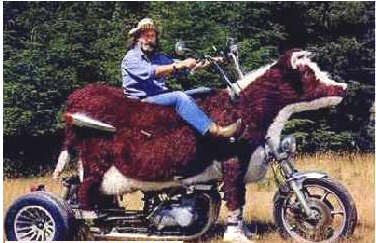
This specially designed vehicle lets Tiger Lilly infiltrate unobserved, eavesdrop on secret plans, unleash a devastating surprise attack and then make a speedy getaway quicker than the cattle can say “Mooove-on.org.”
The factory rep brought this over for her to inspect. Channeling Christian Bale in “Batman Begins”, and thinking of the ninja cows, Tiger Lilly’s response was: “Does it come in black?”
Cownter-terrorism' to Del.icio.us" alt="Add 'Cownter-terrorism' to Del.icio.us" />Cownter-terrorism' to digg" alt="Add 'Cownter-terrorism' to digg" />Cownter-terrorism' to reddit" alt="Add 'Cownter-terrorism' to reddit" />Cownter-terrorism' to Stumble Upon" alt="Add 'Cownter-terrorism' to Stumble Upon" />Cownter-terrorism' to Google Bookmarks" alt="Add 'Cownter-terrorism' to Google Bookmarks" />Cownter-terrorism' to Ask" alt="Add 'Cownter-terrorism' to Ask" />Cownter-terrorism' to FaceBook" alt="Add 'Cownter-terrorism' to FaceBook" />Cownter-terrorism' to Barrapunto" alt="Add 'Cownter-terrorism' to Barrapunto" />Cownter-terrorism' to MySpace" alt="Add 'Cownter-terrorism' to MySpace" />Cownter-terrorism' to Twitter" alt="Add 'Cownter-terrorism' to Twitter" />Cownter-terrorism' to Social Bookmarking Reloaded" alt="Add 'Cownter-terrorism' to Social Bookmarking Reloaded" />In one of Garrison Keillor’s Lake Woebegone Halloween monologues he reminisced about how the wild imaginations of he and his young friends could get taken with the scary thought that cougars were hiding in the low-hanging branches of the trees along their trick-or-treating path. Of course, he said, you knew that cougars were more afraid of you than you were of them, but what if it was an old, sick cougar…an old, sick cougar with nothing to lose?!
I thought of that today when I saw the Fox story about Chicago police shooting and killing a 150-pound cougar on the city’s North side. I guess a 150 pound cougar doesn’t sound like it would be too old or sick to me, and if it really had nothing to lose it would have gone for the South side of Chicago and the baddest part of town. Still, it’s something to keep in mind if you’re ever out trick-or-treating again.
The University of St. Thomas has yet another speaker controversy on its clumsy hands. Just months after inviting, then disinviting, then re-inviting Archbishop Desmond Tutu (he respectfully declined) to speak at the school, the University has now blocked another speaker from appearing: author and pro-life advocate Star Parker.
Enough people (see the links above) are covering this latest development that I really didn’t feel the need to cover it here. That doesn’t mean, however, that I didn’t have an unction to apply the needle a little bit to the young woman who works for me as I left the office today. She’s a St. Thomas grad. “What’s with your old school and it’s treatment of would-be guest speakers, anyway?” I asked. She wasn’t up on the news of the day (I work her too hard for her to peek at headlines).
“What now?” she asked, with a roll of her eyes.
I gave her the quick rundown, and wondered why a Catholic university would block a pro-life advocate from appearing on its campus, especially after the Tutu hoo-doo. “Don’t they have PR people over there, or at least someone who’ll tell them that if you try to play in the middle of the road you get run down by both sides?”
I don’t have her exact quote, but she showed the kind of keen mind and insight that caused me to hire her in the first place. The gist of it was, “It’s not the politics, it’s the money.” She said she used to work the phone bank on campus, calling alumni to ask for money. “So many times I’d call and get someone who was angry about this speaker or that speaker who had come, or a book that was selected for a class, and they’d say they weren’t going to give any money because of that.” She finished by saying something to the effect that St. Thomas was more concerned about the money drying up rather than, say, the same thing happening to free speech.
Wow — here I was, thinking that St. Thomas wasn’t interested in principle, when it turns out that principle and interest are pretty important to them after all!