Hardwared

by the Night Writer

I am not a particularly handy man when it comes to fixing things. In fact, I’ve often said of myself that I can do in half-a-day what it takes two men working all-day to undo. Nevertheless, I love going into old-timey hardware stores. There’s something about the faded floors, jumbled shelves and the scent of grease, oil, wood, copper and sweat that is hard-wired (or hard-wared) into my soul and stirs my imagination. The sight of rows of tools and implements made to fit the hand just make me feel useful and like I want to start some kind of project, even though I may only be able to tell you the true function of a mere fraction of these tools. For some reason I never feel this way when I go to Lowe’s or Home Depot, even though most of my “home improvement” shopping is done at these big box stores. Perhaps it’s because somewhere along the line “home improvement centers” replaced “hardware stores”.

I thought about this yesterday after reading that my local hardware store, Langula’s, is closing after 96 years and three-generations of being in business. I first wandered into Langula’s some 10 years or so ago because I needed my mower blades sharpened and they were the only place around that still did that on site, while you waited. The owner of the shop, Gary, usually did the sharpening himself, ensconced in his grungy workshop at the back of the store where you had to step down into an area  delineated by the original foundations of his grandparent’s store. Gary’s a phlegmatic guy, not much of a talker, but he can find parts and tell you how to use them. Sometimes I’d watch as he’d run the blades along the grinder in a shower of yellow sparks but usually I’d wander around the main part of the store, hefting this tool or running my hands over that piece of equipment. Somehow it all reminded me of when I was a boy and my grandfather would take me around with him when he’d go to visit his many friends who were fuel oil jobbers and mechanics. I remember their twill work pants, Eisenhower jackets and their billed caps with the ear-flaps on the side … and always the smell of petroleum. Okay, it wasn’t frankincense, but these men with their look and jargon seemed to me to be part of some esoteric priesthood of arcane knowledge.

If not a priesthood, it was certainly at least a club. My grandfather would tell me stories of a hardware store in his home town that was run by a couple of friends, one of whom had some talent as an artist. The men in town would congregate at the hardware store and drink coffee from mugs hand-painted for each man by the owner, usually in a risque manner. The men always left their cups in the back of the store, never to be seen by the casual public and definitely never by the wives or women-folk.

Another old hardware store that did things its own way was on Payne Avenue when I lived on the east side of St. Paul. It looked as if it could have been the model for a Norman Rockwell calendar. Hell, I think it probably still had a Norman Rockwell calendar on the wall from 1957. The aisles were narrow and things stacked on the upper shelves seemed to lean over my head like tree branches in an arbor, while the hardwood floor running down each aisle was worn into a smooth trench by generations of work-boots shuffling along, making it all feel as if I was in a tunnel. The haphazard clutter of odds and ends led me to suggest to the clerk helping me that it must be fun to do the annual inventory. “Never happens,” he replied. “When the old man dies, they’re just going to burn the place down and start over.”

Langula’s doesn’t have quite as much “character” as that place, and Gary never offered me a customized coffee mug, but the store is still a true, funky, living artifact of another time, complete with a shop cat that lounges about the place and often naps on the counter next to the cash register. Whenever I’d take a deep breath it seemed as if I could still smell the ghosts in their work-clothes. My grandfather and his friends all passed on long ago and the hardware stores they would have felt at home in are dying out, too. After nearly 100 years in the same location, this coming weekend will likely be the last for Langula’s.

I plan to drop in, browse the aisles, breathe deeply. I’m sure they’ve got something there I need.

For Your Christmas List: Your Chance to “Let Love In”

by the Night Writer

About 16 years ago this month two little girls stood on stage with their Sunday-school classmates and sang “A Whale in the Manger” and other Christmas carols for an adoring public. One of those little girls was my daughter, the Mall Diva, and the other was her best friend, Casii (pronounced “Casey”) Stephan. The two of them would eventually partner as singers and songwriters and do a handful of public performances before little things like the Diva’s married life got in the way. Casii continued to hone her skills as a singer, a lyricist and composer however and even contributed a song to the soundtrack of the recently released movie “A Christmas Snow” (more about this movie in a later post). She also attracted the attention of a local music producer who helped her create a four-song EP that was released last week.

casii-stephan-cd-let-love-in-storeThe EP, Let Love In, features a mix of up-tempo pop songs and soulful ballads that showcase Casii’s luminous talents in the hopes of garnering wider attention in the industry. You don’t have to wait for Casii to be “discovered”, however, in order to discover her yourself. As of today all four songs from the EP — as well as her song “My Sweetest Dream” from the movie soundtrack — are available on both iTunes and Amazon to sample and to download, or you can contact her through her website to get the EP itself on CD.

Casii has always blown us away, even in her younger days when her big, big voice in a little body hardly required a microphone to fill the room when she sang. Maturity has brought depth and control to her voice as she sings with passion and nuance while also showing that she’s a top-notch songwriter and musician. It has been so much fun to watch her bloom over the years and I’m looking forward to her further development and success in the future. Be sure to take advantage of this early opportunity to witness the emergence of an exciting new talent!

For your Christmas list: a book about life, death, kittens and blue angels

by the Night Writer

It turns out that I have a number of very talented friends who have, in the last few months, demonstrated their skills and creativity by publishing books, making award-winning movies and releasing EPs. With Christmas approaching I thought that over the next several days  I’d feature these efforts here with the thought they might make it onto your shopping list.

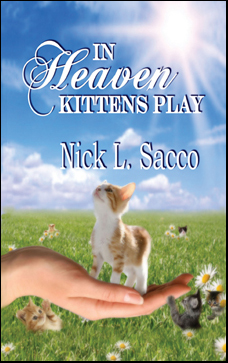
First up is a book written by best bud from high school. He later went on to become a marine and a motorcycle cop. So, what kind of two-fisted book do you think he wrote?  Would you believe…

kittensplay Turns out my friend Nick and his late wife were very involved with cat rescue organizations for the last several years and he has collected his thoughts, experiences and even some visions into a book that is both an moving account of their experiences and a touching tribute to his wife while offering an interesting vision of what happens to our pets after they die. The book, In Heaven Kittens Play: the Blue Angel and Her Garden of Pets is available from Amazon (including a Kindle version)  and from Nick’s own website.
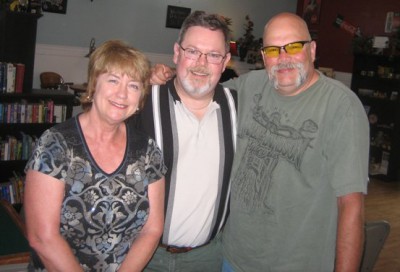
It’s a very nice read for anyone who’s lost a loved one or a beloved pet, and especially for those who are cat lovers (I’m looking at you, Gino). Nick’s been criss-crossing the country on book tours, signing books and doing radio and TV interviews but we both found ourselves back in our old hometown last summer where we were also able to catch up with our former Creative Writing instructor:

Miz Reed, me and Nick

Miz Reed, me and Nick

If you’re an animal lover, or know one, this book makes a great stocking-stuffer for the holidays.

The Revolution has begun

by the Night Writer

“When just one man says, ‘No, I won’t,’ Rome began to fall.”

— Spartacus

I think just about everyone is aware by now that Homeland Security and the T&A — I mean, TSA — has decided that it can look at you naked or aggressively grope you as a prerequisite of flying from one place to another in the land of the free. With the new, so-called “Naked Scanners” TSA agents tell you to “assume the position” with your hands over your head as if you are already guilty of something. Then they irradiate your body from the front and back so they can see under your clothes to determine if you’re packing weapons, explosives or just a little too much of Grandma’s fruitcake.

Sure, you can “opt out” of sharing X-ray-ted imagesof yourself but if you do then  the snap of a rubber glove signals that you are now subject to what Big Sister Janet Napolitano calls an “enhanced pat-down”, or what we used to call a “feeling up”.  TSA agents used to do these with the backs of their hands but now they get to palm your inner thighs, crotch, butt-crack and breasts because that will really show the terrorists.  Seriously, just think about it: we’ve had to go along with taking off our shoes, our belts, chucking our shampoo and deodorant, and now we have to submit to being molested just to fly. No wonder that all the would-be airline suicide bombers since 9/11 have been stopped not by the TSA but by pissed-off passengers. As Napolitano says, “the system works.”

The Christmas Day Knicker-bomber incident (where the nut-job’s father tried to alert the U.S. government of his son’s radical affiliations but was ignored) proved that Homeland Security can’t handle information, so they’ve decided to “handle” everything else, and they’d sure appreciate your cooperation. As Napolitano wrote in an open letter to the people who pay her salary,  “We ask the American people to play an important part of our layered defense. We ask for cooperation, patience and a commitment to vigilance in the face of a determined enemy. We also ask that you turn your head and cough.” (Ok, I added a few words at the end.)

Signs are, however, that after years of progressively greater indignities the public is starting to push back. The airline pilots and flight attendants unions are protesting and now passengers are saying “you touch my junk and I’ll have you arrested.” That’s what ticketed passenger John Tyner said in San Diego the other day after “opting-out” of the Nude Scanner and being faced with a government “grip and grin”. He demurred, and also happened to record his experience with his cell-phone:

A supervisor is heard re-explaining the groin check process to Tyner then adding “If you’re not comfortable with that we can escort you back out and you don’t have to fly today.”

Tyner responded “OK, I don’t understand how a sexual assault can be made a condition of my flying.”

“This is not considered a sexual assault,” replied the supervisor, calmly.

“It would be if you were not the government,” said Tyner.

“By buying your ticket you gave up a lot of rights,” countered the TSA supervisor.

“I think the government took them away after 9/11,’ said Tyner.

“OK,” came the reply.

Mr. Tyner didn’t get to make his flight to South Dakota but he was able to upload the 30-minute audio of his encounter to YouTube.

httpv://johnnyedge.blogspot.com/2010/11/these-events-took-place-roughly-between.html

Mr. Tyner’s decision to opt-out of the scanner treatment was based on concerns about radiation exposure. Big Sister assures us, however, that these concerns are unfounded. After all, the government has had  hours to test these machines and are confident that there are no short-term or long-term effects. Hey, if you can’t trust your government, who can you trust? Big Sister even says that Johns Hopkins has signed off on the safety of these scanners. Apparently, not everyone at John Hopkins got that memo, as described in this article, Naked Scanners At US Airports May be Dangerous: Scientists:

“They say the risk is minimal, but statistically someone is going to get skin cancer from these X-rays,” Dr Michael Love, who runs an X-ray lab at the department of biophysics and biophysical chemistry at Johns Hopkins University school of medicine, told AFP.

“No exposure to X-ray is considered beneficial. We know X-rays are hazardous but we have a situation at the airports where people are so eager to fly that they will risk their lives in this manner,” he said.

A group of scientists at the University of California, San Francisco (UCSF) raised concerns about the “potential serious health risks” from the scanners in a letter sent to the White House Office of Science and Technology in April.

Biochemist John Sedat and his colleagues said in the letter that most of the energy from the scanners is delivered to the skin and underlying tissue.

“While the dose would be safe if it were distributed throughout the volume of the entire body, the dose to the skin may be dangerously high,” they wrote.

The scientists say the X-rays could pose a risk to everyone from travelers over the age of 65 to pregnant women and their unborn babies, to HIV-positive travelers, cancer patients and men.

“Men’s sexual organs are exposed to the X-rays. The skin is very thin there,” Love explained.

The Office of Science and Technology responded this week to the scientists’ letter, saying the scanners have been “tested extensively” by US government agencies and were found to meet safety standards.

But Sedat told AFP Friday: “We still don’t know the beam intensity or other details of their classified system.”

The high-handed actions of Homeland Security and the TSA have even led to calls by some for a National Opt-Out Day on Wednesday, November 24 where travelers are asked to “opt-out” of the scanner treatment and accept a public groping in order to demonstrate opposition to these unreasonable searches. As the Opt-Out Day website says:

It’s the day ordinary citizens stand up for their rights, stand up for liberty, and protest the federal government’s desire to virtually strip us naked or submit to an “enhanced pat down” that touches people’s breasts and genitals in an aggressive manner.  You should never have to explain to your children, “Remember that no stranger can touch or see your private area, unless it’s a government employee, then it’s OK.”

The goal of National Opt Out Day is to send a message to our lawmakers that we demand change.  We have a right to privacy and buying a plane ticket should not mean that we’re guilty until proven innocent.

If you can’t avoid flying on the 24th or  some other time, you might find this video helpful when someone comes up to you and says “I’m from the government and I’m here to grope you.”

httpv://www.youtube.com/watch?v=WXDLQPfqc04&feature=share

Spend ’em if you’ve got ’em

by the Night Writer

The FDA will soon be mandating graphic anti-smoking warnings on packages of cigarettes, the result of a law passed last year giving the Feds authority to regulate marketing and labeling of tobacco products.
Cigarette graphic

Apparently the current anti-smoking efforts and warnings have only been able to reduce the number of smokers in the U.S. population to around 20%, a level that has held steady for the past several years. The thinking now is that gruesome, graphic images taking up half of the packaging on a pack of death sticks will gross the die-hards out. I already don’t have a desire to smoke so I don’t know how effective this might be, but apparently those pushing this measure think this will help until they’re able to pass a law requiring smokers to wear distinctive patches sewn on their clothes in order to make it that much easier to shun them.

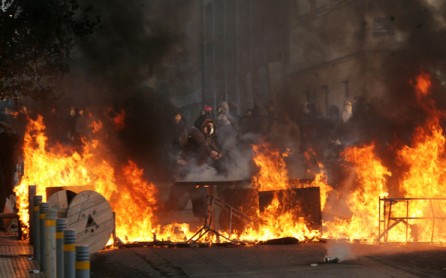
If graphic photos are effective, though, then I’m excited about future possibilities. What if we were to put gruesome images on the front of everything dangerous? What if, for example, we were to require the cover page of every trillion-dollar deficit budget submitted to Congress to have a picture of, say, gutted Detroit or the Greek riots?

Abandoned Detroit

Greek riots

WARNING. UNCHECKED SPENDING WILL KILL YOUR ECONOMY.

They may not take time to read the bill itself, but they’d at least see the cover. Do you think it might work?


Braveheart, 2010: Boehner as Robert the Bruce to Bachmann’s William Wallace?

by the Night Writer

“There’s a difference between us. You think the people of this country exist to provide you with position. I think your position exists to provide those people with freedom. And I go to make sure that they have it.”

With those words Mel Gibson as William Wallace in the movie Braveheart challenged a feckless Scottish noble, foreshadowing not only Braveheart’s battles with the English but also with the gentry that represented his supposed allies in the fight for Scotland’s independence. It also symbolically foreshadows an uncomfortable relationship between the Tea Party and the Republican leadership in the ongoing fight for freedom in America.

In 1297 the central players in an uneasy alliance were William Wallace, the upstart rebel who shocked and demoralized the English with a dramatic victory in the Battle of Stirling Bridge,  and Robert Bruce, the scion of a wealthy and politically powerful Scottish family. In 2010, Republican lion and presumptive Speaker of the House John Boehner plays Robert the Bruce to Michelle Bachmann’s  Wallace.   Bachmann was out-front for the burgeoning Tea Party movement, driving her enemies to distraction and helping spark a historic Republican rout that changes the balance of power in much the same way that Stirling Bridge did. Her decision to now run for a leadership position in the Republican caucus has been greeted coolly by her nobles. I know there are those who will raise an eyebrow or a guffaw at equating Michelle Bachmann with a figure as historically significant as William Wallace but at the heart of the matter there are similarities.

Bachmann is derided by her enemies (both in and outside the Republican party) for being out-spoken, outrageous and deliberately provocative. That’s pretty much how Wallace was presented in Braveheart: coarse, blunt and sometimes appearing to be making it up as he went along. The way the Scottish nobles fought the English in those days is also not too different from the way the Republican leadership has historically contended with the Democrats: a show of force before the battle which merely sets the stage for a parley in the center of the field that ends in negotiation. When Wallace showed up — nearly unwanted — before one battle he was told to hang back and be quiet. When he rode forward to be part of the parley anyway someone asked him what he was doing and his response was “picking a fight.”  The passion and taunts of Wallace and his men discomfited the “civilized” combatants who weren’t expecting to be mooned or to be told that their general could bend over and “kiss his own arse.” Similarly, Bachmann and her unwillingness to “play nice” is barely tolerated by the party elite, while the passion and populism of the Tea Party rallies and town halls has shaken the political professionals and pundits who hope it is an aberration and not a new fact of life.

Consider this as well — the English king, Edward I (aka “Long-shanks”) was as ruthless and canny a leader as there ever was. He controlled the Scottish nobles by also granting them lands in England as well as Scotland, meaning any true rebellion wouldn’t just undermine him, it would undermine their wealth as well. Similarly, the entrenched Republican leadership, epitomized by Boehner the Bruce, has gained power, prestige and wealth by managing the status quo. Like any good general, the Boehner knows how to take advantage of opportunity when someone rocks the boat, but also realizes that if the boat rocks too much there’s no telling who all will go overboard. (At least he may take comfort in knowing that President Obama is no Edward I.)

In the movie, Robert the Bruce is stirred by Wallace’s example and conviction, but also swayed by his father’s adamant insistence that the only thing that was important was keeping his land, his possessions and his title, even if it meant lying, cheating and betraying others. As for the Boehner and the others who have been in D.C. for a long time, they will have to search their own souls to determine whether to be guided by principal or the political equivalents of the land, possessions and titles they’ve acquired by playing the game.

Of course, the risks aren’t solely with them. History tells us that Robert the Bruce eventually united the Scottish clans and factions and became king of an independent Scotland  (even if this was helped by Edward I dying and being replaced by a less resolute heir). History also tells us that William Wallace was defeated at the Battle of Falkirk, just one year after Stirling Bridge, when the Scots cavalry, commanded by the faithless nobles (Bruce was not present), abandoned the field when they could have routed a broken English attack and left Wallace and his pike-men and archers (under the command of one Sir John Stewart) at the mercy of the English cavalry and long-bows. Wallace and his surviving army were scattered and within two years he was ultimately betrayed into English hands, taken to London, convicted of treason and summarily drawn and quartered. While there are many who would like to see the same happen, metaphorically, to Bachmann (or perhaps literally given the vitriol some use in the comment sections of the newspapers), there are two historical lessons to be learned. One is not to trust your “leaders” to have your back. If they’re truly leaders then they need to be out front, which is what Wallace urged Bruce to do. In the movie he tells Bruce, “Your title gives you claim to the throne of our country, but men don’t follow titles, they follow courage. Now our people know you. Noble, and common, they respect you. And if you would just lead them to freedom, they’d follow you. And so would I!” In the movie Bruce is inspired by Braveheart’s passion and sacrifice and summons the will to ignore his father’s advice and to see the cause through to the end.

The second lesson is that a cause that captures people’s hearts and minds is greater than any one individual or group of individuals. While some might say that it’s silly to compare our modern circumstances with Scotland’s fight for freedom from tyranny, let’s not lose sight of the fact that the Scots had little knowledge of what we call democracy. They were used to a feudal system of gentry and serfs where the individual was regularly at the mercy of his “betters” who could impose sanctions and indignities with impunity, even to the point of claiming “first night” rights with a bride. Yet the people  still valued and longed for the right to live their own lives, even if it cost their lives. In comparison, our dealing with a government that would force us to buy health insurance, tell us what kind of light bulb or fast food we can buy or electronically strip-search us “for our own protection” seems almost petty. Or does it?

One of the remarkable documents that came out of Scotland’s battle for independence was the Declaration of Arbroath. Written in 1320, some 450 years prior to our own Declaration, it includes the words that I hope will resonate for another 400 years or more:

It is in truth not for glory, nor riches, nor honours that we are fighting, but for freedom — for that alone, which no honest man gives up but with life itself.

Declaration of Dependence

by the Night Writer

We hold these truths to be self-defeating, that all men are created ignorant, that they are endowed by their Government with certain unknowable rights, but among these are lies, subservience and the pursuit of higher taxes. That to obscure these rights, governments are instituted among men, deriving their assumed powers from the apathy of the governed. That whenever any form of government becomes effective enough in achieving these ends, it is the plight of the people to alter or to demolish their will, and to allow even more government, laying its foundation on such principles as the healthcare they must buy and the type of light bulbs they may not buy, ceding their powers in such form, as to them shall seem most likely to effect the safety and happiness of those in charge.

Of golden chains and gilded gags

by the Night Writer

As part of the furor of the political season, I have seen several news stories in recent days about activist pastors provocatively announcing their intention to endorse candidates from their pulpits. Predictably, this has led to activist groups such as Americans United for Separation (ignore the oxymoron) of Church and State to file complaints with the IRS about the churches violating their tax-exempt status. This was, of course, what the pastors were hoping for in order to force what they hope will be a defining battle over free speech.

All of which I’m sure would cause our hallowed founding fathers — be they Christian, Deist or Other — to shake their heads at the ignorance abounding on all sides.

At issue is that the churches, like most U.S. churches over the past 50 years, have incorporated themselves as 501c3 organizations, ostensibly gaining limited-liability and tax-exempt status, but with the caveat that they can’t engage in politics. The pending confrontation has both sides enthusiastic about the battle, while the IRS is likely much less so. From the article in Tuesday’s Star Tribune:

Although pastors across the country have staged similar protests for years (more than 100 of them this year alone), the IRS has dropped them after investigating the cases, and agency officials have declined to say why they did so.

That’s likely happened because the IRS already knows that a church doesn’t need 501c3 status in order to be tax-exempt.

Despite the rampant ignorance (remember, “ignorance” is not the same as “stupidity”), the issue isn’t that complex. Here’s a useful and easy to understand website that explains this. One section in particular contains the following:

The IRS has acknowledged for decades that it is completely unnecessary for any church to apply for a tax-exempt status. According to IRS Publication 557, as well as IRS Code § 508, churches and church ministries are “exempt automatically.” Application for an exempt status is not only superfluous, but to do so subordinates that church to the IRS. Churches in America have always been nontaxable anyway. It simply makes no sense for a church to go to the IRS and seek permission to be exempted from a tax the government can’t impose in the first place.

The church in America is protected from the government by the First Amendment:

“Congress shall make NO law respecting an establishment of religion, or prohibiting the free exercise thereof.” It would be absurd to suppose that you could have free exercise of religion if you had to pay for it (taxes). If Congress can make NO law respecting the church, it can make NO law to tax the church.

The IRS lacks the jurisdiction necessary to tax the churches in America. The IRS has no more jurisdiction over the churches in America than it does over the churches in Canada. It would be as absurd (and tyrannical) for the IRS to tax the churches in America, as it would be for the IRS to tax churches in Canada. They don’t have jurisdiction.

Neither is your church required to be a 501c3 in order for your contributions to be tax-deductible. Nor is this a radical new concept of Church and State. America’s churches have always been “free” churches as opposed to the state churches prevalent in Europe at the time of our founding. They have neither been under the jurisdiction of, or supported by, the government. In the 1950s the 501c3 was offered as a “benefit” to the churches, perhaps to codify the tax-exemption…while at the same time making all churches who accepted the bargain fundamentally subservient to the State, especially in matters of free speech.

Now you could call it conspiracy, or merely one of those unintended consequences government is so good at, but there conceivably could be a reason why the State (regardless of the administration du jour) might seek to bind the Church’s hands with gold and close its mouth with silver: the Church had historically always been the first to speak up against tyranny, both within and without. Indeed, going back to pre-Revolutionary days, it was the pastors of many denominations who spoke out from their pulpits against the Crown’s violations and depradations, earning the clergy the deep enmity (along with sizable bounties on their heads) of King George and the Tories who referred to them as “The Black Regiment” (because of their black robes). More accurately, the preaching and activism of the clergy was likely worth several regiments in the field. (Here’s a sample sermon, circa 1776, from Rev. Samuel West, perhaps a distant relation of mine.)

The call to conscience, based on the word of God, will often stand in opposition to the rule of law as wielded by tyrants. Henry II is not the only ruler to, in one form or another, say, “Will no one rid me of this troublesome priest?” (Dietrich Bonhoeffer would be a more contemporary version of Thomas Beckett). Bloody decrees somehow only served to fan the flames then; now subtle favors and lulling complacency may be more devastating to liberty. To speak out is not merely the right of the clergy, but their responsibility as well. As John Adams said,

“It is the duty of the clergy to accommodate their discourses to the times, to preach against such sins as are most prevalent, and recommend such virtues as are most wanted.


For example, if exorbitant ambition and venality are predominant, ought they not to warn their hearers against those vices?


If public spirit is much wanted, should they not inculcate this great virtue?


If the rights and duties of Christian magistrates and subjects are disputed, should they not explain them, show their nature, ends, limitations, and restrictions, how muchsoever it may move the gall of Massachusetts?”

As with any right, it comes with responsibility, especially where a nation’s destiny is concerned. As Charles Finney said,

“If there is a decay of conscience, the pulpit is responsible for it.

If the public press lacks moral discernment, the pulpit is responsible for it.

If the church is degenerate and worldly, the pulpit is responsible for it.

If the world loses its interest in Christianity, the pulpit is responsible for it.

If Satan rules in our halls of legislation, the pulpit is responsible for it.

If our politics become so corrupt that the very foundations of our government are ready to fall away, the pulpit is responsible for it.”

Martin Luther’s own words were an unheeded warning in the 1930s as the German state church was subsumed and subverted by the Nazis into a facile caricature of Christianity unable to resist genocide and heritage-shattering megalomania:

“If I profess with the loudest voice and clearest exposition every portion of the truth of God except precisely that little point which the world and the devil are at that moment attacking, I am not confessing Christ however boldly I may be professing Christ.


Where the battle rages there the loyalty of the soldier is proved; and to be steady on all the battlefields besides is mere flight and disgrace if he flinches at that point.”

I’ll credit the vision of the Minnesota pastors speaking out today and applaud their stance, but they never would have had to defend their free speech rights and responsibilities if their churches hadn’t incorporated and accepted their chains and gilded gags in the first place. (One might also wonder when the Revs. Jeremiah Wright and Al Sharpton, and Fr. Pfleger might be called into account by Americans United).

The American Church has accepted a foolish bargain and allowed liberty to be burned before its altars. The cause is no more dire today than it has ever been. Similarly, the cost is the same and must be paid with vigilance and boldness.

Exciting News!

by the Night Writer
Shadow of the Reapers Photo - smaller

We just learned today that Tiger Lilly’s first book, “Shadow of the Reapers”, which was serialized here, won first prize in the category Middle Grades/Young Adult fiction in a Self-Published book contest put on by The Writer’s Digest. Along with the award she picks up a nice little chunk of cash, some writerly swag, and a cool sticker she can put on the cover of her book, proclaiming her prowess. She’ll also get some coverage/promotion in The Writer’s Digest magazine next spring.

Woo-hoo! There’s gonna be some ice cream tonight!!!