Beware the Bumpuses!

Ok, the real reason I’ve been on blogging vacation is that I’ve been cramming for this Friday night’s All-Star Triva Throwdown and fund-raiser for Soldier’s Angels. Our team of Jeff Kouba , Leo Pusateri, Uncle Ben and myself will mix it up with national talk-show host and Blog-father Hugh Hewitt, the Fraters and many other minutiae-minded precontenders. We’ll be “managed” by the Mall Diva who, if this devolves into the expected Wrestlemania brawl, will leap into action, squirting hair-spray into the eyes of our opponents (either that or traitorously turning on Ben).

Our captain entered our team name as “Three Weddings and a Funeral”, but since there’s usually a Hewitt-inspired Ralphie-Christmas Story theme to this competition I’ve suggested we call ourselves “The Bumpus Brothers.” I can just hear Chad the Elder cursing “those %$#@* Bumpuses” as we hound the competition and run off with the prize!

Anyway, the event starts at 9:00 p.m. so come on down and cheer (or heckle) your chosen squad. While you’re at it, please make a contribution to Soldier’s Angels, a great organization dedicated to supporting our troops and their families. Hope to see you there!

Giving the finger

I’m still on blogging vacation, but a recent event got me to pondering comparitive cultural approaches to crime and punishment. I will meditate on this during my time off. In the meantime:

Four young men broke into an apartment in South Minneapolis last week, only to be wounded and chased away by an intended victim wielding a samurai sword. Three of the attempted robbers have been arrested: Hossem Chalbi, Iman Ahmed Abdelhakim and Mohammed Khalil. I don’t want to jump to conclusions, but I’m guessing that these youths aren’t Amish.

Chalbi was slashed on the arm and Khalil was slashed on the abdomen and also lost a finger. Assuming Khalil isn’t a wayward Amish who has forsaken his religion of peace, but is perhaps a follower of the Islamic law of Sharia, then he got off relatively easy: the Sharia penalty for theft calls for amputation of the whole hand.

(Interesting but unrelated sidenote: the attempted robbery took place in the 3100 block of Lyndale Avenue S. I used to live just two blocks away, in the 3100 block of Harriet Avenue S. I didn’t have a samurai sword, but I did keep an old bayonet around the house.)

Going nowhere and enjoying it

“Vacation” is sweet. So far I’ve been able to resist the temptation to let fly on the busted terrorists, the missing Egyptian “students”, the use of samurai swords for home defense, capital punishment for auto-insurance scofflaws and the mystery of how Chrysler went from Lee Iacocca to Dr. Z.

I’ll be getting back to the routine soon enough, but as this video proves, even if you’re on a treadmill it doesn’t mean you can’t have fun.

Lights. Camera. Outrage!

Ok, so it’s day one of my blogging vacation and here I’ve already broken my self-imposed exile. Just because I intended to stop writing, however, doesn’t mean I’ve stopped reading and this post from The Wide Awake Cafe brought me out of my hammock. It contains a link to a series of photos and video images from EU Referendum that show the revealing timeline and backstory behind the famous images from the Qana attack (caution, the photos of the childrens’ bodies are intense).

It is clear that, as we have known, the Israeli attacks killed many civilians. What is illuminated, however, is what we have long suspected: these events, if not deliberately instigated, are enthusiastically manipulated by the likes of the dynamic duo of Green Helmet and White Tee-Shirt Guy with assistance from their gang, The Willing Media in their never-ending quest to score political points.

Sadly, outrageously, the score is being kept by dead bodies. These little girls are dead, perhaps coldly killed by Israeli bombs, but assuredly and cold-bloodedly exploited by the psycho cockroaches of Hizbollah and its patrons who first used these children as human shields and then searched the rubble for the most shocking remains to be paraded bathetically in front of the cameras and then abandoned as indifferently as when they were thrust into the line of fire in the first place.

This story, combined with the news that broke over the weekend of the doctored photos published by Reuters (a story that even CNN couldn’t ignore) is truly depressing. Rather than return to my hammock, I think I may go to my prayer closet instead.

That’s all I’m blogging today. However, for more details on the Reuters scandal see these related stories from Powerline, Michelle Malkin and the blogger credited with exposing the fake photos, Charles Johnson at Little Green Footballs (slow loading due to very heavy traffic).

Call me “Jacque”; see you after Labor Day!

Frankly, I’m not much of a Francophile, but there is one French custom that has a certain appeal to me: the month-long August vacation.

I like blogging and I’ve had more fun and gotten a lot more satisfaction from doing this than I ever expected when I started nearly 18 months ago. Therefore I’m not planning on quitting anytime soon. I am, however, going to take the rest of this month off to try and remember what I did with all my free time before I started blogging.

I’ve got some chewy books I’ve been wanting to read, a couple of new Xbox games I’ve barely touched, a fantasy football campaign to plot and a desire to spend some of the remaining summer evenings out of my basement. There’s also an element of personal development to this exercise: I want to see if I can get through a day without looking at it as blog-fodder; I want to see if I can get to bed earlier at night; and I want to see if I really can stop, anytime I want to.

That doesn’t mean “The Night Writer” is going dark the next few weeks, however. The Mall Diva and Tiger Lilly can post anytime, and I’m pretty sure there’ll be more updates leading to MD’s big golden birthday bash (not to mention the big unveil she’s been promising of her birthday dress). Furthermore, I may pop in if something timely comes up or occurs to me that I can’t let pass without comment.

I’ll be back the week after Labor Day, and I hope you will be, too.

What lives on

Mitch reminds us that yesterday was the one-year anniversary of the death of war correspondent Steven Vincent, killed not in the heat of battle but in cold blood by Islamic “warriors” who targeted him because of things he had written (I believe we’re still waiting for the New York Times to be outraged).

Interestingly enough, today happens to be the birthday of one of America’s first embedded reporters, Ernie Pyle. I read a lot of Pyle’s writing, and writing about him by others, when I was in junior high and high school. It was a time when war was a fascinating subject for me and I read voraciously about the Civil War and World War II, cutting my teeth on Richard Tregaskis and the Landmark Series put out by Random House and moving on to Pyle and many others.

Pyle was a native of Indiana, where I lived at the time, which may have made him more interesting to me at first. What stands out now for me, however, is that his coverage of World War II may have been the first reading I had done that pierced the romantic cloud of glory and honor and all the glittery trappings that can so easily mask the reality of war when viewed from the distance imposed by geography, or experience — or willful ignorance. While there was certainly plenty of glory and honor in Pyle’s stories, it was tight-lipped and gritty as he related the activities of men who didn’t fight for a cuase so much as they fought for each other and for the chance to see another day, and sometimes paused to consider what they may have lost in the process. A great collection of Pyle’s columns can be found online here.

From Pyle I began to get a picture of men who hated what they were doing but knew it had to be done, which I later learned also pretty much described his own feelings about his calling. Though he won a Pulitzer for his reporting and was able to leave the war for awhile, Pyle chose to re-enter the storm and was subsequently killed by a sniper while covering the action in the Pacific.

Steven Vincent was a worthy successor to Pyle and there are many others today such as Michael Yon who carry on the tradition of giving the reader a chance to see the picture up close. That is an invaluable perspective because it blows away the camouflage that others (pro and con, left and right) so easily create for those who prefer to watch from a distance.

In the process some of these correspondents die too young. At the same time, something very important lives on. I urge you to check out the above link to the Pyle collection and rediscover (or discover) the power of a compelling story, expertly told.

Challenging Word of the WeeK: salmagundi

Salmagundi
(sal muh GUN dee) noun

This peculiar word describes, in its narrow sense, a dish, usually served as a salad, consisting of a mixture of chopped cooked meat, onions, hard-boiled eggs, anchovies, pickled vegetables, radishes, olives, watercress and other ingredients, with salad dressing, sometimes arranged in rows to form a color pattern. The term, however, is sometimes applied to a much simpler concoction: a meat and vegetable stew. It can also be spelt with a final -y instead of an -i.

Salmagundi has a much wider figurative application, as a term denoting any heterogeneous mixture or miscellany, and in this sense it is a synonym for gallimaufry or olio or hodge-podge, a medley, a potpourri, a mishmash, a farrago. A painting, for instance, or any work of art, for that matter, revealing a mixture of many influences may be referred to as a salmagundi or pastiche. There is a jocular saying that a camel is a horse designed by a committee. That would make the poor beast a sort of salmagundi of an animal — a little of this and a little of that. Any creation in which too many cooks have had a hand may sadly turn out to be a salmagundi. The word is derived from the French noun salmigondis, said to be based, in turn, on the Italian for “pickled salami,” known as salami conditti. Though it has nothing to do with the old nursery rhyme, the sound of salmagundi brings to mind the sad tale of

Solomon Grundy
Born on a Monday
Christened on Tuesday
Married on Wednesday
Took ill on Thursday
Worse on Friday
Died on Sunday
This is the end
of Solomon Grundy

and the end of salmagundi.

My example: The Minnesota Organization of Blogs (MOB) is a salmagundi of sagacity, savoir-faire and a bit of silliness.

From the book, “1000 Most Challenging Words” by Norman W. Schur, ©1987 by the Ballantine Reference Library, Random House. I post a weekly “Challenging Words” definition to call more attention to this delightful book and to promote interesting word usage in the blogosphere. I challenge other bloggers to work the current word into a post sometime in the coming week. If you manage to do so, please leave a comment or a link to where I can find it. Previous words in this series can be found under the appropriate Category heading in the right-hand sidebar.

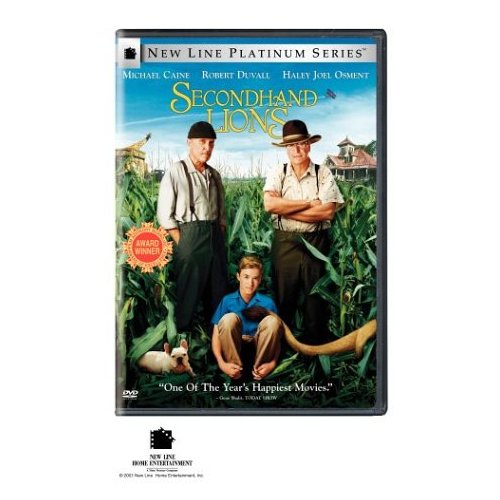
Friday Fundamentals in Film: Secondhand Lions

Secondhand Lions is both a great addition to this blog series and a well-received film by the young men in our bi-weekly viewing group. The viewing group has largely followed the order of the original class I taught a few years ago while the blog series has gone on to feature additional movies. This week I decided to overlap the two and feature the same movie in both. As such it was a change of pace for the class in that it’s not a war movie or a western, but a comedy. Even the movie makes many important points about honor, honesty and “what a boy needs to know to be a man.”

The story is about a young teenage boy, Walter (Haley Joe Osment), who has grown up without a father – and with a never-ending series of lies from his irresponsible and self-serving mother. In her latest scheme she dumps him for the summer with his eccentric great uncles, Hub (Robert Duval) and Garth (Michael Caine) McCann, about whom many local rumors and legends have circulated about their supposed wealth — and how they came by it. Walter’s mother has two objectives; get some time away without the responsibility of having Walter around, and the hope that Walter might find out where the brothers hide their money.

Garth and Hub don’t appear to be especially upright examples of virtuous men as they live in a poorly maintained house on a remote farm or ranch in the wilds of Texas and their main form of entertainment is taking potshots at the series of opportunistic traveling salesmen that come their way. As the days and nights go on, however, Walter starts to hear an amazing tale of adventure, courage, romance and justice spun out that almost sounds too good to be true, especially after his experiences with his mother. While Walter fears being abaondoned, his uncles (especially Hub) fear becoming useless. While Garth appears willing to settle down and act his age, Hub is still restless for his lost love and not ready to surrender to the expectations of old age. As Garth explains it to Walter, “A man’s body can grow old but the spirit inside of him doesn’t.”

Naturally their fears are mutually answered in each other, especially as Walter gets curious about the mysterious speech Garth says that Hub gives to young men on what they need to know to be good men. It could all get pretty syrupy but for a brisk plot and a series of great scenes that advance the story and message. In particular, the scene were Hub, Garth and Walter stop for barbeque at a roadhouse and have their meal interrupted by a young ruffian and his gang who decide to have a little sport with the “old men.” Viewing the youth as no more of a bother than a mosquito, Hub continues his discussion, telling Garth and Walter:

Here’s a perfect example of what I’ve been talking about. Since this boy was suckling on his momma’s tit, he’s been given everything but discipline. And now his idea of courage and manhood is to get together with a bunch of punk friends and ride around irritating folks too good natured to put a stop to it.

Naturally this means the rumpus is soon on, and the leader of the group asks Hub who he thinks he is. Suddenly taking the young man by the throat, Hub stares down into his eyes and delivers the second-best monologue in the movie:

I’m Hub McCann. I fought in two world wars and countless smaller ones on three continents. I’ve led thousands of men into battle with everything from horses to swords to artillery and tanks. I’ve seen the headwaters of the Nile, and tribes of natives no white man had ever seen before. I’ve won and lost a dozen fortunes, killed many men and loved only one woman, with a passion a flea like you could never begin to understand. That’s who I am.

After administering a thrashing to the gang Hub brings them back to the farm to tend their wounds and they listen raptly (in sight of, but out of the hearing of, Walter and us) as he ultimately gives them “the speech” that Walter so longs to hear, but is still excluded from hearing. Later, after being confronted by Walter, Hub agrees to give the boy “just a piece” of the speech, promising to deliver the rest when he’s older. The part he shares is the number one monologue in the movie:

Sometimes the things that may or may not be true are the things that a man needs to believe in the most. That people are basically good; that honor, courage and virtue mean everything; that power and money, money and power mean nothing; that good always triumphs over evil. And I want you to remember this, that love…true love…never dies. You remember that, boy. Doesn’t matter if they’re true or not because those are the things worth believing in.

Ultimately Walter’s mother returns, accompanied by an unsavory new boyfriend. When the boyfriend outrageously steps over the line, Walter has to draw upon the seeds of courage and self-respect that have been planted over the past few months to face her (and get her to face herself) as he makes his case that his best hope for the quality of the rest of his life is to stay with his uncles instead of following her to Las Vegas. Since the movie is told as a flashback, Walter obviously stays with his uncles and grows up. We can assume that he ultimately hears the rest of the speech from Hub on “what a boy needs to know to be a man” but this is never shared with the audience except for the excerpt above.

Typically in this series I include a series of questions and points to ponder for readers to consider or share with others. There were some questions I asked the boys last night about the underlying themes of the movie (including some of the plot elements I haven’t covered here), but I think I will leave you with the same “homework” I gave to them. I told them the next time we get together they need to come back to me with at least one thing they think went into the rest of the speech we didn’t hear. If you want to help us out, leave your thoughts in the comments section below.

Things that go crash in the Night

The recent story of the drunk driver taking out an entire house has reminded me of the time when our own house was unable to duck.

It was in the spring of 2003, about 10:15 at night. The Reverend Mother and Tiger Lilly had already gone to bed and the young Mall Diva was upstairs, probably flipping through fashion magazines. I was on a couch in my basement trying to catch the Twins score on ESPN (I hadn’t even heard of blogging at that time) when I heard a strange rushing noise that lasted just long enough for me to cock my head and try to classify the sound before it was replaced by a loud crash and a shudder through the house. I, and the cat that was on the back of the couch, immediately levitated and were on our toes. As a parent you learn that while the first sound you hear is important, it is the next sound that tells you how serious the situation might be so I froze for a moment waiting for my next clue: would it be screaming, crying or someone yelling at the other cat?

It turned out that the next sound was that of the Diva’s feet stampeding down the steps from the upstairs to the main level, then her voice saying, “Dad – someone’s crashed into our house!” About that time I had cleared the basement steps and could see a strange light outside our dining room window, reflecting a strange kind of fog. “Get me the phone,” I said to the Diva as I headed for the front door, which is right next to the dining room. As I opened the door and came out on our porch I could see a white car crumpled up under the window box a few feet away and resting on my shrubberies, with several heads inside the car bobbing around. Behind the car and parked in the half-circle driveway that divides our front yard was another car, the driver’s side door open and a man standing behind it, shouting in a very authoritative voice, “Turn the car off, you are not going anywhere.”

I’ve just about got the scene processed in my head when the Diva comes out with the cordless phone. I dial 911 and when the operator comes on and asks for a description of the problem I respond with my address and the statement, “Someone has just crashed their car into my house.”

“What was that again?” said the operator.

“I said, someone just crashed their car into my house.”

“Is anyone in need of medical assistance?” she asks.

“Not yet,” I reply.

“Just so you know, officers are on the way.”

By this time people were climbing out of the crashed car looking rather dazed and the mysterious driver of the second car was still shouting instructions. I could already start to hear the sirens, as everyone of my neighbors in the vicinity had already called 911 themselves before I even placed my call. I asked the men who had gotten out of the crashed car if they were all right, but they didn’t have much to say. As they were all standing, however, I figured they must not be hurt too bad. The second driver approached and I met him out in the yard where he introduced himself and gave me the story thus far. It turns out he was driving along the highway near our house when he had noticed the white car driving erratically and then saw it clip a minivan and force it off the road. As a concerned citizen and a computer analyst for the State Patrol he was offended and when the white car didn’t pull over after the accident he had followed it while calling 911 on his own cell phone. The driver in the white car noticed the attention he was getting and exited the highway in an attempt to lose his pursuit in the streets of my neighborhood.

My house is near the highway and sits in a commanding position where three streets come together in front of it. I also happen to have a large front yard. The driver had barreled down the street toward my house and tried to make a left turn onto another street, but given his speed and physical impairment (drunk) couldn’t quite make it. He hit the curb, launched his car into the air, landed halfway across my front yard, careened the rest of the way across the grass (dropping parts everywhere), crossed my driveway, took out a lamppost, broke through one hedge, crossed another sidewalk and kissed my stucco. Later we would pace off 27 steps from the cracked curb to the gouge in the yard where the car first nosed in.
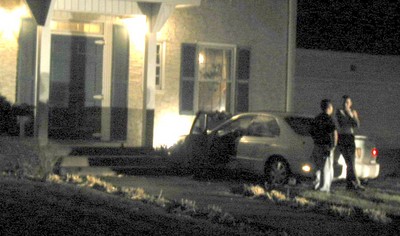
Of course we soon had all kinds of company. Two local squad cars, a couple of Highway Patrol units, an ambulance, a firetruck and eventually a flatbed tow-truck showed up, along with a goodly number of my neighbors. Oh, and my wife and other daughter poked their heads out of the front door to see what was going on as well. After my initial health check on the four men from the white car I hadn’t had any more words to, or from, them and let the officers on the scene sort things out. Once it was determined that everyone was alright and that the front of the house wasn’t going to fall over it was all rather anticlimatic. The relief I felt was matched the next day when we found out that the driver actually had insurance (though I suspected that wouldn’t be the case much longer).

He was insured by Farmer’s, which called and apologized on behalf of their client and arranged for an appraiser and an engineer to come out and examine the house. While the yard and shrubs were looking pretty rough, the damage to the house was negligible. There was a very thin vertical crack in the stucco underneath the dining room window. The engineer also expressed his admiration for the construction techniques of our home, which was built in 1948. He showed my wife where the rim joist the house rests on was actually constructed of two joists sistered together, and that according to his instruments the rim joist had moved all of 1/16 of an inch before snapping back into place. No doubt the hard landing in my front yard and the resulting slide through my greenery had diminished the impact which was fortunate for us and for the driver and his passengers. The driver was also fortunate that he had hit where he did; if he had gone just a little further to the left he would have been into the front porch and probably would have brought the portico down on top of himself.

All in all, God was looking out for us and for the drunk joker. We also got a little money out of deal and the house has stayed solid ever since. Perhaps best of all, the soon-to-be-driving Diva received an up-close example of the combination of alcohol, speed, mass and friction.
To the Max

When I first met my wife I didn’t have much appreciation for art. About the only thing you’d have found on my walls back then was white paint (and food). My favorite artist was the guy who put all the tiny numbers inside the little outlines on the kits I bought as a kid. That may have been because I had a better odds drawing to an inside straight than trying to draw a recognizable picture.

All that aside, today is the birthday (1870) of one of my wife’s all-time favorite artists, Maxfield Parrish. Thanks to her, I’ve also come to appreciate Parrish’s work and I love to look at prints of his dreamlike landscapes and portraits. The unique colors and “glow” in his work are so rich and interesting and it is fun to picture yourself standing (or reclining) in each scene. I even have an outline in my head for a story that I hope to write one day, set in a world that looks like his paintings (I’ve named the woman in the image below “Calla”).

I obviously can’t claim to be too fine in my artistic sensibilities, or unique in my appreciation of Parrish. He’s probably more of a “popular” artist than what the more sophisticated might consider a “master” (at one time in the 20th century it was estimated that one in every four American homes contained a Maxfield Parrish print), but I enjoy the fantastical elements and sense of fun in his paintings and I’ve always had the sense that they were fun for him to paint as well. There are other “popular” artists such as Thomas Kinkade and Terry Redlin who have made luminescence part of their trademark, but it seems to me to be an almost forced quaintness on their part (or at least profitable repetition), rather than something emanating from the artist’s imagination.

Parrish was pretty prolific, but I still wish there was more of his work.