I totally don’t know what that means — but I got it!

Jessica Simpson didn’t have to kick me in the throat to get me to think about High Definition (HD) TV because for some time I have been longing from afar (for HD, not Jessica). The cost of HDTVs, however, made it about as likely for me to find one of these in my rec room as it was for me to have Ms. Simpson calling me from the grocery store to say she’d looked all over the meat department but couldn’t find Chicken of the Sea so would it be all right if she just made tuna casserole for dinner.

I am, however, a patient man (that sound you just heard was my wife snorting). I know that when it comes to technology you just have to bide your time and the price will come down as the “early adopters” drive the market toward the new newest, greatest thing. I learned this lesson long ago before I was even married when I paid more than $600 for a VCR with “breakthrough” 4-head technology for the highest resolution. Now my forehead is what I slap whenever I see a brand-new VCR going for $19.95 at Wal-Mart. Of course, you can fall too far behind the technology curve: I used to really want one of those thin, pricey RAZR cellphones — now companies are giving them away like Skittles and I wouldn’t have one.

Anyway, the HDTVs finally came down into the range where value and opportunity were within hailing distance, and wouldn’t you just know it happened to be right before the Super Bowl? I was able to find an HD-LCD TV with a home theater system for about half what a similar set-up cost this time last year (yes, I was looking last year, too — I told you I’m patient). At last, a big, sharp picture (to compensate for my fuzzy eyesight) and multi-channel surround-sound speakers (to compensate for my fuzzy hearing) and a huge screen (never mind) — if I could just work on my fuzzy logic.

I still had to get the idea past my wife, the Reverend Mother, who also has another title: The Finance Minister (I’m the Minister of Fritter & Waste). She’s also someone who, if it were up to her, wouldn’t even have a television and would never allow one to take up residence in the living room (except when company is coming specifically to watch something on TV). Obviously I wasn’t going to be able to make the case that this was a necessity (“Didn’t I just let you buy a TV three years ago?”) and there wasn’t time for an subtle, extended, Ralphie-like campaign (“You’ll rot your eyes out!”). That left me with … puppy eyes. Or something. I’m not sure just what it was that wore her down, and if I did know it would probably have to be kept a state secret anyway.

I raced out immediately and picked up the TV and accessories last Saturday and set to work getting everything set up in the living room (for the group coming to watch the Super Bowl). I had opted for a 32″ LCD screen based on cost, the size of the room where the TV will normally reside, and the size of our existing entertainment center. I got everything hooked up and brought my wife in. “What do you think?” I said, beaming with pride. She appeared to be underwhelmed.

“I thought it would be bigger,” she said.

Oooh, that left a mark. Not only that, but the next afternoon I was booted out of the living room right in the middle of watching Tiger Woods reel in another tournament so that she and the Mall Diva could watch a chick flick with their friends on the new TV and home theater (very “estrogenic” as the MD would say). That’s okay — it’s the Super Bowl this weekend, bay-beee!

Stop, children, what’s that sound…everyone look what’s going down

Fairness Doctrine? What a bunch of pikers. Those who are serious about bringing back the so-called Fairness Doctrine are either flat-out ignorant or disingenous about their real motives (place your bets). To find out what they really mean, simply look to Venezuela where the darling of the American left, Hugo Chávez, has already nationalized the energy and telecommunications companies, declared — following his (un-Constitutional) third inauguration — that the country “requires a deep reform of our national Constitution” in order to become a socialistic republic and is now threatening to shut down the last vestiges of a free press.

Yet the predictable celebrity “psycho-phants” like Cindy Sheehan, Harry Belafonte, Danny Glover and Princeton professor Cornel West knock the paté out of each other’s hands as they jostle to have their picture taken with this man of the people. Presumably they do so because political dissidents, artists and academics such as themselves have historically fared so very well under totalitarian “socialist” regimes. No, wait, that’s not the reason: they love Chávez because he taunts and insults George Bush — and they hate George Bush, too, reportedly because he’s a meanie who is ravaging our Constitution and destroying free speech.

Nevertheless I’m sure Tim Robbins, Susan Sarandon and the Dixie Chicks felt a distinct chill come over them when this article by the Chairman of Radio Caracas Television (who’s livelihood and possibly his life are being jeopardized) appeared in yesterday’s Wall Street Journal (WSJ subscription required for full article).

Remote Control
By MARCEL GRANIER
January 24, 2007; Page A12

CARACAS — The president of the Bolivarian Republic of Venezuela, Hugo Chávez, has verbally announced his decision to shut down Radio Caracas Television (RCTV) — our TV station, the oldest in Venezuela as well as the one with the largest audience.

So continues a long series of attacks against journalists, employees, management and shareholders of many independent media companies. The aim of all this is to limit the citizens’ right to seek information and entertainment in the media of their choice, to impede public access to those media where they might express or encounter criticism of the government or their proposals for reform, to stifle the pluralism of opinion in news and talk programs, and to cut off the free flow of information and debate in Venezuela. Instead, the Chávez government seeks to install a system that it has described, without apparent irony, as the “communicational and informative hegemony of the state.”

On June 14, 2006, President Chávez — dressed in military fatigues — gave a speech on the occasion of the delivery of a batch of Kalashnikov AK-103s to an army battalion. He brandished a weapon, then pointed it at a cameraman and said: “With this rifle, which has a range of 1,000 meters, I could take out that wee red light on your camera.” Moments later, he declared: “We have to review the licenses of the TV companies.”

In the weeks that followed the incident, various government officials repeated the same threat and started to monitor the editorial positions of the media. “There have been qualitative changes in programming, in news selection, and in the editorial line” of some media, an official observed; “[but] there are other cases in which we have not seen this change, this rectification . . .” He reminded us all that the government “has the ability not to renew a [media] license.”

On Nov. 3, 2006, a month before the Venezuelan presidential elections, President Chávez repeated his threat: “I’m reminding certain media, above all in television, that they mustn’t be surprised if I say, ‘There are no more licenses for certain TV channels.’ . . . I’m the head of state.”

On Dec. 28, 2006, President Chávez, again in military uniform, declared that the broadcasting license for RCTV would not be renewed: “The order has already been drafted, so they should start shutting down their studios.”

Apparently President Chávez is the only one who knows what is best and can be trusted to watch over what happens to the people’s resources, whether it’s oil revenues, electric power … or what they hear or see.

On Jan. 13, in his annual address to the National Assembly, he changed his tune again and said: “The transmission signal belongs to the Venezuelan people and will be nationalized for all Venezuelans.” He added: “RCTV has only a few days left . . . they can scream, stomp their feet, do whatever they want, but the license is finished. They can say whatever they want, I don’t care, it’s over.”

(SNIP)
President Chávez has violated the presumption of innocence and has denied us due process…The actions against RCTV of President Chávez and his subordinates are in violation of the Venezuelan constitution, the American Convention on Human Rights, and the Inter-American Democratic Charter. They are a clear example of abuse of power, and violate the right to work of all those in the media industry, not to mention a violation of the freedom of thought and expression of millions of citizens who seek information and ideas of their own free choice.

We are faced, in effect, with an aggressive campaign to extinguish all thought that differs from that which is officially dubbed “revolutionary.”

I added the bold-face emphasis above about the airwaves “belonging to the people” because it is also a central theme for those advocating a return to government control of what is “appropriate” political commentary and discussion of issues. Admittedly, the marketplace can be an ugly monster depending on your perspective, spawning Rush Limbaugh and Howard Stern, though in terms of ideas it has been harsher on the lefties who through incompetence, intellectual barrenness and their own corruption have failed spectacularly in attracting a paying audience.

When the market has brought forth something I’ve found to be offensive, the typical response has been “you don’t have to watch/listen to it.” I find that an emminently “fair” solution that leaves the power in my hands. No matter how ugly things might be without the “Unfairness” Doctrine, it is nowhere near as ugly or scary as putting the government in charge of deciding what I can or cannot listen to (I know, that’s kind of a “liberal” position).

The idea that the government can create a marketplace of ideas is as flawed and demonstrably untrue as the belief that the government can produce wealth.

I need a new sport


Carp, it’s that time of year again. Football is almost over and I need to find something else to do with my Sunday afternoons. Unfortunately, the local basketball squads (college and pro) are unwatchable and the hockey team is always playing late on the West Coast – and none of these are usually on on Sundays anyway.


Maybe I don’t have to watch anything; I can get outside and do stuff. Winter in Minnesota — there’s got to be something I can do.


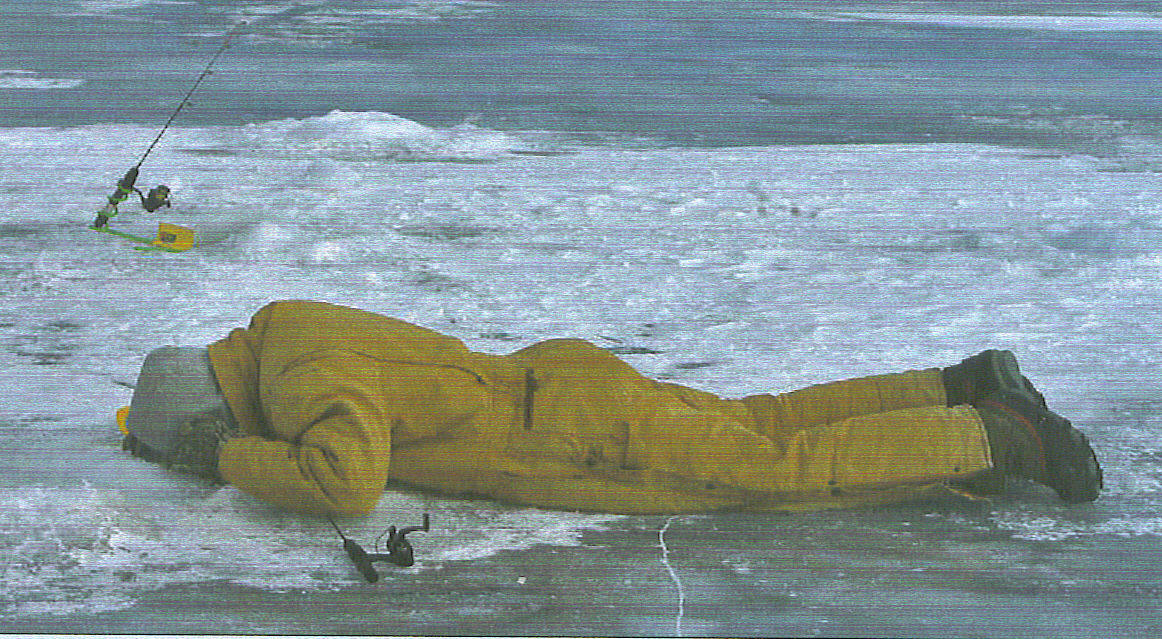
Ice-fishing?


Yeah, that looks real exciting, and I told that guy not to put his tongue on the ice. (Photo by Jim Gehrz, StarTribune)


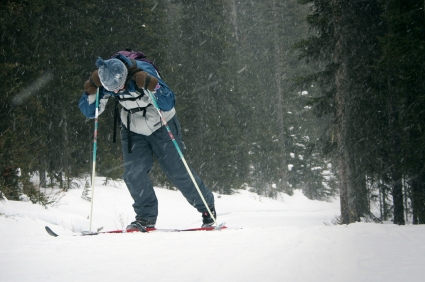
Oh — how about cross-country skiing?


Wee, doggies that looks like a lot of fun. Actually, it looks like a lot of work. Pass.


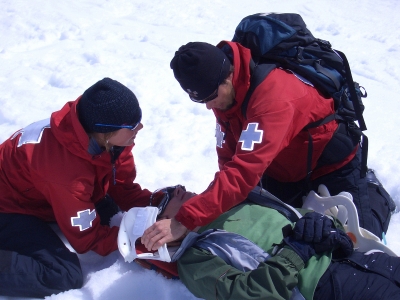
Maybe I could go back to Broomball. Slippery, hard surfaces and people flailing around with clubs in their hands. I don’t remember why I ever quit this game.


Oh, yeah. Now I remember.


Hey, maybe I can take up snowboarding. The Mall Diva has been wanting to try that. Why not?


Oh, that’s right, I’m old enough to know better.


You know, I really don’t like winter all that much anyway. Give me sunshine and warm breezes, or at least the chance to see these on TV. Oh yeah, I know what I want to watch:


Wake me up in May.

Just waiting: January 24, 1997

by the Night Writer
At the end we were just waiting for the practiced heart, which had betrayed him years before and now seemed to want to make amends, to finally lie back and take its rest.

Halfway across the country I listened and could still sense the beat. I also listened through the phone lines as his children gathered and told me of each regression that certainly had to be the last but wasn’t; his life force stretched as implausibly thin yet as miraculously effective as the fiberoptics that carried me into that room as they described sound and color.

Scarcely a week since I had been there to see for myself: told to hurry, and arriving to clasp the withered hand, to see the chalky color, to hear the faint voice, to kiss the papery skin, and to smell…to smell the rubber and the medicine and the institutional disinfectant…and that one scent that they seemed to want to cover up but I could still detect in the back of my throat as I stood at the bedside.

Just waiting, back at home, I stood by another bedside, listening to my wife breathe. Undressing, I fit myself in beside her, our heads touching, our arms around each other, and we talked about the great moments of one’s life — the excitement before a birthday, the joy before a wedding — and how those fall short of the momentous anticipation and anxiety of the days leading up to the birth of a child, of going to bed wondering if this will be the night that everything will change and we awaken to bring forth a new life, at once shuddering in both the hope and the dread of the joy that would be set before us and the trial to be endured. We spoke also of the hope we have in Christ, and of the days leading up to the joy/dread in some distant but nearing future when we go to bed wondering if that will be the night that everything will change and we awaken into new life.

I traced the warm, round firmness of her hip with my hand and sniffed as her hair brushed under my nose, her skin smooth and her lips soft. Still touching, we lay in our temporary cocoon and I remembered that some song describes time as a willow tree, bending over to reach the water, but I knew that the songwriter was wrong. We are the willows, and Time is the river, and we bend and it just goes on, but in that moment we laughed and I said “Naked I came into this bed, and naked shall I go out!”

And from down the hallway came the sound of the telephone. Ringing.

The Nominees are…

The Academy Award nominations were released this morning. Coincidentally, the President’s State of the Union Address is tonight. Both will garner a lot of attention today and in the days ahead. While I haven’t seen the list of Oscar nominees yet, and obviously I don’t know how the speech will go tonight, but I think both events are pretty predictable.

For the record, let me just say that I think it is important for us as a society to honor and recognize those who work so hard to play their parts, even if they are directed by others and their words written by someone else and they make tons of money with very little heavy lifting. Here, then, are my predictions for the nominees for tonight’s performances:

Best Picture: This award recognizes the person who’s picture, taken during the speech, gets the most play in tomorrow’s newspapers and blogs. The favorites in this category have to be President Bush, Vice President Cheney and Speaker of the House Nancy Pelosi (did you know she was a woman?), simply because they get the most screen time. The edge here probably goes to Pelosi, who has better hair, though other “best picture” contenders could be of Hillary scowling or Ted Kennedy passing out face first onto his desk, but since these are familiar images they might not be as “newsworthy”. I think the winner might be a surprise candidate, such as Sen. Dennis Kucinich reading a MAD magazine, or Representative Keith Ellison reading the Koran.

Best Actor/Actress: Isn’t it archaic in this day and age to have separate actor categories for men and women? If you ask me this smacks of quotas and set asides. Why not simply recognize the best performance, based on who’s the most convincing? Expected nominees include President Bush, who will try to convince us he has a plan; Speaker Pelosi, who will try to smile and applaud as the President enters; Minority Leader John Boehner, who will try to act as if he’s relevant; and Representative Jack Murtha, who will act as if he’s actually heard what was just said. A lot of people favor Barack Obama for this award for his overall performance in appearing to have substance, but I think that tonight he’ll be playing it safe and just trying not to screw it up.

Best Supporting Actor/Actress: This award goes to person who does the best job of making the President look good, even if only by comparison. This is always a heated competition, especially in the lightweight division, where Kucinich and Senator Barbara Boxer have been the front-runners. Senator Joe Biden can also be a factor — if he isn’t too busy copying working on his screenplay. I’ve heard, however, that the Republicans are working with Fox News on some excuse to get Howard Dean into the Chamber for the evening. My money, however, is on Senator John Kerry who continues to do good work but will also garner some “lifetime achievement” support for his efforts in 2004.

Best Non-Supporting Actor/Actress: This is an unusual category but one that’s hard to ignore and that has a strong field of candidates. Nominees worth watching include the perennial John McCain, but you take your eyes off of Senators John Warner, Olympia Snowe and Chuck Hagl at your own risk. I think this will go, however, to surprise dark-horse nominee, Senator Norm Coleman.

Best Original Song, Best Original Screenplay: No nominees. Haven’t we heard it all before?

That’s all I have time for because I need to go out and buy snacks and beverages for tonight’s show now so that I don’t have to worry about being late getting to my recliner in front of the TV. I’ll leave it to others to submit your nominations for categories such as “Best Director”, “Best Animation” or “Special Effects.”

Parting is Such Sweet Sorrow

For a friend experiencing this in his family:

Parting is Such Sweet Sorrow
That is what they say, and I’m finding that it’s true.
I’ve always taken it for granted that I would see you again;
I never could imagine there being me without you.

But this time it’s different.
This disease ravages through your whole body-
Slowly, but surely, pulling you away.
There’s no way for me to know what you’re feeling,
Or how long you are willing or able to stay.
To try and hold on to you is to cling to a shadow,
You are not mine to keep or control;
Yet still I feel hope in the gathering darkness
for the glorious light that I know fills your soul.

But what of your life?
It seems all past now, are you content?
Are you satisfied that it was time well spent-
Or do you look back with sorrow, pain and regret?

And what of the future?
Is the path that you’ve laid one you’d want others to follow?
As it winds through life’s joys and sorrows,
There’s ever the presence of hope for tomorrow.

And those of us you are leaving behind
Will rejoice at your arrival to the place we call home,
For we know that all this is just the beginning
And your journey doesn’t end in a cold, lonely tomb.
So I’ll kiss you farewell, for I’ll see you again
And til then, I’ll remember you fondly,
My friend.

— by Faith

She Speaks

Awwww! I feel so special! You miss me!!

Right at this moment writing is a little difficult, as Felix is jealous of “the other” laptop and is trying to compete for his place.

I really haven’t been up to much except the normal stuff, like:
working, sleeping, eating, singing, shopping, etc, etc.

Let’s see, I had the oil in my car changed last Sunday… um, my mom’s been making me cook lately… I cleaned my room…Oh! I did a haircut for “Locks of Love” a couple weeks ago! Guess how many inches I chopped off? Twenty-three. Yep.

I’m going to be a bridesmaid in June. My co-worker is getting married. She and her fiance went to middle school together and were each other’s first crush. Then in ninth grade he moved away. They did meet up once more a few years later, but after that she didn’t see him again until last September at a wedding. They started a long-distance relationship (he lives in Texas) and he proposed on December 4th. We (the peeps at the salon) are pretty sure she’ll be moving. I know this story practically inside-out. That’s what happens when you work in a beauty shop.

And now for something completely different!

There is something that I hear about almost every day that amuses me.
Global warming. It’s true, Minnesota (or at least the Twin Cities and surrounding area) has not gotten a really good snow in quite a while; though I’m sure “global warming” was the first thing that popped into the heads of Oklahomians when they got ten inches.
It’s all perspective.

Save the polar bears!!!

Check out these pants in the family!

OK, fair warning to all would-be lay-about boyfriends; jerks who let their dogs crap in my yard and don’t clean it up; yahoos who play their car stereos so loud the vibrations can rearrange my internal organs; and pouty, sunken-chested boys who don’t wash the car when you tell them to: I finally bought myself a pair of Haggar slacks as advertised by Pete and Red on their how-to show, “Making Things Right.”

Alright, that’s not really a tv show, it’s just a series of tv commercials made to look like a show, as I described before. Nevertheless, I’ve been impressed by Pete and Red’s demonstrations of the flexibility of the “Do-it To-it” waistband, the unbustable seams and the un-rippable pockets as they threw slackers through picture windows or trowelled dog-doo onto clueless jerks so I went out and bought myself a pair in a color I like and made in some mystery fabric described as “micro-gabardine”. They look great and feel terrific, as I’ve already practiced “bending at the knees and swinging from the hips, which comes in handy when you have to grab a squirmy one.”

The only problem is that all the Haggar slacks I had to choose from happened to be pleated. The day after I bought them my wife pointed out that the gay guys who write the Withering Glance column in the Strib had declared pleated pants to be totally out-of-it. Actually, I think this would strike Pete and Red as another product benefit: “Great slacks and you won’t have gay guys checking you out.”

The pants were also a little long, but the Reverend Mother is great at hemming slacks for me. Therefore Sunday right after church I changed out of my suit and pulled on the new pants, then called downstairs to my wife that I was ready for her to come and mark my new slacks for sewing. She called back upstairs, “are they the Haggars?” I responded affirmatively, whereupon I then heard both my daughters yell, “Run!” to the unsuspecting fella who had innocently followed us home from church for lunch. Heh, heh, they work great already and she hasn’t even hemmed them yet.

Anyway, you can check out “Making Things Right” for yourself here. All four commercials are shown in their long form, including some details that I’m certain will never make it to network tv.

Pubs suffering in “Scotland the Smoke-free”

The countdown is on for state-wide smoking ban in Minnesota with competing prophecies of gloom and doom vs. fresh air and sunshine on what will happen. It is worth noting what actually has happened elsewhere.

A nationwide smoking ban in pubs and restaurants went into effect in Scotland in late March of 2006, with many of the same arguments on both sides that we’ve become familiar with here in Minnesota. Shortly after the ban went into affect the Cancer Research UK poll released results confidently predicting that Scottish pubs would benefit from the ban, citing poll results showing that 25% of those surveyed said they’d be more likely to visit a pub because of the ban. The poll also found that 10% said they’d be less likely to go to a pub.

That 10% figure is especially interesting when you read this article:

The smoking ban in Scotland has seen a 10% decrease in sales and a 14% fall in customers in pubs, according to a new study.

The study carried out by Oxford University Press on behalf of the International Epidemiological Association compared sales before and after the ban at 2724 pubs – 1590 in Scotland and 1134 in northern England – where smoking is still permitted.

The study’s authors say this is the first major look at the smoking ban outside of the US – where trade has remained fairly constant.

The report says: “These studies have mostly found no negative economic effects of such legislation on the hospitality sector in the long run.

“However, differences in the social use of public houses in Great Britain in comparison with the US may lead to different findings.”

“Our study suggests that the Scottish smoking ban had a negative economic impact on public houses … due in part to a drop in the number of customers.

“The short-term impact of the ban did not lead to more customers coming into pubs due to the smoke-free atmosphere, and presumably did not lead smokers to spend more money on drink or food instead of smoking.”

The study backs anecdotal evidence from licensees north of the border.

While the study makes a reference to similar bans in the U.S. having little affect on the bar and restaurant trade — an assertion that bears further scrutiny — it appears that the International Epidemiological Association must also acknowledge the statistics showing that harm has been done. In fact, if anyone is clearly benefitting from the ban it is the people hired — at tax-payer expense — to enforce the ban, as reported here:

A survey has found that some of Scotland’s smoke ban enforcers are seriously under-employed with some councils’ officers NEVER having issued a ticket.

An investigation by Scotland on Sunday found seven councils, between them employing at least 11 full-time enforcers, have failed to issue a single penalty ticket or warning since they began work in March.

It is estimated that the salary bill for these officers is around £220,000.

Councils say there is more to the job than handing out fines, however Stewart Maxwell, the MSP who brought the original bill before the Scottish parliament said: “I always thought it would be self-policing. From the start I didn’t think that it would be necessary to employ so many enforcement officers.

“A lot of them were certainly doing a lot of work when the ban was brought in, including distributing posters, but I don’t know whether this is still the case.”

Paul Waterson, chief executive of the Scottish Licensed Trade Association, said the money could be better spent compensating badly hit rural pubs.

It appears that an addiction to bureaucracy is even harder to stamp out than a craving for nicotine. Actually, I know of many people who have been able to quit smoking, but I haven’t heard of any government jobs being reduced. Has anyone ever tried to develop a “Bureaucracy Patch”?

Of course, why worry about livelihoods when lives are at stake? Scottish Health Minister Andy Kerr responded angrily to the survey results, saying “There’s a brutal answer to that. This is about public health, it’s about saving lives – it’s not about businesses.” I’ll bet newly unemployed Scottish pub and restaurant workers are already lining up to apply for jobs as government fat inspectors (fat in food, not government, of course) in anticipation of the next ban.

It’s, like, a real bummer, dude

Katherin Kersten’s column in the StarTribune today laments the fallen state of youthful language skills, citing overheard examples of overused words (“awesome”), trite expressions and ubiquitous cursing. Her take, with which I generally agree, is that we are losing our appreciation for language due to a diminishing common experience of seeing it used well.

Today, teens aren’t the only ones who have lost the ability to speak and write with vigor and eloquence. Folks of all ages are reading less — especially the classics, whose authors wielded our language most powerfully. As a result, our ability to express ourselves is diminishing, because we can’t draw on their example for inspiration.

Indeed, there has been quite some cultural devolution from “It is a far, far better thing that I do, than I have ever done; it is a far, far better rest that I go to than I have ever known,” to “Don’t have a cow, man.” That doesn’t necessarily mean that people, especially young people, are less intelligent or less stimulated; they have shown an amazing ability to adapt to the high-speed inundation of the digital, text-messaging world with it’s word and number contractions and abbreviations, and some hip-hop rapping is remarkably facile and creative. What is missing is a certain cultural currency of universal themes and ideas. Kersten cites one example of an attempt to bring this back:

Last month, Diane Ravitch, an eminent historian of education, provided the perfect antidote: “The English Reader: What Every Literate Person Needs to Know.” In this anthology, she and her son Michael Ravitch have gathered what they regard as the most memorable speeches, poems, essays and songs in the English language.

“Today, our common cultural reference points come from the visual culture: Britney Spears, Jennifer Lopez,” Ravitch told me last week. Our schools could help remedy the problem, but often don’t, she says. That’s because “‘relevance” is now the watchword in education.

In textbooks, teens tend to find countless stories about young people much like themselves, according to Ravitch.

“How much richer it is to be able to use your imagination — to communicate with people who lived 200 years ago and come away with something that remains in your head and your heart,” she adds.

Norman Fruman, an emeritus English professor at the University of Minnesota, agrees. “Good literature deals with ideas, as well as emotions and the psychology of human behavior,” he says. “It records our greatest tragedies and our highest aspirations.” During 40 years as a teacher, he saw a steep decline in students’ knowledge of their literary heritage.

Having a collection of inspiring prose and oratory in one volume is a timely start. According to a Wall Street Journal article from January 3rd (HT: Port McClellan), the classics are being removed from what many might consider their last public refuge: libraries.

Checked Out
A Washington-area library tosses out the classics.

BY JOHN J. MILLER

“For Whom the Bell Tolls” may be one of Ernest Hemingway’s best-known books, but it isn’t exactly flying off the shelves in northern Virginia these days. Precisely nobody has checked out a copy from the Fairfax County Public Library system in the past two years, according to a front-page story in yesterday’s Washington Post.

And now the bell may toll for Hemingway. A software program developed by SirsiDynix, an Alabama-based library-technology company, informs librarians of which books are circulating and which ones aren’t. If titles remain untouched for two years, they may be discarded–permanently. “We’re being very ruthless,” boasts library director Sam Clay.

According to the article, books by Charlotte Brontë, William Faulkner, Thomas Hardy, Marcel Proust and Alexander Solzhenitsyn have already been pulled to make more room for more books from the recent best-seller lists. As in the schools, “relevancy” is puddle-deep evaluation that goes into giving the “customer” what they want, rather than what they ought to have. Granted, the argument, “It’s good for you” has never been especially persuasive to me whether the subject was books or vegetables, and there is quality in many of the newer works. My contention is, however, that we may focus too much on the pretty, colorful fish in the shallows and never venture into deeper waters where there are some truly awesome (in it’s literal sense of the world, not the teen version) creatures.

While there are times I would like to take others by the hand long enough to place a good book there, I look realistically to where I have the most influence: in my family. Reading has always been a favorite pastime for our children, starting with my wife and reading to them when they were still infants. Both my daughters read from an early age, and Tiger Lilly was especially motivated to learn her letters well before she started school. The television has never been a big focus for the two of them (in fact, I probably watch more tv than they do) and I think this shows in their writing and vocabulary. There are still opportunities to go deeper, though.

Tiger Lilly is our sole student in our little home-educating academy and she checks out staggering numbers of books from the local library. I am casting about right now, though, for a suitable classic and I’ve about settled on “The Count of Monte Cristo”, one of my favorite books when I was her age. I think she has the taste for adventure and righteous outlook to become absorbed in the story while absorbing and appreciating the themes of liberty and justice — and the well-turned sentence.