Last chance to Dome-inate

by the Night Writer

Tiger Lilly and I took an evening off from our writing endeavors to go to the Dome with a couple of her friends for the Twins-Indians game. I won the tickets in a drawing at work and they were pretty good seats, located next to the Twins’ bullpen in the fourth row. This was strategic and fortunate as Delmon Young flipped a ball into the stands after catching the third out one inning and the ball ended up at the feet of my daughter’s friend. It was also likely the final opportunity for me to take in a Twins game at the Dome where I had worked as a scoreboard operator for several years.

The evening didn’t start out too well, though, as the Twins lineup in these September days featured guys named Mendoza in the fifth through ninth spots. They were Brendan Harris-Mendoza at (putative) DH; Delmon Young-Mendoza, LF;  Matt Tolber-Mendoza, 3B; Carlos Gomez-Mendoza, CF; and Nick Punto-Mendoza, 2B. Fortunately the Twins managed a stirring come from behind victory in the bottom of the 8th (the only inning they scored) and Joe Nathan – after getting two quick outs – staggered to another save. In addition, Joe Mauer went 3-for-3 with a walk to raise his league-leading average to .371. A real highlight of the evening for me, however, was a trip to the scoreboard room next to the press box where I found three of my old buddies working. They waved me inside and we had a good time reminiscing about some of the events we’d worked and they repeated some of the jokes I had told back in the day (and had nearly forgotten). At one point one of the guys asked me, “Do you hear anything from your old pal Tony Kubek these days?”

I paused for a moment and said, carefully, “Tony and I don’t talk anymore.”

That all goes back to an incident between the famous ex-Yankee and broadcaster and myself that I related, along with several other anecdotes, back in 2007. Since the Dome’s baseball days are dwindling I thought I’d re-run that post here as a good-bye.

At Home in the Dome Continue reading

Okay, don’t look…

by Minfidel

Govt run

You can see the full-sized cartoon by Mike Ramirez here.

The text tells the story, though:

Government can fix health care.

Just look at Medicare and Medicaid.

Okay, they’re broke, but look at Social Security.

Okay, it’s broke, but look at the U.S. Post office.

Okay, it’s broke, but look at Amtrak.

Okay, it’s broke, but look at Fannie Mae and Freddie Mac.

Okay, they’re broke, but look at my budget.

Okay, it’s $16 trillion in the red, but….

Tiger Jack shack attack

by the Night Writer

Having lived in St. Paul for a number of years, including a stretch in the Selby-Dale neighborhood, I am very familiar with Tiger Jack’s Store on Dale St. next to the northern entrance to Highway 94. Tiger Jack Rosenbloom was a black entreprenuer who, along with his wife Nurceal,  sold a little bit of everything from their 8′ x 10′ wood and metal shack The store was a fixture in the old Rondo neighborhood (a neighborhood essentially gutted by the highway’s construction) and a fixture at that corner for decades. Tiger Jack and Nurceal died several years ago and the original shack was donated to the Minnesota Historical Society, but their son, Lucky, has continued to run various enterprises from the tiny plot of land and has been a bit of a conservative gadfly in the community.

Driving by there these days I usually get a smile from the signs Lucky has posted in recent years, asking people to accept Christ, offering lessons to women for conceal and carry permits and volunteering the site (no bigger than my backyard) as a location for Christian Revivals.  Lucky was there on Wednesday night working on his campaign for the St. Paul School Board but decided to step out: “I think my mom and dad and God told me to get out of there for a while,” Rosenbloom said.

While he was gone, a panel truck lost control and crashed through the wall of the store.

On Wednesday, Rosenbloom had been at the store’s other building for several hours signing copies of his book, “Liberal Racism and the Black Conservative,” and waving a sign encouraging people to elect him to the St. Paul school board. He had gone inside the store briefly and was starting to pack up.


That’s when he decided to take a short break and headed to a nearby gas station for juice and lemon cake. He was on his way back when the crash occurred. He thought at first that someone had been shot near the store, but police officers filled him in on what had happened.


“One police officer kept coming over and saying, ‘Lucky, I’m sorry, I’m sorry,’ ” Rosenbloom said.


Rosenbloom does not yet have an estimate of damage. He’s also not sure if he will rebuild, but if he does, he might build a small museum to honor the Rondo community and his parents.


“They trusted me with that corner,” he said.

Fortunately, no one was hurt in the accident and I hope Lucky continues to make his presence — and thoughts — known on that corner for some time to come.

Don’t miss this war

by the Night Writer

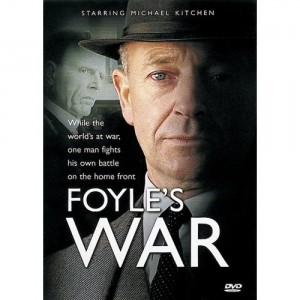
I wanted to take a minute to tell you about a great mystery series our whole family has been enjoying: Foyle’s War.

Foyle's War

It’s a British series set in the southeast of England beginning in the early days of World War II. Michael Kitchen stars as Detective Chief Superintendent Christopher Foyle who would much rather be doing something to aid the war effort but is pretty much stuck in Hastings.  For a quiet area (except for the occasional air raid), Foyle finds himself investigating quite a few murders. A quiet, resolute man he methodically rolls up clues and killers against the backdrop of war-time intrigue and paranoia. Similarly the series quietly grows on you as the main characters subtly reveal, bit by bit, a little more of their own histories and motivations.

Kitchen is absolutely fantastic in understated performances that demonstrate he probably has the most expressive wrinkles and folds in his face of any actor I’ve seen — though you get a hint that there’s great passion being kept under tight control. Complementary players include the awesomely named Honeysuckle Weeks as Foyle’s preternaturally perky driver, Samantha (Sam) Stewart and his wounded investigator, Sgt. Paul Milner (Anthony Howell), plus first class performances by a host of single-episode (so far) actors.

While the mysteries and performances are engrossing, the thing that really sets this show apart is the painstaking attention to detail in dress, settings and the human undercurrents of xenophobic patriots, Nazi sympathizers and government officials with their own agendas and an ever-shifting series of moral and dramatic issues. Each episode is about an hour and a half and there were only four episodes in each of the five years of the show. We ‘re halfway through the second year right now and can hardly wait to get each new disc from Netflix.

Check this out if you like superbly crafted dramas with unforgettable characters.

Why did George Bush hate old, immobile people?

 by the Night Writer

I came across this story from the New Orleans Times-Picayune as part of my day job. It cites a study in the May issue of Risk Assessment by two Dutch researchers from Delft Univesity and two researchers from LSU (emphasis mine):

Four years later, researchers still count New Orleans’ Katrina dead, parsing them into categories, puzzling over exactly how each of the more than 1,400 victims perished — and what might be done to protect them the next time a big one rolls in off the Gulf.


Their findings, though incomplete, jibe with common sense. The dead were overwhelmingly old. Most lived near the levee breaches in the 9th Ward and Lakeview. About two-thirds either drowned or died from illness or injury brought on by being trapped in houses surrounded by water.


The rest died from maladies or injuries suffered in or exacerbated by an arduous evacuation — or an inability to evacuate quickly enough, including many who died in local hospitals that lost power and other life-sustaining services. Neither race nor gender made anyone more likely to die, only a failure to evacuate and a location near a levee breach.


The study of Katrina deaths provides a grim reminder of the hazards of staying for a dangerous storm. The authors concentrated on 1,100 victims in New Orleans and St. Bernard Parish. They found that nearly 85 percent were older than 51, 60 percent older than 65 and almost half were older than 75, the report said.


That compares to pre-Katrina population statistics showing only 25 percent of the two parishes’ residents were older than 50, 12 percent were older than 65 and only 6 percent were older than 75.


The Katrina statistics were similar to studies of deaths during a catastrophic 1953 flood that overwhelmed levees in the Netherlands.


Gender apparently played little role in the Katrina deaths, with 50.6 of the victims male and 49.3 percent female, compared with the pre-Katrina population of 47.1 percent male and 52.9 percent female.


The statistics “do not directly support claims that African-Americans were more likely to become fatalities, ” as some believed in the storm’s aftermath, the study said. A slightly smaller percentage of African-American residents died in comparison to the pre-Katrina population numbers for the neighborhoods in Orleans and St. Bernard parishes that the study examined.


Of the 818 fatalities for which race is listed, 55 percent were African-American, compared to 40 percent white, 2 percent Hispanic and 1 percent Asian-Pacific. There were 35 victims in the deaths studied for whom race was unknown.

Stick-to-itiveness

by the Night Writer

No, I’ve not given up the new book project already (actually some nice progress made last night), but I saw this in today’s Writer’s Almanac posting:

It was on this day in 1901 at the Minnesota State Fair that Teddy Roosevelt (books by this author) gave a speech and uttered his famous phrase, “Speak softly and carry a big stick.” He said that it was a West African proverb that he had always liked. He probably picked it up from his wide reading — he often read a book a day, even after he became president, and he wrote a total of 40 books during his lifetime.

I never knew that that famous phrase was introduced right here at our very own great Minnesota Get-Together, though it is obvious that Minnesotans have taken this philosophy to heart: when we go to the Fair we eat all kinds of food, most of which is sold, yes, on a stick.

The Reverend Mother, Tiger Lilly and I are going to the Fair tomorrow, and if I’m speaking softly at all it will be because my mouth is full of cheese curds.

Booking it

by the Night Writer

Last year at about this time I announced that I was going to step back from regular blogging in order to see if I could apply the discipline and habits of more than three years of almost daily writing into something a bit more ambitious. The problem was that while I knew something inside of me was raising a rumpus to push myself farther and test my skills, I didn’t have a clear idea of just what it was I wanted or needed to do. Write fiction? If so, short stories or a novel? Research and write articles and commentary and try to sell these to print or on-line media? Compile the “Fundamentals in Film” series into a more polished curriculum?

All were good ideas but nothing really grabbed me as experimented with a few things and waited for the inspiration. As time went on, those blogging habits re-asserted themselves and I found myself drifting back into almost daily posting, and eventually even re-engineered the look of this blog. The desire, or inner unction, to do something never went away however and now I’m about to step out again, but with one big difference: I know what I’m going to do.

Over the past two or three weeks an idea has kept coming back to me, with additional details each time, and I started to see how a number of different things I’ve done over the past year or so that seemed unrelated now actually fit together. The ultimate fit, I think, will be a book and I’ve got a workable, even exciting, outline in mind to follow (and yes, Hayden, it will involve that particular post you’ve been waiting for). The only objective right now is simply to do it and leave the fate of those words in the hands of others, or just one other.

I can’t and won’t step away from this blog, however. I’ve seen that I need this fellowship, the interaction it offers, and the “laboratory” it provides. I’m thinking I may only post about once a week here as I spend my evenings mainly following my outline where it leads. I’ll still be reading a lot of blogs and commenting regularly to stay in the groove and I hope to put chapters of this larger work here for feedback. And while I’m excited to start a book, I’m already behind Tiger Lilly who has already finished writing one and has started at least one other (that I know about). I’ve been proof-reading her first book for her and offering observations on the inner logic of the world she’s created, but leaving the story, words and character development entirely to her. I need to get my work on her story finished as well.

As with my announcement last year, the lights will stay on here. I’ll post shorter things occasionally in response to the events or thoughts that interest me and where I think I might have something to add. Tiger Lilly will continue to offer her weekly cartoons and perhaps other written streams of red-bull-induced-consciousness. The Reverend Mother has expressed a desire to do more posting, and who knows when the Mall Diva will go on another cupcake-posting jag or some other flight of fashion or fancy. Meanwhile, the Son@Night may go neck and neck, or word for word, with Sly the Family Rat whenever one of them can find an unused keyboard. If you like this blog, and if you haven’t discovered this already, the RSS feed is your friend and you should sign up.

We have all been blessed and encouraged by the readers who come by here and my hope is that you will continue to visit regularly and comment abundantly.

What you see when you’re listening

by the Night Writer

A friend on Facebook the other day commented on having her 3-year-old, Ella, grab her husband’s iPod and refuse to give it up because she “had to check Ella’s email.” I told her I could relate to that because my own daughter had wrapped her mitts around my new iTouch that morning, delaying me in leaving for work. Then I said my daughter was 21, adding “They’re so cute at that age!”

So, yes, I have an iTouch, but mainly for the wireless access rather than the music. I love music, almost obsessively so at one point in my life, but these days I have enough going on in my head that a soundtrack just gets in the way. Nevertheless, this morning I barely missed my intended train and had to wait 10 minutes for the next one. “Hey, good time to shuffle some tunes on my iTouch,” I thought to myself, selecting a playlist and plugging my ears in. The little machine found a good groove and when the train arrived I decided to keep listening rather than turning to the novel I’m reading about the Spanish Civil War (the story has entered the horrific times and it can be a bit painful to read).

Sitting on the train, listening to tunes through the ear-buds, there’s not much else to do but watch your fellow passengers. I don’t pay much attention to them when I’m reading but today it was interesting to look around and see how many other people also had little wires coming out of their ears, and to note how they went about their business while plugged in. A woman across the aisle from me today, for example, was knitting something as she listened to her music. Every so often, however, she’d completely stop with her knitting needles, close her eyes and, I suppose, just listen. Then she’d start again. Was it classical music? A self-help track? A NARN podcast? I almost tapped her to ask what she was listening to, but it was her world and I didn’t need to barge in.

Other people were remarkably stoic as they listened to whatever it was they were listening to. One guy about my age in business casual clothes was especially stone-faced, so I imagined at first that perhaps he was listening to Joe Biden explaining health care but then I decided that if that was the case his face would have to show either pain or laughter at some point. A couple of younger commuters were multi-tasking; listening to music while their thumbs flew around the screen texting, or perhaps they were playing games. Or, who knows with this generation, perhaps they were listening to music, playing a game AND texting, all at the same time.

As I watched others I became conscious of my own actions. I was in a series of songs with some pretty strong rhythms and found myself rocking my right heel in sync with the beat and occasionally tapping my thumb on the side of my backpack. I hoped that anyone watching me would think I was merely listening to some pretty strong rhythms and not, say, in the early stages of an epilectic seizure. One guy, however, had totally surrendered to the music (or voices) in his head. He was black, wearing a red and white keffiyeh and kept jerking his head and turning his body rhythmically to his personal soundtrack while moving an unlit cigarette around his mouth. I bet he was listening to show tunes and was unconsciously doing the choreography from South Pacific.

My own fear is that I might listen to some favorite song and inadvertently start singing along, which I’m sure would not go over well with those who couldn’t block me with their own headsets and MP3 players. Then, of course, they’d HAVE to go out and get their own MP3 or Blackberry or iPod or whatever and I will have been responsible for stimulating the economy. And then we could all watch each other while we ride the train.

Doctor, Doctor, give me the news

by the Night Writer

Congressional and other townhall defenders of the nationalized healthcare proposals — collectively lumped as “Obamacare” — are quick to deny that rationing of healthcare is intrinsic in the proposals, or that the old and the very young are at risk from a sliding scale prioritizing who receives care. While no politician is likely to put his or her name on such a specific plan, in practice the implementation of such a bill will be up to the political appointees and advisors who will create the regulations that set the directives and protocols. People such as Dr. Ezekiel Emanuel, health adviser to President Barack Obama, health-policy adviser at the Office of Management and Budget, member of the Federal Council on Comparative Effectiveness Research and brother of WH Chief of Staff Rahm Emanuel.

In an opinion piece in today’s Wall Street Journal, Betsy McCaughey describes Dr. Emanuel as President Obama’s Health Rationer-in-Chief and, rather than putting words into the good doctor’s mouth, uses his own copious writings (with citations) to demonstrate his disdain for the bothersome Hippocratic Oath and his stated views on properly prioritizing care for those of most use to the “polity”:

True reform, he argues, must include redefining doctors’ ethical obligations. In the June 18, 2008, issue of JAMA, Dr. Emanuel blames the Hippocratic Oath for the “overuse” of medical care: “Medical school education and post graduate education emphasize thoroughness,” he writes. “This culture is further reinforced by a unique understanding of professional obligations, specifically the Hippocratic Oath’s admonition to ‘use my power to help the sick to the best of my ability and judgment’ as an imperative to do everything for the patient regardless of cost or effect on others.”

… the focus cannot be only on the worth of the individual. He proposes adding the communitarian perspective to ensure that medical resources will be allocated in a way that keeps society going: “Substantively, it suggests services that promote the continuation of the polity—those that ensure healthy future generations, ensure development of practical reasoning skills, and ensure full and active participation by citizens in public deliberations—are to be socially guaranteed as basic. Covering services provided to individuals who are irreversibly prevented from being or becoming participating citizens are not basic, and should not be guaranteed. An obvious example is not guaranteeing health services to patients with dementia.” (Hastings Center Report, November-December, 1996)

So, “Citizen”, as long as you are lucid, or still have a chance to contribute, you’ve got a chance. Start drooling, however, and the tax dollars you’ve paid in over the years might get your sheets changed on a regular basis. (Say, I wonder if one’s active – but politically incorrect – participation in public deliberations could be judged by government experts as a form of dementia?) But never fear, Dr. Emanuel wants to save the maximum number of lives, as long as they’re the right lives…

In the Lancet, Jan. 31, 2009, Dr. Emanuel and co-authors presented a “complete lives system” for the allocation of very scarce resources, such as kidneys, vaccines, dialysis machines, intensive care beds, and others. “One maximizing strategy involves saving the most individual lives, and it has motivated policies on allocation of influenza vaccines and responses to bioterrorism. . . . Other things being equal, we should always save five lives rather than one.

“However, other things are rarely equal—whether to save one 20-year-old, who might live another 60 years, if saved, or three 70-year-olds, who could only live for another 10 years each—is unclear.” In fact, Dr. Emanuel makes a clear choice: “When implemented, the complete lives system produces a priority curve on which individuals aged roughly 15 and 40 years get the most substantial chance, whereas the youngest and oldest people get changes that are attenuated …

Dr. Emanuel concedes that his plan appears to discriminate against older people, but he explains: “Unlike allocation by sex or race, allocation by age is not invidious discrimination. . . . Treating 65 year olds differently because of stereotypes or falsehoods would be ageist; treating them differently because they have already had more life-years is not.”

The youngest are also put at the back of the line: “Adolescents have received substantial education and parental care, investments that will be wasted without a complete life. Infants, by contrast, have not yet received these investments. . . .

Oh those poor, under-capitalized infants. Actually, that reminds me of a case in Great Britain I once wrote about: Charlotte’s Web: When the State Decides if Your Baby Shall Live or Die.

Of course, the “20-year-old that might live another 60 years” would then be 80-years-old, assuming he didn’t lose his ability to participate in public discourse when he was 70 and the national health service didn’t decide to write-off it’s “investment” at that point. And let’s not overlook this contribution to the public discourse from Dr. Emanuel:

Dr. Emanuel’s assessment of American medical care is summed up in a Nov. 23, 2008, Washington Post op-ed he co-authored: “The United States is No. 1 in only one sense: the amount we shell out for health care. We have the most expensive system in the world per capita, but we lag behind many developed nations on virtually every health statistic you can name.”

This is untrue, though sadly it’s parroted at town-hall meetings across the country. Moreover, it’s an odd factual error coming from an oncologist. According to an August 2009 report from the National Bureau of Economic Research, patients diagnosed with cancer in the U.S. have a better chance of surviving the disease than anywhere else. The World Health Organization also rates the U.S. No. 1 out of 191 countries for responsiveness to the needs and choices of the individual patient. That attention to the individual is imperiled by Dr. Emanuel’s views.

There’s a lot more so read the whole thing, especially if you want to have the direct quotes and citations handy.

HT: Amy Ridenour’s National Center blog.
I wish we could all be “so Mayo”

by the Night Writer

Tuesday I spent a chunk of the day down in Rochester at the Mayo Clinic (actually, St. Mary’s Hospital, part of the Mayo complex) while my father’s brother was undergoing an aortic-valve replacement, the same operation my father had in 2005.

It was my first visit to the Mayo campus and the time spent waiting with my aunt and cousins for word on the results of the operation allowed me to ruminate on being in one of the foremost medical centers in the world, the current debate on healthcare “reform” and, of course, on family ties.

One, I’ve never been in a hospital as pleasant as Mayo-St. Mary’s, at least in the parts where I went. The halls were quiet, the waiting room was comfortable, we even had free wi-fi … and nowhere did I encounter that institutional, disinfectant smell that had been such a part of my life a couple of years ago. Even parking was easy; I pulled into an underground lot in front of the hospital, took the elevator to the lobby and a second elevator to the fifth floor and walked to the family waiting room as easily as going to my office. Actually, it was even easier because I didn’t have to go through two security doors, nor did I dodge gurneys and masked orderlies in the halls, or have to work my way around the vortex of a nurses station as I commonly did when my father had his valve replacement or later when he was fighting lymphoma. He had had great care from one of the top guys in the business with his heart surgery at Barnes Hospital in St. Louis, but we were never entirely confident that he was getting the best or most appropriate treatment with his cancer, first at the regional hospital and later in St. Louis. Now, however, I was at the Mayo and my uncle was getting first class care in a setting where we were being treated as customers, almost as if my uncle was someone rich and important like the sheiks that fly into Rochester and the Mayo for their care.

My uncle is important to us, but maybe not so much to the rest of the world, however. He’s a retired rural mail carrier and, hence, a retired federal employee so he has great insurance that apparently covers him traveling 550 miles to get his surgery at the Mayo. Even though he’s well into his 70s and had triple-bypass surgery several years ago after a heart-attack, he didn’t have to go in front of a review board to determine if his quality of life was justified.

To tell you the truth, I have strong but mixed emotions about the healthcare debate that is raging in the U.S. right now (as regular readers already know). I believe very strongly that our current system desperately needs reform, but I believe even more strongly that the plans that are being proposed – in one form of single-payer, nationalized health insurance or another – is the exact opposite way that we should be going. I feel that the chances are good that this will be turned away (this time, anyway) but I’m discouraged that the result will be status quo, which is still unacceptable, and that there will be no stomach left for the good fight to bring about real, market-based reform. Neither the current system or “Obamacare” would affect my uncle: his union and federal coverage would likely still be affect under “Obamacare”, just as it is now. Whether I and other non-federal, non-union folks should be so fortunate is another matter that’s part of the debate.

As I sat with this part of my extended family there was talk of the “Stewart Curse”: my grandfather had died after a series of heart attacks, my father’s oldest brother had died of a heart attack, both of his other brothers had had heart attacks, and there were now two valve replacements in the family history. In addition, my younger brother will need a similar operation, likely in the next two years, and one of my cousins has already had two stents put in. I’m not too concerned for myself, as the risk factors aren’t present in me: my blood pressure is low, my “bad” cholesterol is very low and my “good” cholesterol is, well, “good” and we know my valves are in fine shape, thanks to a little scare a few years back that turned out to be nothing (except a confirmation of market principles). I do have a bit of stress in my life, but I also have resources for dealing with this.

It should be noted that the Mayo is doing very well under the present system, but it is a credible (if so far largely ignored by the administration) voice for reforming this system. In fact, they have long-since used their experience to make a series of proposals on how to go about doing this, including bringing the market incentives back into the insurance equation — not as a way to increase profits, but to improve healthy outcomes. Right now the only way a health plan or a hospital can improve its bottom line is to “save” money by denying care; a nationalized program would further degrade the system into a lowest-common-denominator approach that rations care. In a fair system, such as the Mayo advocates, where insurers and providers compete for the public’s dollars and confidence (the real “public option” in my opinion) there are rewards for innovation, successful outcomes and a culture of excellence. I hope we all live to see it.

(P.S. My uncle came through his surgery in fine fashion, complete with a new aortic valve that is an advanced hybrid that wasn’t available just four years ago when my father had his surgery. Let’s hear it for progress and innovation — and great skill!)