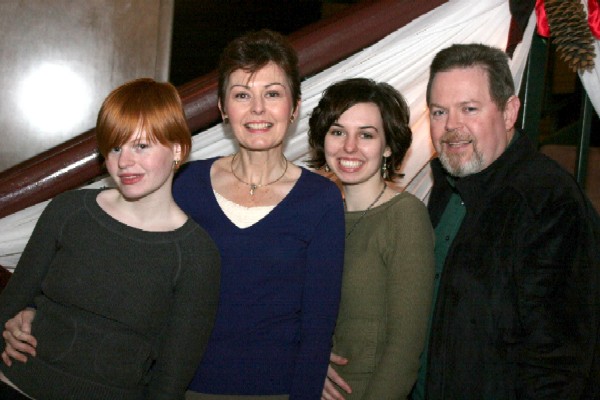
A balm in Gilead, part 2: wife

The second in a series, part writing exercise and part year-end reflection,
about the “balms” in my life, inspired by the book,
Gilead by Marilynne Robinson.

“We should talk more,” she said, her bare foot lightly brushing mine. She’s logical and practical in a way that some men say they wish women could be more like. There’s wisdom and concern in her words, a concern that perhaps we’re becoming too autonomous, rising and setting like the sun and the moon covering the same familiar ground but at different times, our orbits barely overlapping. Nevertheless, sometimes during the day, you can see the moon.

Earlier in the evening we had talked, sitting in big, comfy chairs in front of a too-hot fireplace at a local coffee shop. Then her motions had been gamine-quick, almost coltish as she reached across the small space between our chairs and stroked the arm of mine, or raised up to draw her legs underneath her, or raised her arms to take off her sweater when the fire became too uncomfortable even for her, the one who shivers almost non-stop from Labor Day to Memorial Day. She was telling me about her dreams, literally. Those fast-asleep dreams she had had recently, round and portentous, dripping with symbolism and still crystal-clear upon waking. To some extent they were also Dreams, having to do with what she wanted for the future, to pursue.

As for myself, the one who used to never be able to shut up, I had leaned back in my chair meditatively, parsing the symbols and conjuring context. Leaning back is something I’ve found myself doing more often the last few years; I’m not as concerned about letting silence into the conversation anymore, whereas before I often couldn’t wait to careen in and even high-jack it, not daring to leave a space where someone else could take it away.

Now, later in the evening, when she says “We should talk more,” it’s not so much to say that the talking earlier was fun, but that we don’t have as much fun as we used to have, or could have, and she sees the need to stay in practice. She looks ahead, imagines the inevitable empty nest. I imagine her considering the old buzzard sitting on the other side of that nest. What do the sun and the moon do once what has been your world goes away? “Ummm…” I say.

When we had first gone out I was nervous and had babbled, which I tend to do if I’m nervous. Fortunately, few things make me nervous anymore. Then, however, I had nearly blown it with my chatter, trying one conversational gambit after another looking for a favorable response, some traction. My best stories and jokes, my wittiest observations, littered the top of the table at the restaurant like dirty dishes. So I shut up, and things got better, because she had some things to say, too.

One of the things she said, some time a bit later, was, “Look, I don’t want to lead you on. You’re nice, but I believe God is preparing Mr. Right for me, and when he comes along, you’re out of here.”

Okay, so I have been nervous.

In Gilead the Reverend Ames reflects, with some wonder, over the circumstances that brought his young wife — and ultimately the son to whom he is writing — into his life. A widower who lost his first wife in childbirth and his infant daughter shortly thereafter, he had lived most of his adult life as an outside observer and counselor of the family dynamics taking place around him, covetously (he admits) watching the relationships that appeared to be denied to him, until these, too, overtook him.

I have only half-jokingly said that I was smart and got my trophy wife first. I didn’t have to wait until old age, like Rev. Ames, to know the comfort of a wife and family. And it is a tangible balm.

My wife and I first met in April, 1986. We went on our first date in June. By late September we were engaged (though we didn’t marry for another year). Once, as she and I were clearly getting serious in our relationship, a concerned friend of mine (who had known me for years) drew her aside to urge caution, warning her of the dark moods that were known to come over me from time to time. These moods were not imagined, and during those times, I confess, I was not a good friend. I remember these moods well. Strange, I don’t remember having one since I married.

Once, not too long ago, I was teasing her. “Oh, you’re definitely high-maintenance,” I said, citing how particular she is about the ingredients in the food we bring into the house, her taste in clothes, the way she likes things that concern her to be “just so.” She was not amused, which suggests that there are still times when it is better for me to keep my mouth shut, especially if it gives me time to think. And as I thought about it I quickly realized that almost all the maintenance she requires is handled by her. She rises early for her physical and spiritual exercise, the burdens of selecting and preparing the foods we eat fall upon her, her fastidiousness in her appearance reflects well on both of us with little involvement from me. About all I have to do is avoid shrinking her jeans in the wash (difficult, because I like tight jeans on her) and bring her favorite towel up from the laundry on Saturday night and hang it on the rack above the bathroom radiator (I’ve also ceded this premium towel position to her). Further, since I am almost pathologically detail-averse, she manages the details that keep our household running smoothly, from balancing the checkbook, paying the bills and (usually) putting the things I need out where I can find them or won’t forget them.

She does all of that, and somehow still desires my attention and conversation.

We should talk more.

Related Posts:
A Balm in Gilead, Part 1: Life and Death
A Balm in Gilead, Part 3: Children

Should auld acquaintance … and where you parked your car … be forgot

Columnist and commentator (or “columntator” as he refers to himself) Simon Webster in the Sydney Morning Herald has some useful observations for those preparing to usher out the old year (and several thousand brain cells) in alcoholic revelry:

DOCTORS have warned people to monitor their drinking this New Year’s Eve. Failing to imbibe sufficiently may lead to long-term psychological trauma from spending long periods attempting to communicate with drunken dribblers.

Sober partygoers also face the risk of serious rib and lung damage. Research shows that just as drunks are more likely to survive falls from great heights because they are so relaxed, they are also more likely to escape unscathed after being hugged by sobbing overweight buffoons wearing paper hats.

Drunks, however, are more likely to fall from great heights in the first place, which may have skewed test results. Scientists have called for double-blind studies to be undertaken, as opposed to just blind-drunk ones.

Webster goes on to describe some of the Scottish heritage behind the annual celebration:

Auld Lang Syne is, of course, a Scottish song, written by 18th-century poet Robert Burns. Roughly translated it means “Old Long Sign” and is about a raucous New Year’s Eve that Burns spent in the Welsh village of Llanfair pwllgwyngy llgogerych- wyrndrobwllllantysiliogogogoch.

So seriously do the Scots take New Year’s Eve that they have January 2 as a public holiday. They give their marathon celebrations a special Scottish name, Hogmanay, which is Glaswegian for hiccup.

But the Scottish capital Edinburgh is reeling from a lack of bookings this year, London’s Guardian newspaper reports. For once the city’s hotels are not booked out.

Hogmanay organisers say the lack of interest is due to gales that forced the last-minute cancellation of the city’s street party twice in the past four years. When you’ve got a street full of men in kilts, the last thing you want is strong winds.

Mr. Webster also happens to share my affinity for commenting on television commercials, and later in the same article brings us this report:

A CHICKEN fast-food outlet’s ad featuring a pole-dancing mum has become the most complained-about ad in Australian TV history.

It broke the previous record-holder, an ad for mints in which a bare-chested man had long, erect nipples. The record-holder before that had been a beer ad depicting a tongue that left its owner’s body in search of a stubbie. The combined effect of consuming chicken burgers, mints and beer can be seen on certain special interest pay-per-view channels.

The pole-dancing commercial attracted 300 complaints about the level of nudity and the depiction of mums as erotic dancers, The Sydney Morning Herald reported last week.

The Advertising Standards Bureau dismissed the complaints, saying pole dancing had become a mainstream activity.

The board was split on the issue of nudity and had to watch the ad over and over again to make up its mind.

Perhaps we’re missing the main injustice here. Three hundred complaints is a lot but there would have been plenty more if chickens could write.

With news like that, this year can’t end soon enough.

The Night Hens & a Mystery Guest!

The NightHens are out for coffee at Overflow Espresso Coffee Cafe on University Ave. in St. Paul. We have with us a Mystery Guest (MG). Dun Dun Dunnnnnn.

RM: Ooooooh this tastes penuche-like.
MG: I don’t know about anyone else, but for me that was really ambiguous. It’s like saying “that tastes really glodfarbian”.

TL: So, “Mr. X.” Now people will think it’s one of mom’s exes.
RM: They don’t know I have exes. Besides, everyone has exes, except Mall Diva and you.
TL: Well I have one, remember in first grade?
RM: You were in love with that Merker kid. You wanted to marry him.
MD: Yeah, Charlie Merker. He had red hair.

MD: Do all your exes live in Texas?
RM: No, I think they all live here in the Twin Cities.
TL: Nice.

MD: I know, you can talk about what it takes to become a mystery guest on our blog.
You have to buy us all coffee.

MG: Let me say something.

RM: So, are you going to say something, or what?
MG: I’m just waiting for you to finish all your mollycoddling.
MD: Now everyone’s going to know who he is.
RM: Well, at least his parents will.

MG: So, anyway, I’ve been contrigued for months about this Night-Hens thing and I thought buying coffee would be a small price to pay. Plus I wanted to see who was doing the typing.

TL: Do you want me to type now?
RM: No.
TL: Well then, can I drool on your roll?
RM: No, but you can have a bite of it if that’s what will stop you.
MG: I think you won’t want to eat that, she’s been drooling on it for a few minutes now. There’s a large pool of…stuff…right on top of the penuche frosting.
RM: See, you knew it was the frosting.
MD: Mmm, extra frothy…

MG: (Staring into his coffee cup.) Ahhh yes, as I look into it’s umbery goodness.
RM: Umber is kind of a gold color. Can you tell the future if you look deep into your coffee?
MG: Uh, yes.

TL: Stay tuned for next week when the Night-Hens go to a strip club.

RM: Lets see if we can make the mystery guest cry.
MD: Nope, that’s all the time we have for today.

A balm in Gilead, part 1: life and death

I’m just about finished reading one of the most profound and moving books I’ve come across in (at least) the last 10 years: Gilead by Marilynne Robinson. In fact, the only works of fiction that have affected me as much as this book are Mark Helprin’s A Winter’s Tale and Alan Lightman’s Einstein’s Dreams. Listing these three books in one paragraph makes me realize that, though they are very different, they all revolve around the nature of time and place, the nature of man and the nature —as Lightman/Einstein would put it — of “The Old One.”

Gilead is set in the mid-1950s in Gilead, Iowa and is written as a letter from an elderly pastor to the young son who came to him very late in life and who he knows he will never get to see grow up and become a man. The pastor, Rev. John Ames, has lived his entire life in Gilead, pastoring the church his father pastored before him. Ames is, in fact, the third generation of preachers in his line. His grandfather was a firebrand abolitionist in Kansas, known to preach with a pistol stuck in his belt and thought to have ridden with John Brown and, perhaps, to have killed a federal soldier who was pursuing the Reverend’s band of insurgents. He railed against the spiritual complacency of the “doughface” Christians who could tolerate slavery and warned of God’s judgment on the nation as a result. He fought in the Civil War and lost an eye in the conflict.

Ames’ father was the complete opposite, a dedicated pacifist who saw the 1918 Spanish Flu plague, in the midst of World War I, as God’s judgment on a mad world. Nevertheless, the father took in the aged grandfather when he had no place to go, giving the young Ames a chance to observe their respective theologies and the dynamics between the men, even though the surest sign of a disagreement between them was their use of the title “Reverend” when addressing one another. Also factoring into this narrative are Ames’ older, apostate, brother; Ames’ lifelong best friend, Old Boughton, who is the pastor of the Presbyterian church in Gilead; and Old Boughton’s prodigal son, John Ames Boughton (Jack), who was named after the narrator and who consumes a great deal of the old man’s thoughts and fears as he lays out what little legacy he has to offer his seven-year-old son.

The plot, such as it is, progresses much as an afternoon float trip does, meandering slowly around bends and through shady places as Ames unwinds the story in such a way that you don’t readily realize how much ground has been covered, while leaving you with a vague unease about what rapids or waterfalls might be ahead. I am continuously charmed by each page and awed at the grasp that the author, a woman, has on the inner-workings of a man’s mind. I could have read the book in an afternoon, but I have purposely drawn out the pleasure by allocating myself only a few pages a day to read and ruminate upon.

Now, if my purpose in this post was to offer a book review, I’d hope that my words so far would inspire you to seek out the book yourself (indeed, I do). But that is not the purpose of this post, despite the paragraphs that have come before. Instead, the book has stirred something in my own inner voice, and in my mind, to record some of the thoughts I’ve had of late, some of which have come along of their own accord and some that have been brought forth by the book, and many that are a bit of both.

Dun…dun…DUNNNN!

I told you this was going to happen! Don’t trust cows! Sure, they look stupid, but it’s a nefarious (I love that word) disguise!

As he crossed a field while walking his dog near his home in Brighton, England, in October, police Inspector Chris Poole, 50, was attacked by about 50 cows. He spent 11 days in the hospital, recovering from the butting and stomping, which cost him four broken bones, a severed artery and a punctured lung. [BBC News, 10-29-07]

HT: KingDavid.

Going out in a blaze of luck

As I noted last week, I was playing in the championship game for my fantasy football league, and that following the game I would be retiring from this pastime.

My toughest lineup decision going into the game was whether to start LenDale White or Brandon Jacobs to complement Ryan Grant (and who would ever have imagined that sentence back on draft night in August?). The fact that I was in the championship game itself could almost qualify for “News of the Weird” since my first three draft picks (picking 9th in a 10-man league) had been Travis Henry, Steve Smith and Jacobs; people who follow the fantasy game will know that this was not an auspicious beginning considering the way season played out. I felt a certain sentimentality toward Jacobs because I had predicted such great things for him at the beginning of the year, but I thought I detected a true death stink over the Giants team and feared he might go down the tubes with his squad, so I started White. And then Jacobs scored 18 points in our scoring format, sitting on my bench. This type of thing is one of the interesting agonies of playing this game and, perhaps, one of the quandaries I will not miss.

I thought it would be an ironic farewell to the game if I lost, but it turned out that my opponents (a two-owner team) were “enjoying” those interesting agonies in spades, as nearly every lineup move they made — based on solid reason and intuition (and pretty much the same moves I would have made)— blew up in their faces. My seven starters, even without Jacobs, scored 59 points. Their six “bench” players totaled 61, while their starters managed just 29.

I could say, “I love it when a plan comes together,” but it’s more of a sense of relief than sweet victory. I retire now with back-to-back championships under my belt, some satisfaction, and a healthy curiousity as to what comes next.

Santa drives a tow-truck for Triple-A

The Mall Diva went out of town overnight with some friends last Sunday, leaving her car parked on a St. Paul street outside the house they all had left from. Sunday evening St. Paul declared a snow emergency, and the owner of the home notified the Diva that her car could get towed if it wasn’t moved.

No problem. She called home and asked if someone could get her second key and drive over to her car and move it. Well, one problem: neither she or anyone here knew where that second key was. A messy search of all likely and unlikely places was fruitless (and keyless). Hmmm, what to do?

Just leave it and let the city tow it? No, the towing fee and the ensuing impound fees (since she wouldn’t be back until Tuesday morning) made the expense prohibitive (not to mention incredibly inconvenient).

The car has a keypad door lock; perhaps I could get a couple of people, we could go to the car, open the door, put it in neutral and push it into the driveway? No, the car couldn’t be shifted without a key in the ignition.

Wait a minute, we have family coverage from Triple-A for our cars! I called the company and inquired about getting a tow on a snowy night when there had to be lots of cars in ditches. Sure, they said, they could get a truck over there in three, maybe five, hours but they’d either have to tow the car to a garage or back to our house; they couldn’t tow it 25 feet into a private driveway.

So be it. Now we just had to hope that the AAA driver got to the car before the city driver did. As it was already about 10 p.m. we’d have to go to bed and wait until morning to see who won.

Waking up Monday morning, it was with Christmas-like anticipation that I went downstairs to see if there was something in the driveway. Hallelujah! Peace on Earth! Good will toward men! The Diva’s car was nestled in the driveway, in front of the garage door, leaving just enough room for me to back my car out and get around hers! Better yet, not even a parking ticket! Best of all, the towing was free under our AAA plan!

Others weren’t as fortunate.

The Nights before Christmas, 2007

Merry Christmas and a Happy New Year from Tiger Lilly,
Reverend Mother, Mall Diva and Night Writer!

(P.S. watch this space for an exciting announcement on December 31st!)

The end of an era

I started playing Fantasy Football in 1984, back when Cliff Charpentier’s fantasy season preview was the Bible of preparation, even though it was little more than a compilation of players ranked by the previous season’s statistics. We tried to track our scores from tantalizing snippets on the evening news and had to run outside early Monday morning to grab the newspaper in order to check the box-scores by hand to find out if we’d won or lost. Walter Payton was my first-ever first-round draft pick and I finished out of the money that year.

Things have changed a lot since then. Fantasy Football is a billion dollar business and every channel with a football game but Fox runs continuous individual player stat lines across the bottom of the screen to help you keep track. Not that it’s necessary, because there are multiple services and websites that keep score in real time and I merely have to look over my shoulder at my computer screen to check the score of my fantasy game while I’m watching a real game. Oh, and for the third time in the last four years, my team is playing in my league’s Fantasy Bowl this weekend (as I write this I’m already down 12-0 since my opponent had Ben Roethlisberger playing Thursday night).

Win or lose, this is also going to be my last game.

It’s not that I’ve grown bored with my success or with the game. For the last 23 years I’ve been in at least one league every year, and often as the Commissioner. To some extent it’s been a year-round hobby as I’ve tried to stay on top of off-season moves and their implications and overall it’s been an interesting and often passionate pastime. I’ve always enjoyed the combination of luck and skill required to build a winning record: the pre-draft preparation and hunches on who were going to be the best players in the coming year, the way the best-laid plans could be thrown out the window by capricious injuries, and how you had to hustle to come up with alternate plans and players as a result. This year, however, it has all been more of a chore for me than entertainment.

To some extent it may be due to those nagging distractions called “life” getting in the way. My personal life has had a fair amount of tumult since last spring that left me with relatively little free time to dwell on football, and little inclination to do so when I could have. I think the biggest issue, however, has become the carnage on the field.

As I said, luck and injuries were a wild card in every season and something you simply expected (hoping that it wouldn’t happen to your team) and accepted as part of the randomness that made the game entertaining. Somewhere along the line, however, it started to work on me that these injuries weren’t just an inconvenience I had to work around, but something tangible, painful and even devastating to the real person involved. Not that the existence of fantasy football contributed to these injuries in any way, but it started to bother me that this was my “entertainment.”

Strangely enough, the turning point wasn’t a football injury. Last summer when pro wrestler Chris Benoit killed his family and himself there was a lot written about the wrestling culture and steroids and about how many wrestlers had died young or had serious personal problems. There was a lot of media hand-wringing about who was to blame — the promoters, the personality types drawn to being wrestlers, the lifestyle, etc. No one seemed to touch on what seemed to me to be the obvious: if people weren’t paying out big money to watch the shows, go to the events and buy the merchandise then there wouldn’t be the incentive for the performers to try to make a name and physique for themselves, travel 300 days a year and resort to drugs to buid themselves up and to ease or mask the pain and debilitations that came from being a human torpedo. As I self-righteously scoffed at wrestling fans for being enablers I had a chilling revelation of my own fandom.

No, it isn’t fantasy football that’s driving young men to seek fame and fortune in exchange for their bodies in the NFL (speaking as one who gave up a knee playing the game for free), but my attitude has shifted and I don’t know if will ever go back. I still enjoy watching the game and the big hits, but I can feel myself pulling back.

I made my “retirement” announcement to my league at the end of our regular season, before our play-offs, so the rest of the owners can start thinking about finding a replacement Commissioner now, when the season is at it’s peak, and not in the dog days of summer. I received a very gratifying email from one of the owners thanking me for the entertainment value I brought to the league (via weekly game summaries) and asking me to reconsider. In the message he said my passion and commitment would be missed and couldn’t be duplicated. I told him that I thought the passion and commitment may very well be duplicated by someone else — I just knew that I couldn’t duplicate it any longer, and that was the surest sign that it was time to hang it up.

It’s been a bit odd going through these final weeks as I’ve advanced through the play-offs. I’ve caught myself filing away mental notes about players for next year out of habit before realizing, wryly, there won’t be a next year. Oh well, wish me luck this weekend! I’ve got a 12-point deficit to make up and a decision to make of which two players to start between Ryan Grant, LenDale White and Brandon Jacobs, all while praying for good weather in New England so Randy Moss can catch three touchdown passes.

Other than that, it’s back to reality.