![Anorex[st]ics Inaneymous 042](http://thenightwriterblog.com/files/2009/08/Anorexstics-Inaneymous-042.bmp)
Ciao for now!
bookmark to:
![Add 'Anorex[st]ics Inaneymous #42' to Del.icio.us](http://thenightwriterblog.com/wp-content/plugins/social-bookmarking-reloaded/delicious.png "Add 'Anorex[st]ics Inaneymous #42' to Del.icio.us")
![Add 'Anorex[st]ics Inaneymous #42' to digg](http://thenightwriterblog.com/wp-content/plugins/social-bookmarking-reloaded/digg.png "Add 'Anorex[st]ics Inaneymous #42' to digg")
![Add 'Anorex[st]ics Inaneymous #42' to reddit](http://thenightwriterblog.com/wp-content/plugins/social-bookmarking-reloaded/reddit.png "Add 'Anorex[st]ics Inaneymous #42' to reddit")
![Add 'Anorex[st]ics Inaneymous #42' to Stumble Upon](http://thenightwriterblog.com/wp-content/plugins/social-bookmarking-reloaded/stumbleupon.png "Add 'Anorex[st]ics Inaneymous #42' to Stumble Upon")
![Add 'Anorex[st]ics Inaneymous #42' to Google Bookmarks](http://thenightwriterblog.com/wp-content/plugins/social-bookmarking-reloaded/google.png "Add 'Anorex[st]ics Inaneymous #42' to Google Bookmarks")
![Add 'Anorex[st]ics Inaneymous #42' to Ask](http://thenightwriterblog.com/wp-content/plugins/social-bookmarking-reloaded/ask.png "Add 'Anorex[st]ics Inaneymous #42' to Ask")
![Add 'Anorex[st]ics Inaneymous #42' to FaceBook](http://thenightwriterblog.com/wp-content/plugins/social-bookmarking-reloaded/facebook.png "Add 'Anorex[st]ics Inaneymous #42' to FaceBook")
![Add 'Anorex[st]ics Inaneymous #42' to Barrapunto](http://thenightwriterblog.com/wp-content/plugins/social-bookmarking-reloaded/barrapunto.png "Add 'Anorex[st]ics Inaneymous #42' to Barrapunto")
![Add 'Anorex[st]ics Inaneymous #42' to MySpace](http://thenightwriterblog.com/wp-content/plugins/social-bookmarking-reloaded/myspace.png "Add 'Anorex[st]ics Inaneymous #42' to MySpace")
![Add 'Anorex[st]ics Inaneymous #42' to Twitter](http://thenightwriterblog.com/wp-content/plugins/social-bookmarking-reloaded/twitter.png "Add 'Anorex[st]ics Inaneymous #42' to Twitter")
![Add 'Anorex[st]ics Inaneymous #42' to Social Bookmarking Reloaded](http://thenightwriterblog.com/wp-content/plugins/social-bookmarking-reloaded/sbr.png "Add 'Anorex[st]ics Inaneymous #42' to Social Bookmarking Reloaded")
Ciao for now!
by the Night Writer
Two years ago today the 35W bridge collapsed, drawing attention not only from across the state of Minnesota but also across the country and even the world. When I was in Spain a couple of weeks ago I was talking to an engineer from Madrid and when he found out I was from the Minneapolis area the first thing he wanted to talk about was the bridge collapse. Since the collapse a new bridge has risen, bigger and stronger than the original, the marks of the disaster now largely out of sight underneath the waters of the Mississippi River, just as the scars in the lives of those who survived — or in the lives of the loved ones of those who didn’t — are largely lost to our sight now.
At the time I suggested here (see below) that in the fall of concrete and metal something better and purer might arise, not made by the hands of man, but in the way those hands reached out. Today a new bridge stands, better than ever, where the old one fell. Two years later my question to you is, “Can we say the same thing?”
The bridges of Minneapolis and San Luis Rey, and the Tower of Siloam
Who, what, when, where? Those are the first things we want to know when a disaster makes the news. Close on their heels comes the question hardest to answer: Why?
That question breaks into two parts, the physical and the metaphysical. Why did the bridge fail structurally, and why were these particular people apportioned to survive, die or be injured? The first question will eventually be known to the millimeter; the second will remain fuzzy. Implicit in the second one, however, is the fear that everything is random, that there is no justice, or that justice is applied on a scale so grand that we can’t calculate it; either way we are left with uncertainty as to just what measure is due us personally. The thing is, we want there to be a reason and order to things, and optimistically assume (or hope) that our own accounts will balance to the “good”; promising or justifying our own deliverance from calamity.
We easily extend our version of grace to others (as long as they’re victims and not members of the opposition party), generously judging them good or innocent by the most general of categories: he was a “nice guy”, she was a young mother. “Why do bad things happen to good people?” we cry. Other people, or other times, might view calamity as judgment or karmic justice.
Similarly, was it chance or God’s plan that resulted in the deaths in the collapse of the 35W bridge in Minneapolis? Was it God’s indifference that lead to the fall, or God’s providence that the calamity was not more catastrophic? If there is such a “goodness” scale, by what measure can the survivors claim deliverance and what comfort can be given to the families of those who didn’t? How can a former missionary go missing while a child abuser survives?
People didn’t start asking these questions just when President Bush took office, either. In his 1927 novel, “The Bridge at San Luis Rey,” Thornton Wilder tackles similar questions and circumstances in the person of Brother Juniper who tries to ascertain the central failing in the lives of five people who perish when the titular bridge falls into a chasm. (He could come to no conclusion). Going back a bit further, in John 9:2, Jesus was asked about a blind man, “Who sinned, this man or his parents, that he was born blind?”
“Neither this man nor his parents sinned,” said Jesus, “but this happened so that the work of God might be displayed in his life.” Whereupon he made mud and put it in the blind man’s eyes and then sent him to wash in the pool of Siloam, healing his blindness. Interestingly, Siloam is mentioned again in Luke 13 when people suggest to Jesus that calamity overcame certain people as a judgment. His response: “… those eighteen on whom the tower in Siloam fell and killed them, do you think that they were worse sinners than all other men who dwelt in Jerusalem? I tell you, no! But unless you repent, you too will all perish.”
Or, (excuse my jump in character but not in context), in the words of Clint Eastwood in Unforgiven, “We’ve all got it coming.” The point being made was that no one is innocent, but each may come to the revelation of salvation by grace; by the work of God, not man.
I’m not trying to be dark. In fact, I believe that there is an order and justice in the universe even if we can’t see it all at once. I believe that because, in fact, we are able to see beauty and justice from time to time. If it weren’t so, all would be chaos and despair. Instead, in the midst of the refining fire of a disaster there are gleaming streaks of gold rising through all the impurities; the acts of courage, altruism and goodness in the survivors and rescuers (perhaps even unplumbed in their lives up until that point), and of a community pulling together in empathy and faith.
Bridges are aspirational; tangibly they are an example of our ability to overcome an obstacle to achieve what we want. The failure of one is not just a challenge to getting what we want, it is a repudiation of our ability to even conceive of it; the cutting of the tightrope woven of our doctrines that we walk to find our own salvation. In Mark Helprin’s book “Winter’s Tale” the allegorical and eternal Jackson Mead, an engineer representing either Lucifer or man (I go back and forth on this), strives to bend steel, nature and his will into casting a tremendous bridge of light to Heaven that — like our human understanding — touches the far shore for a moment and falls. Yet one of the messages of the book is that the balances are exact; and one thing cannot fall without something else rising and even more gloriously.
The 35W bridge fell in a crush of broken steel, concrete and bodies — and though the dust sought to obscure it, we could suddenly see something clearly: we are the bridges, standing in or reaching across the gap for and to one another.
Standing, always.
by Son@Night
One of the grand features this summer here at the blog has been the plethora (Three Amigos anyone?) of European travel photos. We’ve certainly got supply. I’m not sure what demand is looking like, but I’m going to flood the market with a few more because NW seems pretty busy and I wonder how much time he’ll have for writin’.
Paris is a nice city. It’s in France. It’s got nice architecture.
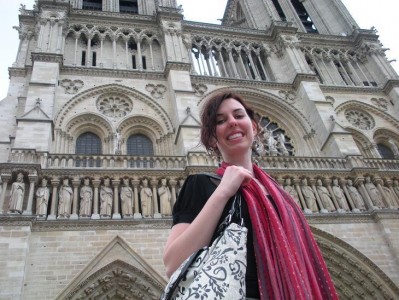
I hurried us away from Notre Dame after this picture because I saw some guy up on the ramparts paying too much attention to Faith. Stupid hunchback had better mind his own business!
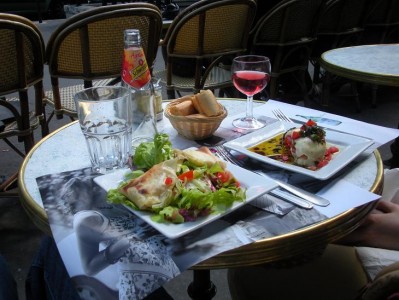
A little lunch starts to look like haute cuisine 'round these parts. Faith was people watching. I was enjoying not shopping.
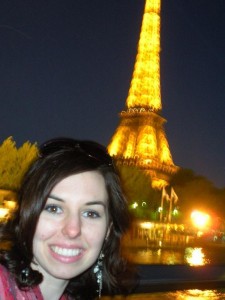
We were strolling one night and found a towery thing. We flicked the light switch and...Woah Nellie!!
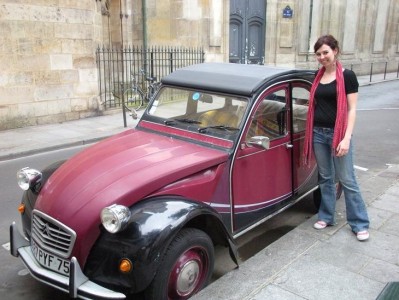
Faith is big on accessorizing.
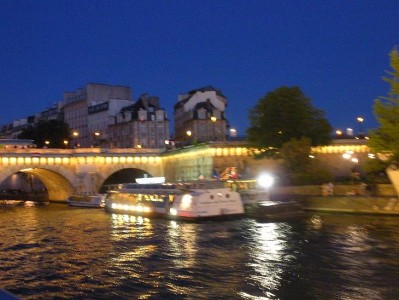
We took a riverboat cruise. Very romantic except for the four guys who mooned us.

Notre Dame's spire stretches towards the sky, pulls hamstring.
by the Night Writer
Here are all the slide shows from our trip to Spain, consolidated in one post (including the new slideshows of Cazorla and Madrid). Some of the photos will be familiar from posts I put up while we were over there, pre-slideshow. All the Cazorla slides, however, came from our friends who went through the Pueblo Ingles program with us and kindly put their photos into a common PhotoBucket file. Great job, guys!
by Tiger Lilly
…well, this is the good, anyway. For the bad and the ugly, see my previous Adventures In Dining post.
When in Rome Madrid (or Barcelona), eat what the Madridians (or Barcelonians) eat.
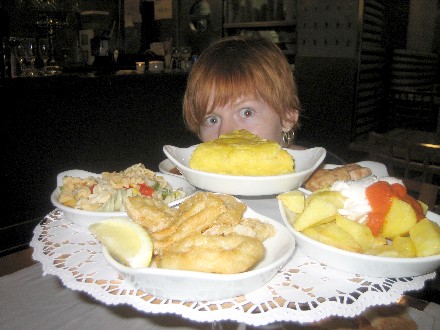
Don't be fooled by the supposed onion rings. They are actually (dramatic pause) CALAMARI!!! Doom.
This was a delicious pizza. I ate most of it. I was trying to cut it into slices, but then I thought, “You know, this is my pizza, no one else is going to eat it (except Mom. She’ll steal some bites), so I might as well just pick it up and take a bite out of it.”
As you can see, that is exactly what I did. I highly recommend doing that. It’s a liberating experience.
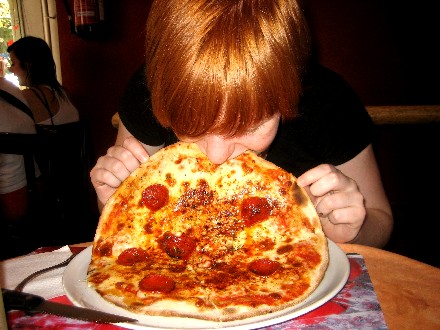
No, it's not my sombrero, it's my pizza!
Oof, yeah… We walked thirteen miles that day (I think), so I felt completely justified. It was only a nine inch pizza, anyway.
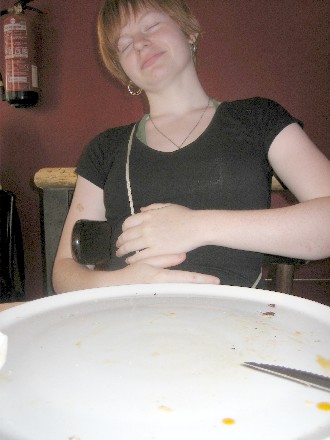
Ahh, pizza...and now for my siesta!
And, one of the best parts of Madrid:

Whenever I'm in Madrid, I always get a Suiza from Chocolat Cafe, Bar & Chocolateria. Oh my gooseness, this drink was one of the most delicious things I've ever tasted.
That drink was mostly dark chocolate. I think it was melted, then added to heavy whipping cream. Of course, it was topped with whip’cream and had a wafer straw stuck into it. It was pure heaven.
Oh yeah, and, I’m wearing my new Spanish fedora in that picture.
And now for something completely different:

Isn't it beautiful? I saw this while searching for Dodge trucks (research for my book), and fell in love. Daddy, I want!
I’m not sure if that’s a Tomahawk or a Viper, the website seemed to not be able to make up its mind about it.
Basking in the glory of food and sweet motorcycle-cars, TL out.
Ciao for now!
by the Night Writer
There is a Monty Python-esque air to the current healthcare debate as I picture anyone actually reading the particulars of Obama-care striking themselves regularly in the forehead with the bill, ala the hooded monks in the opening of Scene 2 in Monty Python and the Holy Grail. Of course, the rest of that scene bears an uncanny resemblence to the proposed care as well, as I noted back in 2005 in a post entitled “21st Century British Healthcare.” Things really haven’t changed much since 2005, or since 1100 for that matter:
(Monty Python and the Holy Grail, Scene 2)
CART MASTER: Bring out your dead!
CUSTOMER: Here’s one.
CART MASTER: Ninepence.
DEAD PERSON: I’m not dead!
CART MASTER: What?
CUSTOMER: Nothing. Here’s your ninepence.
DEAD PERSON: I’m not dead!
Terminally Ill Can Be Starved to Death, UK Court Rules
By Nicola Brent, CNSNews.com Correspondent, August 02, 2005(CNSNews.com) – An appeal court has denied a terminally ill British man the assurance that his wish not to be starved to death once he becomes incapacitated will be respected to the end.Former mailman Leslie Burke, 45, has a progressively degenerative disease that although leaving him fully conscious, will eventually rob him of the ability to swallow and communicate.
He petitioned the High Court last year to ensure that he would not be denied food and water once he was no longer able to articulate his wishes.
CART MASTER: ‘Ere. He says he’s not dead!
CUSTOMER: Yes, he is.
DEAD PERSON: I’m not!
CART MASTER: He isn’t?
CUSTOMER: Well, he will be soon. He’s very ill.
DEAD PERSON: I’m getting better!
CUSTOMER: No, you’re not. You’ll be stone dead in a moment.
Burke won that right when judge James Munby ruled that if a patient was mentally competent — or if incapacitated, had made an advance request for treatment — then doctors were bound to provide artificial nutrition or hydration (ANH).
But last May, the General Medical Council (GMC) — the medical licensing authority — took the case to the Appeal Court, arguing that doctors had been placed “in an impossibly difficult position.”
The appeal judges have now agreed, overturning the High Court judgment and upholding GMC guidelines on how to treat incapacitated patients.
CART MASTER: Oh, I can’t take him like that. It’s against regulations.
DEAD PERSON: I don’t want to go on the cart!
CUSTOMER: Oh, don’t be such a baby.
CART MASTER: I can’t take him.
DEAD PERSON: I feel fine!
Those guidelines give doctors the final say in whether a patient should be given life-sustaining “treatment,” a term legally defined to include artificial feeding or hydration.
The latest ruling obliges doctors to provide life-prolonging treatment if a terminally ill and mentally competent patient asks for it.
However, once a patient is no longer able to express his or her wishes or is mentally incapacitated, doctors can withdraw treatment, including ANH, if they consider it to be causing suffering or “overly burdensome.”
Ultimately, the court said, a patient cannot demand treatment the doctor considers to be “adverse to the patient’s clinical needs.”
CUSTOMER: Well, do us a favour.
CART MASTER: I can’t.
CUSTOMER: Well, can you hang around a couple of minutes? He won’t be long.
CART MASTER: No, I’ve got to go to the Robinsons’. They’ve lost nine today.
CUSTOMER: Well, when’s your next round?
CART MASTER: Thursday.
DEAD PERSON: I think I’ll go for a walk.
Anti-euthanasia campaigner and author Wesley Smith told Cybercast News Service it was important Burke had taken the case to court because “it is now clear that a patient who can communicate desires cannot have food and water withdrawn.
“That is a line in the sand that is helpful.”
However, he added, the judgment had “cast aside” those who were mentally incompetent or unable to communicate their wishes — “those who bioethicists call non-persons because of incompetence or incommunicability.
“I believe that the judgment clearly implies that the lives of the competent are worth more than the lives of the incompetent since doctors can decide to end life-sustaining medical care, including ANH,” said Smith, a senior fellow at the Discovery Institute and author of Culture of Death: The Assault on Medical Ethics in America.
Burke was quoted as saying in reaction to the ruling that it held “no good news at all” for people who shared his concerns.
In the light of public health service cuts and underfunding, Burke said he was worried about “the decisions that will have to be made” by doctors in the future.
“I have come to realize that there are quite a few people who feel the same way I do,” the Yorkshire Post quoted him as saying. “Not everyone wants to be put down. Not everyone wants their life to be ended prematurely.”
CUSTOMER: You’re not fooling anyone, you know. Look. Isn’t there something you can do?
DEAD PERSON: [singing] I feel happy. I feel happy.
[Cart Master hits him in the head.]
Responding to the court’s ruling, the GMC said it should reassure patients.
The council’s guidelines made it clear “that patients should never be discriminated against on the grounds of disability,” said GMC President Prof. Graeme Catto in a statement.
“We have always said that causing patients to die from starvation and dehydration is absolutely unacceptable practice and unlawful.”
A professor of palliative medicine at Cardiff University, Baroness Ilora Finlay, supported the court ruling. “Stopping futile interventions allows natural death to occur peacefully,” she argued in a British daily newspaper. “This is not euthanasia by the back door.”
But the Disability Rights Commission (DRC) took a different view.
The commission was one of several campaigners, including right-to-life activists and patients’ groups, which had strongly supported Munby’s earlier ruling.
DRC Chairman Bert Massie expressed the group’s dismay at the Appeal Court decision, saying it did nothing to dispel the fears of many disabled people that “some doctors make negative, stereotypical assumptions about their quality of life.”
It had also “totally ignored” the rights of those who were unable to express their wishes, he added.
CUSTOMER: Ah, thanks very much.
CART MASTER: Not at all. See you on Thursday.
The Night Writer’s vote for the funniest line: “Ultimately, the court said, a patient cannot demand treatment the doctor considers to be ‘adverse to the patient’s clinical needs.'” You mean, such as, “Please don’t starve me to death?”
See also Suing to Stay on Life Support.
(Monty Python and the Holy Grail excerpt available here.)
by Tiger Lilly
The Anorex[st]ics … they live!!!!!!!!!!!!
Okay, please excuse the shoddy speech bubbles, I’m still trying to adapt to the restrictions of the new site, so I had to do some quick cutting and squeezing. If you notice that the stick figures are a bit thinner than usual, that would be why.
![Anorex[st]ics Inaneymous 041](http://thenightwriterblog.com/files/2009/07/Anorexstics-Inaneymous-0412.bmp)
Quote for the week: Be my palsy-walsy or I’ll break your armsy-warmsy.
Ending on that uplifting note, ciao for now.
by the Night Writer
It’s great to be back in the country with regular internet access and the chance to catch up with my favorite bloggers, including the Lumberjack. That’s where I found this little ditty that seems like a fun vid for a Friday. The Lumberjack speculates that this was performed for a class reunion.
by the Night Writer
…or, as they’d say in Catalan, the official language of Barcelona, “El meu aerolliscador està ple d’anguiles.”
Knowing that Castillian Spanish wasn’t necessarily welcome in Catalunya (Catalonia) was one of the things that I was aware of before traveling to Spain. There were other things I was kind of aware of, but still more were a complete unknown and I tried to catalogue the cultural differences during our 17-day trip. For example:
Greeting women: In the U.S., the handshake is the common “pleased to meet you” or “good to see you again” gesture for men and women. In Spain, the two-cheek kiss is de rigueur (and yes, I know that word is French, not Spanish) for man-to-woman/woman-to-man or woman-to-woman. This is true even when you’re a man being introduced to a woman for the first time. It goes like this: you meet a friend or are introduced to someone new (female), you both lean in, cheek-to-cheek, and make a kissing noise, starting on the left and moving to the right. The lips don’t typically touch the cheek except with people you’re close to. I’ve also noticed that women are more likely to be louder in making the kissing noise. It’s the common way of doing things here, but the the familiarity is unusual for Americans. I know I’ve seen people from my company’s European offices come to the States for meetings and greet American women in that manner, which usually tweaks the freak-out meter a bit for the women not expecting it. Because I’ve seen that, however, and witnessed other people on our trip doing this, I wasn’t caught completely flat-footed the first time a new acquaintance thrust her face at me, even though it happened right in front of my wife. She wasn’t bothered by the action — only, perhaps, that I seemed so practiced at it.
by the Night Writer
The last few days of our trip were spent in Barcelona, the capital of Catalonia, or Catalunya as it is referred to in Spain. It seemed to me that Barcelona has a more cosmopolitan feel than Madrid and is very focused on art and culture. Mere function isn’t enough when designing buidlings here, for example, as even the newer buildings are heavily influenced by the work of Antoni Gaudi and the other modernists and art nouveau designers and architects that stamped the city with their vision in the early part of the 20th century.
Gaudi is of course the most well-known, at least to the casual observer, with the signature private mansions (such as Casa Milà and Casa Bailló he designed, the creation of the distinctive Parc Güell public park and his still unfinished masterpiece, La Sagrada Familia cathedral. Parc Güell was originally envisioned as an exclusive housing district with as many as 60 private estates, a winding park, an open-air theater that overlooks the city and it’s own gothic market beneath the columns and decorated ceilings of the plaza. Only three homes were ever built and the enterprise failed but those few homes and the imaginative landscaping survived and were donated to the city for a public park. Once you climb the steep street to get to the park it makes for a very pleasant evening walk among the often whimsical landmarks along with spectacular views of the city.
I’ve created a slideshow (with musical accompaniment) of our visit to Barcelona, which can be found HERE.
While I like our photos, and the music I selected for the slide show, here’s a better collection of photos and another nice song about Barcelona: