Inheritance taxes

by the Night Writer

A few years ago when home values were soaring my wife and I refinanced our house, taking out some equity to remodel part of our main floor while locking in a sub-5% fixed rate, 15-year mortgage (we hate paying interest). This was back in the day when you could finance 125 percent of your equity. The amount we needed was substantially less than this, and our loan officer kept trying to interest us in borrowing more. My wife wasn’t having any of it (I think this might have been the same loan officer who gushed that our credit score “walks on water”). Frankly, it kind of creeped us out to think about taking on all this extra debt simply because we could, especially for intangibles such as travel or ephemerals that depreciate quickly, such as new cars (both of which were examples of things the loan officer suggested we could spend the extra cash on). Fortunately for us, our instincts were correct.

I think most people have an built-in sense, or skepticism, for those “too good to be true” deals, even if we eventually decide that the deal is “too good to pass up.” Then, like the prize trout being reeled in we say, “I knew there was a catch!” It’s hard to resist, though, when the rest of the school is jumping in the boat on their own. Most of us have the scars on our lips to show for it.

I think that’s why so many people are feeling more than a little queasy about the direction of the economy and the proposed borrowing our way to prosperity budget offered by President Obama. How does it make sense that, if we’re in a crisis caused by unchecked borrowing, even more borrowing will get us out? And who are we borrowing from, and what’s the vig? Having learned a few things the hard way we tend to push back a little when the salesman says “you’ve got act by midnight tonight!” At the same time we really want to believe that things aren’t really so bad, and it will all work out in the long-run, because to believe otherwise calls into questions all those nice little assumptions that allow us to sleep at night. So when the salesman tries to allay our concerns with testimonials “Four out of five socialists prefer…” or say that this the “new and improved deficit, now with less rich people” we kind of say, “What the heck, and, you know, I think my next diet will be the one that works, too!”

“Besides,” the salesman says, “It’s really not my deficit…I inherited it!” So then we think, “Well, yeah, we’ve always had deficits, Winston, so what’s a little more?” If the Bush administration left us with the equivalent of a budget hangover, perhaps a little hair of the dog makes sense. A picture, as they say, is worth a thousand words — and likely a few trillion dollars as well.

As the Washington Post illustrated the other day:
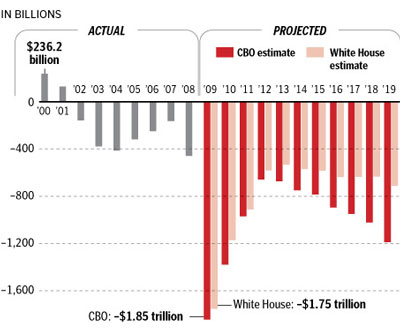

SOURCE: CBO, White House Office of Management and Budget | The Washington Post – March 21, 2009

That’s not the Republicans providing that chart, or The Center for the American Experiment, or even Joe the Plumber; it’s the Washington Post, using numbers from both the President’s office and the ostensibly non-partisan Congressional Budget Office. As sickening as the Bush fiscal record is (and yes, the numbers above do include money spent on Iraq and Afghanistan), the current administration plans to take a case of the swine flu and turn it into Ebola.

As the Heritage Foundation’s Brian Riedl points out:

Perhaps someone can graph this for me: now that it’s been established that when America sneezes, the rest of the world catches cold, how long before the UN decides that our economy is too important to be left in the hands of Americans and requires global oversight?

HT: Bogus Gold.

An agenda in search of a weatherman

by the Night Writer

A couple of weeks ago I was sitting in my warm house, in a comfy chair, just flicking my gloveless fingers over my keyboard and I discovered that the amount of global sea ice was as high as it had been at any time since 1979, according to satellite observations of both the northern and southern hemisphere polar regions monitored by the University of Illinois’ Arctic Climate Research Center. Of course, those paying attention will remember that 2008 was the year that some were predicting that the North Pole would melt entirely.

Didn’t happen. In fact, there was about 10 percent more ice in August of ’08 than there was in August of ’07. The last quarter of the year then saw an exceptionally fast and widespread refreeze to reach the 29-year high reported above.

Meanwhile, the Caitlin Arctic Survey team from the UK set out earlier this year to measure for themselves the amount and thickness of the arctic ice, predicting that due to climate change they’d have to swim (using special suits) for as much as 15 percent of the excursion.

Instead, severe weather and extreme cold put the team in danger as re-supply flights had trouble reaching the explorers:

Three global warming researchers stranded in the North Pole by cold weather were holding out hope Wednesday as a fourth plane set off in an attempt deliver them supplies.

The flight took off during a break in bad weather after “brutal” conditions halted three previous attempts to reach the British explorers who said they were nearly out of food, the Agence France-Presse reported.

“We’re hungry, the cold is relentless, our sleeping bags are full of ice,” expedition leader Pen Hadow said in e-mailed statement. “Waiting is almost the worst part of an expedition as we’re in the lap of the weather gods.”

Fortunately, a relief flight did manage to reach the group the other day, but it was touch and go for awhile:

“It’s been a pretty grim time waiting for the weather to lift enough to get the plane in. It’s no place to just hang around when it’s minus 40 degrees [Celsius], but we could not afford to move without our essential kit, food, fuel and batteries for our survey and communications gear,” said Hadow, the expedition leader, “All of us are just wanting to get going quickly and have a high calorie meal to fuel ourselves up.”

I’m glad to hear that the team is all right for now as only polar bears would truly be happy about the group’s predicament. Some of the commenters on the rescue story are upset, however, that fuel-burning, carbon-dioxide-spewing airplanes were used to resupply the expedition. Perhaps relief via a nuclear sub would have been better?

More taxes on the “lucky”

by the Night Writer

Are you one of the “95 percent” of Americans promised a tax-cut by President Obama? By all means, keep your fingers crossed and “hope” you get a little taste before pending “changes” in other tax laws and regulations swipe it right back out of your pocket.

A couple of weeks ago I highlighted a move by Congressional Democrats to tax your employer-sponsored health benefits. Today I have a couple more stories that suggest more back-door tax increases on your insurance are in the works.

One of the major features of life insurance and annuities has long been the ability to “build-up” cash values tax-free inside certain types of life polices and within annuities, with income taxes being taken when the funds were withdrawn, presumably in retirement when your income tax bracket is (hopefully) lower. It’s a similar mechanism to how a 401k works. Additionally, life insurance death benefits paid to your survivors have also been tax-free. All these tax deferrals act as incentives for consumers to take individual responsibility in planning for retirement and the financial security of one’s family.

This is not an strategy reserved only for the wealthy; cash value life insurance policies and annuities are mainstays of middle-class financial planning, while the more affordable term life plans (with no cash build-up) provide an important and accessible safety net for families with common sense but modest means. There are those, however, who love raising taxes every bit as much as they hate the thought of the individual doing anything for himself when the government could be doing it less efficiently. An example on the radar screen is out west where the Oregon State Revenue Committee is claiming that exempting these private funds imposes too much of a burden on the state which currently can’t get its hands on that money:

The federal government exempts life and annuity benefits from taxation, but Rep. Chuck Riley, D-Hillsboro, Ore., the sponsor of the Oregon bill, H.B. 2854, has argued that conformity with federal income tax rules is too costly, and that Oregon should tax some kinds of income now excluded from federal taxable income.

If passed as written, the bill would take effect on or after Jan. 1, 2010.

H.B. 2854 was first read March 2. To pass, the bill would need approval by a three-fifths majority.

The National Association for Life Brokerage Agencies, Fairfax, Va., has put out a statement opposing the bill, noting it would tax both the death benefits and earnings on the inside build-up of life insurance and annuities.

This “unfairly targets individuals and families who have taken responsibility for their financial future by preparing for retirement and planning for unforeseen circumstances,” NAILBA says in the statement. “Any changes to the tax system must not limit or disadvantage protection and security products, but rather strengthen them.”

It should be pointed out that “conforming” with the federal regulations doesn’t “cost” Oregon anything; it merely keeps money away from them, which really galls those inclined to think that your money (and children) belong to the State. It is also part and parcel of the mindset that, as with the earlier health insurance article, portrays having life insurance as a lucky break and unfair advantage and therefore worthy of confiscation and redistribution. While this particular article refers to Oregon only, if it passes it’s not much of a stretch to see other states trying the same thing.

On a related note, there is a recurring movement afoot in the federal government to repeal the McCarran-Ferguson Act which provides a limited anti-trust exemption to the insurance industry. This arises periodically, but now they are using the AIG imbroglio to justify this latest grab (though the connection is tenuous):

Two House Democrats have introduced a bill that would repeal the McCarran-Ferguson Act insurance industry antitrust exemption.

The bill, H.R. 1583, the Insurance Industry Competition Act, would give the U.S. Department of Justice and the Federal Trade Commission the authority to apply antitrust laws to anticompetitive behavior by insurance companies.

The bill would keep the McCarran-Ferguson provision that puts jurisdiction over insurance regulation in the hands of the states.

The bill was introduced by Reps. Gene Taylor, D-Miss., and Peter DeFazio D-Ore.

Taylor and DeFazio have introduced similar bills in earlier Congresses. They say the controversy over bonuses paid to American International Group Inc., New York, employees highlights the need for action on the antitrust issue.

The current insurance industry antitrust exemption gave AIG a free pass to become “too big to fail,” and “now the U.S taxpayers are on the hook to bail them out or risk even further turmoil in an already fragile economy,” Taylor and DeFazio say in a statement. “This legislation would close that exemption.”

Admittedly, McCarran-Ferguson is a rather esoteric issue in a complex environment, and “anti-trust” always sounds like it’s in the best interests of the public. What the Act does, however, is allow states to regulate insurance companies operating within their jurisdiction rather than bringing it all under federal oversight. The result, however, is to make the insurance products — both life & health and property & casualty — more affordable. Federalizing insurance regulation would, like the initial efforts at “health-care reform” would strengthen the biggest players while harming or even eliminating the smaller companies, and would result in higher costs for consumers, not lower.

As someone who’s worked in marketing and advertising in this industry for a long time I know that I have complained on many occasions about the challenges of working with 50 different state insurance commissions in order to get products and even certain advertising approved. While I’ve often thought it would be simpler to deal with just one entity I also see how state control benefits consumers.

Politicians have long been masters of saying one thing and doing another; of staging a distraction in the park while the pickpocket goes through the crowd. When you hear the music playing, be sure to look over your shoulder.

Picture this: Yo, Lumpy

by the Night Writer

“Take me, mold me,
Use me, fill me,
I give my life into the Potter’s hand…”

Singing this song always makes me think of Romans 12:2: And do not be conformed to this world, but be transformed by the renewing of your mind, that you may prove what is that good and acceptable and perfect will of God.

If you take a lump of clay into your hands your tendency is to squeeze it and roll it, perhaps making a little face out of it as you kind of doodle with your fingers. If you picture our lives as a lump of clay introduced into the world we can quickly see how all the outside forces in our lives try to shape and conform us to some image, squeezing and pressing us with things as diverse as fashion or politics or family expectations, or TV commercials, or our schooling. Everything, it seems, seeks to conform us to some earthly standard of what is acceptable, whether it’s your friends, your job, your gang, your political party — even your church. How the pressure is applied determines the shape our conformation takes on.

But there’s another way to shape clay. A potter can place a lump on a wheel and get the wheel spinning and in doing so begins to bring smoothness and balance to our lump and then, rather than conform, something transforming happens as the potter reaches into the spinning clay and cups his fingers outward, causing the little ball of clay to suddenly bloom outward and expand, displacing clay with air. Depending on the potter’s vision, the transformed lump could become a bowl, a pot, a vase or an urn.

Similarly, when our thinking is conformed to the world we are squeezed into something smaller and denser, our minds grooved and compressed by repetition. When we are transformed by allowing our minds to be renewed — to begin to grasp what has previously been beyond our imagination — however, we get bigger and can hold things; rather than being something to look at we become something useful.

The song above describes God as the Potter, and in my analogy you can see God reaching into us, increasing our capacity, making us fit for bigger, better things. Of course, we still have to be fired in the kiln, the trial bringing out our colors while making our final shape stronger (seeking to pull out of the fire too soon, however, and you’re left with a fragile, untrustworthy object).

But we have this treasure in earthen vessels, that the excellency of the power may be of God, and not of us.
— 2 Corinthians 4:7

Special to Mr. D:

by the Night Writer

The Lumberjack (perhaps related to Minnesota’s Paul Bunyan) feels bad that Wisconsin is getting heat from Intellectual Property-Purists about co-opting the phrase “Live Like You Mean It” to promote the state (apparently, “Wisconsin: Just Say No” didn’t test well with the focus group). Setting aside any easy jokes about using Wisconsin and Intellectual Property in the same sentence, here is a sample of the state’s new campaign and a couple of alternatives from our favorite wood-cutter. View them all.

Taxify him!

by the Night Writer

The EckerNet reminds us, in a long, documented list of Democrat corruption, that former Louisiana Congressman William Jefferson was videotaped receiving a $100,000 bribe from an FBI informant, and a search later turned up $90,000 hidden in his freezer.

I’d almost forgotten about William Jefferson’s “cool” $90,000; I guess I’ve just tuned out all the media talk about it.

Wait a minute — if he took that money from an FBI informant, wouldn’t that be federal funds? Isn’t it time for Congress to get together and vote to tax Jefferson’s greed and arrogance?

AIG agony

by the Night Writer

I’ve read emails that tell how the US government once took over the infamous Mustang Ranch brothel in Nevada because of unpaid taxes…and subsequently managed the business into the ground. The moral of the story was if the government can’t even make a go of selling sex and whiskey, how does it expect to be the de facto, nationalized owner of banks and insurance companies?

I don’t think about brothels much, but the story keeps coming to me as the AIG saga staggers through the never-ending news cycle as the company’s executives and new congressional overseers compete to kill the company in the most Darwin-award winning manner. The current bonus brouhaha may merely be the arsenic icing on a cake made with too many cooks. First, it is incredibly dunder-headed to pay bonuses for behavior that put your company — and the economy — into a tailspin. I work in this industry and regardless of what the contracts say, I’ve not heard of bonuses being paid for screwing up. I do know that the financial services industry is as brand-conscious (if not more-so) as any industry out there and this kind of publicity is like shooting both of your feet off. You could even speculate whether the company would come out ahead in the long run by refusing to pay the bonuses and fighting it out in court even if the eventually had to fulfill the contracts. The perception that they were trying to do the right thing could have been worth hundreds of millions alone — and avoided a congressional coup-de-grace.

Now Congress is shocked — shocked — that gambling is going on, even though it wrote the rules years ago that led AIG into this thicket, then steadfastly refused to do anything to provide oversight, and finally wrote the specific codicil in the bail-out (thank you, Sen. Dodd) that requires companies that take bail-out money to pay scheduled bonuses. Now, to divert the possibility that any blame might come back on them, they’re stomping about, beating their paper-thin chests about the evil and greedy company misusing a small fraction of the billion-dollar suppository of tax-payer dollars Congress shoved up you-know-where — apparently forgetting that the U.S. taxpayer now owns that company and this grandstanding is driving the stock-price down to penny-stock status.

What Congress is also forgetting, as it threatens ever-more-onerous regulations, is that the market — thank you very much — has already exacted its sanctions. (Not only in terms of stock-price and public perception; my company has already benefited by AIG’s stumbles as both customers and top producers have come over to us).

On top of that, what message does it send to the investor community when the government starts threatening confiscatory taxes based on feelings rather than the rule of law? AIG operated on the assumption that it was “too big to fail” but after the last week I’m beginning to think everyone connected with this circus is too stupid to live.

Update:

When I wrote “too stupid to live” up above I didn’t mean it in a “take them out and shoot them” way, but in the extinct Dodo bird way.

I wanted to be clear about that.

Coming home

by the Night Writer

A convicted would-be bomber and accessory to murder and armed robbery has been paroled from prison in California and is returning to Minnesota.

That may be “so what?” news for folks not from around here but it has been quite a story in Minnesota since 1999 when Kathleen Soliah (now known as Sara Jane Olson), one of the FBI’s “most wanted”, was found living a politically progressive, upper-middle class life in a toney St. Paul neighborhood. Soliah/Olson, a sympathizer and likely member of the Symbionese Liberation Army (of Patty Hearst fame) in the 70s had disappeared 23 years prior to her arrest following her grand jury indictment for her role in a bank robbery that resulted in the killing of a female bank customer and for participating in two attempts to bomb police cars in retaliation for a police shoot-out that killed many of her SLA friends. During the time she was “missing”, she adopted her new identity, married a St. Paul physician, raised a family, performed in several community theater productions and became well-known in activist circles for her support various liberal causes.

Her friends in turn took up her cause after her arrest, with well-known St. Paul office-holders Andy Dawkins and Sandy Pappas especially front and center protesting that she had lived a good life in the intervening years while also introducing the novel “everyone was an anarchist bomb-thrower in those days anyway” defense. Olson, nee Soliah, for her part pretty much denied anything other than being an admirer of the SLA. A lot of people, or at least the media, seemed to be buying it, too but a couple of things happened. One, the government started releasing more details of its case against her. The second thing was 9/11.

Any indulgence or sympathy for youthful, terroristic activities began to dry up, and Olson ultimately accepted (then tried to renege on) a plea bargain on the charges of planting bombs under two California police cars. After she started serving her sentence she was also convicted of the accessory to murder charge, and seven years were added to run concurrently with her original 14-year sentence, to be served in California. A year ago she was just about to be paroled a year early due to a clerical error but this was discovered and corrected and she returned prison. The calendar has now turned, but in the days leading up to her release the respective police unions in California and Minnesota, as well as the governors of the two states, have each insisted that they didn’t want her serving her parole anywhere near them. The public statements became a political side-show in a time when there are some real issues to be dealt with. Nevertheless, Kathleen Soliah/Sara Jane Olson is back in Minnesota after serving seven years of her sentence, with three years of parole to come.

Personally, I think I’m ready to call it square.

I didn’t sympathize with her story when she was finally captured and I didn’t appreciate the local DFL’s embrace of her and their attempts to minimize the serious offenses she committed. Nor do I downplay the seriousness of her intent and participation back in the day, or discount that her actions contributed to the death of another mother who will never come home. I was satisfied, however, to see her ultimately convicted and for the political and moral equivalency smokescreens to get hosed down. I also appreciated it when the amount of time she served turned out to be greater than the “two, three years, tops” predicted by the experts at the time she plead.

The fact is, she has done a significant amount of time and absorbed a (justified) amount of public humiliation. Points have been made. Frankly, I don’t feel our community is a more dangerous place with her in it, and I don’t expect a wave of police bombings or bank robberies even though some of her comments during her trial and incarceration suggest that she still harbors more than a little resentment against “The Man”.

The possibility exists that she might become a public figure again due to her infamy, but outside of a small, hard-core group of supporters I don’t think she has the credibility or gravitas to be anything better than a distraction at best — and a liability at worst — for any cause or campaign she aligns with.

If she wants to come back here, be with her family, and live a quiet, invisible life, I’m fine with that. I don’t have any interest in following her around and I hope she will be left in peace. If she desires a more public platform then the abuse that will likely be heaped on her — as with the time she spent incarcerated — will be something she brought on herself.

Thinking Green

by the Night Writer

Here’s a little recycling in honor of St. Patrick’s day — a couple of older posts that I’m re-running here because they fit the occasion. If you weren’t reading this blog in 2006 they’ll be new to you, and if you were, well, you’ve probably forgotten and they will seem new to you.

The first is an account of the events surrounding my first college St. Patty’s day, celebrated on a campus truly dedicated to the holiday:

I don’t think there will ever be a St. Patrick’s Day when I don’t think about my first semester of college when I enrolled in the Spring term at the University of Missouri-Rolla campus. UMR is mainly an engineering college but it was close to where I lived at the time and a convenient way for me to knock out some general liberal arts credits before transferring to the main Mizzou campus in Columbia.

St. Patrick’s “Day” was actually a 10-day party at UMR. The campus was about 90% male then, almost all in grueling engineering classes that seemed to require binge drinking in order to cope. The reason St. Pat is such a big deal at UMR is because he is deemed to be the patron saint of engineers for having driven the snakes from Ireland and thereby creating the first worm drive (engineering humor). The rites and festivities of the season were under the auspices of the St. Pat’s Board: upper classmen (some I think were in their 30s) elected by their fraternities, eating clubs and campus organizations. For most of the year their duties seemed to be based around regular “meetings” marked by drinking and carousing. Come March, however, they were especially prominent in their filthy green coats (part of their semi-secret initiation rites) as they enforced the rules and protocols of the holiday (for those familiar with the St. Paul Winter Carnival – especially in the older days – think green Vulcans).

Part of the tradition was that all freshmen males were to have beards in the week or so leading up to St. Pat’s, and were to carry shillelaghs (an Irish cudgel). Most people think of shillelaghs as being a bit like walking sticks, but at UMR there were specific requirements: the shillelagh had to be at least two-thirds the height of the student and at least one-third his weight, and it had to be cut from a whole tree with at least some of the roots showing. The punishment for being caught beardless by a Board Member (and they usually traveled in packs of two or more) was to have your face painted green. The penalty for being without your shillelagh was to be thrown into Frisco Pond. Frisco Pond was actually the town’s sewage lagoon, but was called Frisco Pond because the St. Pat’s Board of 1927 rerouted the Frisco railroad into the pond after one of their meetings. I’m sure it seemed like a good idea to them at the time.

Fortunately I was able to cultivate my first beard, red and wispy as it was, and I cut myself a suitable cudgel. Carrying books and a shillelagh of the stated dimensions was a challenge, and even more so when certain professors wouldn’t allow them into class, meaning they had to be stacked in the hallways and guarded because Board members liked nothing better than to snatch unattended shillelaghs and then wait for their rightful owners to appear — followed by a honking procession to Frisco Pond. (I did mention the campus was 90% male and fueled by alcohol, right? During St. Pat’s week the campus looked like No Name City from “Paint Your Wagon.”)

The reason we carried cudgels was in case a Board member approached you with a rubber snake and demanded that you “kill” it. This generally meant pounding on the snake with your cudgel until the Board member (not you) got tired. I weighed about 170 then; you do the math as to what my shillelagh weighed, minimum. I was fortunate to go largely unnoticed (as unnoticed as a guy carrying a tree can be) through most of this period. This was especially remarkable given that one of my friends from my hometown was on the Board. Toward the end of the week, however, he came up to me in the dining hall. “Red,” (for my beard) he said, “I think I see a snake.” With chants of “snake! snake! snake!” I was led outside and my “friend” tossed said snake on the ground. It landed, however, in a flower bed. “Freshman! Kill!” was the command. Hoisting my club over my head (and somehow not tipping over backwards) I brought it crashing down onto the hapless rubber creature — and even more hapless plants in the soft earth.

“Hit it again, it’s not dead,” was the order. I looked down once, then again. “Oh, it’s dead, alright,” I said. Actually, it would be more accurate to say, “Missing, presumed dead” because the rubber snake was nowhere to be found in the newly-created crater. Rather than wait around for CSI, or the gardener, the small group repaired to the dining hall to toast the success of the mission and I survived the week, the highlight of which was the St. Pat’s Parade.

In those days the St. Pat’s Board would be out early in the morning with mops and barrels of green paint, painting Pine Street in advance of the parade. High school bands from around the area would march, car dealers would drive demo models with pretty girls in them and various and sundry other parade standards would be present. In particular, however, I remember the Precision Pony Team: a group of students scooting along on empty pony kegs strapped to skateboards with rudimentary heads and yarn tails attached to the kegs. They wove patterns and formations down the street, stopping periodically to lift the tails of their “mounts” and drop handfuls of malted milk balls.

Much like the Macy’s Thanksgiving Day parade, the event culminated in St. Pat (not St. Nick) appearing on the route, riding a manure spreader and attended by his Guard. The duties of the Guard were largely to keep St. Pat vertical (he’d probably been drinking for four days straight) and to bring any fetching lasses from the crowd to St. Pat for a good luck kiss. (I did say the campus was 90% male and fueled by alcohol, didn’t I?).

After this particular St. Patrick’s Day all the other ones I’ve experienced have just kind of faded from my memory.

Note: the annual UMR St. Pat’s parade and related festivities still go on, but in a much more muted manner. A couple of alchohol-poisoning deaths were a factor (sad and true) to be sure, but I also think it was because some of those Board members finally graduated.

Also in keeping with this sainted day, here’s my “Fundamentals in Film” review of the great John Ford and John Wayne classic, The Quiet Man:

From taxing fortunes to taxing the “fortunate”

by the Night Writer

In wartime it’s common to try to dehumanize the enemy, calling them derogatory names and ascribing vile and fiendish character traits to them to make it easier to hate and, I don’t know, drop bombs on them. In class warfare a similar dynamic occurs as it is simply assumed that anyone with any wealth or property could only have gotten it through pure dumb luck (such as inheritance) or by corruption and oppression, thereby justifying the redistribution of their possessions in the interests of being “fair.”

Of course, the definition of who the fortunate ones are can change according to the need at hand. The latest brainstorm of the economically illiterate, morally bankrupt yet somehow electable cotton-headed ninnymuggins in control of our government is that the lucky or evil greedos that get their health insurance through their employers (in other words, “people with jobs”) are not paying their fair share of taxes for this benefit. According to a recent article in Business Insurance magazine:

Sen. Baucus looking at taxing health benefits
March 03, 2009

WASHINGTON (Reuters)—A senior Senate Democrat said Tuesday he would consider taxing U.S. workers on their employer-sponsored health insurance to help pay for extending coverage to millions of uninsured Americans.

“I think that tax provision should be on the table,” said Senate Finance Committee Chairman Max Baucus, who will play a major role in writing the legislation to revamp the U.S. healthcare system as promised by President Barack Obama.

“It’s too aggressive. It skews the system,” he said of the tax benefit.

Most U.S. workers with health insurance get it through their employers — 160 million of them — although recent surveys have shown that number is declining as businesses try to cope with the rapidly rising cost of insurance.

As a matter of fact, 19% of employers say they plan to drop health benefits, while 38% say they are uncertain they’ll be able to provide health benefits 10 years from now. Meanwhile, in the midst of a recession, the government is talking about wanting to essentially raise taxes on people who still have jobs, regardless of what those jobs pay. By the way, let’s have a show of hands from everyone who thinks that the premiums you pay for your employer-sponsored health insurance are too low. Apparently being employed makes you one of the “rich” to be targeted by Congress and President Obama’s cabinet of tax dodgers and community organizers — the people who have also promised a tax cut to “95%” of the country. Do you get the feeling they might not be very good with numbers?

Yet in another article about “Mad Max” Baucus and his cronies, the Washington Post reports:

In recent weeks, however, Sen. Max Baucus (D-Mont.), chairman of the tax-writing Finance Committee, has repeatedly advocated changing tax laws to include employer benefits, arguing that it makes sense to fund the health-care changes by sucking cash out of the existing system. Meanwhile, 13 other senators — from both sides of the aisle — have signed on to a plan for universal coverage that includes a tax on employer-provided benefits.

“I think it’s extremely important from a credibility standpoint to show the American people that you’re making savings in the enormous sums now being spent on health care before you go out and ask them for billions of dollars more,” said Sen. Ron Wyden (D-Ore.), one of the sponsors of that proposal. “And I don’t think I’m the only senator who feels that way.”

What? How do you translate taking money out of the pockets of working Americans by making them pay more for their health insurance as “making savings”? Credibility is, indeed, a problem. Perhaps we’ll find out how big a problem that is when the Obama administration weighs in, as the Post further reports:

So far, administration officials have been careful not to endorse the idea, which Obama blasted as a major tax increase last year after Sen. John McCain (R-Ariz.) made it the centerpiece of his presidential campaign’s health plan. But the president hasn’t slammed the door on it, either.

This week, White House budget director Peter Orszag said taxing employer benefits was among several ideas that “most firmly should remain on the table.” White House economic adviser Jason Furman called for an end to the so-called “employer exclusion” before he joined the administration. Meanwhile, some congressional Democrats say the White House has signaled that Obama would accept a tax on employer benefits as long as he didn’t have to propose it himself.

Riiight. Congress passes the tax increase and President Obama merely comes in at the end and says it’s “an imperfect bill” but something he has to sign anyway. It’s almost enough to make you wonder how much of a grasp on reality our leaders have, and if they’ve ever had to enroll in a group health plan in recent years when employers are passing more and more of the costs on to employees. And then there’s this:

Many economists and tax analysts have long argued for changing current tax law on health coverage, which disproportionately benefits wealthier workers. The law encourages people to enroll in the most comprehensive health plans on offer, the so-called Cadillac plans that provide vast coverage, mask the true cost of health care and contribute to skyrocketing costs.

I don’t know about your job, but my benefit enrollment forms certainly don’t encourage me to select the most comprehensive, or “Cadillac” plans offering “vast” coverage. As a matter of fact, I’ve chosen high deductible plans with an Health Savings Account (HSA) option the past several years to save money. Further, the so-called Cadillac plans aren’t driven by consumer demand, but by state and federal government mandates that require additional coverage (and wait until you see the effects of the Mental Health Parity bill that was recently signed). If consumers were allowed to pick and choose the coverages they actually need the costs would go down. Somehow, however, once the money is on the table there’s no way to get it back in your pocket.

Many lobbyists and others involved in the health-care debate say they see few other places to go for the kind of money that will be needed to meet Obama’s demand for ambitious change. In their view, the question is not whether employer benefits will be taxed but how much of the benefit will be spared.

My personal opinion is that taxing employee benefits is not really intended to raise money for health care. It’s meant to make the current system even more dysfunctional in the hopes that employers will be even more anxious to get out of the system and the public will desperately embrace change — specifically, universal health care.

I’m actually in favor of getting employers out of the business of proving health insurance…but I want to do it by dumping the whole third-party-payer model that is the main reason health care continues to skyrocket, and universal (aka “single-payer”) health care does nothing to relieve that problem while simultaneously reducing the standard of care as I and others have pointed out before. Let’s not forget that the reason we got into this health care predicament in the first place was because of government interference via wage and price controls in World War II that led employers to offer health insurance benefits as a way of attracting a limited pool of workers. That opened the door to the wasteful and expensive third-party-payer system we currently have, the inefficiencies of which can only be outdone by a government-run system.