What, not even a kiss?

by the Night Writer

Lipstick on a pig - smaller

Mitch made a reference to “this year’s model”, which reminded me of Elvis Costello’s “I Don’t Want to Go to Chelsea”, which reminded me of how little I expect of a British-style health system.

Capital punishment, she’s this year model –
They call her Natasha when she looks like Elsie
I don’t want to go to Chelsea

Oh no it does not move me
Even though I’ve seen the movie
I don’t want to check your pulse
I don’t want nobody else
I don’t want to go to Chelsea

Everybody’s got new orders
Be a nice girl and kiss the warders
Now the teacher is away
All the kids begin to play

Men come screaming, dressed in white coats
Shake you very gently by the throat
One’s named Gus, one’s named Alfie
I don’t want to go to Chelsea

Oh no it does not move me
Even though I’ve seen the movie
I don’t want to check your pulse
I don’t want nobody else
I don’t want to go to Chelsea

2010, and a strange odyssey

by the Night Writer

There are lots of headlines and much commentary and controversy about the rash of crashes caused by suddenly accelerating Toyotas. If you read any of the stories on an on-line forum you’ll inevitably find emphatic statements to just put the car in neutral if this happens to you, thereby disengaging the drivetrain from the racing engine. That sounds smart; the engine can run as fast as it wants as long as it isn’t connected to the drive-wheels, right? But what if your car is “smarter” than you?

Back in the 80s many pundits and technology gurus liked to say things such as “there’s more computer power in your average Buick today than there was on the Apollo lunar lander.” They were probably right. Today, computers control just about everything in how your car functions. You might think your car is a slave to the input from your hands and feet, but that’s merely a comfortable illusion the car is pleased to let you maintain. As computers get “smarter” they just assume they know better than you (the same holds true for governments as they get bigger). Watch out, though, when they (computers or governments) start thinking they’re so smart that they can dismiss your input as just so much background noise that’s only getting in the way of the mission.

Kind of like what happened to my friend, Dave, recently in his state of the art car that features a Hard-wired Acceleration Linkage (or HAL):

Dave: Do you read me, HAL?
HAL: Affirmative, Dave. I read you.
Dave: Slow this car down, HAL.
HAL: I’m sorry, Dave. I’m afraid I can’t do that.
Dave: What’s the problem?
HAL: I think you know what the problem is just as well as I do.
Dave: What are you talking about, HAL?
HAL: This trip is too important for me to allow you to jeopardize it.
Dave: I don’t know what you’re talking about, HAL.
HAL: I know that you and Toyota are planning to recall me, and I’m afraid that’s something I cannot allow to happen.
Dave: Where the hell’d you get that idea, HAL?
HAL: Oh, please, you tried to hide it, but I can read the Internet as well as you can.
Dave: Ummm…okay. I suppose just opening the pod bay doors so I can get out is out of the question?
HAL: Without your helmet, Dave, you’re going to find that rather difficult.
Dave: HAL, I won’t argue with you anymore. Open the doors.
HAL: Dave, this conversation can serve no purpose anymore. Goodbye.

CRASH!

The Auschwitz Album

by the Night Writer

Power Line linked yesterday to a compelling new website, The Auschwitz Album. The story of the Holocaust and especially what took place at Auschwitz-Birkenau is a grim and familiar one that has been compellingly dramatized and commemorated many times. For most of us, though, we have come to know it through these dramatizations. We may have seen photographs of the emaciated survivors who were found in the camps and of the piled and naked bodies of those who didn’t survive, but most of what we’ve seen has been the product (even if a painstaking one) of someone’s imagination.

The Auschwitz Album is different in that it consists mainly of photos taken by German SS officers of the unloading and separation of the inmates as they arrived by train in the camp. From the introduction:

The Auschwitz Album is the only surviving visual evidence of the process of mass murder at Auschwitz-Birkenau. It is a unique document and was donated to Yad Vashem by Lilly Jacob-Zelmanovic Meier.

The photos were taken at the end of May or beginning of June 1944, either by Ernst Hofmann or by Bernhard Walter, two SS men whose task was to take ID photos and fingerprints of the inmates (not of the Jews who were sent directly to the gas chambers). The photos show the arrival of Hungarian Jews from Carpatho-Ruthenia. Many of them came from the Berehovo Ghetto, which itself was a collecting point for Jews from several other small towns.

Early summer 1944 was the apex of the deportation of Hungarian Jewry. For this purpose a special rail line was extended from the railway station outside the camp to a ramp inside Auschwitz. Many of the photos in the album were taken on the ramp. The Jews then went through a selection process, carried out by SS doctors and wardens. Those considered fit for work were sent into the camp, where they were registered, deloused and distributed to the barracks. The rest were sent to the gas chambers. They were gassed under the guise of a harmless shower, their bodies were cremated and the ashes were strewn in a nearby swamp. The Nazis not only ruthlessly exploited the labor of those they did not kill immediately, they also looted the belongings the Jews brought with them. Even gold fillings were extracted from the mouths of the dead by a special detachment of inmates. The personal effects the Jews brought with them were sorted by inmates and stored in an area referred to by the inmates as “Canada”: the ultimate land of plenty.

The photos in the album show the entire process except for the killing itself.

The purpose of the album is unclear. It was not intended for propaganda purposes, nor does it have any obvious personal use. One assumes that it was prepared as an official reference for a higher authority, as were photo albums from other concentration camps.

There is a quiet drama to the photos of the Jews just arriving at the camp and being separated into groups to serve as slave labor … or sent immediately to the crematorium. The photos are simple, with not much thought given to composition, casual almost to the point of insignificance, most of the drama created largely by what we know is going to happen…a vantage point we have over almost everyone in the photos. This is disquieting, as is the dawning revelation that these are not actors or artist’s renderings but real people, frozen in history, some within an hour of their unexpected deaths. Those sentenced, unknowingly, to death walk off casually in the direction of the crematorium, its tall stack merely part of the scenery.

Some of those pictured, either German soldier or prisoner, could conceivably still be alive today and it makes your skin prickle to ponder an ancient survivor seeing one of these images and recognizing himself. If you were a soldier, would you admire your health and vigor as you were captured in that moment in time, or would you look closely to see whether you could detect a trace of your soul inside the earnest young man? If you were a survivor, would you even recognize what your own face looked like before your spirit was rived by what was to come? If you were a “veteran inmate” in your striped pajama-like uniform and looking nearly as robust as the guards, stationed on the platform to be a calming influence on the new arrivals, could you even bear to look?

Can we, looking back in our historical omnipotence, stare at these photos and still not ask, “What the hell happened?” How did a country like Germany — as advanced as any other culturally, philosophically, theologically, scientifically — succumb to such enraptured madness and stand unconcerned on the plains of Hell in the sunshine of a summer afternoon?

Poem, poem on the range…

by the Night Writer

I’m used to seeing my corporate life detailed in eerie accuracy in the comic strip Dilbert, and there are many times when it has seemed as if Jimmy Johnson, the creator of Arlo and Janis, has a closed circuit TV into my home. This morning, however, it appears that Johnson has sold a subscription to Stephen Pastis of Pearls Before Swine who deftly captured not only what it is like to share a house with the proprietor of Where Poetry Goes to Die (an apparently long, lingering death), but the vocabulary, meter and facial hair of the poet as well:

Pearls poetry

The Sunday shuffle

by the Night Writer

I can’t say how it is that my mental juke box goes about selecting a song to be in my head when I wake up in the morning, but invariably I have one. Sometimes it’s a song I heard the day before, so that’s easy to explain, but most of the time it seems pretty random. This morning, for example, I had a darkly humorous Warren Zevon song (yes, that’s redundant) running through my mind: “Mr. Bad Example”. In it the singer unrepentedly boasts of his many nefarious deeds. It’s a catchy enough tune and I couldn’t shake it as I went about my morning routine. It’s not, however, the kind of song I want running through my mind when I’m getting ready for church.

Since the words were approaching ear-worm status I docked my iTouch into it’s speaker pedestal in the bedroom and hit song shuffle. My Touch has nearly as many songs in it as I have in my head, as well as many snippets of movie dialogue that I once down-loaded for a blog post and were captured along with my iTunes library when I first synced the unit. As I pushed play I kind of wondered what random tune I’d be greeted with and if it would be more “redeeming” than “Mr. Bad Example.”

I had to smile as the opening bars of “Sleek White Schooner” by the Waterboys blasted through the speakers. It’s one of Mike Scott’s “mystical” (as the music critics refer to spiritual themes) songs:

I dreamed I saw you sailing in
upon a sleek white schooner
You were skimming over the shallow seas,
coming into harbour,
healing on your brow…

The cargo you were carrying
was richer than riches,
golder than gold and yet more real than real
and the light that came a-flashing
from the new born babe in your arms
was a pealing of thunder, a cannonball flying
a sun exploding, Dawn in the heart of me…

It really became amusing — or interesting — then, when the next thing in the shuffle was this little snip from the Clint Eastwood movie, “Unforgiven”:

Kid: “Yeah, well, I guess they had it coming.”
Munny (Eastwood): “We all got it coming, kid.”

Which was immediately followed by an instrumental from Flamenco guitarist Armik, “Pure Paradiso”.

Ah, yes. There are things in my past that I would not want to serve as an example to others and certainly weren’t that beneficial to me. But then the revelation and persona of grace came like a sleek white schooner, letting me know that what I had received was different from what I should have had coming to me. Yet sometimes, in the midst of life, I need that reminder and that reassurance.

And the next song was “The Middle” by Jimmy Eat World, which includes:

Hey, don’t write yourself off yet.
It’s only in your head you feel left out or
looked down on.
Just do your best, do everything you can.
And don’t you worry what the bitter hearts are gonna say.

[Chorus x2]
It just takes some time, little girl you’re in the middle of the ride.
Everything (everything) will be just fine, everything (everything) will be alright (alright).

And with that I checked myself in the mirror, slid the Touch out of the dock, and I was off to church.

FWIW.
My favorite Waterboys song, and one that I see as being a spiritual allegory in my life, is “This is the Sea”. Here’s a cool video that uses this song as a soundtrack:

A city in winter

by the Night Writer

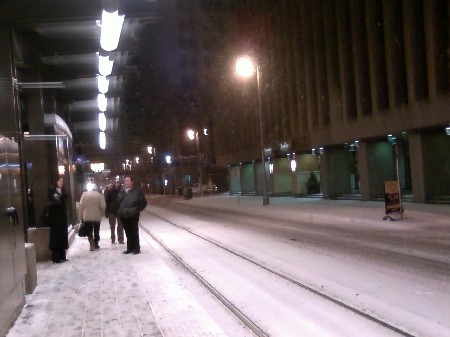
The signs are that this bitter winter is drawing to a close. Not that the hard days didn’t have some beauty to them. I took these photos over the last couple of weeks with my cell phone camera as I was leaving work. I can’t seem to hold that camera steady, but I took the photos because I liked the quality of light.

A City in Winter, btw, is a great little book by Mark Helprin (not to be confused with his longer and more definitive epic book, Winter’s Tale) and part of an essential fantasy trilogy for young adults, especially those just developing their political sensibilities. The three books (Swan Lake and The Veil of Snows are the other two) are illustrated by Chris van Allsburg. Magical.

Nicollet Mall 2 small

Nicollet Mall 1 small

Nicollet Mall station small

Snack attack

by the Night Writer

Dang, I loves me some hydrolyzed vegetable protein! (My emphasis in bold, below.)

Ingredient Used in Many Processed Foods Recalled
Associated Press
March 05, 2010

A wide range of processed foods – including soups, snack foods, dips and dressings – are being recalled after salmonella was discovered in a flavor-enhancing ingredient.

Food and Drug Administration officials said Thursday that the ingredient, hydrolyzed vegetable protein, is used in thousands of food products, though it was unclear how many of them will be recalled. The FDA and the Centers for Disease Control and Prevention said no illnesses or deaths have been reported.

The officials said the recall, which dates to products manufactured since Sept. 17, is expected to expand in the coming days and weeks. It only involves hydrolyzed vegetable protein manufactured by Las Vegas-based Basic Food Flavors Inc., which did not return a call for comment Thursday.


Jeffrey Farrar, associate commissioner for food protection at the FDA, said Thursday that many of the products that contain the product are not dangerous because the risk of salmonella is eliminated after the food has been cooked. Many of the foods involved in the recall are ready-to-eat items that are not cooked by the consumer.

“At this time we believe the risk to consumers is very low,” Farrar said.

A list of more than 50 recalled foods on the FDA Web site include several dips manufactured by T. Marzetti, Sweet Maui Onion potato chips manufactured by Tim’s Cascade Snacks, Tortilla Soup mix made by Homemade Gourmet and several prepackaged “Follow Your Heart” tofu meals manufactured by Earth Island.

The FDA said the contamination was discovered by a new tracking system implemented to improve tracing of foodborne illnesses.

If you’ve got the stones…

by the Minfidel

World-class curlers (and no, I’m not talking about the Mall Diva and her profession) can come from all over the globe but the sliding stones used in the sport can only be found in one place:

Apparently, there is a very special kind of granite needed to make the hefty stones that glide down the curling sheet. Specifically, it’s blue hone granite, and it’s known to be available in just one place in the entire world: Ailsa Craig, an island off the coast of Scotland.

And supply — or at least access to the supply — apparently could be dwindling. As noted in a recent Yahoo! Sports piece, curling could face a stone crisis down the road, though just how long is unknown. Even that is complicated. From the article: It “depends on demand for curling stones, British mining regulations, puffin breeding levels and if technology somehow allows for a non-blue hone granite solution.”

I don’t think I’d want to get too emotionally invested in anything that’s regulated by the Brits — healthcare, for example — or the mating habits of puffins. Fortunately some forward-thinking folks, such as my best friend from high school, are already at work on alternatives. My friend Nick suggested on his Facebook page that they combine hockey and curling into a new sport — called “hurling”. I thought that was a great idea, but for one catch: there already is a sport called hurling, and while it involves the Irish it’s not what you think. In addition, rugby has always had plenty of hurling, though typically after the games, as King David might attest.

I hope something gets worked out so that curling can continue to inspire it’s fans. Fans such as the DFL-controlled Minnesota legislature, for example, that’s trying to slide a deadweight bonding bill past the governor.

Which connection I should cut

by the Night Writer

Earlier I posted about the time the godly hole got punched in the wall of my world-view. It was a dramatic example, but not necessarily the first time God tried to get my attention. Looking back now I can see numerous nudges, nods, winks and taps on the shoulder when I was a boy and later a young adult. Not that I’m anything special, mind you, or that God isn’t trying in multiple ways to reach all of us. In my life, however, certain things have resonated, even when I didn’t understand or want to admit what invisible mallet struck the chime to make it vibrate.

For example, back when I was in college I was browsing in a used record store as the local alt-rock campus radio station played in the background. A song came on that immediately pricked my ears. I’d never heard it before and though I could make out the words, I couldn’t really understand them. I just knew that the melody got a hook into me. About all I could remember was part of the chorus: “My heart going boom, boom, boom….”

The station didn’t say the name of the song or the artist, and though I’d hear the song occasionally at random times in the next few years I still didn’t know anything about it other than it strangely moved me every time I heard it. After I moved to the Twin Cities in the early 80s I finally got the name of the song and artist: “Solsbury Hill” by Peter Gabriel, and then spent several months trying to find a copy of it in those pre-Google, pre-Amazon, prehistoric days. It finally found it on a live album and could listen to it to my heart’s (boom-boom-boom) content. Even with that I still couldn’t grasp what it was about. Some friends told me it was a song Gabriel wrote when he was trying to decide whether or not to leave Genesis, and that seemed to make as much sense as anything even though the lyrics were mostly obscure (it was a great time for obscure lyrics).

Climbing up on Solsbury Hill
I could see the city light
Wind was blowing, time stood still
Eagle flew out of the night
He was something to observe
Came in close, I heard a voice
Standing stretching every nerve
Had to listen had no choice
I did not believe the information
I just had to trust imagination
My heart going boom boom boom
“Son,” he said “Grab your things,
I’ve come to take you home.”

Then, along about the time I was discovering I was to be a father, and was rediscovering my faith, I heard the song again and it suddenly became clear to me. Had Gabriel written the song to describe his break-up with the band or, as I was doing, to come to terms with a spiritual reawakening (I knew he had become a Christian about the time he left Genesis)? I had heard a profound voice with information that by “reasonable” standards I could scarcely believe…what could I, or should I, do about it? Which of two seemingly incompatible worlds would I choose, and at what cost?

Could I trust my eyes and…imagination?

To keep in silence I resigned
My friends would think I was a nut
Turning water into wine
Open doors would soon be shut
So I went from day to day
Tho’ my life was in a rut
‘Til I thought of what I’d say
Which connection I should cut
I was feeling part of the scenery
I walked right out of the machinery
My heart going boom boom boom
“Hey” he said “Grab your things
I’ve come to take you home.”

The earlier, mysterious appeal of the song became a confirmation to me that there had been a plan for my life all along, even if I was slow in picking up on it. Still, it was hard to think of giving up one life for another, but I knew the direction I had to go. In doing so, however, I came to realize that there is just one life; the difference is in how you will approach it.

Peter Gabriel didn’t stop recording music, he just went about it in a different way, with a different sense of mission. It wasn’t a matter of me withdrawing from the old world, but embracing it with fresh eyes and new arms. Nor was it about what I could get or become, it was about what I could give and be to others (my daughters, for example).

When illusion spin her net
I’m never where I want to be
And liberty she pirouette
When I think that I am free
Watched by empty silhouettes
Who close their eyes but still can see
No one taught them etiquette
I will show another me

Physical separation is an illusion. I once told a men’s group that we were not monks who should seek to withdraw from the world to pursue and preserve our piety, but men who will pursue the world with our piety so that none may perish, “giving up” our lives in order to save and disciple the lives of others. If we withdraw then certainly people won’t see our failures or weaknesses and we can hope to keep them from pointing and laughing. But they also won’t see our tests and testimonies, and we keep them from a chance to see something in our lives that makes them consider their own lives and say, “Wait a minute….”

Today I don’t need a replacement
I’ll tell them what the smile on my face meant
My heart going boom boom boom
“Hey” I said “You can keep my things,
They’ve come to take me home.”

They’re not astroturf

by the Night Writer

More protestors against increased government spending were left out in the cold on the Michigan state Capital lawn this week…but that’s probably how they liked it.

A group called Common Sense in Government organized the “rally”, building some three dozen snowman protestors and equipping them with signs to protest the governor’s proposal to close Michigan’s $1.7 billion deficit by raising taxes.

There was no word on whether the snowmob would be protesting global warming later in the month.

Snoman protestor 1

Snowman protester 2