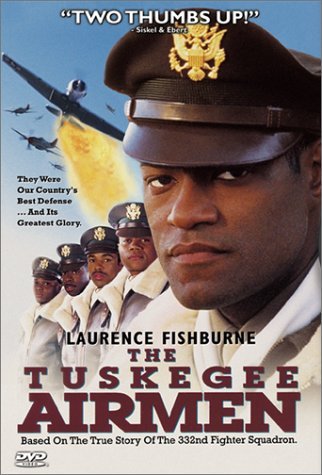
Friday Fundamentals in Film: The Tuskegee Airmen

This week’s movie, The Tuskegee Airmen, is based on a true story about a group of young black men recruited to be fighter pilots in World War II. It’s a stirring and thought-provoking movie that easily stands on its own from a cinematic and historical perspective, but at the same time it plays almost like a sequel to another movie, Glory (see link below). While the black Union soldiers in Glory were fighting for freedom, the men in this movie are fighting for equality and both groups have to overcome many of the same hurdles and pay a blood sacrifice as a down-payment on that goal. (Another commonality is the appearance of Andre Braugher in both movies, as Thomas in Glory and as Col. Benjamin O. Davis in The Tuskegee Airmen.

I recommend this movie to young men not just for its themes of honor, perserverence and looking out for one another but because it deals effectively (and not too heavy-handedly) with the additional burden of being a standard-bearer for your race and the daily, deliberate attacks on your character, integrity and sense of self. In this case these attacks come through racism but in every area of life we are going to be faced with people who don’t like us for some reason — faith, background, politics, accent, past mistakes — and have the power to mess with our lives. When it happens will you blow up, wash out or persevere?

The movie is also an interesting perspective for anyone who assumes that nothing much happened to the conditions of blacks in the U.S. in the 100 years between the end of the Civil War and the civil rights movement. While the young cadets are the first of their race to pursue combat pilot status, each of the young men is college educated. Further, the men from the North had a culture shock when they arrived in the South, such as being removed from their train car because it was now “Whites Only” — and seeing their seats given to German prisoners of war being transported. “Normal” treatment for the southern men, but shocking to the ones from Iowa and New York.

The ensemble cast is universally solid and even exceptional, though it did seem to me that Laurence Fishburne alternates only between super-solemn and solemn moods and Cuba Gooding, Jr. plays, well, Cuba Gooding, Jr. The most interesting character for me was Lt. Glenn (Courtney Vance), the black “liasion officer” between the white chain of command and the cadets during their training. As the only pilot – black or white – on the base with actual combat experience (from volunteering in the Canadian Air Force) his demeanor is ultra-sharp and tightly controlled but you can still see the powerful emotions and drive in him to be the ultimate, consummate soldier and by force of will do the same for the cadets in his charge.

Beyond the racial story, Airmen is pretty much standard war movie fare with good messages in terms of the men maturing, coming to grips with their fears and bonding as a team. That additional element, however, provides an especially poignant perspective that I think is moving, inspiring and educational for viewers of any color. The discipline and common cause the men demonstrated and the understanding that this was something bigger than themselves are important takeaways.

Points to Ponder:

  • Why do you think it was so challenging to people such as Major Joy and Senator Conyers for the black airmen to succeed?
  • Can you help others by being hurtful? Can you hurt others by being helpful?
  • Was the “blood sacrifice” in the movies Glory and The Tuskegee Airmen important? Why or why not?

Questions to Ask:

  1. Was Colonel Rogers correct in his discipline of Cadet Peoples? What was the conflict the Colonel faced within himself?
  2. What did Hannibal Lee mean when he said to his friends, “I’d rather be here by my lonesome than play with a couple of jokers who can’t figure out the game.” What was the significance of this?
  3. What does Lt. Glenn’s demeanor and conduct say about what he feels he has to prove as a soldier, a pilot and an instructor.
  4. The cadets heard two speeches from two different officers, as Lt. Glenn noted, when they arrived in Tuskegee. What was the significance of each speech and what did they say about what was ahead of the men?
  5. References are made in the movie to Jesse Owens and Joe Louis. Who were these men, and what was the significance of these references in the story?
  6. What would you do if faced with the same choices of these men: Hannibal Lee, Colonel Rogers, Lt. Glenn, Cadet Peoples?

Great quotes:
“Cadet (spoiler) just taught you men the most important lesson here at Tuskegee. If you don’t believe in God, you better find yourself a damn good substitute.”

“It’s your privilege to live in the air. It is your destiny to die by fire.”

About Fundamentals in Film: this series began as a class I taught to junior high and high school boys as a way to use the entertainment media to explore concepts of honor, honesty, duty and accountability. The movies were selected to demonstrate these themes and as a contrast to television that typically either portrays men as Homer Simpsons or professional wrestlers, with little in between those extremes. I wrote questions and points to ponder for each movie to stimulate discussion and to get the boys to articulate their thoughts and reactions to each movie. I offer this series here on this blog for the benefit of parents or others looking for a fun but challenging way to reinforce these concepts in their own families or groups. As the list of films grows each week, feel free to use these guides and to mix and match movies according to your interests or those of your group. I’m also always open to suggestions for other movies that can be added to the series.

More signs of the times

I’m working on a couple of longer posts on weightier topics, but couldn’t resist weighing in on Lileks’ old logo nostalgia that Ben picked up on. It got me to thinking about some of the signs and logos I saw growing up in Indiana and Missouri. It can be kind of hard to pull these out of the dusty trunk of boyhood memories because the advertising signs were so ubiquitous as to fade almost into wallpaper — and I can’t remember any of the wallpaper we may or may not have had when I was a youth except for the horrible red, flocked stuff on the walls of one house we moved into.

The easiest thing to remember are oil company logos. My grandfather had worked for Shell Oil and my father owned a Shell service station, so we saw that logo in our sleep, and recognized the competition:

Loyal as I was, I still had to admit that the Sinclair dinosaur was pretty cool:

When my dad came home from work he like to have a beer. Wiedemann’s (“It’s Registered!”) was a favorite, but I also remember the old Falstaff logo.

When we moved to Missouri Dad liked to drink a now defunct regional brew: Stag. That reminds me of another obscure Missouri beer that is no longer with us, Griesedieck Brothers. (Yes, the correct pronunciation was about the most unappealing you can imagine, which may be one reason it’s no longer around. A fun slogan, however, would have been, “Reach for another!” and just think of the product placement opportunities with Brokeback Mountain.)

If we went out to eat when we still lived in Indiana it was most likely to Burger Chef, an erstwhile competitor of McDonalds, or to a nearby Big Boy. (Whoa, strange flashback. I can remember being at the Big Boy one time when my father tried to explain to me why we were in Viet Nam.)

When I was in high school I would often meet my friends at the local Farrell’s Ice Cream Parlor, where if you ordered “The Zoo” (an exotic concoction featuring about 3 pounds of ice cream) the staff would flash lights, blow sirens and race your dessert around the restaurant on a special stretcher in a way that would have made Pannekoeken waitresses seem bashful.

Now that we’ve got some logos out of the way, anyone up for a game of name that jingle?

South Dakota slapfight

I got into a bit of a slapfight over the weekend in the Comments string on Jay Reding’s post on South Dakota’s efforts to ban abortion. I say “slapfight” not in the mocking “girlie-man” sense but as in describing something that generates a flurry of blows doing little damage — in this case damage to either opponent’s beliefs.

Jay, a conservative and one of my favorite blogs, thinks the move by the SD legislature (crafted as much to force a hearing by the SCOTUS as it is on abortion itself) is unwise and focused on the wrong venue, stating “The real battlefield on this issue should be the hearts and minds of the American people, not the courtroom.”

I agreed with him on that, but stated that in my opinion SD’s initiative was ultimately aimed at doing just that: returning the matter to the states to decide instead of leaving it to nine (or just five) people to decide for the nation as a whole and even giving the people the option to change their minds over time. (It has also occurred to me that having the issue contested in as many as 50 venues instead of just one could have an interesting impact on the way money is poured into the issue on both sides).

Predictably I took some shots from other commenters, one who suggested that SD would be overrun with unwanted children overtaxing the state’s resources. Since abortion is already restricted to one clinic in the state I didn’t think a surge was likely. Others used somewhat extreme examples to try and demonstrate the iniquity of SD’s actions. Extreme arguments are not to be discounted, as Kevin noted with this John Stuart Mill quote last week, “Strange it is, that men should admit the validity of the arguments for free discussion, but object to their being ‘pushed to an extreme’; not seeing that unless the reasons are good for an extreme case, they are not good for any case.” One person used the example of a pregnant rape victim being forced to carry the baby to term. (My response: “Ah, so that’s where the idea that two wrongs make a ‘right’ comes from.” Incoming!) Another indicated that abortion should remain available because sometimes birth control fails, or you want a baby and then decide that you don’t, or you make a mistake, or sometimes you don’t want to be pregnant.

Does a ban on abortion make sense in extreme cases? My reaction is let’s take it to the extreme in the other direction as well. Of all the examples – rape, health, changed circumstances, fear, inconvenience, whatever – which of these is the fault of the baby and which justifies that the baby die? From what I’ve experienced in my own life and as a result of the neonatal and perinatal developments I’ve seen in my day job, I can come to no other conclusion but that this is human life we’re talking about no matter how abstract you try to make it. I’ve seen the pictures that today’s 4D imaging technology provide of embryos and through the different stages of development. I know the first-hand accounts of how hard severely premature and/or handicapped babies fight to live after they’re born. Is there really a fate worse than death?

I know we live in an imperfect world that offers imperfect solutions. In complex issues where I might even have conflicting opinions about different aspects of the argument I try to get to what the fundamental issue and irrevocable action are and choose accordingly. There are arguments on both sides that are of varying logical quality and appeal and the “discussion” often degenerates into gross caricatures and generalizations.

I hope I’m not that “slap-happy”. Perhaps the timing is wrong in South Dakota, but maybe things happen in the right time and season no matter what it looks like. I just know that I’m rooting for the future voters – whether they’re already alive or yet to be born.

Update:

A public school finds religion; can you guess which?

Portia Rediscovered was on this story before I was, even though its happening in my backyard, and challenged me to respond.

The Art of Compromise
BY DOUG BELDEN, Pioneer Press

As violent protests over caricatures of the Prophet Muhammad continue around the world, a St. Paul charter school is quietly negotiating the delicate question of how to teach art to Muslims.

Any depiction of God and his prophets is considered offensive under Islam, and disrespectful representations are even worse, as the recent worldwide outrage over the Danish cartoons has shown. But some Muslims also refrain from producing images of ordinary human beings and animals, citing Islamic teaching.

That presented a challenge for Higher Ground Academy, a K-12 school just west of Central High School on Marshall Avenue that has about 450 students. About 70 percent of them are Muslim immigrants from eastern Africa.

Executive Director Bill Wilson said he had concerns for some time about how to reconcile the school’s art curriculum with the views of Muslim families, but the departure of the art teacher at the end of last school year gave him a window to act.

This fall, he hired ArtStart, a St. Paul-based nonprofit organization, to offer more options for about 150 kindergartners through second-graders, including visual arts and drumming. But parents were still upset that their children were drawing figures, Wilson said, and some pulled their children out of art class altogether.

Wilson then sat down with teacher and parent liaison Abdirahman Sheikh Omar Ahmad, who also is the imam at an Islamic center in Minneapolis, to work with ArtStart in determining how to meet state standards without running afoul of Muslim doctrine.

“We said, ‘Look, we can do better than this,'” Wilson said.

This is a very progressive approach by the school, reaching out to the parents who, though the school is a public charter school, are its “customers”. They are trying to find a way to educate the children while being sensitive to the majority’s religious tradition.

Of course, no such accomodation would be available to Christian parents who objected to, say, the sex-ed curriculum or to “Heather Has Two Mommies” being on the elementary library shelf. And heaven, or someone, forbid that those two-weeks off in the middle of winter be called “Christmas break”, even if 70% of students are from nominally Christian families because that would be insensitive to the non-Christian minority. There’s no word in the newspaper story about how the new art curriculum is being received by that school’s non-Muslim minority.

Out the window right away went masks, puppets and that classic of elementary school art class, the self-portrait, said Sara Langworthy, an artist with ArtStart. Revamping the curriculum “definitely requires stepping outside of the normal instincts that you fall back on,” she said.

In their place came nature scenes and geometric forms and patterns, said Carol Sirrine, ArtStart’s executive director. This week, the class was cutting out shapes to make into cardboard pouches. Another project involved taking photographs and mapping the neighborhood around the school.

The conversation about what is appropriate is still open.
In a meeting this week, Langworthy asked Ahmad whether the students can do silhouettes of hands. That’s fine, he said.

Ahmad’s involvement has put many parents’ minds at ease, said Said Jama, father of kindergartner Suhyr Ali Jama. Wilson said Muslim enrollment in art has rebounded since the changes were introduced.
Langworthy said she and fellow teacher Katie Tuma don’t police what the students draw, but they do have conversations with students who are drawing figures to make sure it’s really OK.

I’m in favor of parents having the biggest say in their childrens’ education, and I admire these parents’ resolve and ability to get the school to relent. I certainly know many parents, and of parent groups, who’s concerns have been dismissed or who have found themselves being lectured for their supposed narrow-mindedness. The schools don’t seem that concerned about the number of children who’s parents ask that they be withdrawn from an offensive class, though they do demonstrate a tendency to be very forgetful in notifying the parents in advance when these insensitive days are scheduled, even when they’ve agreed to do so.

At Higher Ground, Wilson said he plans to use ArtStart — which is typically hired for one- or two-week residencies rather than long-term relationships with schools — to expand the art curriculum to grades three through five this fall. And he said once the program is fine-tuned, “we’d like to be able to export this” to any school that is interested.

Wilson said Higher Ground has experience in mediating cultural conflicts because of tensions that have arisen between its majority African population and the rest of the student body, almost all of whom are African American. Certain forms of hip-hop dance performed by African-American students at school talent shows are offensive to some Muslim students, for example, but “we’ve always accommodated that with lots of discussion,” Wilson said.

Principals, faculty and coaches are barred from leading prayer at public schools and even individual students are restricted from offering their own prayers at graduation commencements or school programs — all because of the misguided perception that doing so demonstrates governmental establishment of a particular religion. Somehow, developing and promoting this program isn’t a problem, however, and the ACLU is not pouring fire and brimstone down on the school district.

It may surprise some that I don’t have a big problem with Higher Ground adapting its curriculum to reflect the values of its population, especially since charter schools are supposed to be able to give administrators an opportunity to try different things. It is interesting to me, however, that such creativity is appauded regarding Islam, and censured if it concerns Christianity.

Further, it’s not as if I have a direct stake in this since we avoid such confounding applications by home educating our children, and that’s a topic I hope to address tomorrow.

Face to interface

It’s a quiet evening around the Night cabin. The Mall Diva is out, which explains part of it, but I’ve just recognized another phenomenon.

I am blogging from my laptop in our living room. My wife has a Macintosh set up in the dining room and is working on a freelance design project. Downstairs Tiger Lilly is kicking animated butt on the PC. We’ve never had three computers in the house before, let alone three operating at the same time. Little House on the Prairie, it is not.

Ahh, but wafting from the kitchen is the smell of home-made bread baking, and I’ve finished the milking of this post.

Filings: With love and respect

My wife and I attended our church’s Sweetheart Weekend this past weekend — in romantic, exotic Shoreview! The location, actually, was fine. Sure, a “warm and sunny” getaway is a plus but the expense and logistics for a group like ours makes “close and convenient” more of a draw. We were only two nights and 12 miles away from home, but the two of us enjoy getting away from the routine and devoting some time to one another beyond the usual daily newsflashes that pass for communication in a typical week.

(Speaking of getting out of the routine, Saturday night’s dinner was a formal affair and my wife wore a lethally stunning, coffee-colored gown confirming that, yes, it is good to be me. The dress and matching shoes were picked out by her personal shopper, the Mall Diva, who found and acquired the garment without her mother being present — and it fit perfectly even though sneezing might have been perilous. The Mall Diva may have been hoping that if I could accept my wife going out in public so attired that my restrictions on her own clothing might soften as well. Dream on, MD, but thanks for the dress.)

We’ve been to several of these couples events over the years and have always enjoyed them and gotten useful things from the teachings we’ve heard. In retrospect, however, from my perspective a lot of the teaching has been about how men can show our wives we love them. The assumption has been that women are naturally wired to be love transmitters and receivers. This presumes that women “know” love and understand how important it is to show love to their husbands, but that guys have to work to get on the right frequency. It also assumes that love is equally important to both husband and wife. It’s not a bad theory and you can do a lot of good in your marriage as a guy just by knowing that and trying to tune in. There is a missing part of the equation, however, and this last weekend our group was able to put a finger on it.

Every couple at the weekend received a copy of the book, Love and Respect by Dr. Emerson Eggerichs. My wife and I were one of the couples our pastors asked to review the book in advance and we found it amazing: not necessarily because it’s well written (though it’s not bad), but because the key truth Dr. Eggerichs and his wife had found in scripture has pretty much been hiding in plain sight all along (well, in plain sight if you read your Bible much). Ephesians 5:33 (New Living Translation) says (Paul writing),

So again I say, each man must love his wife as he loves himself, and the wife must respect her husband.

Ok, that’s probably a familiar passage to anyone who’s been to a Christian marriage seminar, but again the focus has been on men learning to show unconditional love to their wives, while the women assume they’re doing their part by showing unconditional love to their husbands. That sounds like a good formula for success, but what the scripture says and what Dr. Eggerichs recognized is that wives are to show unconditional respect to their husbands. Now, this isn’t some “Woman, submit” power trip, but a realization that it there’s something different that floats the boat for each sex.

Respect is the currency for men; we grow up with it culturally in sports, in business, in military models. Guys usually are pretty efficient at sorting out which way the respect flows in any situation. True, guys can sound horrific in their good-natured trash talk to each other — in words that would crush a woman’s esteem if they were directed at her — but it typically occurs among guys who have sorted things out and know they’re all at the same level. Trash talk doesn’t go uphill and usually doesn’t flow downhill except to make a point. Respect can almost be ritualized as in the mafia expression and practice of “men of respect”, and it can be seen in extremis in the gangbanger culture of young men who haven’t learned the rules and applications of respect but will kill each other for being “disrespected” (but that’s for another post). If you asked a man, would you rather your wife showed you love or showed you respect (and the guy took a few minutes to think about it) most would say that respect is more important. Men are respect-oriented and its important to them to know that they measure up in the eyes of their wives.

That’s a challenging idea for women, who are love-oriented. Because love is more important to them they think love is what their husbands want (and we do, but it’s #2). A wife can grasp the unconditional love idea and take pride in unconditionally loving her husband, but still not respect him (“Of course I love the big lug, even if he’s an idiot, can’t hold a job, and can’t be trusted to dress himself without my help”). Asking her to unconditionally respect her husband, however, can be a big hurdle, especially if he’s been less than respectable (“I can love and forgive, but I can’t forget”).

Most men, meanwhile, have grown up knowing they’re supposed to respect women, especially their wives, and will confer that respect on them even if they’re not sure if they love them (“She’s great with the kids, I couldn’t function without her, I’d never deliberately hurt her, but I don’t know if I love her”). This can be especially true if she’s been less than loving and respectful in her actions toward him (“I can say ‘forget about it’, but I don’t forgive”).

Again, respecting your husband isn’t about being submissively obedient any more than a man loving his wife is about being mushy all the time. Differences in opinion and approach are fine when they can be discussed in ways that show he loves and cherishes his wife and wants the best for her and she shows she respects his ability and character. That can mean he is willing to give in on something in order to benefit her and that she doesn’t bring past failures or personal critiques into the discussion.

That’s just a sliver of what is in the book, and I encourage men and women to read it and evaluate themselves (not their spouses) according to what’s there. Some of what’s there gets a little too close to psycho-babble to my mind, but I think it’s fundamentally and scripturally sound and revelatory so that you sense the truth of it. A lot of what I’ve written here are things that my wife and I had already discovered in our marriage without realizing it was the love/respect principle in action. That’s probably why we’ve been happy … and another reason I can say, “It’s good to be me.”

An update on Charlotte Wyatt … and the state of socialized medicine

Last April I posted on the story of Charlotte Wyatt, the British infant whose doctors had gone to court to get a “Do Not Resuscitate” order — over the objections of her parents. The doctors’ petition was granted, and to me it as an example of a socialist state demonstrating that it does indeed believe that it owns the children and is also the final arbiter of what constitutes “quality of life.” There is now more to report on this story and on some interesting developments closer to home.

In Charlotte’s case she is now nearly two and a half years old, despite her doctors’ original opinion that she wouldn’t live but a few months, and their later predictions that she wouldn’t survive each of the many challenges she encountered. (She was born at 26 weeks gestation and today her parents readily acknowledge that she has significant developmental issues; their issue all along is that their daughter has the same right to life as a healthier baby.) The judge’s order was never overturned, but it was lifted by the judge last fall when Charlotte’s improving health made it unnecessary. Charlotte’s parents were able to bring her home for an unsupervised visit last Christmas, and earlier this month the hospital indicated that she might soon be released for good. Now, however, she has caught a cold or picked up an infection in the hospital that has become serious and again the judge has instituted the DNR order.

But little ones cannot keep off infections forever, especially in a hospital and in wintertime, and she caught a cold which quickly began to hamper her breathing. In a normal case when your baby is ill the hospital will step up efforts to help. But Charlotte is special, and instead doctors submitted an emergency application to the judge to get permission not to treat her. Yesturday Justice Hedley concurred with them, reversing his previous order. Apparently the baby was on a “downward rather than an upward trend” and therefore not worth saving.

Never mind the vast improvements she had made, the way she had always made stunning recoveries after each of her illnesses, how she had proven the doctors wrong each time. Never mind that she had shown herself a fighter, and with all the strength in her little body was battling for her chance at life.

After all, she was Charlotte, and Charlotte… Charlotte might always be a disabled child. She might never be quite normal, and her joys might never be quite the same as ours. Disabled people aren’t like the rest of us, and when they are sick…they have to be allowed to die.

What has our grand world come to when we can do this, and still walk the streets without shame? How can we pretend we are innocent of a great crime? –for are indeed guilty to if we do not protest. And the measure of a society is in how it treats her most defenseless.

Or if you are a child with special needs, is it only if you can manage to never be ill, never show weakness, always be impoving that you will be considered worth having around? When it comes to the difficult times, will your life never be worth fighting for?

As in April, from this distance I can offer no perspective on Charlotte’s overall health, medical prospects or quality of life. I stand shoulder-to-shoulder with her parents, however, in saying that her level of care should be up to them and not to the state.

The state’s argument, of course, is that it’s paying the bills and therefore has the right to decide how and when care is appropriated. This position is coincidentally highlighted by this story from the New York Times reporting that an average of one private (and therefore illegal) health clinic per week is opening in our socialized neighbor to the north, Canada. The clinics are opening in response to demand from citizens willing to pay out of their own pockets to get needed surgery to improve the quality of their lives. As the head of one of these new clinics stated, “This is a country where a dog can get a hip replacement in under a week and in which a human can wait two or three years.”

The article also notes that Canada is the only industrialized nation to outlaw privately purchased medical care. The new clinics are encouraged, however, by a Canadian Supreme Court ruling last year that a Quebec provincial ban on private health insurance was unconstitutional when people are suffering and even dying on waiting lists. I suppose if you’re one of those people on a list it’s probably a good thing for you that drugs are so cheap.

But that’s still not the whole story as far as this post is concerned. As Amy Ridenour notes, here’s what one of the leading lights of our own “reality-based community”, Sen. Ted Kennedy, had to say in a speech last year:

…I propose that, as a 40th birthday [of Medicare] gift to the American people, we expand Medicare over the next decade to cover every citizen from birth to the end of life …

… I call this approach Medicare for all, because it will free all Americans from the fear of crippling medical expenses and enable them to seek the best possible care when illness strikes …

… Right-wing forces will unleash false attack ads, ranting against socialized medicine and government-run health care … Today we are immunized against such attacks by the obvious success of Medicare. It is long past time to extend that success to all…

(You can read Kennedy’s entire speech here, but doing so will make you glad you can still buy aspirin over the counter.)

Amy goes on to note that this “successful” plan is currently underfunded for future obligations by $29.7 trillion — more than seven times that of Social Security, and that the system as currently constructed will go broke in 2020, 21 years ahead of Social Security.

We’ve seen what this system leads to in the UK and in Canada, and what is already happening here. And if mental capacity should become a standard for determining whether someone should be resuscitated or not then Sen. Kennedy should look at Charlotte Wyatt and feel humbled … and very, very concerned.

See also, 21st Century British Healthcare.

Challenging Word of the Week: atticism

Atticism
(AT ih siz um) noun

Atticism (often with a lowercase a) is concise, superior, polished discourse and diction. The adjective attic describes elegant, subtle, incisive expression and articulation, with a strong admixture of subtle wit. The English poet John Milton (1608 – 1674) wrote:

What neat repast shall feast us, light and choice, of Attic taste…

Attica was the name of a region in the southeasterly part of ancient Greece. It was under the rule and influence of Athens, whose culture reached its height around the middle of the fifth century B.C. — the age of Pericles, the great poets, dramatists, sculptors and architects. The Roman historian Pliny the Elder (23-79) wrote of “sal atticum” (Attic wit — literally, Attic salt; sal (salt) was used figuratively by the Romans to mean “wit”). Attic wit is dry, delicate, subtle wit. The Romans had a verb atticisare (“atticise”) to describe the imitation of Athenian diction and expression. Atticism, then, is the art of the elegant, well-timed expression, refined simplicity laced with sophistication and wit. In more modern times, the distinction between these two styles has been described in a learned article by Bryan A. Garne in Volume X, No. 3 of Verbatim, the Language Quarterly, which includes this passage:

English inherited two strains of literary exression, both deriving ultimately from Ciceronian Latin. One the one hand is the plain style now in vogue, characterized by unadorned vocabulary, directness, unelaborate syntax, and earthiness. (This syle is known to scholars as Atticism). On the other hand we have the grand style, which exemplifies floridity, allusivenss, formal sometimes abstruse diction, and rhetorical ornament. Proponents of this verbally richer style (called Asiaticism) proudly claim that the nuances available in the “oriental profusion” of English synonyms make the language an ideal putty for the skilled linguistic craftsman to mold and shape precisely in accordance with his conceptions.

Well may you ask, what has this to do with the attic of a house, the room or story just under thre roof? Here is the answer: In the residences of the rich in old Attica, there was often a small row of columns or pilasters placed on the roof, as a decorative feature. Neo-Grecian architecture became fashionable in England in the 17th century. In error, the top floor of a building fashioned in the Attic style was called the “Attic storey” (story meaning, “floor of a house,” has an e before the y in British English). Error, because the Attic feature was a facade, whereas the English imitation was an eclosed floor. In time, the upper case A became a small a, the “storey” was dropped, and we wond up with, simply, attic.

From the book, “1000 Most Challenging Words” by Norman W. Schur, ©1987 by the Ballantine Reference Library, Random House.

My example: There’s no better place in the MOB to find atticism practiced than at The Attic which regularly features superior, polished discourse in its more direct and concise form as demonstrated by drjonz or by the more florid and rhetorically ornamental Joey.

I post a weekly “Challenging Words” definition to call more attention to this delightful book and to promote interesting word usage in the blogosphere. I challenge other bloggers to work the current word into a post sometime in the coming week. If you manage to do so, please leave a comment or a link to where I can find it.