Dad to the Bone, redux

So many thoughts this week leading up to Father’s Day. It was Father’s Day last year when we first faced the possibility of cancer coming back into my father’s life. This morning I spoke for awhile with a father of two young girls who is struggling with their discipline, taking me back to the early days with my own daughters…and then naturally to my oldest, now casting major plans of her own for adulthood. So many things, tumbling around, I’m not sure what will come out here in the coming week, but I think I’ll start things off with one of the first “fatherhood” posts I ever did here.

Dad to the Bone

Every parent either knows – or feels – by heart the words to the “Sunrise, Sunset” song in “Fiddler on the Roof”:

Is this the little girl I carried,
is this the little boy at play?

When I hear this the memory that flashes in my mind is not that of carrying either of my two daughters up to bed, or of piggyback rides. Instead I think of a family photo a few years ago. In it my girls – then about 10 and 5 – and I have been wrestling. I am standing and in each hand I’ve got an ankle of one of the girls and I’m holding them both upside down and off the ground, not unlike a proud poulterer holding up a couple of prizewinners at the State Fair. Imagining the picture now I can still hear the shrieks and giggles.

At this point in their lives – and for this moment now permanently frozen on film – I am Dad the Undefeated and, in their eyes, larger than life. Meanwhile, in the moments that I write this, the next line from that song is passing through my mind: “I don’t remember getting older, when did they?” If asked to reenact the scene today my response would have to be, “One at a time.”

As I flip through my mental photo album the girls seem to grow suddenly in a series of jerks and jumps. Of course I know they are really changing everyday, judging by the continuous trips to the shoe store and cries of, “But I just bought you those pants!” I also can’t help noticing in this album that as they are getting bigger, I seem to be getting – perhaps ever-so-slightly – smaller.

Once when my oldest was very little and concerned that we might be imminently attacked by bears in our own front yard, she was greatly comforted when I assured her that if any bears came near her I’d grab them and twist their noses. Today the same promise still stands regarding boys, not bears, but it’s clear that my powers are coming more into perspective. While there are times when it may seem, in my daughters’ eyes, that I can still rise up and blot out the sun, I cannot stop it from moving across the sky. I am shade, however, standing between them and the heat of the world. I will continue to do so as long as I can stand.

Of course, brute force has always been of limited application. To be a proper protector my defenses have had to be – and must remain – more subtle. Jesus once told his disciples that it was better for them that he go away. His meaning was that his power both in their lives and in the world would ultimately be much greater by his living in them rather than with them. I don’t construe this to mean my girls are better off without me, but rather that I must devote my time with them to preparing them to live on fruitfully, just as Jesus did in his three years with the disciples. The time together already seems all too short.

When they were little, their well-being depended on instant obedience to my authority and that of their mother. It was not expected or accepted of them to ponder whether or not we meant what we said or whether our instructions supported their personhood or hurt their self-esteem. “No,” “stop” and “don’t” could keep them from a boiling pot, a busy street or a strange dog. As they get older they are still at risk from natural forces, careless strangers and unpredictable animals interested only in their own gratification. “No,” “stop” and “don’t” might still have an effect, but it’s better to teach them the underlying reasons and standards for moral conduct so they can also work out the “Yeses,” “do’s” and “go-for-its.” In that way my influence can carry on a lot further than my authority will ever be able to.

For my influence to be effective, however, I have to keep learning and examining myself both for my own benefit as well as theirs. Like it or not, my life will be a standard that my daughters will use to judge men on in the future and I want to set the bar pretty high with no apologies to the young fellas coming along. Perfect or not, it is mine to carry. On one level my girls may see me as “Dad of Dads, Keeper of the Remote and King of Rude Noises,” but they should also know at a deeper level that I have laid and will lay down my life for them. As they grow older I hope that they will not settle for any man who will not do the same, even though the kind interested only in the “lay down” part may be all too common.

If you have daughters I think you know what I mean, and I hope you, too, are preparing yourself and them to live by your influence and that of Jesus while submitting to the authority of God. If you have sons, I pray that you are preparing them to a similar standard and helping them grow into their own responsibilities.

And if you have sons that may be hanging around my daughters, you might want to warn them about that nose thing.

Brothers in Arms

“Brothers in Arms” by Dire Straits is one of the most haunting songs I’ve ever know. I bought the album because of the “Money for Nothing” song when it came out back in, what, 1985? I really liked the song, but it was cemented for me when it was used in a memorable episode of Miami Vice entitled “Out Where the Buses Don’t Run” (back when using popular songs to help illustrate a TV show was ground-breaking).

I’d never seen a video for “Brothers In Arms” until I stumbled across this. Today, the anniversary of the D-Day invasion, the tone and look of the video seem especially appropriate.

My Friday for a Cupcake!

by the Mall Diva

I’m sorry I missed last week. There were too many other things going on, and cupcakes were not high on the list of priorities.

The Queen joined me again this week for the baking of cupcakes, and there was a certain recipe I wanted to try. This one, in fact, so I went to the store for my ingredients. I found out a couple things: #1- You shouldn’t go to the store to buy pears the same day you need to use them, if ripe-ness is important to you; and #2- One vanilla bean costs $10. Yep. “So did you buy it”, you might ask?

Heck no! I’m no snob, I’ll even substitute imitation vanilla! And as for the pear, I bought a can of sliced pears in syrup, then drained the syrup and followed the recipe the same way. I know, I’m a genius!

Stop drooling. It's gross.

Do you see how cute the frosting on that cupcake is? That’s because my own dear mother bought me an icing piper! It is so awesome! Using it makes me feel like a real cake decorator!!!

They were pretty yummy, but super crumbly. That just means I get to practice more! But the problem with practicing more is that I end up with a bunch of cupcakes that I really shouldn’t be eating. The way I solved that problem this week was by bringing a bunch to work with me. The ladies there mostly know about my new hobby, and for the most part are willing to support me by eating the results.

Mmm, pear filling!

And now I’m sad to say that Chockylit, founder of the Cupcake Bakeshop is closing up shop. I’ll be waiting for your next site, and thanks for the recipes!

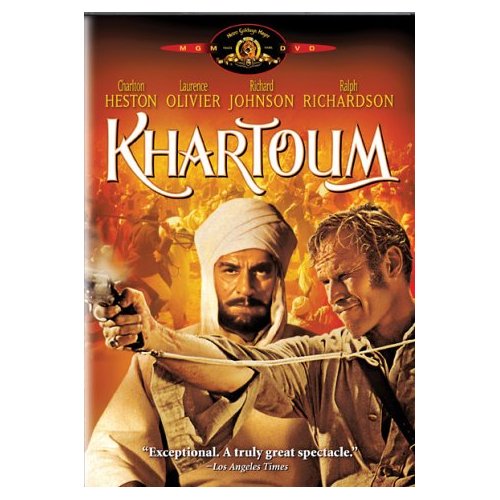
Fundamentals in Film: Khartoum

I’ve always been on the lookout for films with strong messages dealing with honor and character in this series for teen-age boys, and the stories can be fictional, factual or a bit of both. It’s a bonus, however, when we have a chance to see something of a historical nature that can also help us learn something about the world today. Last month our movie was The Wind and the Lion, a mostly historical story with some movie-making embellishments that provided a useful sketch of early 20th century geo-politics while still offering a rip-roaring adventure.

Afterwards the young men seemed to be interested in the Middle Eastern dynamics of that time and how these were still resonating today. Our next class is Thursday night and I’ve decided to follow up on that with a film I happened to catch on AMC right after Charlton Heston died: Khartoum. It’s an amazing and reliably accurate telling of Islamic jihad in the late 1800s that has striking, and sobering, parallels to today.

Here’s the set-up for the story: It’s the 1880s and most countries in the Middle East are under the influence, if not outright control, of one or another of the European nations. Egypt, supported by England, controls the Sudan, including the capital city of Khartoum. A few years earlier a British officer, Charles George “Chinese” Gordon, had been Governor-General of the Sudan and largely stamped out the slave trade in the country. As this had been the major industry in the land, the economy had subsequently tanked and in the hard times a religious leader, Muhammad Ahmad, proclaimed himself the Mahdi (Expected One) and rallied thousands to holy war to drive out the Egyptians and Europeans. He has early successes and England sends 10,000 men under General Hicks to put down the insurgency (Gordon had been recalled to England a few years earlier), but the Mahdi lures them into the dessert and then wipes out the entire command. This disaster is not well-received back in England where the government of Prime Minister William Gladstone is on shaky ground and the public is outraged at the loss of the expedition but also weary of foreign entanglements, especially on behalf of their Egyptian allies. While England and Gladstone want little to do with the Sudan, they need the Egyptians and especially the Suez Canal.

As portrayed in the movie, Gladstone (Ralph Richardson) wants to wash his hands of the Sudan but is experiencing pressure to rescue the Egyptian and European citizens in the city before it is overwhelmed by the Mahdi’s (Laurence Olivier) army. There is no way he wants to commit an army to that cause, however, so he charts a canny course of sending the hero Gordon (Heston) back, alone, to Khartoum to organize an evacuation. Gordon, a national hero with a string of successes in China as well as Africa, is known to be a difficult person to control because of his deep Christian faith and what some described as arrogance and mysticism. He nevertheless accepts the apparently hopeless mission, knowing that he’s being sent as a political gesture but also having an agenda of his own. It turns out he grew to love the Sudan and its people during his earlier duty and he couldn’t abide the thought of abandoning his city, or of England abandoning its allies, to the foreseen slaughter of the Mahdi.

Upon arriving in Khartoum he does evacuate some of the Europeans, but also sets about rallying the Egyptian troops and the citizenry to defend the city, while playing a brilliant but dangerous game of military, administrative and political chicken, simultaneously keeping the Mahdi at bay while hoping to hold out long enough for Gladstone to change his mind and send relief. While the movie sets up the primary conflict between Gordon and the Mahdi, it really is a 3-way battle with Gladstone showing his own determination and tactical abilities. The Mahdi, despite his own mysticism, recognizes the danger of turning Gordon into a martyr, as does Gladstone but for different reasons. Gordon knows that this is where he has them both. One of the great lines in the movie is when Gordon says, “Every man has a final weapon: his own life. If he’s afraid to lose it, he throws the weapon away.”

Both the Mahdi and Gladstone, again for their own reasons, try different ways to induce Gordon to leave. By this time, English public opinion is pressuring Gladstone to send a relief column to Gordon’s rescue. Ultimately Gladstone makes a big show of doing just that, marching a regiment through London to take ship for Africa, ostensibly to support Gordon but secretly ordered to move slowly in the hopes that Gordon will ultimately “see reason” and abandon his quest. I won’t offer a spoiler here on how it comes out (go to your history books if you want that), but the ensuing battle of wills between the three men, plus lots of real battles between armies, makes this a tense and gripping story with some interesting perspectives on the nature of power, the power of belief, and the designs of destiny.

The history is pretty solid in this story and the movie hews pretty closely to what is recorded. There are a lot of resources for historians to refer to, including the newspapers of the time, Gordon’s own writings during the 10-months of the siege, and the writings of Colonel Sir Rudolph Slatin, a contemporary and friend of Gordon’s who got to spend several years as the “guest” of the Mahdi himself.

Great Quotes:
William Gladstone: “I don’t trust any man who consults God before he consults me.”

Gen. Charles Gordon: “Every man has a final weapon: his own life. If he’s afraid to lose it he throws the weapon away.”

Gordon: “I’m known to be a religious man, yet I’m a member of no church. I’ve been introduced to hundreds of women, yet I’ve never married. I daresay that no one’s ever been able to talk me into anything.”

Gordon: “While I may die of your miracle, you will surely die of mine.”

About Fundamentals in Film: this series began as a class I taught to junior high and high school boys as a way to use the entertainment media to explore concepts of honor, honesty, duty and accountability. The movies were selected to demonstrate these themes and as a contrast to television that typically either portrays men as Homer Simpsons or professional wrestlers, with little in between those extremes. I wrote questions and points to ponder for each movie to stimulate discussion and to get the boys to articulate their thoughts and reactions to each movie. I offer this series here on this blog for the benefit of parents or others looking for a fun but challenging way to reinforce these concepts in their own families or groups. I’m also always open to suggestions for other movies that can be added to the series. You can browse the entire series by clicking on the “Fundamentals in Film” category in the right sidebar of this blog.

There must have been something in the airwaves

There’s a site called Grab.it TV that has collected the top 20 music videos from every week starting when MTV debuted all the way through Napster. If you go to the site you can check out what the most popular videos were for any week of significance to you in this time period and click on the links to watch these.

For example, my wife and I were married on October 10, 1986 (the week of October 4), and by checking out that week I re-discovered that the number one video just so happened to be “Happy to Be Stuck With You” by Huey Lewis & the News.

Not only that, but the weekly top 20 also included “Friends & Lovers” by Gloria Long & Carl Anderson, “When I Think of You” by Janet Jackson, “Two of Hearts” by Stacey Q, and “Love Zone” by Billy Ocean. There was also a song by my wife’s favorite actor at the time, “Heartbeat” from Don Johnson.

Also on the charts was “Heaven in Your Eyes” by the appropriately named Loverboy, “Take My Breath Away” by Berlin and “A Matter of Trust” by Billy Joel.

That was certainly an auspicious beginning for us, even if the list that week included “Throwing it all Away” by Genesis, “Walk This Way” by Run DMC/Aerosmith and “Didn’t Mean to Turn You On” by Robert Palmer!

A sign of the Apocalypse?

“I’d feel like a caveman, if they existed … and they didn’t.”
— Ned Flanders

A Boston University sociologist is undertaking a study to learn more about the “evangelical intelligentsia”.

Study to crack evangelical stereotypes
BOSTON, Massachusetts (AP) — For decades, Boston University sociologist Peter Berger says, American intellectuals have looked down on evangelicals.

Educated people have the notion that evangelicals are “barefoot people of Tobacco Road who, I don’t know, sleep with their sisters or something,” Berger says.

It’s time that attitude changed, he says.

“That was probably never correct, but it’s totally false now and I think the image should be corrected,” Berger said in a recent interview.

Now, his university’s Institute on Culture, Religion and World Affairs is leading a two-year project that explores an “evangelical intelligentsia” which Berger says is growing and needs to be better understood, given the large numbers of evangelicals and their influence.

“It’s not good if a prejudiced view of this community prevails in the elite circles of society,” said Berger, a self-described liberal Lutheran. “It’s bad for democracy and it’s wrong.”

My heavens, “…barefoot people of Tobacco Road who, I don’t know, sleep with their sisters or something…”?

“That was probably never correct…”?

Gee, Mr. Berger, did somebody beat you to the studies of Bigfoot and the Loch Ness Monster? Oh well, I suppose that wasn’t very Christian of me. Perhaps it makes me appear as sensitive as those cavemen in the Geico spots. After all, it’s not as if anyone’s ever done a commercial saying, “It’s so simple, even an Evangelical can do it.” So, okily-dokily, I’ll just bite my tongue and be happy that someone is taking an interest.

If you need me, I’ll be studying my the(ist)saurus, working on them big words. You know, just in case.

St. Sabine, St. Adalbert and St. Paul

One day last week I was driving home from work listening to Hugh Hewitt and he introduced an audio clip from a guest speaker at Obama’s church. Unbidden, my mind pictured a black guy.

Then Hugh said the speaker was Father Michael Pfleger; my mind then pictured “Catholic” and “white guy.” Then the cut played and the whispery voice and cadence of Fr. Pfleger spun my brain around again and I thought, “oh, a black guy.” (What really would have scrambled my brain was if the speaker – black or white – had said something I agreed with).

Then, last weekend, I eventually saw a photo of the priest and, lo and behold – a white guy. I had a bit of a laugh at myself and at how automatically our brains grab onto whatever clues it can to create a picture in our minds to help us try to make sense of things on the fly. The picture may not always be right, but without this processing trick our lives and interactions would bog down tremendously, and you could just about kiss off reading comprehension. And in a way, it makes life more interesting when your assumptions are confounded from time to time.

Anyway, I was reminded of this recent sensory experience again this morning when I read Mr. Dilettante’s post about his initial awareness of Fr. Pfleger years ago while living in Chicago, and then the connection Mr. D later made with another “activist priest” after moving to the Twin Cities. The post is only Part One of I don’t know how many, but I found the introduction very interesting and I’m looking forward to the next installment(s). Who knows what may be confounded this time? Check it out.

Update:
Michelle Malkin has the story of Fr. Pfleger being suspended for two weeks by his bishop in the wake of his remarks. Included is a funny photoshopping of Fr. Pfleger into Vanilla Ice. Word to your, er, Father.

American congregations giving record amounts to poor countries

American church congregations of all denominations — Protestant, Catholic, Jewish, Muslim and Hindu — gave $8.8 billion in private relief and assistance to the developing world in 2006 according to a recent study by the University of Notre Dame’s Center for the Study of Religion and Society and the Hudson Institute’s Center for Global Prosperity (CGP). According to the Institute, that amount from religious congregations was more than one-third of the official U.S. government aid of $23.5 billion.

“The study examines religious and development giving that goes directly to orphanages and schools and other efforts in areas such as Mexico and Haiti, as well as monies given directly to U.S.-based organizations such as the Red Cross and Catholic Relief Services,” said David H. Sikkink, associate professor of sociology and the Center’s director.

More than 50 percent of the congregations gave an average of $10,500 to U.S.-based organizations that are involved in relief and development efforts and more than 30 percent made donations directly to programs in developing countries. More than 30 percent conducted short-term mission or service trips.

Sikkink also pointed out that while congregations consider evangelism and service to both be part of a holistic ministry, the survey measured only expenditures for items such as food, clothing and medicines and excluded financial support for evangelism.

“The sample was randomly selected: it was diverse and in addition to mainline and conservative Protestant congregations, it included Catholic parishes, synagogues and Muslim and Hindu congregations,” Sikkink said. “It was also more ethnically diverse than earlier surveys, which had difficulty surveying low-income and African-American congregations.”

Among the findings from the study is that Catholics tend to work with U.S.-based aid agencies, while Protestants (particularly conservative Protestant organizations) work more directly with overseas programs.

Interestingly enough, a recent article (with a great graph) in The Economist about this high level of American private giving cites “An established culture of philanthropy and charity contributes to direct aid-giving, as does a generous tax regime.” (Emphasis mine). Aside from the inference that the U.S. government is “generous” in the amount of their own money it allows its citizens to keep, it belies the notion that Americans who think they can do better things with their money than the government can are “greedy.”

…Annnnd, we’re back

What was shaping up as a pretty strong weekend of blog traffic here, thanks to Manival #5, disappeared, literally, in a puff of smoke. My web host service suffered a fire in their facility, damaging its infrastructure but not the servers. This took all the served blogs off-line for (at least in my case) about 27 hours. I have not heard if there were any injuries or further details on the amount of damage to the facility (and I’m trying to find out), but I commend the team for devoting their weekend to getting the business back up and running.

Rub your burger to block cancer

As long as you rub it with rosemary or rosemary extract, that is.

To Block The Carcinogens, Add A Touch Of Rosemary When Grilling Meats
ScienceDaily (May 24, 2008) — Rosemary, a member of the mint family and a popular seasoning on its own, also has benefits as a cancer prevention agent. Apply it to hamburgers and it can break up the potentially cancer-causing compounds that can form when the meat is cooked.

J. Scott Smith found out about rosemary’s strength against the compounds while researching ways to reduce them as part of a long-term Food Safety Consortium project at Kansas State University. Smith, a KSU food science professor, has been looking into the carcinogenic compounds known as HCAs (heterocyclic amines).

“Put a little bit on the surface,” Smith advised grillers. “Rosemary extracts shouldn’t have much of an aroma to them. Most people don’t want a rosemary-flavored burger. So if you get the extract you don’t really know it’s there.”

The full article has details on the research and how and why the natural anti-oxidant properties of rosemary break up the formation of HCAs (heterocyclic amines), thought to be linked to cancer.

Similar studies have shown that marinating steaks with common, high anti-oxidant herbs and spices such as basil, mint, sage, savory, marjoram, oregano and thyme also reduces HCAs. These herbs and spices are on your grocery shelf, while rosemary extract is reportedly available on the internet.

I think this news definitely calls for some grilling this weekend; all in the name of science, of course!

HT: The Evangelical Outpost.