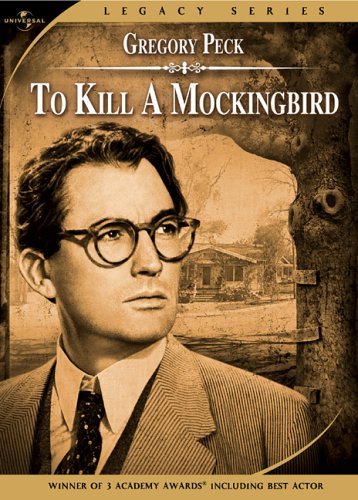
Atticus, we need you

Last week I featured “To Kill a Mockingbird” in the weekly Fundamentals in Film series on this blog. The main drama in that movie centers around a black man, Tom Robinson, on trial for raping a white woman. The man is defended by the main character of the movie, Atticus Finch. As I watched the movie again it got me to thinking about some the interesting parallels and juxtapositions between the movie trial and the seamy details surrounding the current rape case against the Duke lacrosse players.

My interpretation of these parallels does not mean I think the Duke players are innocent of rape as Robinson was innocent. The statements and disparagement of the evidence (and lack of evidence) proclaimed by the defense teams are interesting, but I keep in mind that these are the defense lawyers after all, doing their job while the prosecution has to play it closer to the vest. It is worth noting that while there has been a lot of attention focused on the alleged victim’s questionable past, it turns out that one of the defendents himself may not be a model of decorum either. This doesn’t mean that he or his friend are guilty, either. That judgment must still be played out, and will be in the eyes, ears and hands of the judge and jury that draw the case.

What I found interesting, however, is that implicit in the movie was the prejudicial “you know how they are” assumption by most of the whites regarding Tom and his fellow black men. Part and parcel of that was the belief that one didn’t dare doubt the word of a white woman, especially over that of a black man. Today the situation is reversed: I sense a distinctly implied “you know how they are” assumption about the privileged, white lacrosse players from an elite school. Meanwhile, politically correct doctrine says that of course you never doubt the word of a woman over a man. These are really just different drawers in the same chifferobe, where ugly things have been stuffed for generations. I would have hoped that if we had learned anything by now it is that no sex and no race has a monopoly on honor and innocence, nor is any free from having its own self-serving agendas and rationalizations.

In both the movie and in real life the defense tries to show the absurdity of the prosecution’s case. Atticus Finch, for example, demonstrated that the victim could only have been beaten by a left-handed man, while the defendent was unable to use his left hand as a result of a childhood farming accident. Today, the miracles of DNA testing, cell-phone photos and time-stamped ATM transactions go up against eye-witness accounts and whatever evidence District Attorney Mike Nifong has that has given him the confidence to pursue the case.

In both the movie and in the current events it is clear that something went on. The movie didn’t reveal just what that something was. It will be interesting to see if the same will be said of the upcoming trial. One thing that does seem the same in both cases, however, is that the person representing the interests of the black person (Finch for the defense in the movie, Nifong now) shoulders the most hostility. For everyone’s sake, what this circus needs is the quiet decency of a real-life Atticus on both sides but I fear that possibility left town the minute the first tv camera hit town, leaving the media to grow as fat and thick as ticks on a Carolina hound.

Of course, “To Kill a Mockingbird” was a story, while today’s story is all too real. The real difference for me, however, is that the movie reflected the fear of change. Today’s events reflect the fear that perhaps we haven’t really changed at all.

For the benefit of Mr. Kite (and Alice Cooper and Steven Tyler)… look away

The thing about the latter 1970s is that so much of the weirdness then can be easily attributed to drugs. Well, drugs and Jimmy Carter. Now when I look back on those times I often get the feeling that I’m revisiting an alternative universe. Lately I’ve been inclined to write these perceptions off as a matter of me getting older, while discounting the ready access to certain botanicals and pharmaceuticals back then. After some unfortunate channel-surfing over the weekend, however, I’m back to my original hypothesis.

Friday night I watched the last half of the 1978 “film”, Sgt. Pepper’s Lonely Hearts Club Band. Yes, I had full control of the remote and could have changed the channel or looked away, but there was an oddly compelling desire to look, such as what one gets when passing a road accident or a pro-illegal immigration rally. When I first saw the movie in a theater (what are these “movie rental” and “cable television” things you speak of?) I remember lamenting the experience as nothing more than the waste of $3, which I alternatively could have used to purchase half a tank of gas.

Now, looking back from the omniscience of my years I can see where this movie was the place where the fabric of the universe first took on the look of the frayed or torn blue jeans so common back then. Could it be more than coincidence that torn jeans are once more in vogue and this movie is circulating via satellite waves? (And for the record, kids, back in my day we had to work to get those jeans looking like that.)

I’m sure it seemed like a good idea at the time to movie executives to do a rock opera homage to the Beatles. Beatles music was still big, processed rock and roll was starting to rule the land, no dialogue would make it easier to cover up that no one could act and Peter Frampton still had three or four seconds left of his 15 seconds of fame. Peter Frampton? Lord, yes, the movie starred Peter Frampton, looking like he weighed 110 pounds and in all his white blond curls as if he was trying to channel William Katt in The Greatest American Hero, but with half the machismo.

Predictably the result was more homogenization than homage with casting trying to pull in as many popular icons of the era regardless of field or musical genre. Hence the film also features The BeeGees, George Burns, Steve Martin, Alice Cooper, Aerosmith and Earth, Wind & Fire. The BeeGees have the largest roles after Frampton, but I never could (or never bothered) to keep their names straight; to me they’ve always been Big Hair BeeGee, Missing Hair BeeGee and Blond Hair BeeGee. The trippiest performance, predictably, was Cooper singing “Because” while the best part of the movie was Aerosmith’s great cover of “Come Together” (and I’m not even that much of an Aerosmith fan).

To show just how much drugs (or money) were involved you only need to know that both Alice Cooper and Steven Tyler get their butts kicked by Peter Frampton. Yeah, right, like that could happen, especially since Frampton’s “moves” seemed to have been borrowed from the scene in “Blazing Saddles” where the men’s chorus fought with the cowboys, or perhaps Lauren Bacall trying to hit Edward G. Robinson in “Key Largo”. I don’t know how much they had to pay Cooper and Tyler (or with what) to go along with this indignity, but I hope for their sakes it was enough. I mean, it would have been more believable for George Burns to win the fight, or even Jimmy Carter’s Killer Rabbit who, apparently, wasn’t cast in the movie because he wasn’t famous until the following year.

As insipid as the movie was it somehow exerted a strong pull on me, not unlike what a kleenex must feel as it gets sucked down the toilet. Maybe it was the lateness of the hour and my fatigue, or the effects of some post-hypnotic suggestion I received in the 70s. The pay-off, however, meager as it may have been was the final scene when the producers pulled in every idle celebrity within a 10 mile radius of the studio for a group chorus of “We’re Sgt. Pepper’s Lonely Hearts Club Band,” shot to look like the album cover.

I was just about to turn the tv off when the camera started panning the pre-“We Are the World” assembly, challenging my ability to recognize these people from nearly 30 years ago. OMG, is that Johnny Winter? What’s he doing in this abomination? Rick Derringer and Nils Lofgren — what, did the producers have photos of you with teen-age girls? Wasn’t that Jackson Browne, or only Keith Carradine? Hey, there’s that other guy with my name, and Hank Williams, Jr! Bowser from Sha-Na-Na? They must have been offering free food at the recording session and he walked in. Whoa, there’s Heart from back when they were still good-looking, and a low-miles Bonnie Raitt! Leif Garret, go back to your room NOW, young man. They even had Dr. John and Robert Palmer in there, no doubt to ensure that no matter how stupid the filming was, the cast party was smoking.

I know, I know, I need to chill. I don’t know why this set me off, but I’ll just do what Alice Cooper and Steven Tyler do whenever they think of this and that is to repeat over and over, “It’s only a movie. It’s only a movie.”

Challenging Word of the Week: jeremiad

Jeremiad
(jer uh MYE ud) noun

A jeremiad is a tale of woe, a lamentation, a doleful complaint, a plea for compassion, deriving its name from the Lamentations of Jeremiah, the Old Testament prophet of the sixth and seventh centuries B.C. A book of the Bible attributed to him bears his name. He called for moral reform, threatening doom if his message went unheeded. It is the prediction of doom and disaster that we associate with his name. “How doth the city sit solitary, that was full of people! how is she become as a widow!…She weepeth sore in the night…all her friends…are become her enemies…Jerusalem hath greviously sinned…The joy of our heart is ceased…O Lord…wherefore dost thou…forsakes us…thou art very wroth against us.” Thus spake Jeremiah; but how very boring it can be to be forced to listen to the jeremiads of one’s trouble-prone acquaintances! Jeremiah is a name given to any person who takes a gloomy view of his times and denounces what is going on in the world.

My example: Oh, the jeremiads of the modern major generals (ret.)!

From the book, “1000 Most Challenging Words” by Norman W. Schur, ©1987 by the Ballantine Reference Library, Random House. I post a weekly “Challenging Words” definition to call more attention to this delightful book and to promote interesting word usage in the blogosphere. I challenge other bloggers to work the current word into a post sometime in the coming week. If you manage to do so, please leave a comment or a link to where I can find it. Previous words in this series can be found under the appropriate Category heading in the right-hand sidebar.

Friday Fundamentals in Film: To Kill a Mockingbird

Courage and integrity aren’t always demonstrated in the heat of battle or proved by some dramatic, attention-getting act. Often the best examples are those of quiet resolution by people who wouldn’t even grasp what all the fuss is about when their actions are honored. An excellent example is the 1962 classic film To Kill a Mockingbird starring Gregory Peck in the memorable role of Atticus Finch. (The role of Finch was voted as the greatest film hero of all time by the American Film Institute).

Most people know the story of the local lawyer who sometimes takes hickory nuts and collard greens in return for his services in the small, southern town of Maycomb during the Depression. Atticus is a widower with two young children, Jem, 10, and Jean Louise (called Scout), 6, who is asked to defend a black man accused of raping a white woman. The story is narrated as a flashback by the adult Scout and despite the town’s sleepy demeanor and the polite and respectful way most people addressed each other, there is an underlying creepiness that gradually builds the drama and suspense.

Despite having known tragedy in his life Atticus is a steady, unflappable man who tells his children, “You never really understand a person until you consider things from his point of view; until you climb into his skin and walk around in it.” When the local judge asks him to take the case of Tom Robinson, does so even though he knows that many in the town will be angry if he gives Robinson the defense he deserves and is entitled to by law. When confronted early on by the father of the alleged victim he holds his ground, telling the man, “I’ve been appointed to defend Tom Robinson. Now that he’s charged that’s what I intend to do.”

In the ensuing months leading up to the trial the pressure mounts both for Atticus and his family. Scout, quick to defend what’s right, gets into fights at school with children who criticize her father. When she asks Atticus why he can’t or won’t quit the case or let someone else handle it he tells her that he has to do it because, “If I didn’t, I couldn’t hold my head up in town. I couldn’t tell you and Jem not to do something again.” Ultimately he has to tell Jem, “There’s a lot of ugly things in this world, son. I wish I could keep them away from you. But that’s never possible.”

Some, such as his children, mistake his quiet demeanor as a sign of weakness, not realizing that it is the earmark of a man who knows he doesn’t have anything to prove to himself and unconcerned with what others may think about him (his earlier comment to Scout about being able to hold his head up in town had more to do with being ashamed of himself rather than ashamed of what others would say). He is resolute in doing what needs to be done, whether it’s defending Tom or shooting a rabid dog threatening the street where his children play. When he shoots the dog, in fact, he does so dispassionately and with a bit of regret. He reacts in much the same way later when he sits up at night on the steps of the jail, unarmed, to face down a lynch mob determined to drag Tom out and kill him before the trial can even start.

For those who haven’t seen the movie I won’t give away the ending, but suffice to say there are many challenges and suspenseful episodes with help late in the movie coming from an unlikely source. It’s a good message for a family, but perhaps too intense for younger members.

Questions to answer:

  1. Why do you think the judge asked Atticus to be Tom Robinson’s public defender? Why did he come to his house to ask him in person?
  2. Why did Atticus feel that if he didn’t defend Tom that he wouldn’t be able to ever tell Scout and Jem, “not to do something again”?
  3. Was there anything in common between the way Atticus dealt with the rabid dog and the way he defended Tom? (hint: think of what both had to do with his children).
  4. What did Atticus hope to accomplish (and how) when he went to the jail to gaurd Tom from the lynch mob?


Points to Ponder:

  • Though the story is set in the Depression-era south, do the same challenges exist today? What are they?
  • How are these alike and how are they different from what Atticus faced in the movie?
  • What role do men (and women) like Atticus play in our culture? What is the cost to them?

Great Quotes:
“Miss Jean Louise, stand up. Your father’s passing.”

“There are some men in this world who are born to do our unpleasant jobs for us. Your father’s one of them.”

About Fundamentals in Film: this series began as a class I taught to junior high and high school boys as a way to use the entertainment media to explore concepts of honor, honesty, duty and accountability. The movies were selected to demonstrate these themes and as a contrast to television that typically either portrays men as Homer Simpsons or professional wrestlers, with little in between those extremes. I wrote questions and points to ponder for each movie to stimulate discussion and to get the boys to articulate their thoughts and reactions to each movie. I offer this series here on this blog for the benefit of parents or others looking for a fun but challenging way to reinforce these concepts in their own families or groups. As the list of films grows each week, feel free to use these guides and to mix and match movies according to your interests or those of your group. I’m also always open to suggestions for other movies that can be added to the series. You can browse the entire series by clicking on the “Fundamentals in Film” category in the right sidebar of this blog.

Fun with story problems

The best part of math for me was the story problems; you know the “If Johnny has six apples and you have no apples, and the government takes three apples from Johnny so it can give you one apple’s worth of applesauce while putting another apple in a “lockbox”, what happens to the remaining apple?”

Today’s Fixit column (it used to be “Mr. Fixit” before the surgery) took me back to those happy schoolboy days when a letter writer asked, “Does it burn more gas and so cost more money if you drive 75 miles per hour to get to a destination than if you drive 60 mph?” as opposed to ultimately saving money by getting there sooner.

Fixit offers this example in response:

Bob and Jim each need to drive 60 freeway miles from City A to City B. Both cars get 30 miles per gallon at 55 mph, the posted speed limit.

Bob travels at 55, but Jim speeds and does 75 mph — wanting to get there sooner.

At 75 mph, it would take Jim about 48 minutes to reach the destination.

At 55 mph, it takes Bob about 65 minutes to reach the destination.

At 55 mph, Bob used 2 gallons of gasoline. At $2.80 per gallon, that’s $5.60 to drive the distance.

At 75 mph, Jim would use 2.5 gallons of gasoline. At $2.80 per gallon, that would be $7 to go the same distance.

Fair enough. Jim pays an additional $1.40 to get to his destination 17 minutes sooner. Maybe it’s worth it to Jim to pay roughly the cost of a tall dark roast at Starbucks (no decaf for him, thank you) so that he can do something else with those 17 minutes of his life. Certainly the StarTribune columnist wouldn’t want to get into judging someone’s lifestyle choices, right?

However, it turns out that Jim paid $155.60 for this trip and arrived later than Bob.

How did this happen?

He was ticketed for speeding on the way and was fined (which could raise his insurance rates), and the stop slowed him down. (If they had traveled together in Bob’s car, both would have saved even more.)

Hmmm. Funny that it didn’t mention how much the boys would have saved (but not the taxpayers) if they had taken light rail. Or the bus. Or how much more time those options would have taken out of their lives. Funny, too, that speeding ticket scenario was gratuitously added in as Professor Fixit stepped from the chalkboard and up onto the soapbox.

In the same spirit, let’s assume that Jim, driving at 75 mph and closer to the prevailing speed of the rest of the traffic than Bob, doesn’t get a ticket and that he and Bob are competitors on their way to call on the same prospect. Jim gets there first, makes the sale and is on his way out to lunch with his new client by the time Bob is easing into a parking space. Or, let’s say Bob is really delayed because of the beat down he received from the long line of angry drivers that got stuck behind him, not to mention the related medical expenses that further drives up the cost of his trip.

Oh, but there’s more:

By the way, federal income tax credits of $250 to $3,400 are available in 2006 and 2007 to purchasers of hybrid-electric or diesel vehicles, based on the vehicle’s efficiency and fuel savings. (Tax credits are dollars deducted from taxes owed.) Act fast. After each auto manufacturer has sold 60,000 hybrids, the credit begins to phase out. See www.ase.org/taxcredits for details. (Check out local excise tax reductions and other benefits for hybrid purchasers, too.)

I don’t think Fixit read the article by Jamie Lincoln Kitman in the same newspaper, Best way to save gas may be to avoid hybrids, or this report: Hybrids Consume More Energy in Lifetime Than Chevrolet’s Tahoe SUV.

Numbers are fun!

Crusted but cheeks?

That’s what leapt out at me this morning as I skimmed across a local restaurant’s ad in the Strib’s Variety Source section today. My brain said, “What?” At first I thought the this guy had started a food and restaurant column.

After slamming on my speed-reading brakes I backed up and looked closer. The ad actually was promoting “Asiago-Parmesan Crusted Halibut Cheeks.”

Oh. Well. That’s different.

All the same, I think I’ll check out the salad bar.

Small wonders

This isn’t a particularly deep or thoughtful post, but I saw something to make me roll out my Keanu Reaves impression: “Whoa.”

Z-blog cites the following from a LA Times article:

Last year more transistors were produced, and at a lower cost, than grains of rice, according to the Semiconductor Industry Assn. Moore estimates that the number of transistors shipped in 2003 was 10 quintillion, or 10 to the 18th power — about 100 times the number of ants estimated to be stalking the planet.

Wow, transistors are more plentiful and cheaper than rice — and they probably end-up feeding more people, too, when you think about how essential they are to everything we take for granted these days. I can’t think of anything that’s produced today — even food — that isn’t affected by the technology that solid-state transistors make possible. Furthermore, without them your iPod would be full of tubes and about the size of an old Victrola. (What’s also amazing about this story is that somewhere we have an estimate for the number of ants in the world).

Just like all of those ants, these little transistors are often overlooked. Still, it’s mind-boggling that they can be produced in such quantities and at such prices. Let’s hear it for markets and innovation!

Filings: The empty tomb?

Buffy Holt of Plain Simple English is in London and posted this exquisite photo from inside Westminster Cathedral at 3:00 p.m. on Good Friday. The image is peaceful and meditative but what I found most interesting is that the church is all but empty during the scheduled Celebration of the Lord’s Passion.

What made this so interesting to me was that I had been thinking a lot last week about our all-too-human instinct to take something transcendent and turn it into tradition, and the photo reminded me of something a friend of mine had said several years ago along the lines of how we start with a movement, turn it into a monument and before you know it it becomes a mausoleum. Such is the affect of the traditions of man on the things of God.

Though the picture was of Westminster Cathedral, I don’t single out any religion or doctrine for this fault because it is common to all men and women (though, biblically, you might be able to make a case that women are less susceptible). You could see it happening even before Jesus was crucified, such as the dinner in Bethany (Matthew 26:6-13) when the woman anointed him with expensive oil and was berated by some disciples who took Jesus’ teaching to care for the poor and fashioned it into an on-the-spot doctrine that missed what the Spirit was doing (though the woman didn’t). Later, at the last supper (John 13:1) Jesus went to wash the feet of his disciples and Peter at first refused because such behavior didn’t line up with his thinking of what was proper (though you’d think if the Lord wanted to do something a certain way these guys by now would have learned to let him). When Jesus tells Peter that he must allow it or have no part in Jesus’ plan Peter careened over to the other ditch, telling Jesus to not just wash his feet but his hands and head as well. Again Jesus had to pull Peter back from taking a simple idea and going off in his own direction with it.

Later, after Passover and the sabbath, Mary gathered embalming oils and spices and set off for the tomb to honor and preserve the body according to their tradition. Even though Jesus had told her and the disciples what was going to happen, she thought of him as dead. As much as she loved Jesus and grieved for him she forgot what he said and set out to do what she thought was right and necessary until the angel spoke to her and reminded her (Luke 24:5-8). To her credit, she quickly embraced the new reality and hurried to tell the disciples who, because they couldn’t wrap their minds around it, dismissed her words as idle tales (24:11).

The disciples at Bethany, Peter seated before the basin, and Mary with her spices were all trying to do what they thought was right and proper, and that is how most religious traditions begin. It is all too easy for us to become like the Pharisees, observing the law to the letter and missing the spirit of the law entirely. It does have a way of sneaking up on you, though. Even as individuals we quickly develop our own habits and customs in how we relate to God and try so hard to reason out the things we don’t understand that we, like the disciples on the road to Emmaus, don’t recognize Jesus when he is sitting right in front of us (Luke 24:30). I can say this with complete boldness because I know it applies to my life. I’ve found that if there’s anything more draining to my faith than the traditions of man it is probably the traditions of me.

Tradition can be good, of course. The Passover, for example, was of God because it reminded the Israelites of his mercy and provision, and the spilling of the blood of a perfect lamb on the door mantle to save the first-born foreshadowed the blood of the perfect lamb and the sacrifice of God’s first-born to save us. Nor is this to say that everything old is suspect and we need to go running willy-nilly after every new thing; one path may lead to stagnation but the other can lead to outright heresy. The fault in both is losing sight of Christ and his word and being too quick to add our own refinements based on our own reasoning or even our experience (“well, it’s always worked fine when I’ve done it like this before”). This eventually leads to our faith being in our habits and not in the source of our being, hence the movement becomes a monument and the monument eventually becomes a mausoleum. And there ain’t nothing but dead people in there.

Dogs of war

Buck Sargent’s April 15 post at American Citizen Soldier, quotes Lt. Colonel Dave Grossman from his book, On Combat: The Psychology and Physiology of Deadly Conflict in War and Peace:

If you have no capacity for violence then you are a healthy productive citizen: a sheep. If you have a capacity for violence and no empathy for your fellow citizens, then you have defined an aggressive sociopath — a wolf. But what if you have a capacity for violence, and a deep love for your fellow citizens? Then you are a sheepdog, a warrior, someone who is walking the hero’s path. Someone who can walk into the heart of darkness, into the universal human phobia, and walk out unscathed.

The sheep generally do not like the sheepdog. He looks a lot like the wolf. He has fangs and the capacity for violence. The difference, though, is that the sheepdog must not, cannot, and will not ever harm the sheep. Any sheepdog that intentionally harms the lowliest little lamb will be punished and removed. The world cannot work any other way, at least not in a representative democracy or a republic such as ours.

Still, the sheepdog disturbs the sheep. He is a constant reminder that there are wolves in the land. They would prefer that he didn’t tell them where to go, or give them traffic tickets, or stand at the ready in our airports in camouflage fatigues holding an M-16. The sheep would much rather have the sheepdog cash in his fangs, spray paint himself white, and go, “Baa.” Until the wolf shows up. Then the entire flock tries desperately to hide behind one lonely sheepdog.

Understand that there is nothing morally superior about being a sheepdog; it is just what you choose to be. Also understand that a sheepdog is a funny critter: He is always sniffing around out on the perimeter, checking the breeze, barking at things that go bump in the night, and yearning for a righteous battle.

Here is how the sheep and the sheepdog think differently. The sheep pretend the wolf will never come, but the sheepdog lives for that day. After the attacks on September 11, 2001, most of the sheep, that is, most citizens in America said, “Thank God I wasn’t on one of those planes.” The sheepdogs, the warriors, said, “Dear God, I wish I could have been on one of those planes. Maybe I could have made a difference.” When you are truly transformed into a warrior and have truly invested yourself into warriorhood, you want to be there. You want to be able to make a difference.

Buck goes on to describe how this description applies to the developing Iraqi army of motivated “sheepdogs.” The entire post, which includes several other riveting first-person vignettes from the streets of Mosul is well worth reading.

(HT: Technochitlins).

Challenging Word of the Week: ilk

Ilk
(ilk) noun

The common use of ilk is in the phrase of that ilk, and, correctly employed, has a distinctly limited use. It applies properly only when the surname of a person is the same as the name of his estate or the place he’s from. In a series of letters to The Times (London), Sir Iain Moncreiffe, of Easter Moncreiffe, Perthshire, signed himself “Iain Moncreiffe, Of That Ilk,” meaning “Iain Moncreiffe of Moncreiffe.” Quoting from British English, A to Zed (Facts on File, 1987) by this author:

A friend of the author named Hector Cameron was a Cameron of Cameron, and once announced himself over the telephone as ‘Cameron of that ilk.’ The uneducated (at that time) author, to his shame, ascribed it to drink. There are MacDonalds of that ilk (MacDonalds of MacDonald), Guthries of that ilk (Guthries of Guthrie) and so on. From a Sassenach misunderstanding of usage, ilk has acquired the meaning ‘sort’ or’kind’; used generally in a pejorative sense: Al Capone, and people of that ilk, or even (heaven forfend!) Freudians (or communists, etc.) and their ilk.

The use of ilk is now expanded to include “family,” “class,” or “set” as well as “kind.” Fowler says of ilk:

This SLIPSHOD EXTENSION has become so common that the OED (Oxford English Dictionary) Supp(lement) was constrained to add to its definitions ‘also by further extension, often in trivial use, — kind, sort.’

The COD (Concise Oxford Dictionary) calls it “vulgar.” Ilk is, via Middle English ilke, from Old English ilca. Incidentally, the adjective Sassenach mentioned above is defined in British English, A to Zed as follows:

From the Gaelic for Saxon, an opprobrious term used by Scots, and sometimes the Irish as well, to designate and derogate the English.

My example: While we might figuratively lump all fast food brands into a common group, grammatically only the red-headed clown can accurately describe himself as “Ronald McDonald of that ilk.”

From the book, “1000 Most Challenging Words” by Norman W. Schur, ©1987 by the Ballantine Reference Library, Random House. I post a weekly “Challenging Words” definition to call more attention to this delightful book and to promote interesting word usage in the blogosphere. I challenge other bloggers to work the current word into a post sometime in the coming week. If you manage to do so, please leave a comment or a link to where I can find it. Previous words in this series can be found under the appropriate Category heading in the right-hand sidebar.