In who’s words?

Amy Ridenour is among those wondering why Joe Biden is not experiencing the uproar and outrage over his demeaning remark about Indian-Americans that, say, a conservative radio broadcaster would receive in similar circumstances.

As Biden recently said:

In Delaware, the largest growth of population is Indian Americans, moving from India. You cannot go to a 7/11 or a Dunkin’ Donuts unless you have a slight Indian accent. I’m not joking.

I think the reason is obvious. Okay, two reasons. The second one being that given Biden’s record, everybody just assumes he stole the line from someone else; perhaps Archie Bunker.

Challenging Word of the WeeK: pismire

Pismire

(PIS mire, PIZ-) noun

A pismire is an ant, but the term has been applied contemptuously to a despicable individual. Robert Penn Warren, the American poet and novelist (b. 1905), used it that way, “What do you think I’d do with a young pismire like you?” Shakespeare knew the word. In Henry IV, Part 1 (Act I, Scene 3), the impetuous young Harry Percy, known as Hotspur, cannot bear to hear the name of Bolingbroke:

Why, look you, I am whipped and scourged with rods, Nettled and stung with pismires, when I hear Of this vile politician, Bolingbroke.

In the same play (Act III, Scene 1) the same Hotspur uses the word ant. In reviling Mortimer’s father, he says:

…sometimes he angers me With telling me of the moldwarp (mole) and the ant…

In the earlier speech, the Bard obviously needed a two-syllable synonym for ant. Pismire is derived from Middle English pissemyre (a urinating ant, based on Middle English pisse, urinate, plus obsolete mire, ant). A pismire, then, is a urinating ant, i.e., an ant exuding formic acid.

My example: From my time living in more southerly parts of the country I am familiar with a colloquial version of this word: pisant, or pissant. The meaning is the same, however, as I always heard it used (or used it myself) to describe someone who is an irritating nuisance. I don’t think any of us knew we were borrowing from Shakespeare or thought in terms of having formic acid released upon us (irritating but not very damaging), but we definitely knew that to use the word was to describe someone who was an irritant completely out of proportion to his or her significance, kind of like ….

Well, I’ll leave the examples this week to you. If you’d like to supply the name of your pet pissant, do so in the comments or include the word and the individual in one of your posts and send me a link so I can see it.

From the book, “1000 Most Challenging Words” by Norman W. Schur, ©1987 by the Ballantine Reference Library, Random House. I post a weekly “Challenging Words” definition to call more attention to this delightful book and to promote interesting word usage in the blogosphere. I challenge other bloggers to work the current word into a post sometime in the coming week. If you manage to do so, please leave a comment or a link to where I can find it. Previous words in this series can be found under the appropriate Category heading in the right-hand sidebar.

Report from the front lines at the Millard Fillmore Open Championship

Given the stereotype of bloggers as basement-dwelling cave fish, you might be surprised to learn that a goodly number of us emerged, blinking, into the light for an afternoon of golf Friday at Valleywood Golf Course in Apple Valley. The event was the second annual Millard Fillmore Open Championship (which goes by an abbreviation that I won’t use here to avoid attracting the porn-crazed), hosted by Learned Foot.

When you realize that golf is nearly “blog” spelled backwards, however, our interest in the grand sport is more logical. Actually, perhaps “golb” is a better description of the game my threesome played. There are good reasons, for example, why I am known to the golfing Jedi as “O.B. Juan”. My teammates, Triple-A and Surly Dave, meanwhile, can be compared to Jack Nicklaus (as in Bobby Jones saying of Nicklaus, “He plays a game with which I am not familiar.”) Triple-A’s readers won’t be surprised to learn that his tee-shots veer strongly to the right. Dave’s political leanings are harder to discern from his golf game since he seemed to favor left and right equally. His performance around water hazards, however, could be described as “Kennedy-esque”, so we may have to keep an eye on him.

Despite our adventures, we found ourselves on most holes waiting for the walking two-some in front of us to move out of range (vertically and laterally). Nevertheless, somebody two or three groups behind us called the clubhouse to complain about slow play and the ranger paid us a visit. The ranger thought it was somebody two groups behind us who had complained, which would mean it was Foot’s group, and it was Foot, therefore, that Triple-A assigned the blame. Up to that point Triple-A had been content to write the initials of the golf tournament into every sandtrap he encountered; now angered, at the next tee-box he used the seed/fertilizer mixture provided for filling divots to pour out a rude message for LF. And it was perfectly spelled.

I didn’t see enough of anyone else’s game to offer a comment, but I will note that Nihilist-in-Golf-Short-Pants showed up at the course wearing the same outfit as I: navy blue shorts and a white golf shirt. It was hard to tell us apart at a glance; the telling clue was that he was the one wearing dark socks. Meanwhile Bogus Doug, looking for a hobby to replace blogging, showed up looking like a contender for “Whitest Person in America”, but as he forgot his sunblock, was well out of the running by the 18th hole.

Afterwards we caravaned over to Foot’s house for German and Italian sausages and fireworks. Like Foot’s blog, the evening was explosive, highlighted by shrieking outbursts, fiery retorts (and reports), dramatic fizzles and nervous neighbors. Oh, and of course, there were the fireworks, too.

I can’t wait for next year!

Summer reading: The Shepherd of the Hills

In the hills of life there are two trails. One lies along the higher sunlit fields where those who journey see afar, and the light lingers even when the sun is down; and one leads to the lower ground, where those who travel, as they go, look always over their shoulders with eyes of dread, and gloomy shadows gather long before the day is done.

This, my story, is the story of a man who took the trail that leads to the lower ground, and of a woman, and how she found her way to the higher sunlit fields.

Traipsing the woods and hills of Missouri this past week and revisiting the depredations of the “bushwhacker” era on my ancestors, put me in mind of a book that has long been read for generations in my family, “The Shepherd of the Hills.” It is a stirring tale of romance, action and dark, even violent, secrets that weaves some important character lessons without being sanctimonious (well, maybe a couple of times). Set in the nearby Ozarks it was one of the first best-sellers in modern American literature and helped make its author, Harold Bell Wright, one of the most popular (if critically dismissed) writers of the first half of the 20th century. It also happens that this book was first released to the public on this day in 1907, 99 years ago.

It is a great book for all ages, but especially for young teens. I read it aloud to both my daughters when they reached a certain age and they loved it and were captivated by the story, but it will also appeal to boys and there’s plenty to think about for adults as well. Reportedly based on a true story (my grandfather had a copy of the book autographed by one of the minor characters in the tale) there’s a romance, but also plenty of action, and a deft and engrossing illumination of good vs. evil. Or, as the book itself says, “The story, so very old, is still in the telling.”

It is also the book that first put Branson, Missouri on the map as a tourist destination — long before anyone ever thought to plug an amp into a guitar or glue a sequin onto a coat.

Wright was a minister before turning to writing novels and the book has a profound but not obtrusive spirituality that sometimes borders on the worship of Creation over the Creator but offers an interesting insight into the timelessness of the story. At one point the main character, in one of the few “speeches” in the story, offers the following for those who might judge the quality of another character’s life:

“Here and there among men, there are those who pause in the hurried rush to listen to the call of a life that is more real. How often have we seen them jostled and ridiculed by their fellows, pushed aside and forgotten, as incompetent or unworthy. He who sees and hears too much is cursed for a dreamer, a fanatic, or a fool, by the mad mob, who, having eyes, see not, ears and hear not, and refuse to understand.

“We build temples and churches, but will not worship in them; we hire spiritual advisers, but refuse to heed them; we buy bibles, but will not read them; believing in God, we do not fear Him; acknowledging Christ, we neither follow nor obey Him. Only when we can no longer strive in the battle for earthly honors or material wealth, do we turn to the unseen but more enduring things of life; and, with ears deafened by the din of selfish war and cruel violence, and eyes blinded by the glare of passing pomp and folly, we strive to hear and see the things we hve so long refused to consider.

(He)knew a world unseen by us, and we, therefore, fancied ourselves wiser than he.”

Look the book up and you and your children will be glad you did. You can read it through to yourself in a few hours, or aloud in six or so. (Don’t settle for the movie version, though. I saw it and only the title and some of the names of the characters were familiar to me; the charm of the story was gutted.)

The hidden and unnoticed past: a “brush” with my ancestors

Near as anyone can remember, the last person buried at the Ficke Cemetery was carried in there in 1958, the year I was born. I don’t know how many cars, if any, may have been in the procession then but today we take two vehicles out to where my great-great-grandfather, George Marion West (see previous post) lies. My parents lead the way, and my wife and daughters are riding with me.

In many ways it’s a trip back into the past: memories my parents have of coming to this place, memories I myself have of similar trips to other grounds with my grandfather. Fittingly, we start our trip by driving on the old Route 66 before turning off on a succession of county highways named after letters of the alphabet. We pass through small communities such as Japan (pronounced “Jay-pan”) and Strain, before turning onto a smaller road named for what once was the Red Oak community. Red Oak leads to a gravel road, which itself merely covers the original Indian trail that made its way down to the Bourbeuse River. A centuries-old oak tree, deliberately bent so that it grew into a 90-degree trail marker, still points the way.

At a certain point past the marker tree we stop the cars and get out to apply liberal amounts of Deep Woods Off before embarking by foot along a path pressed into the tall grass of a wooded field by a tractor and hay-wagon. Along the way we see through a gap in the trees an almost surrealistic sight of white cattle standing in a flourescent-green pond. “I think this is it,” my father finally says, stepping down into a ditch and then up the bank to lift a single strand of barbed wire.

The woods beyond the wire at this point don’t look noticeably different from everything else that’s around, but we line up single-file to duck under the wire and proceed into the leafy darkness as if on safari. There is no path, and our eyes constantly switch from looking at the person in front, to looking down for a place to put our feet, to looking up again to make sure a branch isn’t snapping back into our faces. There’s supposed to be a cemetery here?

Sure enough, within a few minutes my parents have found a tall, columned monument rising high enough out of the sumac and other weeds and saplings to where it can be more easily seen. Even at that it takes a few moments for its outline to become clear; using the monument as a reference point we begin to see other, smaller shapes emerging from the shadows, brambles and tall grass around us.


Stepping carefully, holding back or pressing down saplings, we all move slowly, sometimes almost losing sight of each other in the foliage. My parents know the general direction to find the stone over great-great-grandpa George and two of his wives. His first wife was a Ficke, which was what brought him back to this place. Her name was Henrietta and she bore him two children before dying from complications from the birth of the second, who turned out to be my great-grandfather, William. She would never know her son, but I would eventually meet him a couple of times (so I’m told) when he was much, much older. George and his second wife, Martha, would have 11 children, but I have to admit to some favoritism for Henrietta, who died young, for bringing William into the world and, hence, my grandfather, my mother, and me.
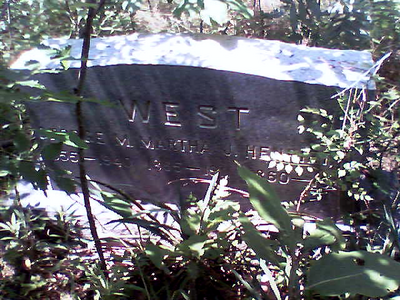
The single stone for George, Henrietta and Martha is large and relatively easy to spot; other markers are smaller and harder to see. Most difficult to see, and to look at, are tiny headstones for infants and children. We’re here on July 3, and my wife finds a small stone for a child who lived from July 4 to August 3, 1892. Regardless of size, all the stones we come across face to the east, in the direction from which their saviour will return.

It’s a bright, sunny day and very hot, but there’s an eerie quiet and stillness in this place, far away from everything else and virtually untended for who knows how long. There’re probably more than 100 people people buried here. You think about the ghosts that might be lingering, and then you don’t have to just think: you can see them.


Two faces stare out from the white circle, mute witnesses to time passing by.

Looking again at the large monument we first came across we can just make out the faded faces of a husband and wife etched into the upper part of the granite, fading from sight and probably from memory.

Something else is missing. When we find the main gate of the cemetery my mother is certain that there once were large stone columns and an arch marking the entrance. A rusty, metal gate among the briars is all that is there today. Her memory is probably correct, though, and the arch may stand on someone else’s farm or resort today, or rests at Restoration Hardware.

Earlier, on the ride out here, my wife had wondered how many cemeteries there might be in rural Missouri that had disappeared from the memories of those alive today. There’s no answer to that, but I told her that, except for this trip today, the memory of the Ficke Cemetery in my family would have passed with the generation in the car ahead of us. Now, two more generations know of it and have walked (unsteadily) on its grounds. I don’t know what that is worth, or what it will mean, but I think I will be back at least once more.

My father is talking about coming out here again in the fall, after the frost and the cold have made it easier to see the ground. He knows a couple of men with connections to the people buried here and thinks that with light chainsaws and some people to drag the brush away the site can be cleared enough to make it visitable for a few years. I offer to come down early on Thanksgiving week and he thinks that might be a good time to do it. I suppose to some people such a project might appear as useless as leaving a perfectly good stone arch hidden in the woods where no one could appreciate it. Certainly the dead don’t need a fancy portal to their burying grounds, or care if the brush is cut back over them. That doesn’t mean that there isn’t some need or appreciation for these things from the living, however. Something inside me, anyway, says this is just the right thing to do. Moreover, it’s not a chore but something I want to do. Though I have never met anyone buried here, if they hadn’t lived, and met, I wouldn’t be here.

I know only the sketchiest details about the lives of my ancestors and have nothing but my own imagination to picture the lives of the others here, but there’s still a kinship. When we’ve cleared the grounds this fall I’m sure I’ll pause at the end of the day beside a newly visible headstone and, like them, turn my face to the east and think about eternity.

Update:

My earlier musings on Memorial Day and rural Missouri cemeteries can be found here.

4th of July: Forefathers

We’re visiting my folks for the holiday, and right now we’re about to go out in the country to Red Oak to try and find the cemetery on what was the old Ficke farm and to check on some ancestors. My great-great-grandfather, George Marion West, married Henrietta Ficke in 1878, but she died of complications after giving birth to my great-grandfather in 1881. George would outlive two more wives (the second, Martha Brown, bore him 11 children) and is buried beside Henrietta and Martha at Ficke. I have a picture of him that I’ll scan and post in the next day or two.

George died 18 years before I was born, but my grandfather would tell stories about him. One of the things my grandfather often talked about was how his grandfather George could remember being five years old and his father, John, waking him up to say good-bye because he had enlisted in the Union army to fight in the Civil War. Great-great-great-grandfather John West died of pneumonia at Vicksburg, and George never saw his father again.

In his later years, my grandfather (another John West) would write a brief memoir of his grandfather. In thinking back over the hard times and trials that have made this country, it seemed like a good day to share a slice of a long ago life and death.

George Marion West
by John West

Grandpa George was nearing the age of sixty when I was born. From memory he was a large, robust man. Circumstances played a role in my getting to know him in his later years. The last days of his life were spent in our home.

On rare occasions he would engage in conversation about his boyhood life. It was seldom that he discussed events that pertained to himself and never in a boastful manner. He was a congenial “man’s man”, however children were not drawn to him for reasons that cannot be explained. He never showed anything but kindness toward children. His father left home to enlist in the army when he was about five years old and he never returned. Grandpa George never forgot the experience of his father’s leaving their home on the Bourbeuse River to go away to war. He spoke with sadness of the memory even in his last years. He had memories of the war as it affected the home life of the people in the community where he lived. There was conflict between neighbors and frequent raids by Bushwhacker elements resulting in the loss of livestock and anything of value in the homes. There were frequent skirmishes that resulted in loss of life.

In the early years of his life most every family experienced hardships in everyday living. Grandpa George perhaps suffered more than a fair share of such experiences. He grew up fatherless in a period of extreme poverty that was made worse by the long-suffering that was brought on by the war. In his words, he was “kicked from pillar to post,” living and working hard wherever food and shelter were available. He worked during all seasons clearing land and planting crops on the Bourbeuse River. His rewards were food and shelter.

In the year 1941 through coincidence I met a gentleman in Owensville, Missouri who grew up from childhood with Grandpa George. The gentleman’s name was Homer Michel. Mr. Michel was in his late 80s and very alert. He and Grandpa George were near the same age. They were from the Bourbeuse River communities of Walbert, Strain and Champion City. Mr. Michel described Grandpa George as being a rough and crude young man in his teen years. He was large and robust with extraordinary strength. Typical of the times, many disagreements were settled by fist-fights and Grandpa George always accounted himself well in such fracases. He could be a mean man physically when circumstances warranted it and the “bullies” of the community were content to let him be. At the same time he was respected throughout the community for his kindness and honesty.

In a rare exchange with Grandpa George I recall asking him if he had ever had a fist-fight and, if so, had he ever been whipped. He told me that everyone had fist-fights when he was a lad. He seemed proud to admit that he had been whipped once. The story, as he related it, was that he had got the better end of fights with two grown men in separate fights. He was no more than 18 or 20 years old at the time. The two of them together teamed up on him at night and beat up on him. he did not think they fought fair. They used “lap” rings for knucks and managed to pull his shirt up over his head and one of them held him while the other poured it on. He carried and wore with pride several scars on the back of his head that he used to remind himself that fighting was poor business.

Unusual circumstances prompted Grandpa George to move his family and home from Franklin County to Crawford County. Legend has it (Grandpa George never related the story to me), that a farm trade was made between Grandpa George and a friend wherein the exchange was made on an even-up basis with no money or other consideration involved. The reason behind the exchange was that the friend who owned and occupied the farm in Crawford County was involved in a serious feud with his neighbor on an adjoining farm and the problem had become so acute that lives were in jeopardy. The feuding neighbors were more than just neighbors, they were also brothers and each was a friend of Grandpa George. The exchange of farms solved the problem. Grandpa George was rewarded by acquiring a farm that was considered much more valuable than the one he exchanged for it.

Lengthy conversations were not a habit and were always to the point, using a minimum of words. He appreciated humor in moderation when circumstances were better served by it. He was not an emotional being. Happiness or sorrow were seldom expressed outwardly beyond a stoic acceptance of the situation at hand. He was an orderly individual. His home, farm equipment and farm animals were well cared for. Neatness was a virtue.

In spite of being handicapped due to a lack of formal education, Grandpa George progressed from poverty to prosperity during his active years. His compassion for ungrateful members of his family reduced him to poverty again before his death. His last years were spent in declining health and, against his independent nature, he was forced to depend on others for daily care. During this period of illness he never complained and displayed quiet dignity. He died January 12, 1940 and is buried in the Ficke Cemetary at Walbert, Missouri.

Next: the hidden and unnoticed past.

Bumper stuck

Our family drove to Missouri for the holiday today. On the highway we overtook a car with a bumper sticker that said:

Men are idiots. And I married their king.

“I bet she’s real easy to live with,” my wife said. “Not like me. Then again, I’m not married to the King of Idiots.”

“Well, no,” I said, “but I am 27th in the line of succession.”

“Well that’s really something,” she said, brightly. “I bet some of those guys ahead of you have got to be pretty old, so you could be moving up if they die, say from natural causes.”

“Or if their wives throttle them,” I said.

“Sounds pretty natural to me,” she said.

Friday Fundamentals in Film: Boys’ Night Out #5 – Glory

I had a coach and gym teacher back in junior high school that used to call us guys a bunch of “Yo-yos”. We knew that wasn’t a good thing, but it also seemed like kind of a silly insult. Now that I’m about the age he was, and have deliberately subjected myself to the company of 13-to-15 year old boys, I know exactly what he meant by the term.

These kids can’t sit still, and bounce around mentally just as much and as fast as they do physically. You can get their attention, but it’s like having it on a string; it constantly goes off in different directions and has to be pulled back. Similarly my own experiences with them are up and down. I’ve gotten involved because I want the lads to be of future benefit to society, but there are times when I think society might be best served by me drowning them in the river. Then there are times…

Last night we got together to watch Glory, the movie about the black regiment, the 54th Massachusetts, during the Civil War. The movie quickly got their attention (exploding heads in the opening scene will do that) and it appeared they were soon caught up in the story, even taking the unusual steps of raising their hands to ask questions about what was going on at different times in the movie. I’d stop the movie and answer the questions, giving them additional history about the Civil War and the politics of that time and using the opportunity to point out contrasts between different characters and how the actions of various men reflected their thoughts, assumptions and expectations (good and bad) of their fellow soldiers.

The boys became so engrossed in the story that they started offering exclamations and commentary when certain things happened on the screen, showing their own frustration with what the men in the movie were experiencing. When the 54th arrived in the South and was put to work felling and hauling timber one of our young men made the observation that, “They’re still just like slaves!” At the end of the movie when the written epilogue revealed that the fort the men had sacrificed themselves to storm was never taken, another young man exclaimed, “What a waste!”

This was an excellent opening into discussing the movie, because I could ask him why he thought it was a waste. His response was because they had been killed with nothing to show for it; I asked the rest of the group if that was true, which led to some good responses as they started to grasp the significance of the “blood sacrifice” the regiment had made toward earning the respect of the nation for themselves and for their people. We also spent a long time talking about the dynamics of the flogging that one character received in the movie and whether or not it was “just”, what it “cost” different people in the movie and whether it served a greater good. It was a very interesting discussion with some saying it was a racist act, while others saw the need for discipline to be enforced for the benefit of the regiment.

The boys were energized by the movie, and I was energized by their interest and the quality of their questions and answers and by the way they listened to the observations from the dads in the group. Before the movie started I had told them to watch for how different people had different expectations about the soldiers (even among the soldiers themselves) and how these expectations were reflected in different actions…and led to different results. A key thing I wanted them to understand is that “hard” doesn’t necessarily mean “bad” and that “no pain, no gain” doesn’t just apply to one person at a time. (Click on the link earlier in this post to see the original study guide and questions I use with this movie if you want to know more).

It was a good for me to review the lesson on expectations as well. Both the men in the movie and the boys in the class have to deal with the expectations — positive and negative — of others. Whether the boys made the connection or not, they, too, are judged by others simply because of their age and the “expectation” of their behavior. Sometimes they are dismissed as uncontrollable and barely human; other times they are held to an idealized and unrealistic standard; often the person holding both of those attitudes is myself.

What the men of the 54th needed, and what these boys who will be men are needing, is to be seen for the value that they have and for what they will be. Training can be hard and unpleasant for all concerned, but training exercises are a piece of cake compared to the real-life lessons that await. We do them no favors by thinking of them as just so much fodder to be thrown away, or by cutting them slack now out of mis-placed pity for how tough things are going to be for them later. Thinking back to my own days as a “yo-yo”, I can see the difference others have made in my life.

A graduation present

Time of passage,
time is passing,
the leaves are here and gone.
Turn the page,
start an age,
and hear the faint old song.

Distant rhythm,
always driven
like the thread that weaves the linen,
Soft but binding,
knit but winding,
what wondrous cloth we’re given!

Go and come back,
give and get back,
but never the same again,
Familiar sights,
seen in different lights,
are like old but distant friends.

Momentous starts,
kept in our hearts,
guide all our decisions,
While faith and fate,
will always wait,
to shape our future missions.

Experience counts,
but in different amounts,
by the memories it’s based upon,
So pick and chose,
for you’ll win and lose,
with those that you take on.

But as you go,
please always know,
we can’t change our view of you,
With love and pride,
for what’s inside,
and all that you will do.

– John Stewart

Hey, what’s a Sitcom?

Hello, Tiger Lilly here. Most unfortunately, I have been tagged by the evil Kevin for the “What Sitcom Character Are You?” thingamajig. Since I’m not allowed to watch sitcoms (I know, I lead a very sheltered life – the only one I’ve ever seen a little part of was Everybody Loves Raymond), I have decided to use someone from the awful, disgustingly-so-ugly-it’s-nastily-cute show, Spongebob Squarepants.

GAAH! I hate Spongebob, but it’s the only thing I can think of right now. Anyway, my Spongebob character would be Sandy Cheeks. Why? Because…well, see…it really…o.k, you’re just going to have to take my word for it. We do, unfortunately, have a couple things in common:

1. We both know some form of Karate.
2. We both can’t breath underwater.

Don’t ask for anymore. Spongebob is too stupid to even think about right now. It’s like The Three Stooges. When I first saw that, I had to go upstairs crying because it was soooooo stupid, I couldn’t even understand what was going on in their stupidity. I don’t even remember what episode it was, because I have wiped it from my memory to make room for more sensible things. Grr….

Ciao for now!