Friday Fundamentals in Film: Gene Kelly

I’m going to take a little bit of a different approach with this FiF entry in that I’m not going to delve so much into the character themes in a particular movie, but I do want to call your attention to some treasures you might be overlooking.

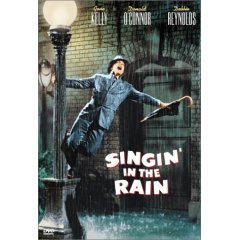
I was doing some channel surfing the other night and came across Singin’ in the Rain on the Turner Classics channel. It was close to the beginning of the movie and I’d only ever seen snippets of the film, so I put the remote down and the Mall Diva and I settled in to watch. I’ve always liked Gene Kelly’s athletic dancing style and good-guy persona so I expected to enjoy the movie. What I didn’t anticipate was how much the Mall Diva would like it!

The phrase, “they don’t make them like they used to” definitely applies to Singin’ in the Rain and similar movies of that era that used the story mainly to create a link between one singing and dancing number and the next. For that matter, the singing and dancing didn’t even have to have much to go with the movie or the story at all and this is especially true with Singin’ in the Rain (even the title of this movie has very little to do with the story itself; I think it mainly serves to let you know that this is the movie with the great sequence of Gene Kelly dancing down a city street in a rainstorm). That just serves to make the movie even more of a refreshing change of pace from today’s films. Of course, it helps a great deal that the singing and dancing itself is exceptional.


They don’t make them like that anymore — and they don’t need to because they did it right the first time.

Kelly, as I’ve said, is brilliant but SitR also features a young Debbie Reynolds and a truly amazing performance by Donald O’Connor. I didn’t have much of a conception of O’Connor other than his later “Frances the Talking Mule” movies so it was an unexpected delight to see what gifted singer, dancer and physical comedian he was. The Diva and I laughed outloud at several of his antics, especially in his tour-de-force performance of “Make ‘Em Laugh”. While the plot of the movie is a puffy confection, the entertainment value is very high. If you haven’t seen SitR, don’t dismiss it as being an “old” movie; I think you’ll be as delighted in the experience as my daughter and I were.

Also, I referenced Kelly’s good-guy persona earlier. I’ve watched several of his movies and always liked his characters (though they were usually just variations on the same). He always played a decent, honorable guy that you couldn’t help but root for. Also, from what I’ve read about him, it sounds as if Kelly was a decent and stand-up guy in real life as well. One of the pleasures of watching some of these old movies is that they could (and did) feature nice guy heroes without feeling an obligation to add some character flaw to make him “real”. Okay, that may be necessary in dramas, but I can appreciate good schmaltz, too (which reminds me of the “Schmaltz Waltz” number in Kelly’s An American in Paris. In fact, a Gene Kelly trilogy of Singin’ in the Rain, An American in Paris and Brigadoon would be a nice collection for a film fan’s shelf (tough as it is to leave out Anchors Aweigh or On the Town).

I’m not saying that all old movies are great and all new movies are crap; there’s good and bad in every era. Truly good things, however, transcend eras and hold up. If you want an entertaining and uplifting diversion that leaves you feeling good about yourself and others then I highly recommend these three films.

“Leaf us alone,” head of lettuce group warns

Des Moines, Iowa – “It was the worst experience of my life,” said Cyrus Greenleaf, head of Vegetables Entitled to Respect and Green Equality (VERGE) after he and several other heads of lettuce, as well as several pounds of spinach and green onions, were abruptly tossed from a local grocery store after shoppers and USDA officials became concerned that the group was potentially carrying E.coli bacteria.

Consumers have been on high alert lately following recent news stories and studies linking green vegetables such as lettuce and spinach to E.coli outbreaks. Speaking on behalf of his group, Greenleaf claimed that he and his friends were victims of “veggie-profiling” and that they were being singled out for “traveling while green.”

“This is obvious vegetarianism,” he said. “The public and the administration gets its undies in a bunch and suddenly it’s ‘E.coli this’ and ‘E.coli that.’ It’s simply easier to blame somebody than to address the root causes. I blame the American culture; people in this country learn to hate green vegetables when they’re young and then when they get older you shouldn’t be surprised when their prejudice crops up. Green vegetables are peaceful and nutritious; these latest charges are harassment, plain and simple.” Greenleaf indicated that the group may seek redress in the courts.

While definite links between vegetables and illnesses such as E.coli, salmonella and hepatitus have been discovered, there is still some uncertainty about the organic nature of the threat, even among government officials. For example, when asked recently whether lettuce or spinach posed a greater threat, incoming chairman of the House Intelligence Committee, Silvestre Reyes, said, “I don’t know, I have a hard time telling one from the other.”

Meanwhile, both the FDA and the USDA encourage consumers to be alert, saying they are the best line of defense against E.coli attacks and other terra-ism. “Not all vegetables have E.coli, but all the latest E.coli carriers have been vegetables,” said Brad LeBeouf, a spokesman for the USDA.

Oooo, we wants it


Hat tip to Port McClellan for calling my attention to Steven Pressfield’s book The Afghan Campaign, a historical novelization of Alexander the Great’s war in Afghanistan and part of the Claremont Institute’s annual Christmas Book recommendations. I loved Pressfield’s Gates of Fire novel about the battle of Thermopylae and I admired his story-telling craft in his book Tides of War, though I never warmed to its main character, Alcibiades. (Pressfield also wrote the charming and somewhat mystical book, The Legend of Bagger Vance.)


I am totally up for reading his novelization of Alexander’s misadventure among the Afghans — and why shouldn’t I be? Here’s Claremont president Brian Kennedy’s description of Pressfield: “Think Victor Davis Hanson meets Mark Helprin.” Helprin is my favorite author and VDH is working his way up my list. I trust Pressfield’s research and attention to detail, and the subject is very topical. I look forward to putting this book “On the Nightstand”.

Filings: Warp factor

Yesterday’s post about extremism and the ensuing comments got me to thinking again about the culture wars. I remembered how my family used to make it a point to watch “Star Trek: the Next Generation” when there were still new episodes. We loved the characters and the writing, the imagination and the mostly discrete sexuality of the show. It also had a very edifying vision of human virtue and potential.

The only problem I had with the program was that this vision of human potential was based on the Secular Humanist views of its creator, Gene Roddenberry. Yes, we would all like to live in a world where everyone demonstrates love, joy, peace, patience, kindness, goodness, faithfulness, gentleness and self-control as the characters in ST:TNG did. Roddenberry, however, saw this occurring through self-directed human evolution while I, as a Christian recognize these traits as fruit of the spirit imparted by God and developed through a personal commitment to renew my mind as I transform myself in order to be more like Jesus.

It may appear that the Christians and Humanists have a similar vision. There is a difference in how we go about fulfilling that vision, however.

As a Christian, I use God’s word as a standard to strive for and measure myself against. It’s not based on feelings, polls or my own thoughts about what is right and what is wrong. Today’s culture may hold out a vision of ennobling evolution — while at the same time saying that any type of standard (except for their own) is merely a prejudice. Maybe that’s why I as Christians can hope to see a change in myself within my lifetime, while Roddenberry’s super-humans don’t get it until the 25th century.

I see the human soul as being made up of our mind, will and emotions — and as being something that needs to be disciplined in order to exalt God. It seems to me that Humanists see the soul as the thing to be exalted – and that excellence can be achieved by indulgence. My focus is to improve the individual so the individual can effect society; Humanists try to change society so that it can affect the individual. They label as intolerant, unprogressive and “out of the mainstream” any discussion of morality when it comes to personal behavior and responsibility (except when they refer to what you do with your wealth and private property). Meanwhile, you can do whatever you want with your body, or whoever else’s body you can get to along with your program.

Let me, finally, get to the point. Despite my self-indulgent and even extremist rant, the Humanists are really irrelevant to a Christian’s own spiritual growth. Sure, they may pollute the culture with their illogical approach, but even if we “win” the cultural and political war we gain little but breathing room. That’s because Christ’s example is always from the “inside out.” While I would like to see a day when the culture around us is more wholesome, that in and of itself will not release us from our spiritual obligation to become more like Christ and to continually work out our salvation. In fact it may even invite a complacency that could be terminal — to us and ultimately to our culture.

Our individual commitment to tending the fruit of the spirit in our own lives — and to helping these develop in other people’s lives — must be unchanged regardless of what is going on around us, no matter how good or how bad it looks. We cannot look back longingly for “the good old days” or wait expectantly for the wonders of the 25th century because Christ is the same yesterday, today and tomorrow. “What would Jesus do?” is the wrong question. Better for me to ask, “What is Jesus doing?” and make sure I’m a part of it.

Filings is an ongoing section of this blog where the posts focus specifically on issues of Christian life. The name comes about because “filings” are the natural by-product of Proverbs 27:17: “as iron sharpens iron, so one man sharpens another.”

Extremely interesting

I recently acquired a book entitled “A Year With C.S. Lewis” which features short, daily excerpts from many of his great works. I thought this morning’s excerpt was especially apt.

It’s from The Screwtape Letters, the book where Screwtape, a senior demon in Hell, counsels his young nephew, Wormwood, on how to best distract and deceive the human he’s been assigned. This particular missive focuses on the value of extremism in faith … or by extension, politics…football…blogging…

To the Extreme
Screwtape explains the usefulness of extremism:
I had not forgotten my promise to consider whether we should make the patient an extreme patriot or an extreme pacifist. All extremes, except extreme devotion to the Enemy, are to be encouraged. Not always, of course, but at this period. Some ages are lukewarm and complacent, and then it is our business to soothe them yet faster asleep. Other ages, of which the present is one, are unbalanced and prone to faction, and it is our business to inflame them. Any small coterie, bound together by some interest which other men dislike or ignore, tends to develop inside itself a hothouse mutual admiration, and towards the outer world, a great deal of pride and hatred which is entertained without shame because the ‘Cause’ is its sponsor and it is thought to be impersonal. Even when the little group exists originally for the Enemy’s own purposes, this remains true. We want the Church to be small not only that fewer men may know the Enemy but also that those who do may acquire the uneasy intensity and the defensive self-righteousness of a secret society or a clique. The Church herself is, of course, heavily defended and we have never yet quite succeeded in giving her all the characteristics of a faction; but subordinate factions within her have often produced admirable results, from the parties of Paul and of Apollos at Corinth down to the High and Low parties in the Church of England…

Wombs with a view

Football wasn’t the only thing on the tube yesterday as I found myself pulled away from ESPN and NFL Network game highlights to watch the National Geographic Channel’s program, “In the Womb: Animals.” Using the latest 4D ultrasound imaging, state-of-the-art cameras and computer graphics the 2-hour program took us through the stages from conception to birth of yellow labradors, elephants and dolphins as they developed in their mothers’ wombs.

The elephant goes from a single cell to a 260+ pound “baby”; the dolphin learns to swim before it is born and the dog also showed full-grown dog behavior while still in utero. The film work, showing color and movement, is spectacular and engrossing (and sometimes just gross, based on some of the Mall Diva’s reactions). When you see the amazing close-ups and sharp detail of these developing species it is impossible not to think about the implications if the National Geographic Channel should devote the same study to comparable stages of human babies — pardon me, fetuses. As I watched the program I even thought outloud how great it would be if they used the same technology to cover human development, but I figured that would be anathema to contemporary thought and too controversial. Still, I was happy that this program was available as it couldn’t help but make anyone watching it pause to think.

I was therefore pleasantly surprised — nay, thrilled — to learn that NGC in fact had already kicked off their series back in November with a study of human infants in the womb, and is planning to carry another “In the Womb” program in January featuring the development of human twins (maybe even triplets), including film of the unborn children playing, fighting and cuddling. (More details here). I’m definitely going to check my listings for repeats of the first show and the broadcast schedule for the upcoming one.

The footage in these programs is absolutely devastating to the “blob of tissue” arguments that persist mainly because people don’t want to — or haven’t been able to — see the truth for themselves. There’s also something else in last night’s program that was plain to see: intelligent design.

While the narrator went on and on about evolutionary development and millions of years of random coincidences that led to these “miracles of birth” in each of the animals, when you see the process up close like this — and give it even a moment’s thought — it’s impossible (for me, anyway) to believe each of these tiny but crucial steps could have happened by accident. For example, how does a dog’s uterus “know” how to contract in such a way as to place and attach each puppy embryo an equal distance apart inside its walls? Yes, I know what the evolutionary models (and the narrator) say, but to cling to that despite the evidence of my own eyes seems to require an even greater leap of faith than what my superstitious mind is accused of making. But that’s just me; you can come to your own conclusions. The important thing is that you take the time to watch this incredible series for yourself.

Note: how detailed is 4D ultrasound imaging? Here’s a sample (the images and in utero photography on the NGC program are even more dramatic). You can see more images like this over here.

Three reports shoot down “Flying Imams”


Given the prominence of this story I thought this latest development would be all over the media, but I didn’t see anything about this on the Fox, CNN or New York Times main web pages. From the Washingon Times:


Probes dismiss imams’ racism claim

By Audrey Hudson

THE WASHINGTON TIMES

December 6, 2006


Three parallel investigations into the removal of six imams from a US Airways flight last month have so far concluded that the airline acted properly, that the imams’ claims they were merely praying and their eviction was racially inspired are without foundation.


An internal investigation by the airline found that air and ground crews “acted correctly” when they requested that the Muslim men be removed from a Minneapolis-to-Phoenix flight on Nov. 20.


“We believe the ground crew and employees acted correctly and did what they are supposed to do,” US Airways spokeswoman Andrea Rader said.


(SNIP)


“We talked with crew members and passengers and those on the ground. We’ve done what we typically do in a situation where there is a removal or some kind of customer service at issue,” Miss Rader said. “We found out the facts are substantially the same, and the imams were detained because of the concerns crew members had based on the behavior they observed, and from reports by the customers.”


The Minneapolis airport police department’s report on the incident said the imams’ behavior warranted their removal. The imams were not accused of breaking any laws.


The Department of Homeland Security’s (DHS) Office of Civil Rights and Civil Liberties is reviewing the actions of department members who were involved in the incident.


Secret Service agents questioned the imams, who are accused of making negative comments about President Bush and the Iraq war. Officials of the Transportation Security Administration were involved in screening the imams and their baggage.


“There is no indication there is any inappropriate activity, at least no indication at this time,” DHS spokesman Russ Knocke said. “To my knowledge, we are only doing a review, and that is a fairly routine practice with incidents like this.”


The Air Carrier Security Committee of the Air Line Pilots Association investigated the incident and said, “The crew’s actions were strictly in compliance with procedures and demonstrated overall good judgment in the care and concern for their passengers, fellow crew members, and the company.”


“The decisions made by all the parties were made as a result of the behavior of the passengers and not as a result of their ethnicity,” the report concluded.


(SNIP)


Mr. Shahin told television reporters that he needed the seat-belt extension because he weighs 280 pounds. However, the police report lists his weight as 201 pounds. Weights listed for the other imams ranged from 170 pounds to 250 pounds.


I can’t wait for Imam Shahin’s diet book to come out.

Can you judge a Good Book by its cover?

According to an article in yesterday’s Wall Street Journal (subscription required), Bible sales have been booming the last few years, driven in no small part by an interest in aesthetics as much as ethics. The basic black Bible, austere as a Quaker, is emerging like a butterfly from its conservative cocoon.

Always a dependable seller, the Bible is in the midst of a boom. Christian bookstores had a 25% increase in sales of Scriptures from 2003 to 2005, according to statistics gathered by the Phoenix, Ariz.-based Evangelical Christian Publishers Association, a trade group. General-interest bookstores, while declining to give figures, have also seen increasingly strong sales. “Bibles are a growth area for us and we’re giving them more space in our stores,” said Jane Love, religion buyer for Barnes & Noble. “It’s partly because of the way they’ve evolved over the last three or four years.”

Indeed, publishers like Thomas Nelson; Grand Rapids, Mich.-based Zondervan; and Tyndale House in Carol Stream, Ill. — which together represent an estimated 80% of the Bible market — have gone far beyond offering the Scriptures between black, burgundy, navy or white covers.

“For a long time the Bible was just the Bible,” noted Kevin O’Brien, director of Bibles at Tyndale House. “You put it out there and people bought it. They didn’t ask about the options, because there weren’t any options. But now, especially in evangelical circles, people are seeing their lives not just in color but high-definition color, and they want the Bible to fit in with that. This is not your mother’s Bible.”

Actually, I use my grandmother’s Bible. It’s big, black and weighs about two pounds, but it has really large type that allows me to read a scripture reference in church without putting on my reading glasses. It also has reproductions of great, classic religious paintings. Oh, and it’s the King James version, which, of course, is the Bible officially used by Jesus. How I doth love it!

Thus, following the gospel of Seventh Avenue, publishers are displaying their wares in the season’s hot colors. “This year alone I’ve seen four shades of purple,” said Ms. Love, whose stores have also done well with two-tone Bibles. The pink and brown model has been particularly popular. Bibles are also available in the colors of your college, with a fur cover, a flower-patterned cover, and to appeal to young adherents, with a camouflage cover, a metal cover and a duct-tape cover. Next spring Tyndale House will be bringing out a paperback Bible in a plastic case that looks like a flattened Nalgene bottle.

But Bibles are becoming as much personal statements as fashion statements. “What people are saying is ‘I want to find a Bible that is really me,” noted Rodney Hatfield, a vice president of marketing at Thomas Nelson. “It’s no different than with anything else in our culture.”

It used to be just carrying a Bible said enough about you; now we need one that is “really me”? Oh well, whatever rubs your Buddha, I mean, whatever floats your boat, as long as people care as much about what is inside the covers as they do about the covers themselves. Besides Grandma’s Good Book, over the years I’ve owned and got a lot out of the New King James Version, the NIV and The Living Bible, and I do like to pick up my JB Phillips New Testament in Modern English from time to time. The most useful for me now, however, is the on-line Blue Letter Bible with its Search tools and multiple translations at the click of a mouse.

Using the Blue Letter Bible I can quickly search and compare 2 Timothy 3:16-17 in both the King James:

All scripture [is] given by inspiration of God, and [is] profitable for doctrine, for reproof, for correction, for instruction in righteousness: That the man of God may be perfect, throughly furnished unto all good works.

And the New Living Translation:

All Scripture is inspired by God and is useful to teach us what is true and to make us realize what is wrong in our lives. It straightens us out and teaches us to do what is right. It is God’s way of preparing us in every way, fully equipped for every good thing God wants us to do.

Good stuff, that. Wish I had written it.

Of Trolls and Men

One of the unexpected benefits of blogging is the people my family and I have met that we otherwise might never have known if I hadn’t started this blog (at my wife’s urging) nearly two years ago. I’m not just talking about electronic contact, but actually getting to meet and socialize with new friends. One of the first people I met was Leo Pusateri.

Actually, our first meeting was less than memorable. Leo and I both started our blogs within a week of each other, and shortly thereafter we each made our first pilgrimmage to Keegan’s. Each of us was introduced to the other bloggers there for the weekly trivia game and in the course of this to each other, but with all the new names, faces and aliases I couldn’t quite place Leo the day after. Nevertheless he became the first-ever commenter to one of my posts and we became regular commenters on each other’s blogs and frequent e-mailers. We didn’t get to see each other all that much since he lives in St. Cloud, but we hooked up a few times and even got a round of golf in this summer.

Anyway, Leo announced this week that he’s pulling the plug on Psycmeistr’s Ice Palace, and the reason is flip-side of that blogging relationship coin. You see, blogging itself exists in the ether commonly referred to as “the blogosphere”. As such there’s a certain unreality to it as the things you read and the things you write – while a good measure of a man or a woman – aren’t typically connected to a face and sometimes we lose that sense that there are “real people” behind each post and comment. That’s why actually meeting the people behind your favorite sites is so satisfying. At the same time that relative anonymity encourages a certain amount of abuse and loss of perspective.

What I’ve always liked and admired about the Ice Palace is Leo’s passion and direct, no-sugar-coating way of expressing his thoughts and ideals; his bluntness was the perfect bucket of water dumped on the airy confections that pass for the cornerstones of liberal idealogy. Leo has been fearless in expressing his views and guileless in disclosing who he is, where he lives and what he does for a living. In addition to the Ice Palace he was a regular contributor to the Murtha Must Go blog. When we golfed this summer he told me about some of the comment trolls that had mobilized as a result of MMG and who were extending themselves beyond the rough and tumble of the blogosphere to engage in tangible intimidation and physical harassment against him. (This is an all-too-real drawback of blogging; I know one lady blogger who has had to contend with petty vandalism and a stalker, and Michael Brodkorb of Minnesota Democrats Exposed had his house egged last weekend. Last year an innocent person who was merely thought to be MDE had his house vandalized.)

One such troll, though I don’t know if he’s directly related to the MMG site, has become such a threat that police intervention is a possibility and, for the sake of his family and his sanity, Leo has decided to pull back from the circus invisible, at least for a time. While that may seem like letting the terrorist win, you also have to realize that there’s no cost-benefit analysis in the world that makes playing this out look like a good idea. Blogging, for all but a very few, is a hobby and an outlet; a way to do good and/or to do battle. But whether your on-screen persona is Don Corleone or Don Quixote, there’s just no percentage in “stepping outside.”

Trolls are one of the hazards of blogging and to be expected if you make a habit of stating your opinions and sticking to them. While some people want to debate (sometimes profanely), other trolls use the anonymity of the Web to get their jollies for (I imagine) the same reasons flashers hang out at the bus stop. (Hammerswing had a couple of these types plaguing his Comments section this summer, one of whom followed a Mall Diva comment back here to leave his filth. I had no qualms about nuking his butt – banning his ISP – at once.) It’s one thing to attack someone’s ideas and character on-line, and you can typically expect a robust defense in response; that’s the blogosphere. It’s something else to attack someone’s job, property or loved ones; that’s illegal.

All in all, the “good” folks you meet in blogging far, far outweigh the bad, even if one bad one skews the equation considerably. If there’s one thing I’ve learned, however, from life and from blogging it is that you can’t keep a good man down. We’ll see you somewhere down the road, Leo!

Update:

Other tips of the hat to Leo here, here and here.

Filings: Rich kids

You must each make up your own mind as to how much you should give. Don’t give reluctantly or in response to pressure. For God loves the person who gives cheerfully. And God will generously provide all you need. Then you will always have everything you need and plenty left over to share with others. As the Scriptures say,

“Godly people give generously to the poor.
Their good deeds will never be forgotten.”

— 2 Corinthians 9: 7-9 (New Living Translation)

When Tiger Lilly was six years old she saw the advertisement in the newspaper for the Union Gospel Mission’s annual Thanksgiving banquet for the homeless. She studied the photo of the elderly man with the long beard and old clothes. She read the headline that said just $1.79 would provide a full Thanksgiving dinner with all the trimmings to a hungry person. She looked at me.

I have $1.79,” she said, with some amazement. “I can buy someone’s dinner!” I sent her upstairs to get her bank to be sure. There were a few bills in there and a lot of coins, and she methodically counted out the full amount. I kept my face non-commital as I asked her if she was sure she wanted to give that money, since it represented a lot of what she had in her bank. She was positive. I had her get an envelope to put the money into and that afternoon we drove over to the Mission. I could have simply written a check covering her contribution along with a larger one from my wife and I and mailed it in, but the Mission isn’t far from our house and I wanted her to see where the money was going and have the personal connection of seeing the real people she was helping. We went inside and the chaplain there was an acquaintance of mine. He wasn’t used to receiving direct contributions, but he took us into his small office, collected Tiger Lilly’s envelope, earnestly wrote her a receipt and thanked her for her for giving, saying how much it would mean to someone.

I remembered that episode last week when I read the article in the Wall Street Journal (subscription required) by Arthur C. Brooks analyzing the results of the Social Capital Community Benchmark Survey. According to these results, 85 million U.S. households give money each year to non-profit organizations, while 30 million households do not. The differences between these two groups is not based on income, but on political and religious outlook, with conservatives and people of faith being the ones most likely to give and to volunteer. Besides giving to non-profits, this charity extends to giving to friends and neighbors and even to propensity to donate blood.

The article observed that some might be surprised by the discrepancy in the giving habits between conservatives and liberals given the stereotype of the heartlessness of the right. And of course it is common knowledge that religious people are all hypocrites. I wasn’t surprised, however. Many of the people I know are always open and willing to help meet a need; they draw the line at institutionalizing one, however.

To some extent this may be due to believing there’s something beyond yourself that you need to be accountable to. It can be highly motivational if you truly believe that one day you’re going to stand before God and give an account for yourself. (And, as I’ve written here before, if God asks me if I gave to the poor I don’t think he’ll be impressed if I say, “Well, I paid my taxes.”) But as 2 Corinthians says up above, it us up to each of us to choose what to give and that if we give cheerfully He will provide everything we need. It is the evidence of the latter in my life that leads me to give cheerfully, not out of a desire to receive more but out of the confidence that God will give me the means to give (providing seed to the sower as it says in verse 10). In contrast, what is the state of your heart and the measure of your actions if you believe there’s never enough of anything to go around unless it’s taken from another?

Giving is important because it’s what God wants us to do, but taxes are the government deciding who can afford to give, and the repercussions of that affect more than just the wealthy; even to the point of hurting the working poor by stifling the economy. “Free will” (or “free market”) giving, where the individual is responsible to decide how much he or she will give (or not give) is different. It also doesn’t set up stultifying and self-perpetuating bureaucracies that don’t have the incentive to ferret out fraud.

One of the greatest satisfactions of my life has been seeing my daughters grasp this important principle naturally from an early age. They’ve been tithers from the time they first received money and givers for as long as they can remember, and not just from obedience but out of joy. I remember how much they loved to put the money in the Salvation Army’s red buckets everytime we saw one when they were little, and the five-year-old Tiger Lilly spontaneously giving a dollar of her own money toward the 10-year-old Mall Diva’s first missions trip. I’ve observed the thoughtfulness and joy they’ve put into filling shoeboxes for Operation Christmas Child each year, and watched them get involved with organizations such as Samaritan’s Purse and Soldier’s Angels, and Operation Starfish where the Mall Diva is helping a young mother develop the life skills she needs to provide for her family. The neatest thing, however, is that they don’t have to have a program or some official ministry to get involved in in order to give; whether it’s time, money, encouragement or, occasionally, blunt advice, they give easily out of their abundance of spirit to their friends and others.

So why do I feel like the one who’s rich?

Filings is an ongoing section of this blog where the posts focus specifically on issues of Christian life. The name comes about because “filings” are the natural by-product of Proverbs 27:17: “as iron sharpens iron, so one man sharpens another.”