Biofuel me once, shame on you…

Don’t like the opportunistic, economically-flawed, even counter-productive rush to biofuels? You’re not alone, though you might be surprised who shares your concerns.

Oxfam International, a social justice, anti-poverty organization has released a report condemning the EU’s biofuel mandates as not only being unproductive, but downright nasty:

EU proposals will make it mandatory by 2020 for ten per cent of all member states’ transport fuels to come from biofuels. In order to meet the substantial increase in demand, the EU will have to import biofuels made from crops like sugar cane and palm oil from developing countries. But the rush by big companies and governments in countries such as Indonesia, Colombia, Brazil, Tanzania and Malaysia to win a slice of the ‘EU biofuel pie’ threatens to force poor people from their land, destroy their livelihoods, lead to the exploitation of workers and hurt the availability and affordability of food.

“In the scramble to supply the EU and the rest of the world with biofuels, poor people are getting trampled. The EU proposals as they stand will exacerbate the problem. It is unacceptable that poor people in developing countries should bear the cost of questionable attempts to cut emissions in Europe,” said Robert Bailey from Oxfam.

Biofuels may offer the potential to reduce poverty by increasing jobs and markets for small farmers, and by providing cheap renewable energy for local use, but the huge plantations emerging to supply the EU pose more threats than opportunities for poor people. The problem will only get worse as the scramble to supply intensifies unless the EU introduces safeguards to protect land rights, livelihoods, workers rights and food security.

EU member states agreed that the ten per cent target must be reached sustainably, but Oxfam warns that the current proposals contain no standards on the social or human impact.

“The EU set its biofuel target without checking the impact on people and the environment. The EU must include safeguards to ensure that the rights and livelihoods of people in producing countries are protected. Without these, the ten per cent target should be scrapped and the EU should go back to the drawing board,” said Bailey.

“Let’s be clear, biofuels are not a panacea – even if the EU is able to reach the ten per cent target sustainably, and Oxfam doubts that it can, it will only shave a few per cent of emissions off a continually growing total.”

Published reports show that as much as 5.6 million square kilometres of land – an area more than ten times the size of France – could be in production of biofuels within 20 years in India, Brazil, Southern Africa and Indonesia alone. The UN estimates that 60 million people worldwide face clearance from their land to make way for biofuel plantations. Many end up in slums in search of work, others on the very plantations that have displaced them with poor pay, squalid conditions and no worker rights. Women workers are routinely discriminated against and often paid less then men.

You can read the entire report on Oxfam’s site. While there’s a certain amount of “World to end; women and minorities hardest hit” perspective, it’s an interesting take on an issue that many people, despite differing political views, still sense is profoundly wrong-headed.

HT: Amy Ridenour’s National Center Blog.

I don’t know art, but I know what I like

Business took me over to the Walker Art Center today. Afterwards, since we’d parked the car over by the Parade Stadium parking lot, we decided to take a walk through the Sculpture Garden on the way back to our ride.

It wasn’t the nicest day outside; gray skies, temperature around 40 and a light but cold wind. Nevertheless, there was something very appealing about walking down the paved lane toward the famous Spoon and Cherry bridge.

On a summer day, the view from the lane toward the sculpture is like unto a rich oil painting:

On a day like today the effect is very much pen and ink. In summer the leaves on the trees soften the lines and obscure the trunks of the trees. Today the trees looked like stark, straight columns converging on the sculpture, echoed in miniature by the parallel hand rails, as the red orb of the cherry became the focal point against the gray sky and the dull grass. The leaves were now dry, gold flakes pushed by the wind into a long ribbon that meandered the lane more or less in a diagonal.

I know the view is no accident. Someone with vision and precision laid these lines with precisely this effect in mind and I sense the subtle harmony of balance and perspective. Behind me, inside the Walker, are some beautiful works — and many that are tortured executions of an artist’s self-absorption, intended to resonate only in some critical echo chamber, to be praised for bringing us face to face with some existential ugliness or dissonant reality or other such twaddle. In this moment outside, however, and in this light, there is a beauty and grace and a palpable, pervasive resonance, despite the bitterness of the day.

Or I suppose you could just say it was pretty.

FAGS fighting back

Don’t look at me like that. In this case FAGS stands for Fight Against Government Suppression (it’s also Brit slang for cigarettes), and is the name of an English political party established by pub-owner Hamish Howitt, the first pub-owner in England to be prosecuted for violating the country’s new smoking ban for pubs and restaurants. Howitt, a non-smoker himself, pleaded guilty but vows to continue to allow smoking in his pub and to not pay the fines.

From Scotsman.com:

I’ll still ignore smoking ban, vows publican fined £500
KIM PILLING

A SCOTTISH pub landlord vowed yesterday to continue to allow his customers to flout the smoking ban in England after being fined for offences at his bar in Blackpool.

Hamish Howitt, 55, who was born in Glasgow, was fined £500 and ordered to pay £2,000 prosecution costs after he admitted flouting the ban, which was introduced in England in July.

The owner of the Happy Scots Bar is the first publican south of the Border to be convicted of breaching the law. Howitt, a non-smoker, has been a staunch critic of the ban and set up a political party called Fight Against Government Suppression, or FAGS.

However, District Judge Peter Ward, sentencing Howitt at Blackpool Magistrates’ Court, said his campaign had been “silly, misguided and pointless”.

Granted, it’s not exactly William Wallace mooning the Brits, but Howitt has definitely set out to pick a fight as the signage on the outside walls of his pub demonstrate in these Flickr photos here and here. (Normally I would download the images and post them here rather than poaching bandwidth by linking to the site but the images are copyrighted and I don’t want to stretch the “fair-use” doctrine, especially when I don’t know who to credit for the originals).

Howitt doesn’t risk losing his head (merely his pub license) for his violations, though judging by the comments from readers at the end of the article, there are some who wouldn’t mind seeing him drawn and quartered.

As a dedicated non-smoker myself (never smoked, in fact) and someone who has deliberately avoided public places that are too smokey, I nevertheless side with the rights of private property owners to manage their legal businesses (and customers using legal products) as they see fit, free from government encroachment, especially when dubious science is involved. (I’m sure it won’t be long before some study links the number of smokers being forced outside to man-made global warming.)

Shifting the son

Shifting the Sun

When your father dies, say the Irish,
you lose your umbrella against bad weather.
May his sun be your light, say the Armenians.

When your father dies, say the Welsh,
you sink a foot deeper into the earth.
May you inherit his light, say the Armenians.

When your father dies, say the Canadians,
you run out of excuses. May you inherit
his sun, say the Armenians.

When your father dies, say the French,
you become your own father.
May you stand up in his light, say the Armenians.

When your father dies, say the Indians,
he comes back as the thunder.
May you inherit his light, say the Armenians.

When your father dies, say the Russians,
he takes your childhood with him.
May you inherit his light, say the Armenians.

When your father dies, say the English,
you join his club you vowed you wouldn’t.
May you inherit his sun, say the Armenians.

When your father dies, say the Armenians,
your sun shifts forever,
and you walk in his light.

by Diana Der Hovanessian,
from the book “Selected Shorts”
published by Sheep Meadow Press.

Related posts:
In My Father’s House, Part 1
In My Father’s House, Part 2
In My Father’s House, Part 3
Turning Toward the Mourning
In My Father’s House, Conclusion – yet to be posted.

Turning toward the mourning

Turning Toward the Morning
by Gordon Bok

When the deer has bedded down
And the bear has gone to ground,
And the northern goose has wandered off
To warmer bay and sound,
It’s so easy in the cold to feel
The darkness of the year
And the heart is growing lonely
For the morning

Oh, my Joanie, don’t you know
That the stars are swinging slow,
And the seas are rolling easy
As they did so long ago?
If I had a thing to give you,
I would tell you one more time
That the world is always turning
Toward the morning.

Now October’s growing thin
And November’s coming home;
You’ll be thinking of the season
And the sad things that you’ve seen,
And you hear that old wind walking,
Hear him singing high and thin,
You could swear he’s out there singing
Of your sorrow.

When the darkness falls around you
And the Northwind comes to blow,
And you hear him call your name out
As he walks the brittle snow:
That old wind don’t mean you trouble,
He don’t care or even know,
He’s just walking down the darkness
Toward the morning.

It’s a pity we don’t know
What the little flowers know.
They can’t face the cold November
They can’t take the wind and snow:
They put their glories all behind them,
Bow their heads and let it go,
But you know they’ll be there shining
In the morning.

Now, my Joanie, don’t you know
That the days are rolling slow,
And the winter’s walking easy,
As he did so long ago?
And, if that wind would come and ask you,
“Why’s my Joanie weeping so?”
Wont you tell him that you’re weeping
For the morning?

Now October’s growing thin and November’s coming home. I’m thinking of the season and the sad things that I’ve seen.

In the morning I’ll be turning south, toward what was my father’s house…

What you realize

What You Realize When Cancer Comes

You will not live forever—No
you will not, for a ceiling of clouds
hovers in the sky.

You are not as brave
as you once thought.
Sounds of death
echo in your chest.

You feel the bite of pain,
the taste of it running
through you.

Following the telling to friends
comes a silence of
felt goodbyes. You come to know
the welling of tears.

Your children are stronger
than you thought and
closer to your skin.

The beauty of animals
birds on telephone lines,
dogs who look into your eyes,
all bring you peace.

You want no more confusion
than what already rises
in your head and heart.

You watch television less,
will never read all those books,
much less the ones
you have.

Songs can move you now, so that
you want to hold onto the words
like the hands of children.

Your own hands look good to you.
old and familiar
as water.

You read your lover’s skin
like a road map
into yourself.

All touch is precious now.

There are echoes

in the words thrown
before you.

When they take your picture now
you wet your lips, swallow once
and truly smile.

Talk of your lost parents
pulls you out, and
brings you home again.

You are in a river
flowing in and through you.
Take a breath. Reach out your arms.
You can survive.

A river is flowing
flowing in and through you.
Take a breath. Reach out your arms
.

“What You Realize When Cancer Comes” by Larry Smith, from A River Remains. © WordTech Editions.

California fires are close to home

My sister and her husband and twin daughters live in Oceanside, CA, just north of San Diego and pretty much in the middle of the fires. I’ve been trying to keep up with the progress of the fires and its proximity to where they live. CNN has some interesting video, but watching on TV is maddening since every two minutes Anderson Cooper or someone reminds you to stay tuned for their upcoming program on global warming and how its related to these fires. Somehow I feel like there’ll be a lot more smoke in that report than there is in San Diego County — and it looks as if there is a LOT of smoke in SDC.

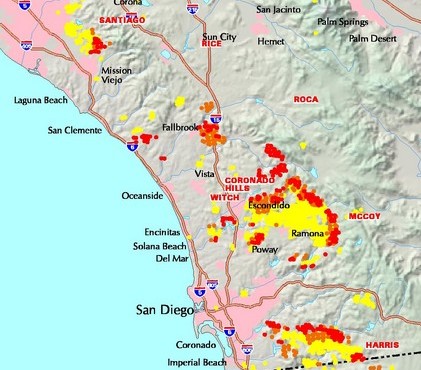
I’ve Google-mapped my sister’s address and also found NASA’s MODIS (or Moderate Resolution Imaging Spectroradiometer) map of the fires in the area, as of 1900 hours on Oct. 23. (See image below).

The red areas are fires; yellow marks areas that have already burned. My sister and her family are due west of Vista on the map; the small red blotch north of Oceanside, I’m pretty sure, is the fire located on Camp Pendleton. By comparing the various images I can pretty much pinpoint their home in comparison to the fires, and I’ve also seen maps pointing out evacuation centers near them, including one at a church that I think we visited when we were out there a few years ago. You’d expect the prevailing winds to be off of the Pacific, blowing inland, which would be good news for them but these are the notorious Santa Ana winds, the ones Raymond Chandler famously referred to in his story, Red Wind:

“those hot dry [winds] that come down through the mountain passes and curl your hair and make your nerves jump and your skin itch. On nights like that every booze party ends in a fight. Meek little wives feel the edge of the carving knife and study their husbands’ necks. Anything can happen.”

The Santa Anas form over the Nevada Basin, then come riding westward up over the San Gabriel mountains and stampeding down into Southern California like thirsty cowpokes at the end of a long trail. This week fire comes along for the ride.

You can see it coming in shots from space, through satellite pictures beamed into your living room, the reality still somehow so unreal. The technology at my fingertips is incredible, yet the sense of helplessness seems all the more complete because of it. Nature can be a bitch. I’ve tried several times to get through to my sister’s cell phone and the circuits were predictably jammed either by traffic or missing towers or both. So far I have gotten one message through that reached her voicemail. Senselessly I told her to call when she gets the chance, as if she wouldn’t do that anyway, but it was good to make some contact, nebulous as it was.

Fortunately there’s someone who has a better view than even the satellites and the best technology can provide, and isn’t dependent on cell phone towers or microwaves for communication. I’ve got him on the line.

Update:

We received an email from my veterinarian sister, aka “Queen Chick of the World and Marathon Mom” Wednesday afternoon:

We are all fine and safe in Oceanside except for the daily dose of snowy ash covering the neighborhood. Oceanside, especially near the coast is not a worry, even with the start of a fire near the Camp Pendleton/Oceanside border that occurred due to a transformer explosion near the front gate commissary. They feel this one will be contained very quickly and it is moving northwest. The DeLuz area near Fallbrook and the Riverside County border is pretty scary still. We had guests due to the evacuation this week — one bathroom, plastic up, dry wall dust and all! Jenny and Gene had to evacuate their home in Fallbrook but so far their home is still safe. Fortunately most are safe of our group and clientele. The fire on Palomar Mountain is not controlled; the Witch Fire has threatened a lot of our clients in Escondido and Valley Center and now Julian and is not considered controlled. The weather is changing slowly and they feel that they will have a turn around in the fire control today or tomorrow. The San Marcos fire was west of the clinic and we did not have to evacuate the clinic but it has been very smoky and we are full up with injuries and evacuated pets. More later!

The black days of October

Twenty years ago this month the Twins won their first World Series and my wife and I were married. Stellar events to be sure, but in the last week has been a lot said and written about Black Monday — October 19, 1987 — the day the Dow Jones Industrial Average dropped more than 500 points (don’t blame me, I was out of the country on my honeymoon).

Then, just a few days later, another dark day — as noted by this morning’s Writer’s Almanac:

It was on this day in 1987 that the United States Senate rejected the Supreme Court nomination of Robert H. Bork on a 58-to-42 vote. Bork was one of the leaders of a judicial theory called “original intent,” which is the idea that Supreme Court justices can only base their decisions on what the framers of the constitution originally intended. If the constitution doesn’t mention a “right to privacy” then there is no such thing as a “right to privacy.” This idea was controversial, but Bork decided to enter the debate head on, and he openly discussed his constitutional philosophy with the senators. Democrats portrayed him as a radical, and when the final vote of the full Senate came on this day in 1987, Bork was rejected by 58 to 42. Republicans have since argued that Bork was the target of a smear campaign, and they began using his last name as a verb, saying that they wanted to prevent future nominees from getting “borked.” The word “bork” was recently added to Webster’s dictionary, defined as, “[Seeking] to obstruct a political appointment or selection, also to attack a political opponent viciously.” Robert Bork said, “My name became a verb, and I regard that as one form of immortality.”

Several years ago I read Bork’s “Slouching Towards Gomorrah: Modern Liberalism and American Decline.” As the two parts of the title suggest, I found the book an interesting juxtaposition of being both acerbicly entertaining and accessibly academic. Here’s one quote that describes the author’s life path:

In many ways, I understand the Sixties generation because at that stage of life, I reacted similarly. Suburban, middle-class life seemed stifling. Dixieland jazz was my rock and roll. All night partying was my escape, political radicalism my protest. The superintendent of schools in a heavily Republican suburb had to be brought in to prevent me from running an editorial in the high school newspaper calling for the nationalization of industry. Denunciations of bourgeois values rolled easily off my tongue. Fortunately, mine was not a large generation and very few of my high school classmates-none to be precise-felt the same way. There was no critical mass. By the time I got to the University of Chicago, where there were student radicals, I had been in the Marine Corps, an organization well known for teaching the reality principle to its recruits; and the Chicago school of free market economists educated me out of my dreams of socialism. I was fortunate; the Sixties generation was not.

Perfect weather

Crisp, sunny autumn days like last Saturday are great — and as refreshing as biting into a Honeycrisp apple, but there’s a special seasonality to an overcast day in early fall like today.

This morning the sun rose but never shook off its blanket and the gray backdrop was the perfect canvas for the prima donna colors, helping the grass in my yard take on an extra-deep and lush green while the reds, yellows and oranges of the various leaves on the ground and still on the trees competed for attention. I enjoyed driving through my neighborhood, looking at the leaves that had fallen since last weekend’s rakings and, like the children at the bus-stop, resplendent in their new jackets, just waiting.

On days like these it is hard to keep your eyes on the road, but even at that I was rewarded. As I pulled up behind the line of cars waiting to turn left off of the Ayd Mill Road I broke into a smile when I recognized the autumnal glory of red taillights and flashing orange turn-signals in gleaming clarity that would not have been possible on a sunny day. Perfect. Absolutely perfect.

Maybe not so “far and wee…” after all

Courtesy of The Writer’s Almanac, yesterday was the birthday of poet e.e. cummings, known for his unusual punctuation and his way of arranging words and spaces on a page to create a rhythm for his poems. Less well known is that he was also frozen out by the literary and academic communities for being “politically incorrect”:

It’s the birthday of poet E. E. (Edward Estlin) Cummings, born in Cambridge, Massachusetts (1894), who became interested in communism as a young man and traveled to Russia to see it firsthand. He was horrified to find the theaters and museums were full of propaganda, and the people were scared to even talk to each other in public. Everyone was miserable. Cummings went home and wrote about the experience, comparing Russia to Dante’s Inferno.

His view of communism was not popular in the literary world at the time, and magazines suddenly began refusing to publish his work. For the next two decades, he had a hard time publishing his books, and he got terrible reviews when he did. Critics thought his exotic arrangements of words on the page were silly, and they said he wrote like an adolescent. Then, in 1952, his friend Archibald MacLeish got Cummings a temporary post at Harvard, giving a series of lectures. Instead of standing behind the lectern, Cummings sat on the stage, read his poetry aloud, and talked about what it meant to him. The faculty members were embarrassed by his earnestness, but the undergraduates adored him and came to his lectures in droves. He began traveling and giving readings at universities across the country, even though he suffered from terrible back pain, and had to wear a metal brace that he called an “iron maiden.” He loved performing and loved the applause, and the last 10 years of his life were the happiest.

E. E. Cummings said, “If a poet is anybody, he is somebody to whom things made matter very little — somebody who is obsessed by Making.”

Today our theaters and museums (and Nobel nominating committees) are full of propaganda and things such as so-called Fairness Doctrines and Hate Crimes proposals still try to make people afraid to talk to one another. And if your views aren’t acceptable to the gatekeepers at the Ivory Towers you won’t get invited or, if you do, you get food thrown on you.

It’s nice to see how far we’ve come.