The violence inherent in our systems

Tonight my thoughts are turning to violence.

No, not that I desire to wreak any such thing on anyone, it’s just that there seems to be so much of it in the air. I mean, you’ve got Ben talking about being in tune with his Spidey-senses and calculating the most destructive way out of the scenario if the Girl Scouts in front of him on the street turn out to be a ninja hit squad in disguise (must be the weight-lifting and all the red meat he’s eating); you’ve got Gino talking about he and his sister standing back to back to teach some rowdies a lesson; and you’ve got KingDavid in turn reminiscing over getting his own adolescent male ya-yas out and ending up in the principal’s office.

I’m not dismayed or appalled. In fact, it all reminds me of a lesson my father taught me when he said, “You don’t have to win, but you do have to fight.”

And then I laugh as I remember the time somebody, and I can’t remember who, thought it was a good idea to give my brother and I boxing gloves for Christmas when I was in my early teens. These weren’t the big, pillowy 16-oz. gloves, either, where you had a better chance of suffocating from a punch in the face as being knocked out. No, these were 8-oz. demolition specials of bright red leather, packing a little padding and quite a wallop over the knuckles. I’m sure they were probably banned from toy stores about the same time as Jarts.

In those days we lived in a neighborhood full of boys and we marked the passing seasons by the games we played. Football in the fall, basketball all winter long (shoveling the snow off the asphalt driveways and turning our hands black in the dribbling), baseball or some mischief in the summer. One summer day of boredom and too many boys we remembered the gloves. Tired of whacking one another around, my brother and I brought them out for the group. It was actually pretty structured. We marked out the corners of the “ring” with lawn chairs in our back yard and matched opponents up by age and weight class. I was far from being the most graceful or athletic but I had a simple yet effective style: absorb the incoming shots as I waded into range and then, Whammo! The matches usually didn’t last very long.

One of the younger boys, a wiry and athletic sort who was one of the fastest runners in the neighborhood, and also the biggest trash talker, was offended by my pugilistic style, or lack thereof. His name was Albert. He may have preferred just “Al” or “Bert” but he was the type where we just had to hang the full name on him. Anyway, his own matches in his “weight class” were marked by fancy footwork and flashy flurries, and he’d roll his eyes at me from the sidelines and talk about the “sweet science” as I’d stagger another opponent. He kept talking about how useless I’d be against someone who knew what they were doing. I suggested that, perhaps, he was thinking of himself? He said that, well, as a matter of fact, yes.

“Oh, come off it, Albert. I’ve got two years and 25 pounds on you.”

“But you’re slow. You’d never touch me.”

And so it was on. Albert laced up and started circling, jumping in and out, throwing leather into my shoulders, or glancing off the top of my head. I turned as well, tracking him like the turret of a battleship surrounded by torpedo planes. A couple of my left jabs came back empty, touching only his laughter. He came in again, and this time I timed it and decided to see how the right hand might fare. Fairly well, actually, as my straight overhand going out met his forehead square as it was coming in. I could almost hear for myself the pinball bells that started ringing inside his head. His forward progress immediately reversed and he was flat on his back, somewhere in the middle of next week. And he wasn’t moving.

Ho. Ly. Crap.

Nothing to do for it in that case but to invoke the Diety, or in this case, my mom. Actually, both of my parents were home at the time and my brother ran in and brought them out, no doubt trying to gasp out the hyperventilated words, “boxing”, “Albert”, “dead”, and “It wasn’t my fault.” They came out briskly and with concern as Albert started to regain what little sense he had before he challenged me. I thought we were all going to get yelled at, but instead my parents were very concerned and solicitous of young Albert, touching his head, patting his shoulders, asking if he was all right, even bringing him a cold glass of lemonade. I’m sure they were thinking thoughts like, “We are going to be so sued,” and “I’m going to bury those boxing gloves, preferably with my kid still in them.”

Albert revived, and the last thing he wanted to do was let his parents know what happened. Actually, as far as he was concerned, the fewer people who learned what had happened the better. I like to think that it somehow made him a bit wiser, though he continued to be pretty much the same obnoxious kid as our sports seasons continued to turn. Maybe, just maybe though, it was a lesson that took a little time to reach the surface.

It was a valuable part of my education, I know that. Those scrambling episodes in boyhood gave me some useful and — in the grand scheme — not too painful lessons. I learned that life sometimes comes at you pretty fast, and that you’re going to have to take some shots, but if you keep your feet and keep moving in you’re eventually going to get your chance.

And when you do — Whammo!

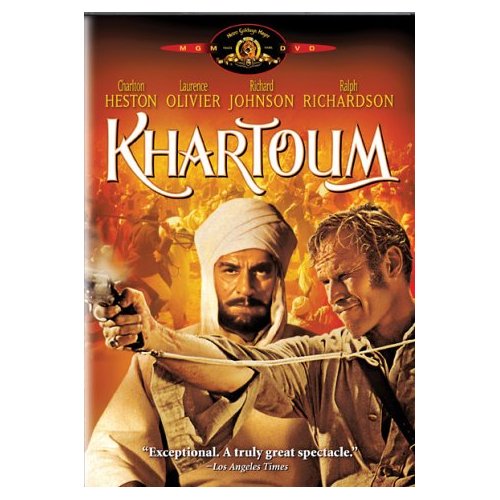
Fundamentals in Film: Khartoum

I’ve always been on the lookout for films with strong messages dealing with honor and character in this series for teen-age boys, and the stories can be fictional, factual or a bit of both. It’s a bonus, however, when we have a chance to see something of a historical nature that can also help us learn something about the world today. Last month our movie was The Wind and the Lion, a mostly historical story with some movie-making embellishments that provided a useful sketch of early 20th century geo-politics while still offering a rip-roaring adventure.

Afterwards the young men seemed to be interested in the Middle Eastern dynamics of that time and how these were still resonating today. Our next class is Thursday night and I’ve decided to follow up on that with a film I happened to catch on AMC right after Charlton Heston died: Khartoum. It’s an amazing and reliably accurate telling of Islamic jihad in the late 1800s that has striking, and sobering, parallels to today.

Here’s the set-up for the story: It’s the 1880s and most countries in the Middle East are under the influence, if not outright control, of one or another of the European nations. Egypt, supported by England, controls the Sudan, including the capital city of Khartoum. A few years earlier a British officer, Charles George “Chinese” Gordon, had been Governor-General of the Sudan and largely stamped out the slave trade in the country. As this had been the major industry in the land, the economy had subsequently tanked and in the hard times a religious leader, Muhammad Ahmad, proclaimed himself the Mahdi (Expected One) and rallied thousands to holy war to drive out the Egyptians and Europeans. He has early successes and England sends 10,000 men under General Hicks to put down the insurgency (Gordon had been recalled to England a few years earlier), but the Mahdi lures them into the dessert and then wipes out the entire command. This disaster is not well-received back in England where the government of Prime Minister William Gladstone is on shaky ground and the public is outraged at the loss of the expedition but also weary of foreign entanglements, especially on behalf of their Egyptian allies. While England and Gladstone want little to do with the Sudan, they need the Egyptians and especially the Suez Canal.

As portrayed in the movie, Gladstone (Ralph Richardson) wants to wash his hands of the Sudan but is experiencing pressure to rescue the Egyptian and European citizens in the city before it is overwhelmed by the Mahdi’s (Laurence Olivier) army. There is no way he wants to commit an army to that cause, however, so he charts a canny course of sending the hero Gordon (Heston) back, alone, to Khartoum to organize an evacuation. Gordon, a national hero with a string of successes in China as well as Africa, is known to be a difficult person to control because of his deep Christian faith and what some described as arrogance and mysticism. He nevertheless accepts the apparently hopeless mission, knowing that he’s being sent as a political gesture but also having an agenda of his own. It turns out he grew to love the Sudan and its people during his earlier duty and he couldn’t abide the thought of abandoning his city, or of England abandoning its allies, to the foreseen slaughter of the Mahdi.

Upon arriving in Khartoum he does evacuate some of the Europeans, but also sets about rallying the Egyptian troops and the citizenry to defend the city, while playing a brilliant but dangerous game of military, administrative and political chicken, simultaneously keeping the Mahdi at bay while hoping to hold out long enough for Gladstone to change his mind and send relief. While the movie sets up the primary conflict between Gordon and the Mahdi, it really is a 3-way battle with Gladstone showing his own determination and tactical abilities. The Mahdi, despite his own mysticism, recognizes the danger of turning Gordon into a martyr, as does Gladstone but for different reasons. Gordon knows that this is where he has them both. One of the great lines in the movie is when Gordon says, “Every man has a final weapon: his own life. If he’s afraid to lose it, he throws the weapon away.”

Both the Mahdi and Gladstone, again for their own reasons, try different ways to induce Gordon to leave. By this time, English public opinion is pressuring Gladstone to send a relief column to Gordon’s rescue. Ultimately Gladstone makes a big show of doing just that, marching a regiment through London to take ship for Africa, ostensibly to support Gordon but secretly ordered to move slowly in the hopes that Gordon will ultimately “see reason” and abandon his quest. I won’t offer a spoiler here on how it comes out (go to your history books if you want that), but the ensuing battle of wills between the three men, plus lots of real battles between armies, makes this a tense and gripping story with some interesting perspectives on the nature of power, the power of belief, and the designs of destiny.

The history is pretty solid in this story and the movie hews pretty closely to what is recorded. There are a lot of resources for historians to refer to, including the newspapers of the time, Gordon’s own writings during the 10-months of the siege, and the writings of Colonel Sir Rudolph Slatin, a contemporary and friend of Gordon’s who got to spend several years as the “guest” of the Mahdi himself.

Great Quotes:
William Gladstone: “I don’t trust any man who consults God before he consults me.”

Gen. Charles Gordon: “Every man has a final weapon: his own life. If he’s afraid to lose it he throws the weapon away.”

Gordon: “I’m known to be a religious man, yet I’m a member of no church. I’ve been introduced to hundreds of women, yet I’ve never married. I daresay that no one’s ever been able to talk me into anything.”

Gordon: “While I may die of your miracle, you will surely die of mine.”

About Fundamentals in Film: this series began as a class I taught to junior high and high school boys as a way to use the entertainment media to explore concepts of honor, honesty, duty and accountability. The movies were selected to demonstrate these themes and as a contrast to television that typically either portrays men as Homer Simpsons or professional wrestlers, with little in between those extremes. I wrote questions and points to ponder for each movie to stimulate discussion and to get the boys to articulate their thoughts and reactions to each movie. I offer this series here on this blog for the benefit of parents or others looking for a fun but challenging way to reinforce these concepts in their own families or groups. I’m also always open to suggestions for other movies that can be added to the series. You can browse the entire series by clicking on the “Fundamentals in Film” category in the right sidebar of this blog.

A sign of the Apocalypse?

“I’d feel like a caveman, if they existed … and they didn’t.”
— Ned Flanders

A Boston University sociologist is undertaking a study to learn more about the “evangelical intelligentsia”.

Study to crack evangelical stereotypes
BOSTON, Massachusetts (AP) — For decades, Boston University sociologist Peter Berger says, American intellectuals have looked down on evangelicals.

Educated people have the notion that evangelicals are “barefoot people of Tobacco Road who, I don’t know, sleep with their sisters or something,” Berger says.

It’s time that attitude changed, he says.

“That was probably never correct, but it’s totally false now and I think the image should be corrected,” Berger said in a recent interview.

Now, his university’s Institute on Culture, Religion and World Affairs is leading a two-year project that explores an “evangelical intelligentsia” which Berger says is growing and needs to be better understood, given the large numbers of evangelicals and their influence.

“It’s not good if a prejudiced view of this community prevails in the elite circles of society,” said Berger, a self-described liberal Lutheran. “It’s bad for democracy and it’s wrong.”

My heavens, “…barefoot people of Tobacco Road who, I don’t know, sleep with their sisters or something…”?

“That was probably never correct…”?

Gee, Mr. Berger, did somebody beat you to the studies of Bigfoot and the Loch Ness Monster? Oh well, I suppose that wasn’t very Christian of me. Perhaps it makes me appear as sensitive as those cavemen in the Geico spots. After all, it’s not as if anyone’s ever done a commercial saying, “It’s so simple, even an Evangelical can do it.” So, okily-dokily, I’ll just bite my tongue and be happy that someone is taking an interest.

If you need me, I’ll be studying my the(ist)saurus, working on them big words. You know, just in case.

American congregations giving record amounts to poor countries

American church congregations of all denominations — Protestant, Catholic, Jewish, Muslim and Hindu — gave $8.8 billion in private relief and assistance to the developing world in 2006 according to a recent study by the University of Notre Dame’s Center for the Study of Religion and Society and the Hudson Institute’s Center for Global Prosperity (CGP). According to the Institute, that amount from religious congregations was more than one-third of the official U.S. government aid of $23.5 billion.

“The study examines religious and development giving that goes directly to orphanages and schools and other efforts in areas such as Mexico and Haiti, as well as monies given directly to U.S.-based organizations such as the Red Cross and Catholic Relief Services,” said David H. Sikkink, associate professor of sociology and the Center’s director.

More than 50 percent of the congregations gave an average of $10,500 to U.S.-based organizations that are involved in relief and development efforts and more than 30 percent made donations directly to programs in developing countries. More than 30 percent conducted short-term mission or service trips.

Sikkink also pointed out that while congregations consider evangelism and service to both be part of a holistic ministry, the survey measured only expenditures for items such as food, clothing and medicines and excluded financial support for evangelism.

“The sample was randomly selected: it was diverse and in addition to mainline and conservative Protestant congregations, it included Catholic parishes, synagogues and Muslim and Hindu congregations,” Sikkink said. “It was also more ethnically diverse than earlier surveys, which had difficulty surveying low-income and African-American congregations.”

Among the findings from the study is that Catholics tend to work with U.S.-based aid agencies, while Protestants (particularly conservative Protestant organizations) work more directly with overseas programs.

Interestingly enough, a recent article (with a great graph) in The Economist about this high level of American private giving cites “An established culture of philanthropy and charity contributes to direct aid-giving, as does a generous tax regime.” (Emphasis mine). Aside from the inference that the U.S. government is “generous” in the amount of their own money it allows its citizens to keep, it belies the notion that Americans who think they can do better things with their money than the government can are “greedy.”

Hell’s belles

So we’re sitting around tonight talking about an upcoming event and I mention that someone we know said he will be there with bells on, and the Reverend Mother says, “I hope he’s wearing more than that, because that’s not someone I want to see with nothing more than bells on,” and I say, “Oh, sounds like you have a list of people you do want to see,” and she says, “Yeah, I’ll show it to you later,” and then Tiger Lilly, who’s baking chocolate chip cookies, says, “I know I sure do,” and it gets real quiet.

Then the Mall Diva says, “You are soooooo grounded.”

Hey, chocolate chip cookies!

I’m so glad we had that time together

Actor and comedian Harvey Korman has passed away at the age of 81. I loved watching him and the gang on the old Carol Burnett Show, where he was recognized with four Emmys and a Golden Globe, and he had a memorable role in the funniest (imho) Mel Brooks film ever, Blazing Saddles as Hedy, I mean Hedley Lamarr.

As much as he could make me laugh, some of his funniest performances were in skits with the great Tim Conway where he did everything he could to keep himself from laughing. When I heard the news while driving home tonight that he had passed away, one classic scene came immediately to mind.

Thanks, Harvey.

Memorable weekend

Boy, that three-day weekend came just in time for me. I didn’t crack the laptop for anything work related the entire time and it was refreshing. That doesn’t mean that I didn’t work; I mowed the lawn, moved a high spot in my side yard to a low spot in my back yard, put up the awnings (with Tiger Lilly and Ben’s help) and put a tonneau cover on my truck, plus doing the laundry, which is my usual weekend gig anyway. On top of that I still found time for some other notable moments. Here are the highlights:

Bike Bubba. (me, not him in this instance). I bought a used 10-speed from someone at work earlier this year with the idea that I’d try to get some rides in for exercise. Since then when I’ve had the time to ride the weather hasn’t cooperated. Saturday afternoon, however, even though I’d already “exercised” in my yard I decided to set off for The Black Sheep on my bike when my wife said we were out of coffee. It’s a little more than a mile each way, I think, so it’s not exactly the Kessel run, but there’s a pretty significant hill between here and there, and it’s up-hill on the way back.

Of course, that means it’s down-hill on the way over, especially if I take Marie Ave. where the slope is particularly steep. I was cruising down the hill at a good clip when I saw a white Mustang pulling onto Marie from a side street. The driver was talking on a cell phone, looking the opposite direction from me (natch) and stuck the nose of his car three-feet into the intersection, right in front of me, still without looking. Not having a horn, I later told my girls I had to resort to speaking Japanese. They gave me puzzled looks, so I elaborated: “AH SO!”

Coming back with the coffee I decided to take Southview Blvd. because, while the slope is longer, it’s not quite as steep. It’s still not easy, though, especially since it gets much heavier traffic and you don’t want to be wavering a lot on your two wheels. I set myself a goal of getting to the top of hill without walking or even standing on the pedals, even if I had to go all the way down to first gear. 100 feet from the top I was wondering if I was going to make it but I kept my momentum and made it up and over, gliding through the stop sign on the other side when there wasn’t any traffic because I didn’t trust my legs to put them down. Then I had to climb a much smaller hill before rolling back onto my street and finally into my driveway and garage. I got off the bike, went in the kitchen and put the coffee on the counter and headed for the living room to sit down. I got as far as the entry hall before my legs went to jelly, but I managed to get to my recliner before losing control.

Surrender Dorothy. Sunday afternoon my wife and I played golf with some friends visiting from back east. We were playing at Oak Marsh in Oakdale, in the northeast quadrant of the metro area. It was a sunny afternoon, but as we finished the first hole the tornado siren went off. Our friends don’t have this phenomenon in Jersey, so that was a bit of a thrill for them. Since the weather still looked nice I called the pro shop on my cell and asked if the siren was for tornadoes or lightning in the area. He said there was a tornado watch but it was up to us if we wanted to keep playing. We did.

A little while later as we were walking toward the fourth hole we could see the sky darkening in front of us. The wind, however, was at our backs and the sky in that direction was clear and sunny so we figured that we were going to stay dry. The fifth and sixth holes run west to east and as we finished the fifth we saw a strange sight: the prevailing wind was still out of the south, where it was still sunny, but looking west we could see low, dark clouds coming out of the north, against the wind as if to flank us. Not good. We kept heading for the sixth tee, where we finally saw some lightning, just as the temperature dropped by about 20 degrees. The clubhouse was about 100 yards in front of us so we started briskly pushing our carts in that direction as the winds got stronger. We made it with about a minute to spare before the rain hit, and then it was all over about 10 minutes later and we were able to go back out and finish our round. Later, of course, we heard that there had been at least one tornado in Hugo, about 15 miles north of where we were and that there was at least one fatality.

So far I’ve played golf three times in Minnesota this year. The first time I got snowed on, the second time we froze and got rained on, and the third time we dodged a tornado. I don’t think our friends from Jersey are going to be relocating here anytime soon.

The Mall Diva’s animal magnetism. Monday we decided to drive down to Northfield for a picnic. It was a wise decision because the weather stayed cool and overcast here in the cities but we had sunshine in Northfield (which is actually south of here). We got into town and set up our lunch at a picnic table alongside the Cannon River, after Ben first drove off a surly gang of illegal aliens, i.e., a flock of Canada geese. As we were eating some of the geese became bolder and moved closer. I noticed that a breeze had come up, and so had the goose-bumps on the Mall Diva’s arms and neck. “No wonder the geese are coming over here,” I said. “They think you’re one of them!”

It was mentioned that the Diva was rather pale for that. “They want to worship the Albino Goose Goddess!” I said. Everyone thought that was amusing, so I said they could feel free to use that in one of their blogs. Nobody did, however, so I had to do it.

When brats attack. We came back from Northfield late in the afternoon to grill some odds and ends of meat from the freezer. This included some steak, a large chicken breast and several bratwurst. Tiger Lilly honed in on the steak, saying that brats were fat, greasy and gross. Her convictions could only have been deepened when Ben bit into his brat and a sudden jet of greasy fat shot out of the side of the brat and hit her in the cheek, leading to much commotion.

Yep, it was a great weekend.

Update:

Oh yeah, the Mall Diva asks how I could have forgotten to mention the flashy purple dress she tried on. We’ve even got pictures! Unfortunately, Ben was working the camera and his hands got so shaky when the Diva first came out of the dressing room that the first shot was all blurry. He calmed down enough to take the second photo.

A little something off the top

The Art of Manliness had a post last week in praise of the masculine sanctuary known as the barber shop. It struck a chord with me because of my own experiences, especially at one barber shop in particular.

Growing up, barber shops were something I went to with about as much enthusiasm as going to the dentist. In fact, if I could have gone to the barber shop as often as I went to the dentist (twice a year) I would have been happier. Nevertheless my mother would take me to get my haircut about once a month, dating back to the days when the barber would plop a booster seat in the big swivel chair and my mother would request a “Regular Boy”. I think she was referring to the style of haircut and not to me, specifically.

As I got older one of my aunts would often cut my hair in her beauty shop, though once I got to college my desired “twice-a-year-whether-I-need-it-or-not” schedule became more of a reality. Once into the corporate world I visited a succession of walk-in centers ala Cost Cutters or Fantastic Sam’s. Then in 1993 we bought a house over on St. Paul’s east side and I soon discovered a classic barber shop on Payne Avenue, just a couple of blocks from my house, called Parkway Barbers.

Walking in the first time I knew I was in a real-live, honest-to-goodness barber shop. It had the classic candy-striped rotating pole outside and four barber chairs inside. The barbers were a couple of older guys named George and Ted (who were in charge) and a couple of younger guys. Brick walls, sports magazines and Popular Mechanics defined the waiting area, with some chairs set along the wall in front of the barber chairs so people could sit and join in on the conversations taking place in the big chairs. The smell was a masculine concoction of leather, tonic, shaving soap, pomade and Clubman Pinaud as distinctive in its own way as walking blind-folded into a bakery. It was as comfortable as slipping into a favorite sweatshirt or old leather jacket.

I’d walk in on a Saturday morning, shortly after opening time and if the shop was busy (usually) I’d maybe get a cup of bitter coffee and flip through one of the magazines. More often I could just drop into whatever conversation was going on at the time. Most of the customers were guys my age or older, and it felt as if we knew each other, even if we didn’t. Some of the men were in there with young sons, introducing them to the Ways of Men. One time I was in Ted’s chair when hockey legend Herb Brooks came in and plopped down in one of the waiting chairs. “Hiya, Herbie,” Ted said. Turns out Herbie was another regular.

Most of the men who came in had “their” barber and would wait for him to be available if the shop was busy, but I’d generally take George or Ted, whoever had an open seat first. The thing is, nobody was ever in a hurry. It was a great place to hang out while knowing you were going to be able to check something off your schedule of weekend projects. Once you left the shop it was back to the “honey-do” list. It’s not that women weren’t welcome; I’m sure that any woman who came in there would have been treated very respectfully. It’s just that it was a place where men went to get their hair cut and there was no reason for a woman to poke her head in. Even after we moved out of the neighborhood I’d still drive back every month for my cut (no blow dry).

Both George (first chair by the door) and Ted (second chair) had an amazing ability to remember who you were and what you’d talked about the last time. Sometimes it almost seemed as if they’d pick up the conversation right were it left off in the previous visit, keeping track of kids, jobs and the golf or fishing trip you’d been planning. Some of those conversations inevitably turned to their retirement plans, to cutting down on the number of days in the shop, to moving to Arizona. Being men of their word, that’s what they ultimately did. I’m not sure what the transaction was but after they were gone the other two guys stayed on and I continued to stop in. Business may have been dropping off though, because one time when I went in they had converted the back half of the shop to a beauty parlor and a woman was operating a chair and a hair-washing station.

I went back a couple more times out of loyalty, and even had the woman cut my hair once, but it wasn’t the same anymore. The constant hum of the hair-dryers and the sound of the women trying to talk over them drowned out other conversation, even if you still really wanted to talk about putting a new front end into an ’89 Oldsmobile. The smell of the perming solution similarly overwhelmed the more understated, manly scents from before. You’d see one the regulars come in the door with a smile on his face and almost immediately go quiet, taking a chair to wait and fidgeting uncomfortably, perhaps taking a distracted flip through a magazine.

I’m sorry to say that it no longer seemed worth the drive for me to go back there to get my haircut. I found another barber shop closer to home. Still with some of the old-fashioned feel, though not quite as comfortable. I went there for a few years but never felt like I was part of a club. Eventually the time came around where my daughter started to cut my hair, and now when I get my haircut I just have to go downstairs. It’s comfortable all right, with all my stuff and favorite people around, but you know, somehow it’s just not the same. Maybe I need to buy some Clubman Pinaud.

Are you marriageable?

Last week Brett at The Art of Manliness had a post about how to tell if the woman you’re interested in is “the one” to marry. They were good questions but they made me think that there should be some good questions a guy should be asking about himself first to see if he, too is marriage material. I’ve also been thinking lately of developing some discussion topics and exercises for some young men I know on how to become marriageable. My outline for that covers six to eight weeks of classes and exercises, but here are some of the highlights.

A lot of guys hope or assume that they’ll be able to sense when it’s time to marry, either because they’ll find someone they feel they can’t live without or they feel it’s time to settle down. Both of those feelings are important, and feelings provide valuable momentum, but they don’t necessarily indicate that you have the proper outlook or skills to marry. Yes, of course, people do get married in the throes of passion and somehow manage to develop the proper survival skills on the fly when reality sets in. Then again, many people try it this way and fail spectacularly. Ask yourself, would you rather learn to swim by being thrown into the deep end to see if you’ll go up or go down, or after you’ve been able to rehearse a few techniques while still at the side of the pool? Here are a few questions to try out on yourself.

How’s your conditioning?
Marriage is a marathon, but most of us spent our single days as sprinters, chasing women and running away from commitment. You get yourself into a distance race, though, and you’ll find you may look good for the first couple hundred yards and then you start to seize up. Blisters form from the friction, and just about every part of your body screams, “What were you thinking?” Now I’m not saying that you prepare for marriage by a series of progressively longer relationships; that may “condition” you, but not for marriage. What I am suggesting is that if your objective is to get married that you look to the condition of other things (ideally before you even meet the woman you’d like to marry). For example:

Opportunism is stimulated

Well, the so-called “economic stimulus” checks have certainly stimulated some creative thinking. I can’t count the number of email and junk-mail offers that have tried to attract my attention lately, each mentioning the imminent tax rebate checks and, of course, suggesting that this particular service or product is the best way to do my patriotic duty. One in particular stood out yesterday; an offer from a carpet company offering a $300 voucher on their product and touting that that amount combined with the average “economic stimulus” check would give lucky me more than “$1500 in buying power!” That’s not a match for my brain power, however.

Given the slate of presidential candidates before us, one of whom actually has to win, I think the smart investment is in guns and gold. Interestingly enough, a one-ounce American Gold Eagle bullion coin and a Desert Eagle handgun are both running close to $1,000. Maybe a Sig and some silver are the solution for future home security.

Speaking of opportunists and home security, we also received two visits last night from “advertising directors” offering us a free home security system in return for posting one of their security signs in our “fabulous” front yard for advertising purposes. This is becoming an annual event, though we’ve never had two different duos (both from the same company) hit us in the same night as they worked our neighborhood. Well, of course, I’d buy a security system from somebody going door-to-door, just to avoid the hassle! Wouldn’t you?

Oh, wait – I don’t have to buy it, it’s free because I’m going to let them put their sign in my yard! But what if my security system somehow keeps Santa Claus from dropping in? You know, sometimes you just know you’re being scammed even though it’s hard to see exactly what the scam is. Trust your gut and then hit the internet, which is what I did some time back when these offers started to show up at my door. If you fall for it, what happens is that they install some cheap keypad/sensor/siren apparatus (usually hooked up to one window or door; if you want more “protection” it costs extra) and they con you into signing the service agreement for an over-priced monitoring service that adds up to thousands of dollars – and will cost you nearly that much if you try to break the contract once you find out what you actually agreed to (more details here and here).

Anyway, as it stands right now our economic stimulus is still safely in-hand and I’ve resisted the siren call of the free home security system. Until we decide what to invest the windfall return of our own money into we’ll be going with the tried-and-true security system of smearing jello on the floors, even though that means I’ll have to venture into the black market for Diazinon for the inevitable ants.