That was the week that whizzed

I took last week off from work, yet it still turned out to be a pretty full week. It actually started out the Saturday before last when I landed a free “Supporter” badge to the US Women’s Open. My company was hosting a Sky Tent on the 14th Hole (in Carl Pohlad’s back yard) and the guy who put it all together could only stay the first half of the week and left me his pass, which he said would get me in anywhere but the Patty Berg Pavilion and the women’s locker room, I think.

I arrived Saturday during the weather delay and met up with a woman from work who had had to evacuate the Sky Tent during the weather watch. While we were waiting by the ropes for the all clear and looking very official an older couple walked up to us for an update on the conditions. Noticing that my impressive badge said “SUPPORTER”, the gentleman asked what that meant. “It means that I’m an athletic supporter,” I said, straight-faced. “Let’s ask her,” the woman said, pointing to my partner.

Sunday was the unfortunate incident with the small but expensive container of chocolate ice cream.

On Monday I told Tiger Lilly we could go to the matinee show of WALL•E, which made her very happy, until I told her I just had to do some e-mails from work first, which didn’t. Work e-mail is like a cancerous growth that keeps dividing and multiplying when you’re not looking and I knew that if I didn’t try to prune it a bit even while on vacation it would turn into a hazardous blob that would frighten Steve McQueen by the time I got back to work. Still, there’s a reason I refer to my laptop computer as a “laptrap” and Tiger Lilly flopped resignedly on the couch. (I well know her feeling because when I was a kid my father owned a gas station and every time the family got into the car the trip was sure to include at least one stop at “the station” where he would disappear inside while we waited in the car with nothing but AM radio.) Sure enough, an hour and a half later I was ready to set out, and we made it to the movie in time though we missed about half of the “Play Green!” propaganda being shown on the movie screen to the captive, mostly-kid audience. Darn. Oh well, the commercials will probably have the same effect as those PSAs telling kids not to do drugs.

The movie itself was pretty cute, if not Pixar’s best, though I hear the “critics” are lauding the film to high heaven. That’s presumably because of the environmental “message” of humans filling the planet up with so much garbage we have to take to outer space. Of course, this is the same medium that would have you believe that Wile E. Coyote can really afford all that stuff he buys from ACME. The first half of the movie was kind of odd as the only “words” came from the communicative noises the robots made, though this wasn’t any harder to understand than, say, Arianna Huffington.

In an interesting (to me) contrast, later that evening I watched a show on the Discovery HD channel about what has gone on in the Ukrainian village of Prypiat, which rests next to Chernobyl and was evacuated in 1986. There are those who would have you believe that Prypiat and the 18-mile “Exclusion Zone” all around it are a nuclear wasteland, yet in reality it has become a booming, if unintentional, nature preserve as the forest has taken over much of the city and flora and fauna are thriving. Bears, wolves, elk, birds of prey and all manner of rodents and insects have moved in an thrived, including many species that were thought to be extinct or nearly extinct. You could tell that the narrator, and presumably the producers, were struggling to make sense of this, one moment intoning about this “greatest disaster of mankind” and the “evil unleashed on the earth” in this area that will be unfit for habitation for another 300 years, and in the next moment marveling at the health and diversity of the wildlife that has flourished there over several generations, apparently without ill effects.

Wednesday was the funeral for our friend Joe, which also happened to be the first funeral my wife has conducted. Appropriately, it was pretty much a biker affair as a row of Harley’s lined the street in front of our church and filled the funeral procession out to Fort Snelling (Joe was a vet). The Reverend Mother is a biker, too, though she dressed more formally than the majority of the folks who came to the service. She should have worn her “Biker Chick” pin on her dark knit suit, but otherwise the service was flawless and touching.

On Thursday the girls and Ben took off for the cabin, leaving my wife and I home alone and without any plans. We made do, enjoying dinner at a new place, Aura in Calhoun Square (try the great “small plates” – like tapas but slightly larger portions, great for combos), grilling steaks on Friday night and going to our favorite place, Muffuletta, on Saturday night where I enjoyed a fabulous watercress puree and blue cheese cold soup (refreshing!) with orange aioli and cracked pepper for starters, while my wife thoroughly enjoyed an asparagus and horseradish appetizer and a beet salad. The menu changes regularly here so it’s always fun to try something new but that night I opted for an old favorite, the Asian burger (ground pork, spicy thai peanut sauce and Chinese cabbage). It was a lovely evening as well, so we sat out on the deck and enjoyed the evening, the neighborhood and each other’s company. It’s a fun and romantic place, just the ticket if a certain someone wanted to take another certain someone to someplace special for a meaningful dinner!

All in all, I think it was one of the best vacations I’ve ever had. I felt refreshed and rested all the way up until Sunday afternoon, when I started hacking at the e-mail jungle again!

Meme-ing of life


From Mitch. Nothing but one-word answers – and you can’t use any word twice:

1. Where is your cell phone? Pocket.
2. Your significant other? Trophy.
3. Your hair? Distinguished.
4. Your mother? Cuba.
5. Your father? Missed.
6. Your favorite time of day? Night!
7. Your dream last night? Forgotten.
8. Your favorite drink? Coffee.
9. Your dream goal? Published.
10. The room you’re in? Living.
11. Your ex? Unlucky.
12. Your fear? Itself.
13. Where do you want to be in 6 years? Letterman.
14. What you are not? Emaciated.
15. Your Favorite meal? Most.
16. One of your wish list items? BIA-3.
17. The last thing you did? Laundry.
18. Where you grew up? Midwest.
19. What are you wearing? Smile.
20. Your TV is? Awesome.
21. Your pets? Noisy.
22. Your computer? Laptrap.
23. Your life? Python-esque.
24. Your mood? Whatever.
25. Missing someone? Yes.
26. Your car? Truck.
27. Something you’re not wearing? Tie.
28. Favorite store? Cabela’s.
29. Your summer? Missing.
30. Your favorite colour? Green.
31. When is the last time you laughed? Saturday.
32. When is the last time you cried? Wednesday.
33. Your health? Functional.
34. Your children? Keepers.
35. Your future? Golden.
36. Your beliefs? Biblical.
37. Young or old? Mature.
38. Your image? Graven.
39. Your appearance? Welcome.
40. Would you live your life over again knowing what you know? Yup.

Family communication

The other day I stopped at Cold Stone Creamery and bought a small container of their Ghiradelli chocolate ice cream to share in a little private quality time with my wife.

Unfortunately, when I got home — and before any such quality time could materialize — I tucked it into the freezer of our kitchen refrigerator. This is an environment generally overstuffed with items that would enthrall an arctic archaeologist analyzing the lifestyle of my family. Hiding a small, innocuous container in there should have been relatively safe. Except. Except that I live in a house with three women and their chocolate-senses started jangling as soon as they all returned and entered the kitchen together.

Later I went into the freezer and saw that the container and been disturbed. And decimated. There was also a post-it note stuck to it, with large letters in Tiger Lilly’s hand-printing: “FOUND YOU!”

There was only one thing I could do.

I took the post-it note and in red ink struck a line through the word “found” and replaced it with my own “I WILL FIND” and stuck the note on the freezer door.

Let me know if you see any of them.

“All men must make their way come Independence Day…”

There’ll be light blogging here during the holiday weekend as most of what I’ll be doing that is blog-related will be behind the scenes. There’s plenty for you to read, however, in The Manival #10 (The Independence Day Edition) hosted this week by Brett at The Art of Manliness.

There are several posts from regular Manival contributors, plus a lot of material from others who are new to the fraternity. This week guy’s are trying to answer questions such as “What Does Religion Mean to Your Marriage?”, “Why Doesn’t She Want Sex Like I Do?”, “Is Chivalry Dead?” and whether it’s okay for a man to wear Crocs or clogs.

There are also posts on how a man can be a lighthouse for his children, how to help your kids develop decision-making skills and a humorous look at how one guy is trying to establish family traditions. There’s a lot more than that as well, so celebrate your independence from the man-numbing popular culture by going to the Manival link above seeing what these guys (and a gal) have to say!

Tied to the tracks

As I’ve mentioned here a couple of times I’ve been considering — and testing — the possibility of making use of the Light Rail Transit (LRT) Hiawatha Line for a part of my daily commute. I’ve ultimately decided to do this starting in August (more on that in a minute). On a micro-level (e.g., my checking account) it makes sense/cents because I can save about $80 bucks a month. I’ve had my doubts about the macro-savings, both in dollars and energy, of the current public transportation options, but haven’t taken the time to dig into it. Fortunately, Bike Bubba did so last week, referencing a report from the Cato Institute:

Metro’s buses [Note: St. Louis, MO area. NW] today consume more energy and emit more greenhouse gases, per passenger mile, than a typical sport utility vehicle. Its light-rail lines do better, but consume almost as much energy, and emit almost as much greenhouse gas, per passenger mile, as the average car.

Moreover, even where rail operations do save energy, this savings almost never makes up for the huge energy cost of rail construction. Highway construction also consumes energy, but because highways are more heavily used than rail lines, their energy cost per passenger mile is far lower.

If we ignore construction costs, many rail operations do consume less energy than the average auto — but almost none consume less than a Toyota Prius. As Lave suggested in 1979, to save energy and reduce greenhouse gas emissions, it is far more cost effective to encourage people to drive more fuel-efficient cars than to build rail transit lines.

Transit agencies that want to save energy and reduce greenhouse gas emissions should focus on increasing bus loads or reducing the size of their buses. The average Metro bus has 39 seats, yet averages less than 10 passengers. Concentrating service in areas where loads are higher, and using smaller buses in areas or times of day where loads are lower, will do far more to save energy than building rail transit.

So if it’s more economically, environmentally and energy-efficient to get people to drive more fuel-efficient cars than it is to get them to build and ride rail transit, how do you “get” them to do so? If only there were some invisible hand that could get people’s attention and cause them to act in a more enlightened (or just self-serving) manner! Something like, you know, the marketplace!

While the cost of gas has been driven up due to the oil supply being deliberately restricted, it does create the motivation to look for alternatives. Even as math-averse as I am I can still do it (the math) when I have to, and spending $50 for a tank of gas will get me reaching for a calculator. I think most folks are capable of doing a basic cost/benefit analysis, which brings me to why I’m not going to start my full-time LRT commuting until August.

My parking contract at work requires a 30-day notice to terminate, and can only be given at the first of the month; even if I stop using the ramp I still have to pay for July. Now, if I could get the $39 a month Metropass through my employer it would still be about a push on the savings to pay both parking and transit fee; however I can’t get the pass from my employer until the parking comes off the books. I could buy a MTC “GO” pass (actually, recharge the one I’ve been using) but the rush hour commuting charges would add up to $80 for the month. That means the parking, gas and train fees don’t come out in favor of the transit, especially when you add in the extra time and hassle it takes as opposed to driving. So, it’s easier on my budget and simpler to drive another month while I satisfy the parking contract, regardless of whatever benefit I perhaps bestow upon the planet (especially dubious given Bike Bubba’s revelations). Similarly, in the future if the monetary savings of using transit diminish, or the inconveniences get too big, I reserve the right to change my mind again.

OK, so I guess that it’s all about the money for me when it comes to saving the planet. Of course, as Speed Gibson points out, the same goes for the Metropolitan Transit Commission as well.

You’ve probably heard that transit fares will be rising, probably about 25 cents, probably around October 1st. A number of public hearings are scheduled in July.

Most of us will be paying more for transit July 1, however, when the sales tax goes up 0.25% in Hennepin, Ramsey, Anoka, Dakota, and Washington Counties. Also starting July 1, you’ll be paying a $20 Transit Improvement Vehicle Excise Tax when you sell a vehicle registered in these Counties.

But that’s already figured into the projected $15 million shortfall in the fiscal year starting July 1. As I posted earlier, that amount is suspiciously similar to the Light Rail subsidy. Increased business for an enterprise with such high fixed costs should more than cover the rising fuel costs.

So what does Metro Transit do? Raise bus fares, which will reduce ridership by pushing some back into their cars or carpools. And not just this fall, and not just a quarter, mind you. The resolution also would grant authority for another increase of up to fifty cents in 2009.

What else can we do to discourage ridership? Let’s expand the morning rush hour to start at 5:30 AM, not 6:00 AM, so we can charge 50 cents more for these early birds. Isn’t the purpose of off-peak fares to encourage off-peak ridership?

Oh, and let’s make it complicated again, with the return of suburban fare zones to nickel and dime quarter and dollar us further.

All of this of course is just a double shuffle to secretly get more Light Rail subsidies. They’re going to need still more money to run the Central Corridor and the Metropolitan Council is willing to further degrade the bus service to get it.

Keep your calculators handy!

Custer’s Last Stand and the Twilight of the Sioux

The Battle of the Little Big Horn (or Custer’s Last Stand) took place on June 25th and 26th of 1876, 132 years ago this week. When I was a boy one of my cousins had a huge painting on the wall of his bedroom depicting some artist’s rendition of Custer’s Last Stand. I didn’t visit there too often, but I was always fascinated by the picture, and would spend a long time studying it each time, moving out from the main action — Custer standing tall in his buckskins and with saber raised in one hand while the other held his pistol reversed like a club — to the other desperate confrontations that spread edge to edge across the canvas; Indians swarming and shooting, soldiers falling, some already stripped or being scalped. It was a rendering from the artist’s imagination, of course, but it obviously fired an interest in me for the history of the battle. Something about the desperateness and the inevitable defeat also had an impact on a young mind that until that time had seen only glorious images of warfare.

Later when I was in college I took a series of elective courses “taught” by author, poet and historian John G. Niehardt. Niehardt had been dead for a few years by the time I took the classes, but the University of Missouri had filmed his lectures and used these and his books as the source material. We read his classics, Black Elk Speaks and When the Tree Flowered, and his epic poem, Twilight of the Sioux (nearly 300 pages!) which included Indian accounts of the battle of the “Greasy Grass” and later the messianic millenarianism of the Ghost Dance movement. It was a fascinating diversion from my other studies and while I didn’t (and don’t) embrace the attractive mythology of the “Noble Savage” as some might have, it did help me picture the humanity of the Sioux and other Plains Indians, with all the good and bad that comes with that.

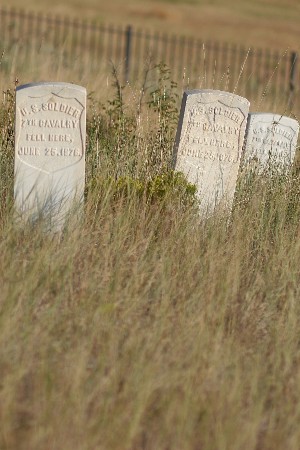
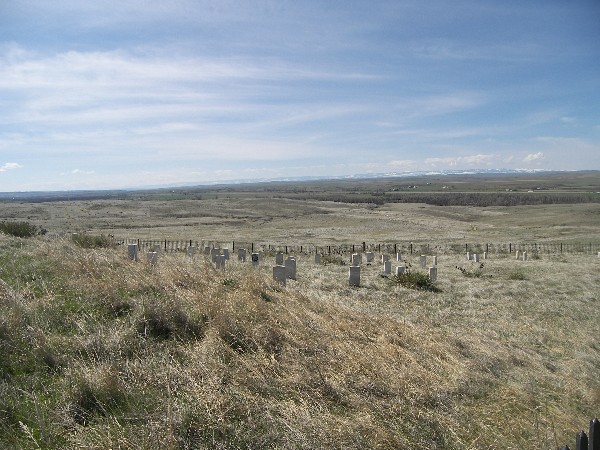
A few years ago my family took a two-week, multi-state driving vacation across the West and I at last had the opportunity to visit the famous battleground in Montana. After having heard and read (and seen so many bad movies) of the battle I was expecting to be a little underwhelmed by the reality. Instead I was mesmerized by how well the area had been preserved and made into a national park. You can follow a road from place to place throughout the battlefield, easily following the course of the battle across the bluffs and ravines of the valley of the Big Horn. The 7th Cavalry soldiers were buried where they fell when the other troops arrived two days after the battle. When the bodies were recovered a few years later for re-burial, individual markers were placed for each, in some cases even providing the name and rank of the man who fell there.

Because the battleground is so preserved you can understand how manageable the size of the Indian camp (obscured by a stand of trees) may have appeared to Custer from his initial vantage point, and experience for yourself (almost) the shock Reno had to of felt when he led his force along the river and around those trees only to suddenly see thousands of teepees. Besides the soldiers’ markers, historians have also been able to survey the battleground in detail after a massive grass fire cleared the area down to the ground in the 1980s, revealing artifacts and human remains and even making it possible to track individual weapons (identified by their spent cartridge casings) as they moved around the field. You can follow the main body of Custer’s troops after the initial attack as they fought their way westward along a ridge (individual markers along the way) to “Custer Hill”, the site of the the famous “last stand” where they fell to the last man.


The last stand on Custer Hill. Lt. Col. George A. Custer’s marker is the one with the black background.

The day we were there it was incredibly hot; the car thermometer registered an outside temperature of 105 degrees. My wife and daughters were more interested in staying in the car than in understanding the place. Frankly, I could feel the sweat rolling down my face and between my should-blades as I stood at various locations, but I couldn’t help but feel the weight of the history as well as I slowly turned my head to scan each panorama, picturing myself in the midst of the markers, seeing nothing but roiling clouds of dust and Sioux surrounding me. It’s mind-bending (or it could have been incipient heat stroke). I highly recommend making the stop if you’re ever in the vicinity.

I’ll also recommend the video below. The song is “The Song of Crazy Horse” and is from an album that I had in college. The ballad itself took up the whole first side of the album, and is only excerpted in this video, though it was obviously created with some love by the YouTube submitter. The song has always stirred me, even though some of the lyrics aren’t up to the caliber of the story. The imagery, however, and certain musical passages have long been grooved in my memory. It’s certainly not one of the better chapters of our history (and I don’t mean the battle itself) but it’s certainly worth remembering, even 132 years later.

Gone into the night

by the Night Writer

When my wife became a police chaplain we knew we could expect some tense calls in the middle of the night since chaplains are commonly called on for death notifications. We didn’t expect that the first call she received would be for someone we know.

Joe was the kind of guy for whom guardrails were invented. Life had thrown him a few curves and he had a tendency to get a little wide through these at times, drifting out on the edges where the traction can be treacherous. The same age as me, he was whippet thin and had a look about his eyes that suggested a dog that had been kicked too many times. There was no doubt he had been.

Kick a dog, or a man, often enough and he can get mean. That wasn’t Joe. There was still a level of optimism, trust and forgiveness in him despite all that he had been through. Some of it was the rub-your-neck admission of the things he knew he had brought on himself, and some of it was a faith that things were inevitably going to get better. He loved his wife, he loved his kids, he loved riding his motorcycle.

His father left home when Joe was two; he didn’t see him again for more than 30 years. Once when he had had the opportunity and inclination to do the same thing he pointed his bike toward the open road, but couldn’t, wouldn’t do it. Bad company and bad choices had often been his reality, but there had also been a share of good choices when he said, “I’m turning around.”

Including that most important time, that time when he looked into Hell and said, “I’m turning around.”

Monday night was a lovely night for a ride, and one of the few things he could afford right now. He and a friend set out into the darkness and at some point he found one last, non-metaphorical guard rail. His shattered wrist watch said 12:15. Our phone rang not long after. Another chaplain had received the original call-out and gone to the house, but when he arrived Joe’s wife had asked for Marjorie.

Today a wisp of a song played through my mind, over and over. An older song, sung by someone who shares my name, called “Midnight Wind”.

There are dreams that fly in the midnight wind
Souls that cry in the midnight wind
Lovers who try in the midnight wind
You and I in the midnight wind

Sometimes…you can see, feel the edge coming. And sometimes it drops away from you without warning. You, and I, in the midnight wind.

Whoa-ooh here it comes: The Manival #9

Wouldn’t you just know it, it’s the shortest night of the year and I’m hosting Manival #9. What does the summer solstice have to do with anything? Well, since I’m the Night Writer, that means this is the shortest window of opportunity for me all year — and there were 36 entries into this week’s carnival to be read, reviewed, accepted or rejected!

I’ve tried to make it easier for readers to sort through these by organizing the posts into categories and providing a brief description of each article (or maybe just to prove that I read them all). There are 22 linked here; the ones that were excluded were also interesting and well-written but were eliminated for one of two reasons. 1) Multiple submissions from the same blogger (I didn’t know until I hosted that the Manival limits you to one post per person per week). 2) The topic was interesting, but not “manly” enough; that is, the topic was general enough to be relevant for a large audience, but not specifically geared toward men. That sounds arbitrary (because it is), but hey — my week, my call.

EDITOR’S CHOICE
I was having a tough time picking a favorite from so many worthy entries but, wouldn’t you know, the last entry under the wire blew me away. Man Up: Power by Corey at The Simple Marriage Project. Read it first, or read it last, and see if you don’t agree.

PARENTING
On the parenting front, David B. Bohl examines The Difference Between a Dad and a Father on his Slow Down Fast blog.

Tony Chen gets “in the zone” with Tiger Woods and I are Pretty Similar over at SavvyDaddy.

Charlie Kondek goes from Thomas the Tank Engine to “Infinity and Beyond” in examining how his son is learning to distinguish good and evil in Daddy, What Does Evil Mean? at Virile Lit.

Totally Consumed is totally touching in Father to Son: an open letter on leadership.

Dad of Divas offers the thoughtful post Time In a Bottle, reminding us that no one has yet figured out how to get that time to stay in the bottle.

Babbo examines the dark twists on the path to enlightenment in his post Was Buddha a Schmuck? over at Daddy Brain.

Oh boy, just in time for the Solstice, Derek offers 10 Things To Do With Your Kids This Summer from the Man Page. (The article link works fine, just don’t try to go directly to his blog’s home page because the stupid Bill Engvall audio file will crash your browser – or at least it did to mine, repeatedly. But I’m not bitter. Update: Derek fixed the site, click away).

Inspired by these, I’ll link to one of my older posts about a painful, but valuable, lesson my daughters and I learned in Duty is Ours. Results are God’s.

GUY STUFF & MANLINESS
Looking to beat a manly retreat from the hustle and bustle of daily life? James Hills has a series of posts on “Man Trips” or “mancations”, including a review and interview regarding a Stogies and Sticks golf package at the Arizona Biltmore, on his Man Tripping blog.

Dr. Awesome keeps the Male Bag, I mean, Mail Bag, open with another advice column, this time on the topic of what qualify as manly Careers. (Advance warning, male hairdressers may want to start calling themselves “hair wranglers”.) You can check it out on To Every Man a Manswer.

I think you can expect Russ to fully accept any bouquets or brickbats that might come his way from his Accepting Responsibility post over on Escaping Enlightenment.

Doug Rutter asks a question: do you want to “have” kids or “raise” kids in his post Koke has Man Shoes on his self-named blog.

Kevin submitted a couple of good selections for this week’s Manival, but I chose his tribute to Tim Russert, not because of it’s timeliness but because the inspiration Kevin received is timeless. (While you’re on the Return to Manliness blog you might want to look around for his “Top 10 First Date Conversations.”)

With a blog named Stormbringer’s Thunder, and his own straight-forward manly name, you can be sure Bob has little time for sissies in his post What About the Guys? (Bob seems like the kind of guy who never got in touch with his feminine side, probably because of a restraining order it took out on him).

Dustin at dBlogit gave me two posts to choose from and I selected Why Men Hate Chick Flicks And How to Avoid Watching Them. Though some of his criticisms of chick-flick cliches could also apply to more manly buddy-type action flicks, the clincher is he also offers great escapes for when a chick-flick appears inevitable.

There’s a reason the classic TV show Home Improvement featured tools prominently: tools are manly. Andrew from Primer magazine submits a list of the 10 Tools Every Man Should Have, so make sure you’ve got what it takes.

MARRIAGE AND RELATIONSHIPS
The Manival has a fine tradition of including “How To” posts. This week Cory Huff has some great advice on “how to shoot yourself in the foot” with The Ultimate Guide To Winning An Argument With Your Spouse at A Good Husband.

A wise man I know often says, “You can be happy, or you can be right.” Hayden Tompkins carves a trail for you over similar ground in How to De-Escalate Your Marriage at Persistent Illusion.

I beg your pardon; may I suggest you read Use Your Manners by A Husband on the I Am Husband blog? Thank you.

OTHERS
Andrew Scotchmer has to literally walk the talk (or talk the walk) as he uncovers the benefits of becoming bilingual in Do You, Parlez-Vous? at Complete Kaizen. (And no, GSL – Grunting as a Second Language – doesn’t count).

GP offers a great photo and a reflection that dreams — and grace — do come true in a post entitled Zen of the West.

If you’d like to be part of Manival #10 submit your blog article using the Manival submission form.

The zero lottery

by the Night Writer

A few weeks ago my wife and I were playing golf with some folks from New Jersey, lifelong East-coasters enjoying a little of the Midwestern experience. During the round a tornado siren went off, startling and somewhat confusing our guests, who wanted to know what the siren was for.

“It’s either a tornado warning or lightening in the vicinity,” I said, as I matter-of-factly dialed the clubhouse on my cellphone to get more details since the day was still clear and sunny. Ultimately it turned out that this warning was related to the storm that delivered a deadly tornado on the town of Hugo, MN, a dozen miles away from where we were. As we played golf we saw the skies darken and the ominous clouds coming, remarkably, from opposite directions. It was pretty much standard summer fare for my wife and I (we didn’t know until later that evening of the net effects of the storm), but our friends from Jersey seemed to find it rather amazing that people live in a place where deadly storms are a routine part of your existence.

Of course, Nature (as far as we know) hasn’t sworn to wipe us out.

I thought of this example the other day as I read Yaacov Ben Moshe’s post from Breath of the Beast entitled Welcome to Sderot.

Sderot is an Israeli town within range of Hamas rockets and the victim of the leadership policies of both the Israeli government and that of Hamas that requires a macabre calculus of acceptable losses that keeps both groups of leaders in power … while killing Jewish civilians. Hamas knows that launching rockets on a slow but steady basis, but killing only a few at a time will maintain its political power base with the jihadis, satisfy its foreign sponsors, while not seriously exposing itself to all out countermeasures from Israel.

Simultaneously, Israel’s government tacitly accepts a handful of deaths as being below the threshold of requiring dramatic and deadly response, knowing that it will be pilloried by foreign public opinion and seen as the aggressor if it does so. Ben Moshe cites JINSA (Jewish Institute for National Security Affairs) Report 781:

“For Hamas, the key is to keep the rocket attacks below an understood threshold and Israel’s response will be tolerable, precise and produce minimal collateral (Palestinian) damage. The Hamas pattern is to fire one, two or three rockets at Sderot. Wait a few days and do it again. Injure two, three, four Israelis. Kill one or two, but not more than that – this week. Increase the range and accuracy of the rockets incrementally. Hit Ashkelon, but just once. Then wait. Hit a shopping center, but if no one is killed, the Israeli response is unlikely to threaten Hamas rule. If Israel does retaliate, the world will probably be more annoyed by the “disproportionate response” than the original rocket attack.”

Ben Moshe continues:

As I was reading, though, something was bothering me. I was still stuck on the seemingly more limited issue of the terror involved. Who are these people who are being killed by the rockets? How do they live knowing that, only if some, unspecified number of them of them are killed and maimed, will their government be moved to do something about the terror under which they live? This dangerous and painful situation is only partially a product of the Arab/Islamist dream of annihilation of Israel. It is made possible by a combination of ruthless internal enemies (e.g. the far left peace movement), clueless dupes (e.g. Olmert, Livni, et al) and shortsighted erstwhile foreign “friends” who do not understand the reality of the threat. This motley assortment of fools and instigators hold Israel’s defense establishment, her regard for her own citizens and, indeed, her very moral, civic, ethical and intellectual integrity hostage.

His point, or part of it, is that the Israeli government has decided that the greater good for the country, or for itself, is to sacrifice a few for the perceived benefit of the many. Ben Moshe’s thoughts as he dwelt on this lead to a chilling analogy:

When Shirley Jackson’s famous short story The Lottery was first published sixty years ago in the June 26, 1948 edition of The New Yorker magazine, it set off the most violent reaction the magazine had ever experienced. In the story, the reader is gradually drawn into a nightmare- as what seems to be a “normal” American farming village gathers for some sort of annual community gathering. There is a lottery involved and little by little it becomes apparent that it is a “selection process”. The reader’s curiosity gives way to bemusement as the author quietly seeds in ominous details that build a sense of foreboding. Then, near the end of the story there is a sudden shift to horror when we realize that the “slightly too” nonchalant dialogue and mysterious references have been leading up to the revelation of a sacrificial rite. One person in the community is chosen by lottery to be stoned to death- sacrificed for “the good of all”.

It is little wonder that the story caused the explosion of controversy that it did. A scant three years after World War II, the cataclysmic battle against totalitarianism, here was a story that hinted that the enemy was not dead, but could lie ever so close beneath the surface in the most unlikely of places. Is this lottery totalitarianism? I think it is. It is a society that holds itself hostage in a suicide pact. The eerily believable rationalization that the lottery must be carried out because the welfare of the group is everything- the individual is nothing- is the brutal signature of fascism.

The weird, unconvincing quality of the “reason” that stoning one member of the community to death is “for the good of all” is also a dead giveaway. It is true that an oblique reference to the sacrifice having a good effect on the corn is made but there is a dispiriting vagueness about it and nobody seems to endorse it convincingly. In fact, the agricultural pretext is really irrelevant. The central drama of The Lottery is the absence of individual human value. In my post about Islamofascism, I quoted Louis Menand (ironically, writing in the New Yorker), “official ideology can be, and usually is, absurd on its face, and known to be absurd by the leaders who preach it.” This is another hallmark of totalitarian systems. These lottery victims are the moral equivalent of suicide bombers, human shields and hostages. They have no power to achieve anything. Their own genuine emotions and aspirations are anathema to the system in which they live. Only their annihilation is of value. Every one of them is a martyr- most of them just aren’t dead yet. They are, in every sense imaginable, dead men walking.

…The people of Sderot listen for the sirens all day and all night 365 days a year and all must wonder if today is the day that a rocket will come through the ceiling in a busy dining hall or a kindergarten classroom or a high school auditorium and finally be “enough” to force the government to use the power it has always had- but may not always retain- to eliminate the threat. They wait for the government to act. They pray for the rest of the world to recoil in horror. They face each day with bravery and hope. Just like the people in Jackson’s story, they are hostages.

Ben Moshe goes on to remark on Muslim mathematicians having developed the concept of zero, observing with grim irony that, “…at least under the most fundamental application of their religion-as-political-system, zero is the human condition.”

If there was outrage in 1948 over the publication of that short story, how could there not be outrage today when an Israeli government dares Hamas to kill one more Israeli and see what happens and when they do, dares them to kill another one. Over and over again the children of Sderot draw lots and when one of them is torn apart by ball bearings or has a leg blown off, what happens? Is it somehow “for the good of all” that they suffer?

Is it too far a leap to suggest that, of all the grim ironies, the most insidious is that of the West’s blindness to its own willingness to trade blood for peace, to cutting off fingers and feeding them to dogs under the table so as not to upset the place-settings?

Do you believe that it is about The Nakba or The Occupation or The Settlements? Do you allow yourself the fantasy that there is a way to stop the madness- a sacrifice big enough to satisfy this ravenous cult?

Then what did the innocent victims die for on 9/11- or Madrid- or London- the Darfur? This is part of the same grotesque lottery that has been going on for 1500 years. In spite of the sacrifice of the innocent victims of 9/11, it is all too easy for us to deny that we are hostages too, but those “zero beings” from the Islamist void will not be happy to delete only Israel. They have “selected” them for annihilation first but it is nothing personal, you understand, just a sacrifice to prove there is no value to human life. There is no value to anything that does not affirm the spiritual vacuum of Islamism. It is not because they worship Allah, nor is it is that they believe Mohammed was a prophet. It is that they believe that he was the only prophet, that they know the absolute truth and that it is their mission to ignore (and destroy) all evidence to the contrary. If you believe in life, liberty and the pursuit of happiness, they will not rest until they destroy you too.

The Jihadists are not interested in cease-fires or peace. They are happy to tell you what they want. They want the world to live under Shari’a law. They believe that anyone that doesn’t want that is sub-human and deserves to be killed. This is nothing less than another confrontation with the evil of fascist, totalitarianism, and that is a beast whose hunger cannot be sated with souls, nor can its thirst be slaked with blood. The lottery they are holding is to determine not if you will be destroyed but when you will be destroyed. We are all citizens of Sderot- its just that most of us don’t know it yet.

This type of post is hardly my forte. Grasping the political, economic and military realities of this situation is something my friend Jeff Kouba does much better than I. I know, however, that Yaacov Ben Moshe is hardly an unbiased observer, or without his own agenda. Even discounting for his perspective, I still finding myself counting my fingers.

Something Manly This Way Comes

I’ve been asked to play host to Manival #9 next week. Use the link here if you have a post from your blog that you’d like to share that has insight, humor or edification (or all three!) on the ways of men. You need to send these to me by Monday, as the Manival rides on Tuesday!

I’ve found a lot of new and interesting blogs by participating in this carnival. It’s been surprising and encouraging to see how many men are using their talents and keyboards to inform, entertain and encourage other men and women. Apparently I’m not the only one that has noticed. The Pioneer Press ran an article this week about The Art of Manliness
Dad Gone Mad
Gunfighter: A Modern Warrior’s Life
A Good Husband
The Man Page
The Simple Marriage Project
DaddyBrain
To Every Man a Manswer
I Am Husband
Stormbringer’s Thunder
Manmail