Vampire Weekend doesn’t suck

by the Night Writer

And now, as the man said, time for something completely different.

There were those weekends in my college days when my work and social schedule resulted in me essentially being up all night and trying to sleep all day. Those days are what I thought of when I first heard anyone talk about the band Vampire Weekend a couple of years ago; I figured they were a college band with a schedule like mine. Otherwise I didn’t pay much attention to them or hear any of their music since I don’t listen to pop radio much anymore. I was somewhat aware of them as the trendy flavor of the month with some people but my curiousity wasn’t really piqued.

A few weeks ago, however, I read a review of their new album, Contra, and the reviewer described their interesting rhythms and sound as somewhat reminiscent of Paul Simon’s “Rhythm of the Saints” or work by Peter Gabriel and Afro-Celt Sound System. Since those are all favorites of mine I decided to sample the album via iTunes and was a bit surprised to find out I liked what I heard. Yes, there are Gabriel/Afro-Celt sounds on the album but the music is brighter and more upbeat and with a Martha’s Vineyard kind of vibe. It’s preppy and poppy almost to the point of being dismissed, but then some new rhythm line comes blowing in to bounce the mullygrubs out of you.

Most of the songs are pretty short, about three minutes as in the old days of pop radio, and the lyrics are pretty spare. I think the words from a typical song would fit into a tweet with characters left over, but that doesn’t mean they can’t be beguiling or just off-the-wall enough to make you do an aural double-take. The first song I listened to, in fact, started out with the two lines “In December, drinking horchata, I look psychotic in my balaclava.” I mean, don’t you just have to know what comes after that? The other songs I sampled were also appealing so I took the somewhat impulsive step of blowing the $25 iTunes gift certificate I got for Christmas on Vampire Weekend’s self-titled first album and Contra. I have to say, I wasn’t disappointed. In fact, whatever disappointment you might be feeling in your life right now, VM may likely cure it with their rhythm and verve. (Wait a minute, make that “Rhythm & Verve” and I’ve coined a new music term – move over Alan Freed!)

So, anyway, I’m not going to try and analyze their music or message, or go song-by-song through their collection opining on contrapuntal constructions and sugar-coated schadenfreude or the socio-artistic relevance of their oeuvre. This is purely happy stuff, and you can take a free listen for yourself here. Just take your shoes off before you do, or at least loosen them. I guarantee your toes are going to want to tap.

The band also bears the Tiger Lilly stamp of approval. Perhaps she’ll add her own thoughts here as well.

No need to spin this

by the Night Writer

It’s not a big deal in the grand scheme of things, but there is considerable brouhaha in the PGA where one pro, Scott McCarron, has essentially accused other pros, most prominently Phil Mickelson, of cheating by using illegal clubs.

The issue stems from the PGA’s new rule this year outlawing clubs (especially wedges) with deep, square grooves. These grooves are what help an accomplished golfer (not myself) put greater spin on a ball so that it’s easier to keep the ball on the green. Due to a long-ago lawsuit the PGA settled with club manufacturer Ping, however, the PGA is not allowed to outlaw a particular older model of Ping wedge which features these grooves. Mickelson and some others continue to use this “legal” club, and it is this that McCarron is criticizing.

Technically, the Ping wedges aren’t illegal, but that’s because of the settlement, not their design. By the spirit of the new rules, however, the club is in violation and clearly gives those who use it an advantage. It’s not too dissimilar from the the days in Major League Baseball when the steroids weren’t officially banned. Golf is different from baseball, however, in many ways and one of the most essential is not just the premiium, but the mandate, the sport places on honesty and integrity. Golfers are expected to, and routinely do, call penalties on themselves or gamely accept their punishment if found to have inadvertently violated a rule, even when the infraction was for something picayune that barely created an advantage.

I’m not saying that all of those years when golfers could legally use the square-grooved wedges should be erased from the record books. These clubs were vetted and approved at the time. Now that the rules have changed, and are clear, Mickelson, et al, should honor the intent of the rule and the spirit of integrity the game calls for. If not, every dollar they earn this year should come with a big, fat asterisk beside it.

Sergeant York, in his own words

by the Night Writer

Last week Mitch had a discussion going about the best movies you’d use to teach someone from another country about America. It was a great discussion and quite an impressive list. One that I suggested that was largely overlooked by the others is Sergeant York, the 1941 Gary Cooper classic (he won an Oscar) about the Tennessee ruffian who had a profound religious conversion that changed his life and his outlook, and who then had to struggle with his faith and duty when drafted into the Army in World War I.

He didn’t believe it was right for him to kill others but after a day of seeking God’s will (prayer and fasting is implied in the film) he decided he should fight. He went on to become the most celebrated U.S. soldier of the war, single-handedly using his sharp-shooting skills to force more than 130 Germans to surrender to him and the decimated remains of his unit. True to his character, he turned down the glittering celebrity opportunities offered to him by the government and his fame. I’ve used Sergeant York as part of the Fundamentals in Film class that I’ve taught to teen-age boys, and the lessons from it are about faith, repentance, honor and humility.

Coincidentally, a couple of days after the on-line discussion I received an email from someone who wasn’t part of that forum, with an excerpt from York’s diary describing the events of the day that led to his Medal of Honor. Here’s the description in his own words from his diary and, I think, from a message he delivered:

Continue reading

Little boy lost?

by the Night Writer

How old do you feel?

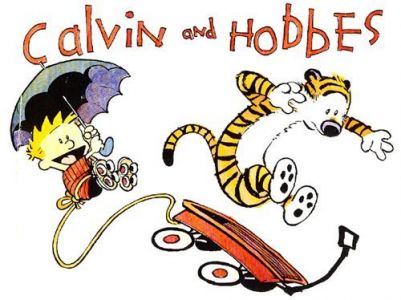
How old would you feel if I told you it has been a little more than 14 years since the last Calvin and Hobbes comic strip (December 31, 1995) appeared? Well, before you fall out of your rocking chair you might want to check out this link to a new interview with the reclusive C&H creator Bill Watterson in today’s Cleveland Plain Dealer. You may also be please to know that the U.S. Postal Service will issue a Calvin and Hobbes stamp this summer in honor of this iconic comic strip.

calvin_hobbes

It’s hard for me to believe that the strip has been so long, and hard not to think that our world is the poorer for it’s loss. Of course, it’s not really gone since the books are still readily available and Google turns up a multitude of (legally questionable) images. As Watterson notes in his interview, it’s probably better that the strip went away while it was still hitting its stride rather than limping on into irrelevancy or bloated, cynical repetition (Calvin and Garfield, anyone?). The strip was a perfect combination of art and entertainment with an inspired premise — a stuffed tiger that was alive only when alone with Calvin — and boundless creativity nearly as unconstrained as Calvin himself.

And, behind the chuckles, it was an often profound and poignant look into the mind of an active boy in an increasingly “Sit down!” world. Boys are naturally energetic and imaginative, quaities that are non-conducive to factory schools. In my day I was fortunate enough to have teachers who recognized this and found ways to constructively challenge and channel our exuberance and hyper synapses. From what I hear and read today, and the studies I’ve seen, it appears the current approach to boys is to dope them with drugs or stupefy them with routine, slowing the brains and deadening any love for learning.

It was fun to see Calvin wage hopeless war against well-meaning but hapless orthodoxy, and hope that there was a brilliant man inside him, waiting to come out. Today we no longer have Calvin the cartoon; I hope to God we have not lost the character.

Catherine

by the Night Writer

The last of my grandparents, my maternal grandmother, is fading away. I don’t know if she will last until I, too, become a grandparent later this summer. Her tiny frame shrinks a little more each day, her grasp on time and place as shaky as her fingers trying to take hold of a coffee cup. She’s 93, and so restless she won’t stay in her room at the nursing home, setting out in her wheelchair at all hours, or thinking that she just got back from another town some distance away.

I can’t blame her. If I was in her place and had a single thought it would be “What am I doing here?” I don’t know that I could shake the sense that I belonged someplace else, someplace I couldn’t quite remember, or someplace I had heard about, or someplace just a little bit beyond the hazy cloud wall in my mind, someplace…just …not here.

My mother holds her hand, holds her own breath. Holds the memories of all that has been, holds off the thoughts of what will be. When we are babies our parents hold us, carry us, anticipate our needs for rest, for food, for a change because we have no words for what bothers us. When dissatisfied, or frightened, we wail and our parents make comforting noises. Long years later, the children sit and anticipate the needs of the parent , who may have the means to speak, even if it is only to ask “Why?”, and the response, again, is comforting noises.

I don’t know “why”. I wish I did. Or perhaps I don’t. At some point this summer I will lean over a crib and say, “Sh-sh-sh-sh, it’s all right.” And I will think of another time, and another place, and I will think of a poem I read recently.

Susanna
by Anne Porter

Nobody in the hospital
Could tell the age
Of the old woman who
Was called Susanna

I knew she spoke some English
And that she was an immigrant
Out of a little country
Trampled by armies

Because she had no visitors
I would stop by to see her
But she was always sleeping

All I could do
Was to get out her comb
And carefully untangle
The tangles in her hair

One day I was beside her
When she woke up
Opening small dark eyes
Of a surprising clearness

She looked at me and said
You want to know the truth?
I answered Yes

She said it’s something that
My mother told me

There’s not a single inch
Of our whole body
That the Lord does not love

She then went back to sleep.


“Susanna” by Anne Porter, from Living Things: Collected Poems. © Zoland Books, 2006

Songs of innocence and experience

by the Night Writer

Riding into work this morning my iTouch randomly played Richard Thompson’s version of “Oops…I Did it Again”; the kind of off-beat juxtaposition I tend to like in my music selections. It also brought back the clear memory from nine or ten years ago of driving my oldest daughter, her cousin, two of their friends and my youngest daughter to Valley Fair amusement park one fine summer morning. The four older girls were just barely into their teens and greatly enamoured with Britney’s original version of that song. Squeezed into my wife’s Mercury, they were singing the song and doing the accompanying hand motions, forming little halos over their heads as they sang, “Sent from above…I’m not that innocent.” Even then the words made my heart ache a little bit.

Ironically, or perhaps cosmically, the next song that came up on my Touch was Mindy Smith’s Hard to Know,

I really didn’t care
‘Cause I was trying to hurt myself
A sticky situation
I’m still trying to work it out

And I didn’t want to know
That I was the one to blame
Pointing my finger
Tryin’ to push all the blame away

Sometimes it’s hard to know
That you need to be saved
‘Til you hit the bottom
And rattle that cage
Sometimes you just gotta keep
Digging away
Until you break through
To the light of day

Since that long ago day on the road to Valley Fair I’ve nearly lost track of one of the four older girls, while two of them have gotten married (one now pregnant) and the other girl lived with her underemployed boyfriend, got pregnant, and has moved back with her baby to live with her parents. A couple of years ago she landed an opportunity to get a job paying $16 an hour, but she needed to go to a week-long training program first. The training site wasn’t far from where I work and her father asked me if I could drive her in the mornings. Sure I could. I’d go to the designated spot to pick her up and I’d see the boyfriend drop her off and drive away in his vehicle with one of those small, temporary tires on one wheel. Each day. A couple of days into the training her father called me to say that she was feeling ill and wouldn’t be able to make it that day. I bit my lip, then my tongue, and picked her up the next morning as scheduled. I gently told her how important it was to make a good impression in a new position and how little things such as just showing up when you’re expected can make you stand out from most others of her age and with her experience. She seemed to understand, but later in the week she missed another day … and was terminated, much to her distress.

When I hear “Oops, I Did it Again” (and couldn’t that be the theme song for all of us?) I always end up thinking about “innocence” and what it means. An Innocent is someone who is unaware or uninformed about some aspect of life, who doesn’t see the sometimes dark aspects of things that are largely bright and wonderful. Such ones can often find themselves caught in the snares of others or find their attempts to cast snares of their own sundered. Ah well, there are easy ways to learn a lesson and there are hard ways, but the important thing is that one learns. As a father, though, I am all too aware that I have to ultimately send my daughters out into the world of wolves while desiring that they be as wise as serpents and as innocent as doves. It’s a difficult assignment, finding the way to expose them to just the right amount of fire that will temper them without searing or burning them.

On that same trip to Valley Fair the young Tiger Lilly, who was about six then, stayed with me while the older girls were allowed to run off in their pack. The two of us rode the more age appropriate thrill rides as we made our way through the park. At one point as we were leaving one place I turned to latch a tricky gate behind me while Tiger Lilly ran ahead, not realizing I had stopped. When I turned back around she was already out of sight in the summer crowd. On full alert I jumped up on a nearby 3-foot retaining wall to get a better vantage point, my eyes peeled for a flash of orange hair. I didn’t have far to look because she had only gone about 60 feet before realizing that I wasn’t behind her. Her immediate distress at this revelation caught the attention of a passing woman who stopped to help. They both looked my way as I came down off the wall and steamed through the crowd in their direction like a dreadnought parting the waves. “I bet that’s your father right there,” the woman said. Indeed.

I don’t know if that memory has stayed with her, but I think that Tiger Lilly and her sister have always had a sense that I’d be nearby, flying cover (in word if not in person) while they ventured, ready to swoop if needed. How valuable is that to their confidence, decision-making and sense of security? I suppose it’s impossible to quantify though many may seek to diminish it. I only know — now that one is an adult and the other acts more adult than some grown-ups I know — that I wouldn’t have wanted to try it any other way.

Women’s Media Center unclear on the concept of free speech

by the Night Writer

While you might argue how “free” the speech is if it costs $2.5 million, we have another example today of the so-called progressive left’s unique views on the freedom of expression: if they hate what you have to say then it must be “hate” speech and banned. The latest case in point is the call by the Women’s Media Center and the National Organization for (Some) Women for CBS to ban a pro-life ad featuring Tim Tebow and his mother from this year’s Super Bowl.

CBS Corp. said Tuesday it had received numerous e-mails — both critical and supportive — since a coalition of women’s groups began a protest campaign Monday against the ad, which the critics say will use Tebow and his mother to convey an anti-abortion message.


Funded by the conservative Christian group Focus on the Family, the 30-second ad is expected to recount the story of Pam Tebow’s pregnancy in 1987. After getting sick during a mission trip to the Philippines, she ignored a recommendation by doctors to abort her fifth child. She later gave birth to Tim, who won the 2007 Heisman Trophy and helped his Florida team win two BCS championships.

Well, I mean, the nerve of the Tebows to use their personal true story. And I thought the left was supposed to be the “reality-based” community. Or not.

On Monday, a coalition led by the New York-based Women’s Media Center, with backing from the National Organization for Women, the Feminist Majority Foundation and other groups, urged CBS to scrap the Tebow ad.


“An ad that uses sports to divide rather than to unite has no place in the biggest national sports event of the year — an event designed to bring Americans together,” said Jehmu Greene, president of the media center.

This is an event designed to bring Americans together? Well, at least they didn’t say “it’s for the children.” I wonder, however, how an inspirational message of hope and potential is considered “divisive” while a strident attempt to shut someone up isn’t? Perhaps it’s just another example where they’re unclear on the concept. It’s worth noting here that last year NBC did ban a similar themed commercial about how a baby was born into a broken home, abandoned by his father, raised by his mother … and went on to become the first African-American president. You might have remembered this commercial…if you’d been allowed to see it:

Anyway, kudos to another network, CBS, for reconsidering its position on not allowing advocacy advertising. Perhaps they recognize their responsibility, or perhaps they merely listened to their shareholders who were advocating that they not turn down a couple of million dollars. (The network did note that if some group wanted to respond to the ad there were still some advertising slots available.)

As today’s news story indicates, there have been more than a few people who are hailing, not damning, the network’s decision. It’s possible that the women’s groups will recognize they may have over-stepped with the public. If so, I expect they’ll rephrase their protest in terms of how much good Focus on the Family’s $2.5 million could have done for the poor — especially poor children — if it hadn’t been wasted on some frivolous game. If that complaint sounds familiar it may be because you have heard it before (John 12:5) . At which point it will be my turn to say, “It’s for the children.”

Going “my way” or the “highway” and avoiding the ditches. Part 2

by the Night Writer

ELINOR: Surely you don’t compare your conduct with his?

MARIANNE: No. I compare it with what it ought to have been. I compare it with yours.

— from “Sense and Sensibility”

In Part 1 I outlined the reasons and the need to pursue self-development, but also the risks of emulating someone who’s life may turn out to be not that exemplary or even all that helpful. If your role model swerves into behaviors or beliefs that make you uncomfortable it can be very liberating — or very disillusioning. What standard do you use in determining if you’re being led into exciting new revelation or into an old deception merely packaged in a new way?

Well, the Apostle Paul knew the “one simple secret” long before all those acai berry ads started popping up on websites. Since I didn’t come up with it myself, I’ll let you have it for free: “Imitate me as I imitate Christ.” (1 Corinthians 11:1) Well, maybe that isn’t so simple, but at least it’s short. Do you see, however, the three-way relationship implied in just those few words?

The premise is that a healthy Christian life is one where we try to be more like Christ and that process involves a 3-way relationship: one, follow Christ; two, follow someone more experienced as they “imitate Christ”; and three, help someone less experienced along the same road. Ideally this means that all three people in the process — the person who’s disciple I am, myself, and the person(s) I’m discipling — are all looking to Christ as our ultimate example while being guided by another. The external standard is critical because without one — or without a relationship with someone to hold us accountable to that standard — we can easily lie to ourselves about how we’re doing, or cut ourselves some slack, thinking no one’s going to know. We can also lose the critical awareness of considering the impact our actions will have on someone else.

That’s not to say that this process hasn’t been abused, especially within a Christian setting. We all can think of cases where religious leaders, in large groups or small, have disastrously led their disciples astray. In the instances that come to my mind, however, the leader lost sight of imitating Christ; not surprisingly, the followers soon forgot that part of it as well. The focus needs to be on the leader and the follower living up to an ideal beyond themselves. Then, if you truly imitate Paul, you should in turn be trying to set an example for someone else to follow as well. That means people should see something worth emulating in your life; you should see something worth emulating in someone else’s.

A discipleship relationship is an accountable one where each party essentially says, “examine my life.” There has to be accountability in the relationship for it to be true discipleship. You have to be in regular contact. I don’t think you can have this kind of relationship with someone you only see on TV or hear on the radio — or read on-line. You may be inspired by what you see, hear or read, but there isn’t a relationship or any personal exchange between you unless there’s regular two-way contact of some kind. If you’re a disciple, you have to say that you are and you show that you are by doing what the other does.

For the “leader” it is an awesome responsibility to live consistently to your standard and being willing to have your actions watched and judged. That alone is enough to make many shy away from the responsibility. Conversely, or perversely, there are some who don’t mind receiving the attention or being in the spotlight. To be a true leader, however, you can’t be focused on what you can get out of it, you have to be concerned about helping other people benefit.

Being a leader, however, is not an agreement to live “perfectly” or to never miss it. It is, however, the willingness to say, unabashedly, that this is what I am pursuing, this is how I’ve benefited by doing so, learn from the victories I’ve achieved and the mistakes I’ve made, and will continue to make.” Probably the purest and most natural discipleship responsibility and opportunity we have is in raising our children, and yet a number of people will not step up to this mantle and standard and be that kind of example in front of their kids — it’s easier to leave it to the schools, the teachers, the youth pastors, the television, the peers — and so much easier to lay the blame on these when the time comes.

For the disciple the hurdle is being willing to acknowledge the lack in your life, recognizing that there is a difference between you and the person you would emulate (as the first step in seeing how different your life is from Christ) and in humility saying, “I’m not what I should be, please help me.” It’s difficult to make that admission out loud or even to ourselves, even when we see the need. Again, it’s far easier to say to ourselves, “I’m not really so bad or that far off; I’m certainly not missing it as much as some people.”

I’ve seen it time after time in people who find themselves in desperate enough straits where their fear overcomes their pride and they cry out for help, receive relief and support in the present crisis, but draw back from the opportunity to make the kind of long-term commitment in their lives that can give them the wherewithal to survive or even avoid the future storms, let alone help someone else get out of the same type of situation. Part of the reluctance is due to the perception of giving up one’s will or admitting a weakness (really it’s just admitting it to yourself; God — and likely everyone else — already sees it). The rest of the reluctance comes from exposing yourself so that your life can be examined — both by the person you would emulate and by the ones in the future that you should, in turn, be discipling.

In a superficial, self-centered world personal development becomes a self-directed way of trying to fill a void that makes us feel bad about ourselves. It can be the spiritual equivalent of being like those who undergo serial surgeries and injections in the hope or belief that if their noses or waists were smaller, or their lips or busts larger, or their tummy more tucked or their thighs more adducted they will at last be happy. And then, if they’re not happy, there must be some other procedure that’s required. Well, except for that one little extra procedure (and the next, and the next) that’s required to be truly happy.

The soulish equivalent is saying this year I’ll become a vegetarian, next year go vegan, and the following year become a raw vegan and then I’ll be a Better Person. All of it seems to be aimed at exalting the self, while a Christian, discipleship approach is about the denial of self. No, not the false humility of outward spirituality or the use of literal or metaphorical hair-shirts to mortify the flesh while taking pride in the process, but seeking a greater revelation of how small one is in the scheme of God, but still how precious.

If our objective is to become like Christ, what does that really mean? What will it look like? Ultimately, can it be achieved by our reaching up, or by God reaching back? Consider this excerpt from Dietrich Bonhoeffer’s book, Ethics:

Christ remains the only one who forms. Christian people do not form the world with their ideas. Rather, Christ forms human beings to a form the same as Christ’s own. However, just as the form of Christ is misperceived where he is understood essentially as the teacher of a pious and good life, so formation of human beings is also wrongly understood where one sees it only as guidance for a pious and good life.

Yes, we all want to be “good” people, but our perception is that if we can just focus on getting all the “bad” things out of our lives then all that will be left will be “good”. Or we think that if we can just do everything the “right” way we will be transformed. Either way — in reference to Romans 8:12 — we are trying to conform ourselves to the world as we see it, using our standard to set and measure goals, rather than being transformed by the revelation of Christ in us.

Christ is the one who has become human, who was crucified, and who is risen, as confessed by the Christian faith…To be conformed to the one who has become human – that is what being really human means…All superhumanity, all efforts to outgrow one’s nature as human, all struggle to be heroic or a demigod, all fall away from a person here, because they are untrue.

It’s not that seeking to improve ourselves is wrong or unnatural; it’s just that thinking we can do it ourselves leads us into one ditch or another. In the one ditch we can become obsessed with obtaining a perfection beyond ourselves through perfect man-made doctrines or by our pursuits. The other ditch, however, is to think that we’re irredeemably base and corrupt. What’s missing is the revelation that our elevation isn’t about us reaching for God, but about God reaching for us; it’s God sending Christ to make a way for us and in us.

The real human being is the object neither of contempt nor of deification, but the object of the love of God…To be conformed with the one who became human means that we may be the human beings that we really are. Pretension, hypocrisy, compulsion, forcing oneself to be something different, better, more ideal than one is – all are abolished. God loves the real human being. God became a real human being.

While it is God that does the drawing and shaping, it is clear from scripture that he puts others in our life to facilitate this — both to help us to learn and to help us teach others. It’s not something we do on our own, and church is an important part of the process. Again, however, we have to realize that we tend to put the focus in the wrong place. Just as when we think self-development is the be-all and end-all of our improvement, we can think that just getting to church is the objective.

Don’t let your time spent in church define your religious life or level of commitment. Jesus actually spent very little time in synagogues but was out and about with people, eating, teaching, healing, sometimes to large groups but often to individuals. That does not mean we don’t have to go to church, however. Church is an important place to go to be taught, to receive ministry ourselves and to encourage other believers but ultimately it should prepare us to act in a Christ-like way when we leave the building. From that perspective, church should be the starting point, not the culmination of our spiritual week. Modern discipleship appears to be focused on getting people into church; our objective ought to be getting the Church out to people.

When Jesus spoke the Great Commission in Matthew 28 he said “go and make disciples of all nations”. He didn’t say, “get them into your church so you can disciple them.” But that’s a subject for another essay.

A Catskill eagle soars away

by the Night Writer

“…and there is a Catskill eagle in some souls that can alike dive down into the blackest gorges, and soar out of them again and become invisible in the sunny spaces. And even if he forever flies within the gorge, that gorge is in the mountains; so that even in his lowest swoop the mountain eagle is still higher than the other birds upon the plain, even though they soar.”

— Herman Melville

I’m just about finished with Part 2 of “Going My Way or the Highway, and Avoiding the Ditches” and hope to have that up later tonight or sometime tomorrow. I must, however, pause to take note of the passing today of author Robert B. Parker. Parker was the modern master of the hard-boiled, wise-cracking detective and a prolific writer, cranking out something like three novels a year. I first came across his Spenser series back in the early 80’s and it became my second-favorite all-time detective/adventure series behind John D. MacDonald’s Travis McGee. Parker also created two other mystery series for protagonists Jesse Stone and Sunny Randall, and wrote some pretty successful westerns (one of which, Appaloosa, was made into a movie). His books were the basis for the mid-80s TV series Spenser for Hire (a show that totally impressed me with the perfect casting of Robert Urich and Avery Brooks, who looked almost exactly as I had pictured Spenser and Hawk in my mind’s eye when reading the stories).

Some will dismiss the detective mystery genre as inconsequential, but the best of it features compelling characters, a lot of chewy philosophy and a rugged worldview. Among those who write at this level, Robert B. Parker is that Catskill eagle who, even when he swoops low, remains higher than any other. While some of his later books were rather formulaic (though very entertaining), he had a style and a philosophy that was engaging and even educational. A Catskill Eagle is, of course, also the title of one of the Spenser novels, and in my mind a seminal one. It is the book in the series that simultaneously turns the Spenser character into a darker, but also more hopeful, hero.

I first got hooked on mysteries by reading Raymond Chandler stories and novels and when I came upon the early Spensers I was thrilled with Parker’s revival of the smart-mouthed, hard on the outside, soft on the inside detective. In addition to engaging in wisecracks, cultural commentary, compelling plots and PG-13 sex, Spenser shared details on manly gourment cooking and sharp dressing. As the book series went on it seemed to me that the plots became less intricate and the main characters spoke almost in a kind of shorthand meant for old friends and regular readers. Meanwhile, the “Parker code” became as much of a character in the stories as Spenser, Susan and Hawk. The code was essentially Parker’s “a man’s gotta do what a man’s gotta do” philosophy of honor, duty and obligation that was understood by Spenser and Hawk and eventually by Susan. I could describe it as a Spenser code except that it was there, big as life — unspoken-word for un-spoken word — in two of Parker’s westerns; Gunman’s Rhapsody and Appaloosa (it’s probably in Brimstone and Resolution as well, but I haven’t gotten around to reading these yet. It was almost anachronistic, and I can’t say I bought it completely (in fact, I almost wrote an essay once on where I disagreed with it) but it was part and parcel of the Parker experience. Parker/Spenser himself probably recognized the limits of the philosophy but would have stuck with it anyway out of loyalty. In a way, while I should be quoting Parker, I think his view of it and faith in it is more like the speech that Uncle Hub gave in the movie Second-hand Lions:

Sometimes the things that may or may not be true are the things that a man needs to believe in the most. That people are basically good; that honor, courage and virtue mean everything; that power and money, money and power mean nothing; that good always triumphs over evil. And I want you to remember this, that love…true love…never dies. You remember that, boy. Doesn’t matter if they’re true or not because those are the things worth believing in.

Perhaps the first book where the code began to come to the fore (I’ve read all the books but I’m not at a place where I can write a thesis) is Early Autumn where Spenser takes a confused teen-age boy under his wing and shows him what it means to be a man. As I said, it’s not a perfect code, but it’s better than most.

It was fitting when Parker took on the project to complete Chandler’s unfinished novel, Poodle Springs, and did it seamlessly, allowing Chandler and Marlowe to live on into a new generation. Similarly, there may be posthumous Parker manuscripts. Parker was 77 years old, but still maintaining his writing pace. Reports are that he was found dead at his writing desk this morning by his wife when she returned from her morning run. He has another book that’s due out in a couple of months, and reportedly there are two finished but unpublished Spenser manuscripts set aside as well.

I’ll keep my eyes open for those when they come out, and I plan to go back and re-read some of the early Spensers and keep my eyes open for the new works (I may have missed one of the newer releases), and I may look up the two westerns I haven’t read. Robert B. Parker has been a significant part of my life and has influenced my thinking and writing in ways that I may not even be aware of. Though I know how the old books end, and know the formula so well as to predict the plots and outcomes of the newer ones, I think it’s important to revisit these.

After all, a man’s got to do what a man’s got to do.

Going “my way”, or the “highway”, while avoiding the ditches. Part 1

by the Night Writer

Note: if you’re looking for the Monday Anorex[st]ic Inaneymous, scroll down to the next post.

About this time last year, an emerging star and influential blogger in the Self Development field announced that his personal journey had brought him to such heights of self-awareness and emotional and spiritual development that it was unnatural for him to be constrained within the bounds of traditional marriage. He was therefore eager to explore polyamory, with his wife’s full support and his own confidence that it would have a positive affect on his two young children. Not surprisingly, he was divorced (or in the process of divorcing) before the year was out. Now, this month, he has just announced how excited he is about the transcendent growth opportunities he’s discovering in the world of sexual bondage and domination. Boy, I bet you just can’t wait for next December’s Christmas letter, eh?

No, I’m not going to name this yutz and send any traffic his way should you have any morbid curiosity in watching a family and career go through the wringer, or in reading comments from people who think that his critics are unevolved, unenlightened dumb people. I bring it up because this is the time of year when folks like to make resolutions and set objectives for the coming year. The desire to improve one’s self, or to overcome a debilitating habit, is natural and laudable; especially if one is able to summon the will-power and self-discipline to reach that objective.

Sometimes that might be something personal and prosaic such as losing weight or getting in shape. Other times we set more ambitious objectives to not just change our habits but to renew our minds and think in healthier, less self-destructive ways. Often in doing so we find ourselves wanting to emulate some successful person, whether they’ve got a new diet, a new book or a new-found reason for celebrity. While the “Be Like Mike” Nike campaign was a branding breakthrough in 1992, it tapped into a much-older human tendency to naturally want to mimic the fashions, behavior and over-all “cool” of those we admire. “If I could only be like him (or her)” is an underlying theme of a lot of advertising.

That’s because it sells a lot of soap — or books for that matter, especially in the self-help or personal development areas where we’re especially eager to find some here-to-fore secret, but nevertheless easy, way to be better than we are. Or, as one person I admire says, “Different isn’t always better, but better is always different.”

The problem with picking a guide for your personal development journey is finding someone “authentic” whose character and charisma transcends the hype of Hollywood celebrities or the perfectly groomed PR profiles of captains of industry. But how do we know we’re following a leader and not a billboard? As with the case cited above, what if the moral compass of the person we’re following gets so distorted by the magnetic pull of his or her own ego and lusts that we both lose sight of true north? (One thing that will happen is we’ll likely be told that true north is only outdated thinking that no “smart” person believes exists anymore, anyway.)

Given the potential for abuse, I might question a person’s ultimate motives for setting out on such a quest or series of quests, and what standard he or she is going to use to measure progress. I want to ask, “Is this all for your own benefit or for the benefit of others?”

Well, duh, it is called “personal development” after all, and one pretty much takes it as a matter of faith that if I am happy then those around me will be happy, too. I mean, that’s what the commercials always seem to promise, right? Speaking of faith, perhaps another question to ask about motives is, “Are you doing it in the hopes of evolving yourself into a better, even god-like, human — or have you considered simply becoming more like God?”

As humans, we will naturally find ourselves influenced by someone’s teaching or example; in fact, it’s virtually impossible not to be unless you’re one of the minuscule percentage who is truly an original thinker. If we’re Christians, however, our examples would ideally help us be more “Christian” — the term that was first used by those in Antioch to describe that weird new sect of people who were “Christ-like”. Whether secular or religious, however, what standards do we use in determining who is a good leader or example, or evaluate our own ability to lead or be an example to others? Following a religious leader is not necessarily any better or safer than following some new age guru. Recent and ancient history are rife with disastrous examples. Mindlessly following anyone because of a few signs and wonders (or best-selling books and appearances on Oprah) is dangerous. While the popular stereotype of Christians as superstitious idiots is all around us, I believe that a true Christian walk engages and stimulates us intellectually as well as spiritually. After all, Romans 12:2 tell us to renew our minds, not chuck them overboard.

I believe there is a proven model that improves not just our own lives and enables us to improve the lives of others, with built-in fail-safes that will keep us from ending up dead in some jungle or blowing ourselves up in a market. What is it? Check back on Tuesday for Part 2.