Friday Fundamentals in Film: The Tin Star

The Tin Star is another western and my personal favorite from this genre. I selected it for this series because, while it has similar themes of honor and duty as in High Noon, it adds an element of what the world today calls “mentoring” but I call “discipleship”.

The story involves a wizened and jaded bounty hunter, Morgan (Morg) Hickman, played by Henry Fonda, who rides into town with his latest “dead or alive” target, who is distinctly in the former category. While Morg would just as soon get paid and get out of town, he has to wait around a few days while the local bank gets confirmation in order to release the money. Morg’s claim naturally brings him into contact with the town sheriff, Ben Owens (Anthony Perkins), a young and idealistic man filling in as a temporary replacement for his recently murdered predecessor. Ben is eager to be a force for law and order in the town (despite his girlfriend’s objections) and tries to make up for what he lacks in experience with bravado and passion. He finds Morg’s work disgusting and doesn’t approve of killing, even if it’s a bad guy.

Nevertheless, the two hit it off as Morg, a former sheriff, sees something of his less jaded self in Ben, while Ben (after an unexpected demonstration in the streets) admires Morg’s experience and ability to size up a situation and react appropriately. When Ben learns Morg used to be a sheriff he asks him for help in learning how to do the job effectively and stay alive. Morg reluctantly agrees since he has to hang around for a few days anyway and he sees that young Ben has a lot to learn.

Of course, it turns out to be a pretty eventful few days as Ben has to deal both with a rabble-rousing, power-hungry bigot who wants the sheriff’s job for himself, as well as the murder of a much-beloved citizen and a lynch-mob that wants to exact its own justice. Throughout the process Ben learns that a fast brain is more important than a fast gun and Morg learns simply that some things are just more important, period. Along with that you see an interesting illustration of bullies and mob dynamics. There’s also the pusillanimous townspeople with high-minded notions of justice but ultimately wanting peace at any price (which inadvertently became a sub-theme in this series as it appears in this movie, in High Noon and in a later movie we’ll look at as well).

While the action and drama centers around Morg and Ben, the kindly Doc McCord (John McIntyre) also sets an example of service and selflessness that is easily overlooked by the viewer, perhaps because he’s an “old” guy. When I discussed the movie with the class I went around the room and asked each lad who he thought the best man in the movie was. Some said Morg, some said Ben; none said Doc McCord so we had a fruitful discussion about his character traits as well. Here’s the rest of the outline the boys and I went through:

Key Points:
The importance of discipleship: being willing to receive it, and being willing to provide it.

The importance of will in separating a leader from a follower.

The importance of character (and vision/understanding of a cause or ideal beyond yourself) in separating a leader for good from a leader for evil.

The Rule of Law is worth defending, even at great personal cost.

Some Questions to Answer:

  1. Why did Ben want to be Sheriff? Can you come up with four words that describe his character?
  2. Why did Bogardes want to be Sheriff? What words describe his character? (Does he remind you of anybody?)
  3. Why did the crowd want to follow him?
  4. What is the most important “tool” a Sheriff needs to know how to use?
  5. Why was Bogardes almost able to get the drop on Ben the first time?
  6. Why was it important that the McGaffy brothers get a fair trial even though it was obvious they were guilty?
  7. Why wouldn’t Morg accept the badge at first? Why did he put it on later?
  8. Were Morg’s reasons for turning his back on being a sheriff justified?

Points to Ponder:
Compare and contrast Morg and Ben with Will Kane (High Noon).

  1. What role could faith have played in Morg’s life?
  2. Why does a mob behave the way it does?
  3. What would you do?
  4. Who was the best man in the movie?

Friday Fundamentals in Film: Zulu

The second movie in the series for the boys was the classic “Zulu“, starring a very slender Michael Caine in, I think, his first movie. It’s based on the true story of barely 100 British soldier’s standing alone against some 10,000 Zulu warriors in the battle of Roark’s Drift the day after a much larger British force had been wiped out by the same Zulu army.

I selected this movie for the boys not only because it is an example of courage in the face of great odds, but because it shows the value of discipline as preparation for unseen and unknown challenges in the future.

While there are many real life stories of heroes rising to the occasion on a moment’s notice, many times this is possible because the “hero” has spent considerable time learning to master his/her fear and will. In this movie both sides show a tremendous amount of discipline under great stress and in the face of carnage. Additionally this is an interesting examination of the way prejudice and disrespect is reflected not only between races, but even within the same race and society.

Here are the key points I wanted the young men to get out of this movie and ensuing discussion:
Courage and discipline in the face of extreme odds can carry the day.

The power of words to both encourage and discourage.

The importance of training and discipline, combined with character and courage, in making it possible to rise to an occasion when called upon.

Overcoming differences in order to work together for success.

Courage and tenacity will win the respect of your enemy.

Complaining when you find yourself in a tough situation isn’t going to help you resolve that situation.

The questions:

  1. Was Rev. Witt’s use of scripture appropriate? Why or why not?
  2. How did each army demonstrate discipline?
  3. How many forms of prejudice were demonstrated in the movie?
  4. Why did Lt. Bromhead say at one point that he wished he “were not an officer and a gentleman?”
  5. What was the nature of the relationship between Sgt. Maxfield (the sick man in the infirmary) and Private Hook? Why did each behave as he did?
  6. The way Color Sergeant Bourne conducted himself hardly changed regardless of what was happening around him. Why do you think he was so unflappable?

Great Quotes:
Chard: “Hold our ground? What military genius came up with that? Someone’s son and heir who got his commission before he could shave?”
Bromhead: “I rather expect he’s no one’s son and heir now.”

Bromhead: “When you assume command, Old Boy, you’re on your own.”

Soldier: “Why us?”
Color Sergeant Vaughn: “Because we’re here lad. No one else. Just us.”

Food for thought

Night daughter Tiger Lilly has a post called “Can You Put God in a Box?” over on the MAWB Squad today about Operation Christmas Child and her approach to filling shoeboxes with gifts for children in crisis areas. Among other things she writes that she likes doing stuff with charity organizations.

I can easily vouch for that sentiment because I remember a time when she was six years old. It was about this time of year and she was flipping through the newspaper looking for the comics when she came across a large ad from the Union Gospel Mission in St. Paul. The ad featured a picture of a ragged looking, bearded man with a full plate of food and a headline that said for $1.79 you could buy someone a full Thanksgiving dinner. She studied that for awhile and then asked if you could really get all that food for that amount of money. I told her it was so. A dawning realization came over her, and she said, “Hey, I’ve got $1.79 – I could buy someone dinner!” To prove it she went upstairs and brought down her stash, pulling out a crumpled bill and counting out 79 cents.

My heart in my throat, I tested her by asked whether she was sure she didn’t want to save her money to buy something else. It was such a rush then to see her respond so naturally and spontaneously that I now can’t remember her response word for word, but it was along the lines that no, she’d rather see somebody get something to eat for Thanksgiving. So a little while later she crammed the money in her pocket and I took her down to the mission where she could give it directly to a friend of our family who was serving as a chaplain there. She brought out her cash, he thanked her and gave her a receipt. I wrote out a check worth a few more dinners and we floated home.

Her $1.79 warmed more than one heart that year.

Friday Fundamentals in Film: High Noon

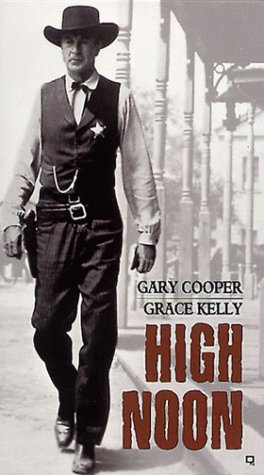
It seems that most of the television and movies kids are exposed to today don’t offer much in the way of constructive lessons or examples of how to live your life, especially for young men. Well, just about everything is an example I guess, but good ones are few and far between. There are some movies, new and old, that do offer inspiring examples and over the next few Fridays I’d like to share some of these with you, along with the story of how they were incorporated into a group of junior high and high school aged boys. The first movie in this series is the Gary Cooper classic, High Noon, but before I get into that allow me to offer a little background.

A couple of years ago my oldest daughter was still in private school and I found myself frequently in the company of the boys in her classes. Listening to their conversation and the things that were interesting to them I could tell that the images of manhood they were getting from their entertainment were rather limited: essentially either Homer Simpson or pro wrestlers, and this was showing up in their behavior.

Now this is a complex age for boys already, and these images they were absorbing weren’t helpful. I wanted better for their lives, especially since they were around my daughter, so I tried to think of a way both entertaining and challenging to offer examples to model character in concentrated doses. Almost immediately a plan developed nearly fully formed in my mind. I worked it out with the school and my employer so that I could show a series of movies (with discussion time after each) to the boys on Friday afternoons during the spring semester as part of an elective class where the boys would be graded. Naturally, an afternoon of watching movies was appealing to the lads, but there was a catch. I divided them into two teams, gave each boy a scorecard I designed and announced special rules, only for them.

In order to view that week’s movie, each boy would have to earn a set number of points on his scorecard. The card detailed the point values of various acts of service and courtesy they could earn. There was also a list of things with point values that would subtract from their totals. If a young man hadn’t earned the minimum number of points by class time, he’d have to spend the afternoon in a study hall or in classes with the girls. Not only that, his behavior also affected his team which not only got credit for all points earned by its members, but also for having a full complement present during class time. At the end of the semester the highest scoring team would be treated to a Famous Dave’s feast. In the coming weeks I’ll describe how this experiment played out, along with providing the questions and “thinking points” I brought up with the guys for each movie. If you’re already familiar with these movies then try the questions out yourself. If there are important issues you think I’ve missed in any of the films then feel free to leave your input in a comment. As with the young men, I hope you’ll find this exercise entertaining and useful.

My first Meme ever!

I saw this on the EckerNet (who got it from Kathy the Cake Eater) and couldn’t resist.

The Average American?
The Average American meets a number of criteria. Let’s see how I measure up.

Eats peanut butter at least once a week.
Heck no! Peanut butter is nasty!

Prefers smooth peanut butter over chunky.
Ok, if I have to eat peanut butter, it has to be chunky. I’m serious.

Can name all Three Stooges
Moe, Curly, and … that other one.

Lives within a 20-minute drive of a Wal-Mart.
Question: Does anyone not live within twenty minutes of a Walmart?

Eats at McDonald’s at least once a year.
Only if the alternative is starvation. Have you seen “Supersize Me”?

Takes a shower for approximately 10.4 minutes a day.
No comment.

Never sings in the shower.
I think that this question is wrong. It should be:
Never admits to singing in the shower.

Lives in a house, not an apartment or condominium. Has a home valued between $100,000 and $300,000
Yes, and no, respectively.

Has fired a gun.
Ooooohh, yeah.

Is between 5 feet and 6 feet tall.
Duh

Weighs 135 to 205.
Not even soaking wet, with my gun, in my boot.

Is between the ages of 18 and 53.
Haha!! Just shy.

Believes gambling is an acceptable entertainment option.
Actually, I think it’s really lame, though I do play poker with Starburst wrappers.

Grew up within 50 miles of current home.
Not grown up yet, but more mature than many!

So, I guess I am the very un-average American.
That’s fine with me. I’ve always known I was different.

Superior, Minnesota

I usually leave the fisking of Nick Coleman, Doug Grow and the other StarTribune columnists to others. One reason is that I usually ignore their columns as part of my own “quality of life” commitment. A second reason is that I try to use outrage in modest doses as leavening in this blog rather than as a main course. And a third big reason, of course is that, as the Night Writer, by the time I’ve sat down at my computer to blog in the evening these columns have already been fisked to within an inch of their lives by others in the MOB so I turn to other topics.

Earlier this a.m., however, I grabbed a section of yesterday’s Strib to catch the debris as I trimmed my beard. It turned out to be the Metro section – or what they now call “twin cities + region”. Avid reader that I am, I found myself reading through the section before completing my grooming, which certainly made it easier to trim my hackles.

Mr. Coleman had a follow-up on the 11-year-old girl who died mysteriously last week; Mr. Grow was offering a tribute to a strip club doorman who died young. There was also a short AP article about a woman who just finished a 154-mile walk to the state capital to deliver petitions demanding a constitutional amendment requiring affordable health care. Oh, and there was an article about bars in Minneapolis trying to figure out how to hold onto what’s left of their smoking clientele in Minneapolis after the onset of the bar-smoking bans and winter.

Individually, each article had more than enough to get Mitch, Foot, Marcus and some others salivating. Taken as a whole, however, there was a certain ironic pattern that caused me to alter my pre-breakfast routine. Can you detect it?

Yo-ho and avast, there still be pirates — and why you might care

I saw an article today in the StarTribune, Miami-based Cruise Ship Attacked by Pirates off Somalia, and it reminded me of a book I read last year by John S. Burnett entitled Dangerous Waters.

It’s an excellent and eye-opening read about a subject most people think has become quaint: high seas piracy. Burnett was motivated to research and write the book after his own small boat was boarded and robbed. While you won’t find much in the way of masted ships flying the Jolly Roger looking for easy pickings today, the reality is that the basics of piracy in the 17th century and today are still in place: slow-moving, lightly-guarded ships loaded with valuable cargo in international waters with little controlling authority — and a large, international pool of people greedy enough, or desperate enough, that have access to fast boats and weaponry and little fear of being caught. In fact, about all that’s changed is the technology. Galleons have been replaced by high-speed boats; cannons replaced with rocket-propelled grenades; cutlasses with Uzis.

While this (literally) cut-throat business has never really gone away, even in the age of high-tech navies, it is mostly invisible because it doesn’t affect our lives in many noticeable ways. As Burnett points out, however, piracy today can easily lead to a serious and confounding global problem.

One of the most pirate-infested areas today is the Malacca Straits. While the location might not be as colorful-sounding as, say, the Caribbean and you might be a little vague on the geography, the Malacca Straits are a very important little body of water. They link the Indian and Pacific Oceans and are the shortest sea route between India, China and Indonesia. They are filled with shallow reefs and tiny islands and there are only narrow channels available for the nearly 1000 ships – mostly cargo ships and oil tankers – that pass through each day like slow, fat fish in a barrel. Heavy traffic in narrow confines makes for relatively easy pickings for pirates in “smash and grab” types of raids (board, loot any crew and passengers, take electronics and other valuables from the bridge and beat it to a nearby hideout or fishing village). Sometimes, however, this results in tanker or cargo crews being tied up and their ships left to plow on out of control through a highly congested area. It doesn’t take much imagination to think of the effects that a grounding or sinking of a tanker in this area could have on this vital commercial thoroughfare. Here’s some of what the above link about the straits has to say:

The narrowest point of this shipping lane is the Phillips Channel in the Singapore Strait, which is only 1.5 miles wide at its narrowest point. This creates a natural bottleneck, with the potential for a collision, grounding, or oil spill (in addition, piracy has historically been a regular occurrence in the Singapore Strait, but over the past 15 years has grown alarmingly). Some 400 shipping lines and 700 ports worldwide rely on the Malacca and Singapore straits to get to the Singapore port. For example, 80% of Japan’s oil comes from the Middle East via the Malacca Straits. To skip the straits would force a ship to travel an extra 994 miles from the Gulf. All excess capacity of the world fleet might be absorbed, with the effect strongest for crude oil shipments and dry bulk such as coal. Closure of the Strait of Malacca would immediately raise freight rates worldwide. With Chinese oil imports from the Middle East increasing steadily, the Strait of Malacca is likely to grow in strategic importance in coming years.

Whether through criminal accident or premeditated terrorism (elements of Abu Sayaff and Al Quaida are active in this area), it may be just a matter of time before such an incident fills headlines around the world.

It’s not an unknown threat to people who’s business it is to be concerned with these things, Burnett’s book and others (see below) does a good job of describing the efforts cargo and passenger lines, governments and military forces are making to mitigate the problem while also describing the bureaucratic, political and logistical hurdles they face.

All in all, today’s news story (selected by the Strib perhaps because it was so unusual sounding) highlights an issue we often overlook. If you’re intrigued by this information, Dangerous Waters is a sobering but very interesting read. You might also find the following related books suggested by Amazon of interest:

Jolly Roger With an Uzi: The Rise and Threat of Modern Piracy by Jack A. Gottschalk

Pirates Aboard!: Forty Cases of Piracy Today and What Bluewater Cruisers Can Do About It by Klaus Hympendahl

Maritime Terror: Protecting Your Vessel and Your Crew Against Piracy by Jim Gray

Filings: What can we glean from social justice?

My wife accepted an invitation from a friend of ours and has attended a couple of Social Justice Bible Studies. The invite came out of a conversation she and this friend, a Christian, had about his Kerry/Edwards bumper sticker and his belief that conservative Christians who criticize the federal welfare program aren’t concerned about the poor. To our friend’s way of thinking, this behavior is breaking faith with a fundamental premise of Christianity (and don’t we consider ourselves fundamentalists?).

There are certainly a lot of places where you can begin in taking on that argument, but my wife decided to start by going to the Bible study to hear what they were talking about, in part because she was really curious about what the group meant by “social justice.”

The group’s focus, as I’ve said, is on helping the poor and what we need to do as a nation to rectify this injustice. After my wife’s last visit I was curious as to what scriptures the group was using to support their position that this is the government’s responsibility and not that of the church or of Christians as individuals. The leader that time had cited either Leviticus 19:10 (“And thou shalt not glean thy vineyard, neither shalt thou gather [every] grape of thy vineyard; thou shalt leave them for the poor and stranger: I [am] the LORD your God.”) or Deuteronomy 24:21 (“When thou gatherest the grapes of thy vineyard, thou shalt not glean [it] afterward: it shall be for the stranger, for the fatherless, and for the widow.”)

Well that’s pretty clear direction, but where the leader was missing it, in my opinion, was making the leap that the if people weren’t following that instruction then it became the government’s responsibility — ostensibly from a desire to do good — to pass a law requiring it. Oh, the peril of good intentions (and unintended consequences)!

It’s my take that when you’re trying to determine the nature or intent of God you should look for where the relationship is. Whether with the first Adam or the second, and through all the prophets in between and the apostles that came after, God has shown he is interested in establishing relationships, both between himself and people, and people to people. Now, in the case of the social justice bunch, it may seem like a natural step for God-fearing people to reflect this desire by delegating to their government the authority to act for this good. To me, though, that is also the first step leading to replacing a relationship between God and man with a relationship between man and the other big G – government.

Let’s play out the example of the gleaners. Man, or the church, through hardness of heart, is not leaving the gleanings for the poor. In an effort to be righteous (and concern that others aren’t being righteous enough), people get together and direct the government to pass a law requiring that gleanings be left. Then, if the poor aren’t doing a good enough job of picking up the gleanings (or if the more motivated ones are out-hustling the infirm or indolent) someone gets the bright idea that maybe they should put some of the poor to work collecting the gleanings and bringing the second harvest in where it can be distributed more equitably. If the people hired to do this were among the more ambitious ones mentioned earlier, they soon see that they get the same share no matter how much effort they put in to picking up the food.

Now, before the law was passed a poor man might pray and ask God to help him find the means to feed his family. Coming upon a field just harvested, he might thank God for bringing him to that place and giving him the strength and ability to collect the food his family needed. Maybe even a landowner passes by at that time and sees the man is diligent and offers him a job. After a time of living under the government’s rule, however, that man (or his now grown children) starts to see the law, not God, as his source and the excess harvest as something he’s entitled to; not because he’s a child of God, but simply because he’s poor. Furthermore, bitterness might start to set in and he starts to wonder why the owner of the field gets to have first pick, and why, instead of just leaving what falls during the harvest and what collects in the corners of the field, he can’t start also leaving every third row unharvested for the poor as well. Of course then the government has to hire more people to collect the additional food. The poor man’s belly might be full, but what is in his heart and his spirit? What was the result of all those good intentions?

And what benefit does the landowner get by doing it God’s way in the first place rather than being hard-hearted and subjected to government fiat? Well, certainly less interference in his life on a business level, but he also gains favor with God by following his commands and escapes judgment as well. As I’ve written before, when I stand before God and he asks if I helped the poor I’m not going to get very far saying, “Well, I paid my taxes!” Perhaps the most insidious harm from the welfare state isn’t the trap it creates for those who live from it, but that it disconnects everyone else from realizing their responsibility to get directly involved.

It’s a lesson that bears repeating even for those who are receptive, and I know that I don’t always get high marks on this test. Yet my family has at times taken people into our home, helped other people move into homes, and bought groceries or medical care for those who needed these things. Where possible we’ve also tried to disciple others so they could learn they can trust God and also avoid behaviors that might put them back in the same place. When the time comes when these people have no longer needed direct help from us or our church, we’ve been genuinely happy for their success and progress. If, however, it was my job as a government employee to distribute these things then I’d have to worry that if I was too successful I’d be out of a job myself!

Finally, I give the social justice group credit for wanting to do God’s work. I wonder, however, if they are as quick in desiring that the government enforce by law other scriptural commands such as those dealing with adultery and homosexuality. Perhaps my wife will raise this question at a future meeting. She finds the meetings pretty interesting and the conversation polite even though there are significant differences of interpretation and doctrine between her and a couple of the group leaders. She feels she is getting something out of it by hearing other perspectives, and hopes that the others are also benefiting. She plans to keep going back as long as they’ll have her.

It is, after all, all about relationships.

Update:

Similar thoughts are in this post from Stones Cry Out.

President Bush annnounces avian flu plan

Details here.

The key element in the proposal, in my mind, is the emphasis on developing a vaccine through the use of cell-based cultures rather than in millions of chicken eggs, which has been the standard since the 1950s. The egg process takes nearly a year, as I understand it, while the cell culture method is much faster and allows researchers to move more quickly through various experiments and trials, both for the H5N1 avian virus or for any other strain that may develop.

While it may appear odd that we’ve not made many technological advances in this area over the past few decades – as opposed to, say, digital music media — the fact is there hasn’t been an economic incentive or suitable risk/reward profile — for companies to invest time and money in this area.

“We’re not as well-prepared today as we want to be,” Leavitt said. “We’re better prepared than we were yesterday, and we’ll continue to get better prepared every day as time goes forward.”

…Part of the president’s plan, he said, will deal with what he called “junk lawsuits” that stifle the output of vaccine manufacturers.

“The manufacturers simply refuse to make it if they haven’t got some protection, so that’s part of the president’s plan to provide that type of liability protection,” Leavitt said.

The people I talk to who are closer to the situation say recent developments and the increased awareness world-wide are encouraging and if the H5N1 virus doesn’t mutate to a form easily transferred human-to-human in the next year we will be in a good position to significantly mitigate the threat. If it develops sooner than that then we could be in for a rough time globally. The latest projections from Health and Human Services now predict – in a worst case scenario – up to 1.9 million deaths in the U.S. alone.

Historically, there is a high statistical probability that the world is due for an influenza pandemic of some kind. Whether it turns out to be the bird flu or some other strain, the work that’s being done in revamping research and development capabilities now will pay off.

Halloween Screams

I remember the first time I was going to go trick-or-treating for Halloween. I was four years old and my mom had bought me a black skeleton costume with silver sequined bones on the front that was probably next to invisible in the dark. It had a plastic mask that covered my face and had eye-holes that more or less lined up with where my eyes were. The material was some kind of filmy fabric that probably would have ignited in a warm breeze. (Kids in my generation had to be a lot tougher – or luckier – to survive). And I couldn’t wait to get out there and start hauling in my share of the loot.


When the moment finally arrived to hit the street I impatiently nodded my masked head at my parent’s reminders to be careful and bolted out of our front door like a greyhound out of the starting gate. The slamming sound of the storm door preceded by one and a half seconds the slamming sound of me colliding headfirst with the telephone pole in our front yard. I spent the rest of that hallowed eve tearfully laying flat on my back on the living room sofa with a large goose-egg and an ice-pack on my forehead while countless other kids came to our door for candy. I think the next year I went out as a cowboy.


I did, however, learn early on how important it is to think through a costume idea and I enjoyed the creative aspect of devising each year’s design as I got older until parents at the door started refusing to give candy to the big lug trick-or-treating with the little kids, no matter how clever the costume. The next year I decided to stay home and pass out candy in costume. My first customer of the night, a three-year-old girl in a white fairy princess costume ran screaming for the street and her father when I stuck my monsterized face around the edge of the door at her height. I felt really bad the rest of the night.


In later years when I was old enough to go to grown-up Halloween parties, complete with adult beverages, I reignited my creative muse and quickly added three important ground rules to future costume design: 1) I must be able to sit down while wearing the costume. 2) I must be able to drink while wearing the costume. 3) I must be able to use the bathroom while wearing the costume. Then, once I became a parent, I pretty much got out of the whole costume and Halloween thing. The world was getting weirder and I had more reservations about the underlying spirit behind the evening. We’d normally darken the house and take our kids in their costumes to “Hallelujah Night” at church.


Then, the Halloween after 9/11 I got to thinking that it was better to be out and involved in the neighborhood, and I started a tradition of setting up a firepit in my front yard and serving hot apple cider to the parents who, because of the way our house is positioned, could stand by the fire and watch their kids hit nearly every house around. Every kid that came by got a handful of candy and a “God bless you.” It’s become a popular stop each year since, especially in the years when it’s been very cold and windy.


Last year the folks at my office decided to have a dress-up day and costume contest for the first time. I struggled to regain my muse up until the night before when an idea finally dawned on me. A part of our Division had just been sold off to a company from Scotland. I thought that if I wanted to come up with something really scary, then I should dress up in full kilt regalia. A friend of mine just happened to have the authentic ensemble and let me borrow it. It was a big hit (see photo under “About” in the right sidebar) and I even won a prize. During the potluck lunch, however, I walked by a conference room were a number of our nurse consultants and our HR generalist were eating. The HR lady waved me in and said that she had been working lately on a new dress code, including approved underwear, and she and the group were wondering what… er, umm …a Scotsman might have under his kilt.


I may have blinked twice before responding, in brogue, “Ye mean tae tell me ye’ve no heard of the Loch Ness Monster?”


Great laughter and shrieking ensued, drawing a crowd as I slipped quietly away to the other side of the building … where I could still hear the additional uproar as the incident was recounted to new waves of the curious who had gathered in the conference room.


So, anyway, Monday night I’ll be out front of my house, tending the fire and passing out candy and cider. You can send your kids around, it will be safe. Just tell them not to ask any silly questions.