Riding the tiger: the Reign of Terror

An interesting and illuminating history lesson, courtesy of today’s The Writer’s Almanac. Check out the Wikipedia link in the article below for more details.

It was on this day in 1793 that Maximilien de Robespierre, became the head the Committee of Public Safety, which led to the Reign of Terror in France.

Robespierre had started out as an idealistic lawyer and judge. He was well known for representing poor people in court, and he often spoke out against the absolute authority of the king. Even after he became a public figure in Paris and Versailles, he lived an extremely frugal life. He lived as a lodger in the house of a carpenter. He worked on the first French constitution and fought for universal suffrage. He opposed all forms of religious and racial discrimination, taking the unpopular view that that even Jews and black slaves should be granted full citizenship.

After the French Revolution broke out, Robespierre was elected to the new National Convention, where he called for the execution of the king. He then worked to unify the various splinter groups within the revolution. At the time, France was being threatened by war with Austria. There was also a great fear of civil war breaking out between the various revolutionary factions. In his diary, Robespierre wrote, “What is needed is one single will.”

And so, a man who had fought for constitutional democracy and universal citizenship found himself helping to organize a military dictatorship. On this day in 1793, he took his place on the Committee of Public Safety, which would rule France for the next year. And in order to keep French citizens in line, Robespierre advocated the use of the guillotine, a new machine that was supposed to make all executions efficient and humane. The guillotine was set up in the Place de la Révolution, which later became the Place de la Concorde, and over the next year more than 2,000 people were beheaded for having opposed the Revolution.

At first Robespierre executed people who had supported the monarchy. But then he began to execute revolutionaries who were too moderate. And finally, he began to execute people who had merely opposed him on one issue or another. Eventually, members of the National Convention began to realize that no one was safe, and even they could be the next victims. So they turned on Robespierre. Exactly one year, to the day, after he had taken control of the Committee of Public Safety, he was arrested, and the day after his arrest he went to the guillotine himself.

For more than a year Robespierre had been executing people in the public square to cheering crowds. When Robespierre went to his own death at the guillotine, onlookers said the crowd cheered just as loudly as ever.

To the Max

When I first met my wife I didn’t have much appreciation for art. About the only thing you’d have found on my walls back then was white paint (and food). My favorite artist was the guy who put all the tiny numbers inside the little outlines on the kits I bought as a kid. That may have been because I had a better odds drawing to an inside straight than trying to draw a recognizable picture.

All that aside, today is the birthday (1870) of one of my wife’s all-time favorite artists, Maxfield Parrish. Thanks to her, I’ve also come to appreciate Parrish’s work and I love to look at prints of his dreamlike landscapes and portraits. The unique colors and “glow” in his work are so rich and interesting and it is fun to picture yourself standing (or reclining) in each scene. I even have an outline in my head for a story that I hope to write one day, set in a world that looks like his paintings (I’ve named the woman in the image below “Calla”).

I obviously can’t claim to be too fine in my artistic sensibilities, or unique in my appreciation of Parrish. He’s probably more of a “popular” artist than what the more sophisticated might consider a “master” (at one time in the 20th century it was estimated that one in every four American homes contained a Maxfield Parrish print), but I enjoy the fantastical elements and sense of fun in his paintings and I’ve always had the sense that they were fun for him to paint as well. There are other “popular” artists such as Thomas Kinkade and Terry Redlin who have made luminescence part of their trademark, but it seems to me to be an almost forced quaintness on their part (or at least profitable repetition), rather than something emanating from the artist’s imagination.

Parrish was pretty prolific, but I still wish there was more of his work.

Oz comes to Never-Never land

Amanda Lee Donoho at The Wide Awake Cafe reacts to John Kerry’s statement that the Israeli-Lebanon (actually Israeli-Hezbollah/Syria/Iran) conflict would never have occurred if ““I were president.”. Her post, If Kerry Were King of the Forest features a photo of Bert Lahr as the Cowardly Lion and speculates on what else surely wouldn’t have happened if Kerry were president. Check it out.

Unlike the Cowardly Lion, however, you’d have to say Kerry has some nerve.

Life is sad, believe me Missy,
When you’re born to be a sissy
Without the vim and verve.

But I could change my habits,
Nevermore be scared of rabbits
If I only had the nerve.

I’m afraid there’s no denyin’
I’m just a dandylion
A fate I don’t deserve.

But I could show my prowess,
Be a lion not a mowess
If I only had the nerve.

Oh, I’d be in my stride, a king down to the core
Oh, I’d roar the way I never roared before
And then I’d rrrwoof
And roar some more.

I would show the dinosaurus
Who’s king around the fores’
A king they’d better serve.

Why with my regal beezer,
I could be another Caesar
If I only had the nerve.

Still, what it reminds me of is another famous song from “The Wizard of Oz”, sung to the same tune:

“If I Only Had a Brain.”

Challenging Word of the Week: revanchism

Revanchism

(rih VAN shiz um) noun


Revanche, French for “revenge” has given rise to the noun revanchism, the policy of a nation seeking to regain territory lost to another nation, such as France’s attitude and policy towards Alsace and Lorraine, lost to Prussia after the Franco-Prussian War of 1870-71. The adjective describing the policy is revanchist (rih VAN shist). The revanchist attitude of the Arab states as to territory lost to Israel after the Six Day War of 1967 has played a prominent part in causing the turmoil of the Middle East.


My example: 20th century revanchism described nations seeking to regain territory in Europe and the Middle East. In the 21st century a cultural revanchism can be seen in the reconquista movement promoted by La Raza and others (perhaps nations?).


From the book, “1000 Most Challenging Words” by Norman W. Schur, ©1987 by the Ballantine Reference Library, Random House. I post a weekly “Challenging Words” definition to call more attention to this delightful book and to promote interesting word usage in the blogosphere. I challenge other bloggers to work the current word into a post sometime in the coming week. If you manage to do so, please leave a comment or a link to where I can find it. Previous words in this series can be found under the appropriate Category heading in the right-hand sidebar.

The Producers?

I thought I’d have a new “Friday Fundamentals in Film” post ready for today but time and circumstances worked against me. The next one in the series is imminent, however.

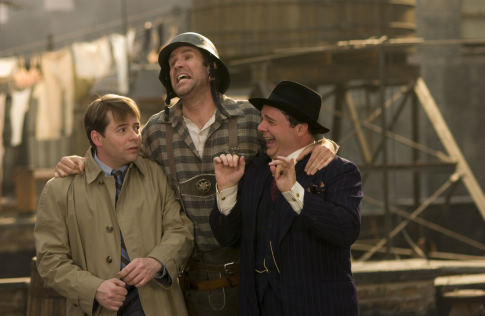
I did, however, recently see a movie that will never make it to the FIF list, but I’ll describe it here as a warning and public service. The movie is The Producers: The Musical, a remake by Mel Brooks of his 1968 comedy classic, with the latest version essentially being a filming of the hit Broadway-musical version of the show.

I ordered the remake from Netflix with both anticipation and trepidation. I loved the original movie and was interested to see how it would look with a real budget, but I was concerned with how it some of my favorite scenes might translate into the modern version. The original was so off-the-wall and unlike anything else I’d ever seen (I don’t think I stumbled across it until the mid-70s) that I’ve always cherished it even though it looked as if it had been written in one weekend and filmed in two. The success of the Broadway version in recent years encouraged me. The fact that I hadn’t noticed the new movie when it was first released to the theaters, however, might have been telling.

The latest version is fast-paced and very slick looking. I will say that I like Nathan Lane as Max Bialystock better than Zero Mostel, but Matthew Broderick as Leo Bloom is no Gene Wilder; in fact, he couldn’t carry Wilder’s blanket. Broderick plays the same whiny nebbish he’s played in The Road to Wellville and The Stepford Wives (a long way from his role as Col. Robert Gould Shaw in Glory). Of course, the role calls for a whiny nebbish, but while Wilder made it funny, Broderick never rises above the annoying.

The best thing the movie did this go-round was to expand the role of Franz Liebkind, the erstwhile Nazi turned playwright. The best and funniest scenes involve Franz, played by Will Ferrell — and I should let you know that I normally cannot abide Will Ferrell. While I missed Dick Shawn as Hitler, the flower-power-hippie role as presented in the original movie obviously was too dated for this version, and updating to a gay parody was inspired. The problem was (as is often the failure with Brooks films) in beating the joke to death. Brooks at his best (Blazing Saddles and Young Frankenstein, imho) sets up the joke, gets the laugh and moves on to the next absurdity. At his worst (e.g., History of the World, Part 1 and Spaceballs – which even so has many funny scenes) you see the joke coming a long way off, it is carried on for way too long, and then repeated again and again. TPTM falls into this bog.

There are some good bits in the new version, and the movie is not bad as a Netflix rental, especially if you keep your expectations low (a service which I hope I have performed).

The fire which time

I’ve been following the story about the fire that’s burning through the Boundary Waters Canoe Area (BWCA) in northern Minnesota. It’s not like it was a big surprise or anything, the situation has been inevitable since a huge windstorm resulted in a massive blow-down of 400,000 acres of trees in 1999. Afterwards any cleanup was stymied by policies and politics. Necrophiliac tree-huggers strongly objected to letting logging companies clean out the deadfall and to the thought of second-hand exhaust from vehicles and chain saws (motors have long been banned from the BWCA) violating the pristine area. Meanwhile the Forest Service pretty much took the position that “Nature created the mess, let her clean it up.”

We were all just waiting for the unavoidable spark, conditioned by years of warnings from Smokey the Bear to dread forest fires and hoping that the inevitable wouldn’t result in a flaming holocaust. Now that it’s here, though, it’s looking as if it won’t be as catastrophic an event as some might have feared (unless you’re a species of endangered wood tick or similar trapped in the thousands of acres burned so far). While the sky in the area may not be as pristine as it was, it is generally acknowledged that an occasional fire is a good and necessary thing for the ecosystem. Or, as Kenneth Mars might have said in Young Frankenstein, “A riot (fire) is a terrible thing. Und I think it is high time ve had one!”

In reading the news, however, I think I’ve seen some similarities between what’s going on in the Boundary Waters and events in the few-boundaries Middle East. Certainly there’s been all kinds of kindling piled up for years in the area and politics and policies have prevented any serious effort to get in there and clean out the fuel. In fact, “controlled burns” of aggressions immediately followed by half-measure mediations have only increased the pressures. Conditioned by years of fears that a fight such as what is happening in Lebanon would lead to World War III, we all held our collective breath at first, but now it is looking as if the result may be clarity instead of calamity. And maybe just what the region needs.

What is interesting (and the reason it hasn’t blown up – yet) is that countries such as Eygpt, Jordan and Saudi Arabia have, for the time being, apparently signed up for the International Don’t Call list and Hezbollah and Hamas are therefore having a hard time getting the “Arab street” to return their calls. Those three countries, and others in the region, have their own reasons for not being too concerned if the Shiites hit the fan if it serves to crimp Iran’s ambitions in the region. Instead, whatever adventurism on the parts of Hamas and Hezbollah may sparked this conflagration, it has literally blown up in their faces.

The problem for a guerilla operation is that it is in trouble when it gets entrenched. Once you, say, actually have a headquarters with a mailing address you can’t assume the old advantages still apply to you. Once your opponent musters the will they’ll be ringing your doorbell like Jehovah Witnesses and you’re going to get ALL the literature whether you like it or not. Similarly, I don’t think the old bail-out tactics are going to work. As long as Israel maintains the momentum and focuses only on southern Lebanon there likely won’t be much in the way of “World Opinion” cavalry to ride in to the rescue. I think the usual players are content to sit back and watch Iran and Syria’s proxies get slapped around a bit, knowing that when’s it all over they, too, will be free of a nuisance and will still have plenty of time to denounce Israel’s aggression.

Collateral damage is inevitable and unfortunate, but the real endangered species is the parasites that have lived off of the blood (and money) of others and used their neighbors as human shields. Still thinking they were playing by the old rules, Hezbollah has said that the only way they’ll lay down their weapons is if you pry them from their cold, dead fingers. Only this time the Israeli response was, “finally, a peace proposal we can support!”

You can’t take it with you — so some one else has to

My grandmother just moved into an assisted-living center. It’s a nice place, the staff is great and she was the one who ultimately decided it was time so everything is generally acceptable. By my count, this is the fourth time she’s moved since she left the house after my grandfather died, and each time she’s had to shuck more things; not an easy thing for someone who’s a bit of a hoarder by nature.

“Use it up, wear it out, make it do or do without,” was the motto of her generation, so nothing was ever parted with lightly. Bales of wire hangers from the dry-cleaners; stacks of empty Cool Whip containers (some even with lids), enough to stage a road show of the “500 Hats of Bartholomew Cubbins with plastic bowls as hats; plus many other treasures with stories that still have some miles left on them. Each move was like peeling off another layer or two of husk and now we’re down to the kernel and cob, with a few wisps of silk. The new place is the smallest yet and she’s down to the essentials, with still a few eccentricities such as the radio that hasn’t worked in no one knows how long. Some things were questioned during the pack-up but there is no one else in the family who can say they know what it is like to walk into a new room and know that it is this far and no further, last stop, and so slack is given.

The things left behind just don’t dissolve away, of course. When I was down there earlier this month Grammy’s previous apartment was still half-full of “things” that needed to be dealt with. It was like preparing for an estate sale, or hearing the reading of the will, but without someone dieing first. Still sad, though. “Dishes are going here, linens with so-and-so. What do you want? What can you take?” It’s almost overwhelming to me, seeing it for the first time, but my parents have been looking at it for weeks.

“What do you want? What can you take?

My wife and daughters and I roam the rooms, lifting, turning, trying to imagine what we might do with this or how we’d use that. For the ladies it’s just so much stuff; there’s little here that they’ve ever seen or had a connection to. I’m using my eyes and my memory, looking for something to take away that has extra meaning. In a closet I find a couple of hats of a kind that my grandfather wore when gardening. My heart races as I pick them up, but they’re just hats. There isn’t any dirt or sweat stains on them, and they don’t smell like him. They’re just hats and I put them back on the shelf. I do end up with a few things, and my daughters find some jewelry they like. Patience finds some hats that look just funky enough for her. Faith picks up some linen napkins and some old lamps for her trousseau – transferring things from this last apartment that will ultimately go in a first apartment. My wife scores some cookie sheets and Tupperware and a huge measuring cup. It is just about all that we can fit in the car, yet it seems as if the stacks left in the rooms are barely diminished. Still plenty of room for ghosts, though, and everything must go eventually.

“What do you want? What can you take, please?”

We all go along all through our lives picking up things we want or have to have, generally parting only with the things that wear out or break down. Sure, we know that certain things are hopelessly out of style, or will never be used again, but we’ll deal with them “later” when we have “more time.” It all stretches out behind and around us as if we’re so many Marleys and we’re all so used to it that we hardly notice. It makes me wonder what my kids will want when I get to that place with no closet space. Will someone take the leather jacket? The golf clubs? The Monty Python tapes?

What will they want? What can they take?

Because Morgan Freeman had already done it once

Samuel L. Jackson will be the voice of God on a new CD version of the New Testament due to be released this September. (HT: Robbo at The Llama Butchers.)

It sounds logical; Morgan Freeman has already played God (and George Burns is dead), and the producers must have liked Jackson’s reading of “I will strike down upon them with great vengeance and furious anger those who attempt to poison and destroy my brother and you will know my name is THE LORD when I lay my vengeance upon you.”

I guess I buy it; about the only person cooler than Samuel L. Jackson is God, but doesn’t it make you kind of wonder who’s been cast for the other roles?

Who’s Satan, Mr. T — or Gilbert Gottfried? (Though I might characterize that voice as being more like Barry White’s.) How about Jon Lovitz as Judas, and William F. Buckley for the Apostle Paul?

As for voicing Jesus himself, Brad Pitt would be great box office, but I’d prefer E.F. Hutton. After all, as the old commercials always said, “When E.F.Hutton talks, people listen.”

Anchors aweigh. Never forget.

There’s an interesting story that’s been going through the emails for a couple of months, but I haven’t read any accounts of it in the blogs. I got around to checking it out and I found out that not only is the story true (and pretty neat), there’s another eerie detail as well.

The main part of the story is that construction is about half-completed on the USS New York, a new amphibious assault ship for the Navy that will be launched next year. There are a couple of details that make this noteworthy: the ship is one of three such craft made to support special operations missions against terrorists, and all three ships bear a name associated with 9/11. The other two ships are the USS Arlington (for the Pentagon) and the USS Somerset (for the county were Flight 93 crashed). The coolest detail is that the New York’s bow is made from 24 tons of scrap steel salvaged from the Twin Towers and reforged. You can read the touching story here.


Artist rendering of USS New York (Northrop Grumman)

While the Navy used to name battleships after states of the union this practice is currently reserved for nuclear submarines, so resurrecting the name for an amphibious assault ship required an exception. In fact, there have been at least seven ships named the USS New York, and the last one was a sub (I know, a sub is really a boat, not a ship).

Here’s the eerie twist: after googling the name of the ship I discovered that prior to the submarine the last USS New York (BB-34) had been a battleship that had seen action in both World Wars. The keel of that battleship was laid on a very interesting date:

September 11, 1911.