The black days of October

Twenty years ago this month the Twins won their first World Series and my wife and I were married. Stellar events to be sure, but in the last week has been a lot said and written about Black Monday — October 19, 1987 — the day the Dow Jones Industrial Average dropped more than 500 points (don’t blame me, I was out of the country on my honeymoon).

Then, just a few days later, another dark day — as noted by this morning’s Writer’s Almanac:

It was on this day in 1987 that the United States Senate rejected the Supreme Court nomination of Robert H. Bork on a 58-to-42 vote. Bork was one of the leaders of a judicial theory called “original intent,” which is the idea that Supreme Court justices can only base their decisions on what the framers of the constitution originally intended. If the constitution doesn’t mention a “right to privacy” then there is no such thing as a “right to privacy.” This idea was controversial, but Bork decided to enter the debate head on, and he openly discussed his constitutional philosophy with the senators. Democrats portrayed him as a radical, and when the final vote of the full Senate came on this day in 1987, Bork was rejected by 58 to 42. Republicans have since argued that Bork was the target of a smear campaign, and they began using his last name as a verb, saying that they wanted to prevent future nominees from getting “borked.” The word “bork” was recently added to Webster’s dictionary, defined as, “[Seeking] to obstruct a political appointment or selection, also to attack a political opponent viciously.” Robert Bork said, “My name became a verb, and I regard that as one form of immortality.”

Several years ago I read Bork’s “Slouching Towards Gomorrah: Modern Liberalism and American Decline.” As the two parts of the title suggest, I found the book an interesting juxtaposition of being both acerbicly entertaining and accessibly academic. Here’s one quote that describes the author’s life path:

In many ways, I understand the Sixties generation because at that stage of life, I reacted similarly. Suburban, middle-class life seemed stifling. Dixieland jazz was my rock and roll. All night partying was my escape, political radicalism my protest. The superintendent of schools in a heavily Republican suburb had to be brought in to prevent me from running an editorial in the high school newspaper calling for the nationalization of industry. Denunciations of bourgeois values rolled easily off my tongue. Fortunately, mine was not a large generation and very few of my high school classmates-none to be precise-felt the same way. There was no critical mass. By the time I got to the University of Chicago, where there were student radicals, I had been in the Marine Corps, an organization well known for teaching the reality principle to its recruits; and the Chicago school of free market economists educated me out of my dreams of socialism. I was fortunate; the Sixties generation was not.

Perfect weather

Crisp, sunny autumn days like last Saturday are great — and as refreshing as biting into a Honeycrisp apple, but there’s a special seasonality to an overcast day in early fall like today.

This morning the sun rose but never shook off its blanket and the gray backdrop was the perfect canvas for the prima donna colors, helping the grass in my yard take on an extra-deep and lush green while the reds, yellows and oranges of the various leaves on the ground and still on the trees competed for attention. I enjoyed driving through my neighborhood, looking at the leaves that had fallen since last weekend’s rakings and, like the children at the bus-stop, resplendent in their new jackets, just waiting.

On days like these it is hard to keep your eyes on the road, but even at that I was rewarded. As I pulled up behind the line of cars waiting to turn left off of the Ayd Mill Road I broke into a smile when I recognized the autumnal glory of red taillights and flashing orange turn-signals in gleaming clarity that would not have been possible on a sunny day. Perfect. Absolutely perfect.

Maybe not so “far and wee…” after all

Courtesy of The Writer’s Almanac, yesterday was the birthday of poet e.e. cummings, known for his unusual punctuation and his way of arranging words and spaces on a page to create a rhythm for his poems. Less well known is that he was also frozen out by the literary and academic communities for being “politically incorrect”:

It’s the birthday of poet E. E. (Edward Estlin) Cummings, born in Cambridge, Massachusetts (1894), who became interested in communism as a young man and traveled to Russia to see it firsthand. He was horrified to find the theaters and museums were full of propaganda, and the people were scared to even talk to each other in public. Everyone was miserable. Cummings went home and wrote about the experience, comparing Russia to Dante’s Inferno.

His view of communism was not popular in the literary world at the time, and magazines suddenly began refusing to publish his work. For the next two decades, he had a hard time publishing his books, and he got terrible reviews when he did. Critics thought his exotic arrangements of words on the page were silly, and they said he wrote like an adolescent. Then, in 1952, his friend Archibald MacLeish got Cummings a temporary post at Harvard, giving a series of lectures. Instead of standing behind the lectern, Cummings sat on the stage, read his poetry aloud, and talked about what it meant to him. The faculty members were embarrassed by his earnestness, but the undergraduates adored him and came to his lectures in droves. He began traveling and giving readings at universities across the country, even though he suffered from terrible back pain, and had to wear a metal brace that he called an “iron maiden.” He loved performing and loved the applause, and the last 10 years of his life were the happiest.

E. E. Cummings said, “If a poet is anybody, he is somebody to whom things made matter very little — somebody who is obsessed by Making.”

Today our theaters and museums (and Nobel nominating committees) are full of propaganda and things such as so-called Fairness Doctrines and Hate Crimes proposals still try to make people afraid to talk to one another. And if your views aren’t acceptable to the gatekeepers at the Ivory Towers you won’t get invited or, if you do, you get food thrown on you.

It’s nice to see how far we’ve come.

In My Father’s House, Part 3

1989 was my first Father’s Day as a dad myself (thanks, Mall Diva). As a first-timer that June I wrote a letter to my father that included the following:

There are things about growing up that can’t be explained to — or understood by — the emerging adult. At those times the elders can only say “Wait until you have kids of your own” to indicate the unseen forces and emotions that will one day come into play. It is an enigmatic, somewhat ominous, prophecy born of instinct, experience and intuition. Given enough words, it can be described but not experienced. Given enough experience, it no longer needs to be described.

The revelation of being a Father, to accept the title that has always belonged to someone else, is almost dizzying. The family armor, passed on for generations, has been taken off the wall and handed to you with your banner. It is your turn.

Some find their armor rusty and decrepit. Corroded by years of venom, its surface has been marred by each coat of blame and accusation they have applied over the years. These men will always find their armor ill-fitting and uncomfortable. Never having learned or cared where the weak points are, they don’t know what parts need to be reinforced, what parts need extra care, what parts need to be protected the most. They clank and creak into battle already spiritually defeated, blaming the previous owner, and scarcely able to defend themselves, let alone carry out their sacred charge. Some even abandon the field completely, leaving it (and the next generation) to the enemy!

Others will be blessed and even surprised to find their armor in good shape, and not nearly as big on them as they thought it would be. Oh, there’s a scratch here, a small dent there, but these only serve to reinforce the necessity of such gear. These men are properly outfitted and equipped, and where necessary they have taken it upon themselves to repair or replace whatever they see missing. Respect, and a good teacher, have kept the pieces oiled and in good working order.

I have been thinking about armor lately; thinking about how it’s something worn on the outside as protection against the things that would pierce or cut us, the mortal thrust to our vitals from an external foe. But what about the poisoned blade that comes from inside?

Think about the wonderful design of our bodies; how they easily and automatically handle the vital chores of our survival: respiration, digestion, circulation, even healing and restoration. From the time we’re in the womb our bodies perform countless tasks dedicated to our survival, including resisting infections and toxic interlopers. In today’s vernacular, you could say our bodies “have our back.” How cruel and crushing, then, for our closest friend and ally to turn on us, for our very own cells to go rogue, even to the point of using our own defenses against us.

And how quickly it can happen! The doctors estimate that from the time my father’s mutinous lymphocytes first went over the wall to the time he was diagnosed with Stage 4 lymphoma (lymphoma in multiple locations above and below the diaphragm) was only about two months; this in a person who was undergoing nearly constant check-ups and monitoring due to a previous bout with prostate cancer and a heart-valve replacement a couple of years ago. What can you do?

Then again, maybe there is an internal armor and a toughness after all. Cancer is an insidious foe that, along with the measures used to combat it, strips away virtually every visible vestige of one’s dignity. I know heart attacks can be devastating and life-changing and leave you weak as a baby, but at least they leave you with your hair. The chemo takes your hair and your appetite and nearly every illusion you have about being in control of your own body. When I was down to see my dad in June he still pretty much looked like himself, but the stress of the pain and the effects of the pain-killing medication caused him to throw up — much to his dismay. “I haven’t thrown up in more than 30 years,” he said. At one point when I went to see him in September he was throwing up every 30 minutes. Rather than lurching into the bathroom each time he had fashioned a bucket from a one-gallon plastic milk jug and used that. The first time I went in to assist my mother he was sitting up in bed, spitting up into the bucket. He was well past the point of feeling embarrassed, he just gave me a matter-of-fact look over the lip of the jug and went about his business.

He’s lost his hair, and more that 40 pounds from a frame that can barely spare it. He’s been poked with needles and IVs so many times the nurses can barely find a vein that won’t collapse and there’s scarcely a bodily function he can perform without an audience, yet he still jokes with the nurses even if his voice sometimes sounds more like his 100-year-old mother’s than his own. He struggles to swallow his food, and to keep it down even when he does, yet he’s drawing sustenance from his will and a determination not to give up no matter what fresh hell the day brings, and doing it with a grace that I never would have expected in him.

We think of armor as being made of metal. Apparently, it has more to do with mettle.

My Twisted Humor

Hey everybody!! Do you want to make a big difference in the world?? Do you want to break into Hollywood, even if it’s indirectly? Have I got the opportunity for you!

My good, good friend, Princess Flickerfeather, has written a song that she would like to get into the upcoming “Batman, Dark Knight” movie. Right now it is up on her myspace; its called “My Twisted Humor“. Her goal is to get 1000 friends and have the film people notice. It absolutely kicks butt; I was there when she recorded as the Q.C.

What can I do to help?
Be her friend!

What if I don’t have a myspace?
Ha ha, funny joke. Everybody and their dog has a myspace.

No, seriously.
What? You’re serious? Well, if you don’t have one, get one! Then add her to your friends list and tell every single person you know about the song. Let’s prove that we can make a difference!

Thank you for your support.

P.S.~ There is also an official website that is in the works right now. I will keep you updated.

It was 20 years ago today…

…No, this isn’t a Beatles/Sergeant Pepper reference (though I have to admit it’s getting better all the time)…

…And I’m not jealous of Mitch Berg’s ongoing saga (though he might have reason to be)…

…And I’m not going to say “Score!” because some people, you know, just wouldn’t take it in the right way…

…So I’ll just say, “Happy Anniversary, Mrs. Stewart!”

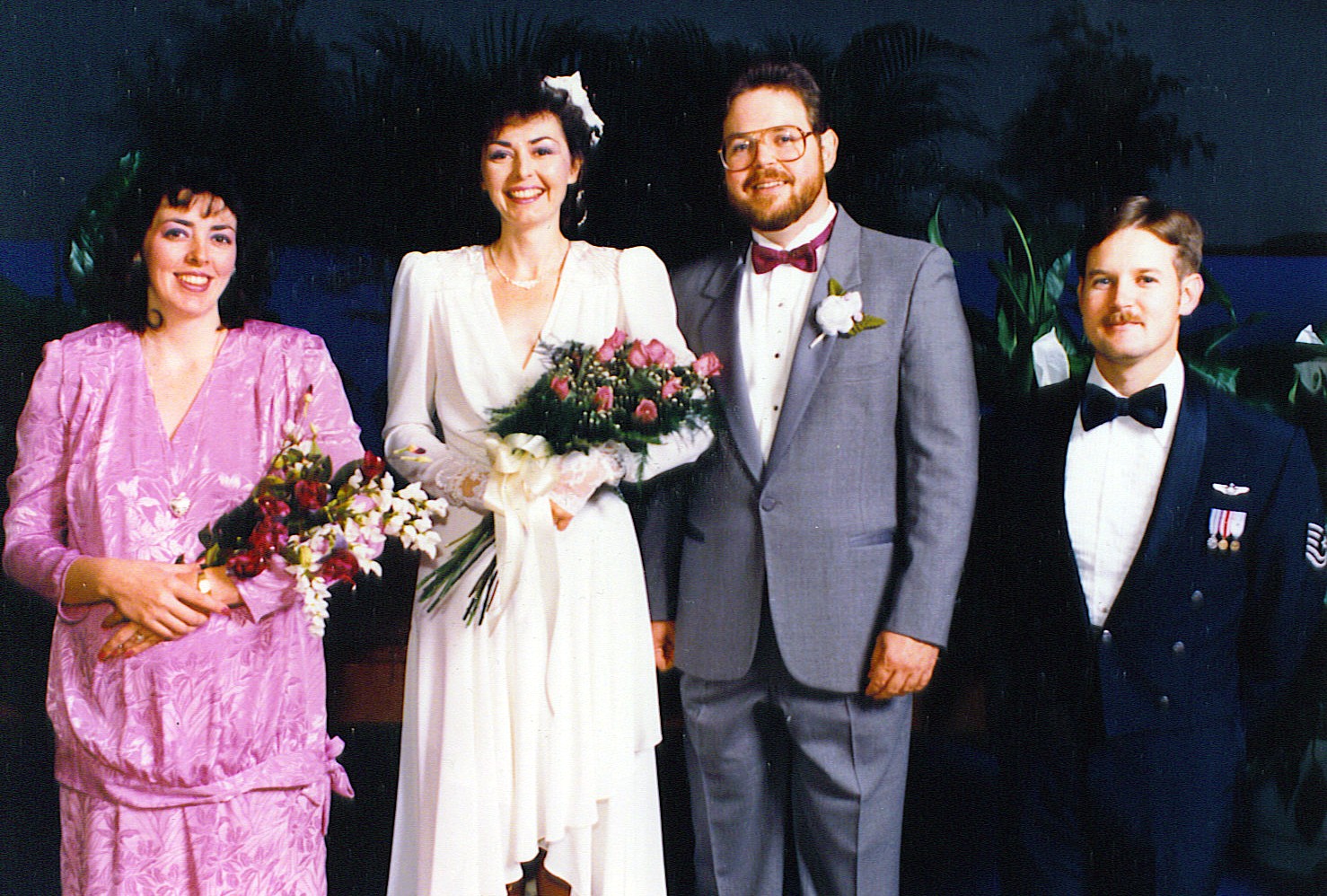
Let’s see, it was a pretty small bridal party. One Maid of Honor (pregnant with the future Miss Inver Grove Heights), and my Best Man, aka Heathen Brother. He was on a special training cycle at the time and didn’t think the Air Force would let him out for the weekend, but Someone higher up intervened and there he was in his dress blues.

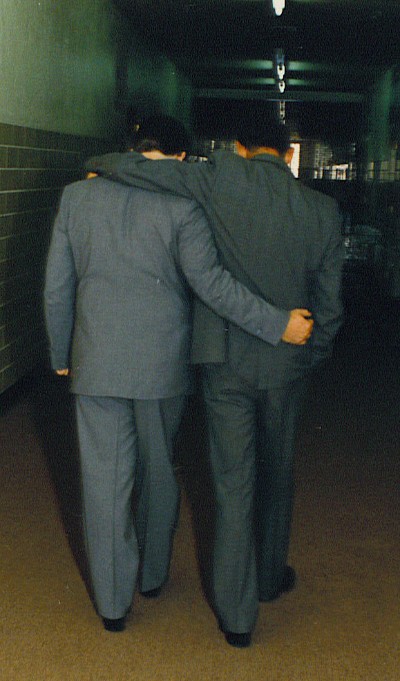
Some last minute words of advice from my dad. Sorry, can’t remember a thing…

In My Father’s House, Part 2

A childhood memory: waking up in the pre-dawn winter hours to the muffled thrumming of my father’s car warming up in the driveway. In my mind I can picture the clouds of crystalline exhaust illuminated by the back porch light. I would lie snug in my bed and listen to the sounds of my father preparing to go to work: his step (the heaviest in the house) in the hallway, the jingle of the dozen or so keys on the big ring on his belt, the clink of a coffee cup being set down on the counter; finally the closing of the back door to mark his passing. It was familiar and unremarkable, and I would go back to sleep.

When I awoke again my mind was filled with my own thoughts and plans for the day. In this time my father owned his own business and was rarely home for supper. My brother and sister and I would eat with our mother, and go about our evening routine. I would often be in bed again when I heard him return. There would be the sounds of my mother frying him a steak, and of talking; their voices distinct, but not the words. Sometimes the tone was obviously my mother reciting the sins of the day, and if they were heinous enough, we would be summoned from our beds for the promised retribution of When Our Father Gets Home.

As a father now myself, I understand how this had to have been as unpleasant for him as it was for us.

During this time our father was a seldom seen force in our lives, operating outside our understanding, toward ends unknown. We would see him mostly on Sundays, and there was a feeling of awkwardness as if none of us were quite certain about how we should act. And yet there was always food on the table, a comfortable house, and clothes for every season, even though we gave little thought, or saw little connection, to how these things came to be.

It wasn’t until I was 11 or 12 and old enough to go to work with my father that I really started to get to know him, and learn what a just and wonderful man he was. I admit he never seemed to be at a loss for things for me to do: pick up rocks and litter, sweep the drive, clean the restrooms for the rest of the workers and the guests. As I learned more about how to please him, my responsibilities and privileges grew. I came to know the special feeling of joining him in the early morning while everyone else was asleep as we got ready to go to “our” work.

In My Father’s House, Part 1

The day before Father’s Day this year I happened to be parked at the far pumps at a BP gas station and convenience store in Ottumwa, Iowa, filling up. As I squeegeed my windshield I heard a commotion behind me and turned to see a large pickup rock to a sudden stop in front of the convenience store. It wasn’t the sound of the approaching truck that had caught my attention, however, but the not-so-muffled shouting coming from inside the cab.

A man was yelling at a boy, waving his arms and perhaps throwing some litter around. Outside of several f-bombs it was hard to make out what was being said, but it was a one-sided exposition. I casually and automatically looked away as the man got out of the truck, continuing the barrage. “Happy Father’s Day,” I thought, as he stalked off into the convenience store, my own thoughts suddenly dizzy in my head. A couple of minutes later I hung the nozzle back on the pump, and made my way toward the store as well. I had to walk in front of the truck on my way. Not wanting to embarrass the young man further I glanced sideways at him through the windshield and was impressed to see that, though tears were rolling down his cheeks, he had his head up. I turned my head fully toward him, made eye-contact, and winked.

I hope what was communicated was encouragement, a friendly contact and a silent assurance that things will get better.

Yeah, I’ve been there. My own father’s temper has been known to be … expressive. I absorbed my share of it growing up, though I can’t remember now any particular incident or cause, no more than I remember a particular thunderstorm. I mean, I know there were thunderstorms when I was growing up but I don’t remember any specific ones. What does come back to me now, however, is a time when I was in second or third grade and my dad was trying to get his business launched, working long hours away from the house. He must have felt some need to spend some time with me, however, and out of the blue one Sunday afternoon he took me for a special treat: to play miniature golf. I don’t remember where my brother and sister were, but I’m sure I was delighted that I was the only one to get this attention. The problem was, it was an especially hot day and the putt-putt course was laid out on what seemed like acres of cement, none of which could have been very far from my head given my height then.

I don’t know how long we played, but at some point I started to feel dizzy and nauseous. I didn’t know heat stroke from heat rash then but I was definitely sick and my dad was definitely scared. He got me off of the premises, carrying me to his car and laying me down with a wet handkerchief on my face. We went home and he put me in front of the window a/c unit until I recovered. I’m sure he felt bad that his great plan to spend some time with his son had almost ended in disaster; I know I did, though for different reasons. I remember the concern on his face, however, at a time when I might have expected him to be angry.

Another time when he could have gotten angry and didn’t was when I was 16 or 17 and we were anchoring a mobile home. He was steadying the 4-foot anchoring rods in their crosspiece while I swung the 8-lb. sledge to drive them in. At one point I accidentally clipped the upper part of his ear with the handle of the hammer as I repositioned myself for another swing. It drew blood but no explosion, though I’m sure he didn’t like it. (Which also reminds me of a time when we were trying to level and anchor a trailer on the side of a steep hill near Steelville, Missouri. He wouldn’t let me get under the unit as he delicately worked with hydraulic jacks, concrete blocks and wooden shims along the underframe. Just as he was placing a shim and lightly tapping it into place with a hammer a sonic-boom rocked the valley. I had heard of greased lightning up until that time, but I had never seen it until I saw him crab sideways out from under that trailer!)

Family lore has it that my father’s father was known for a volatile temper. I saw a little of it growing up, but other than a couple of years when he lived near us I wasn’t around him that much. Most of the accounts are from stories my uncles would tell at family gatherings. Most folks today will accept that a temper can be passed on to each generation whether by nature or nurture or a spiritual manifestation. Whichever, my father received his inheritance and passed it on. My brother and I heat up about as quickly as he did, though expressing it is an indulgence that I have tried hard to limit and thankfully haven’t seen it in my children.

Anyway, I survived with minimal trauma and with greater memories such as the ones I’ve just described taking precedence. I don’t know what the future holds for the young man and father I saw in Iowa, but I hope the incident was an isolated one that one day will be acknowledged yet set aside in favor of ones happier and more plentiful, for both their sakes.

As I entered the store I tried to think of something to say to the father; something encouraging, in just a few words, that might give him a different perspective. I could come up with nothing in the moment and even now, months later, I still can’t think of the perfect sentence to calm the situation and allay my own fears. My fears were not for the future of that family, or that whatever I said might provoke an additional outburst. My concern was that in speaking to that father I might end up telling him why I was in Iowa that day and telling him where I was going and why, and that neither of us would want to hear that outloud.

You see, the reason I was standing in that gas-station was because my daughters and I were on our way to Missouri to see my dad as a Father’s Day surprise. He had been feeling sick for weeks and experiencing a lot of back pain. Though we could barely breathe the word, our family was concerned that cancer had returned. Thoughts of the past and the future had been folding themselves constantly in my mind during the drive. If it was cancer, would he need chemo? If he needed chemo, would he put himself through that ordeal or — after what had happened to friends of his — say, “To hell with that”?

He was surprised and pleased to see us when we got there, twisting stiffly in his swivel chair to see what the dog was barking at. He got up for hugs all around, his golf shirt stretching a little around the bit of gut his cardiologist had been after him to lose. He didn’t look much different since I had seen him back in December, but I could tell he was in pain from a fractured vertebrae and the subsequent bone biopsy he’d had the day before. We talked some over the weekend about the pain and the possible implications, but tried to keep things light and positive. The test results would be back on Tuesday, I was heading back on Monday.

The girls and I stood around him and prayed before we left. He acquiesced, but it felt to me as if I was throwing a saddle on a newly busted bronco for the first time. I have personally seen and experienced great, even miraculous, results from prayer, and have prayed many times for people, standing on scripture and faith, the words usually come easily as I follow the leading that comes. This was harder, though; so much I wanted to pour into it, so little that seemed to want to come out. Through the long drive home I took some comfort from the knowledge that it is the power in the words, not the eloquence that makes the difference. We arrived home Monday night.

Tuesday brought the word. Lymphoma, stage four. He would start chemo on Wednesday, no fuss. “Let’s get it done.”
Smoke — or something — gets in their eyes

In this week’s Tuesday Morning Quarterback on ESPN.com, Gregg Easterbrook (no fan of George W. Bush) writes:

Exaggerating the Case Against Bush Only Lessens the Focus on His Real Faults:
There’s a lot to dislike about the George W. Bush administration — the Iraq war, lack of action on petroleum waste, wiretapping — but in the rush to make Bush seem as bad as possible, the establishment media consistently have distorted his domestic environmental record, which is basically fine. Air, water and toxic pollution have declined since Bush took office; all U.S. environmental indicators except greenhouse gas emissions have been positive for 20 to 30 years, which you’d never know from opening the morning newspaper.

A problem is that environmental journalists are genetically programmed to spin all stories as bad news while ignoring progress. A classic example is stories expressing horror and outrage that environmental prosecutions initiated by the EPA or filed by the Justice Department are declining, as they have been since the middle of the Clinton administration. But it’s good that environmental prosecutions are declining — the reason is that pollution is declining! As pollution declines, there are fewer violations to prosecute. If speeding declined, police would write fewer tickets: Would we be glad speeding was declining or express horror over the shocking, shocking reduction in prosecution of speeders?

There the canard was again as the Sunday lead-headline story of The Washington Post: “The Environmental Protection Agency’s pursuit of criminal cases against polluters has dropped off sharply during the Bush administration, with the number of prosecutions, new investigations and total convictions all down by more than a third,” the story began. Of course environmental prosecution is declining, there is less to prosecute every year! The Post’s banner story ran 38 paragraphs but never mentioned that all forms of pollution except greenhouse gases are declining, and because greenhouse-gas emissions are legal, there’s nothing to prosecute. Mention that pollution is in long-term decline, and Sunday’s front-page banner story in The Washington Post goes “poof.”