What Christmas Carol are you?

Hark! The Herald Angels Sing

You are ‘Hark! The Herald Angels Sing’. You take
Christmas very seriously. For you, it is a
religious festival, celebrating the birth of
the Saviour, and its current secularisation
really irritates you. You enjoy the period of
Advent leading up to Christmas, and attend any
local carol services you can find, as well as
the more contemplative Advent church services
each Sunday. You may be involved in Christmas
food collections or similar charity work. The
midnight service at your church, with candles
and carols, is one you look forward to all
year, and you also look forward to the family
get together on Christmas Day.

What Christmas Carol are you?
brought to you by Quizilla

Hmmm. Close enough, but in reading through all the other possible results I think I’m more like “Silent Night”. My favorite Christmas carol is “The Little Drummer Boy” or a really heart-felt “Oh, Holy Night”.

Of hectic weeks and random thoughts

I’m in the middle of a hectic week at work which will be topped off by a couple of significant ceremonies on Sunday at church. During the regular service my wife, aka Night Visions, will be ordained — an interesting story in and of itself, but for another time. Following service we’re having a graduation ceremony for the Mall Diva to commemorate both her home school high school graduation and her completion of her cosmetology program and imminent licensing. This latter event will require a little speechifying from me so I’m distracted with what I’ll say and how I’ll keep my composure, not to mention working out sundry details in bringing these events off smoothly.

I say all that just to say that this means tonight’s blog entry is not going to be a deeply thought and highly polished gem of reason, but a few random thoughts about winter.

  1. Charlie Brown and me. I know I already touched a little on the Charlie Brown Christmas special recently, but watching it always brings back memories. This was the 40th anniversary broadcast of this classic, and I was there for number one as well. Yeah, it’s weird to realize I’ve been around long enough for the 40th anniversary of anything, but it’s a good biblical number. I know I saw the first broadcast because my mother made kind of a big deal about it at the time and, because my brother and sister and I didn’t know Peanuts from the Katzenjammer kids, telling us about the comic strip and even buying us a paperback Peanuts collection. Once we saw the show we loved it, of course (we watched it at my grandparent’s house because they had color tv).

    Now, whenever I watch the show I always think about how much Charlie Brown’s neighborhood reminds me of my own neighborhood from back then, and I also remember that I had a corduroy hat with a bill and ear flaps just like the one Charlie Brown wears. Watching the show with my kids gives me the opportunity to ask Tiger Lilly what she wants for Christmas and have her say, “Real estate.” Of course, I’ll never forget the true meaning of Christmas.

  2. Colder than a well-digger’s monkey. That’s right, I’m not from Minnesota, so cut me some slack, Andy. Now, I don’t mind weather that’s “bracing”, “brisk”, “nippy” — or even “Minnesota-like.” It’s that Canadian weather that rushes across the border like it’s in a hurry to get to Florida that I can’t stand. Mr. President, defend these borders!

    I have a winter coat that weighs about 35 pounds. It zips up past my face and extends below my knees. It’s not very rakish, but it’s lined with down, thinsulate and a layer of cashmere and I swear it’s almost bullet-proof. And sometimes I wear it and still feel like a streaker. I left the house the other day and it was like getting busted across the face with a frozen codfish. It was the kind of cold that makes your nose hair stand at attention while the wind goes through your pockets looking for loose change; the kind of cold that gives you goosebumps the size of Volkswagons on your flannel-clad bottom. It was so cold (how cold was it?) that the legislature was keeping its hands in its own pockets.

  3. Northern Lights. It also gets dark around 4:00 o’clock in the afternoon this time of year. That would be almost unbearably depressing when it’s this cold except for one saving grace. When I leave my office each evening I stand under a large, lighted portico and look up the Nicollet Mall. The lights of the city glowing in the darkness turn the sky a rich purple-blue that is nearly as mesmerizing for me as the ocean. Often I’’ll linger a bit, just taking it in — until I get hit in the face with a codfish.

Four more months til golf season.

Brave, brave Sir Howard

The Misanthropic Frat Boy has a list over on the Nihilist in Golf Pants blog (and really, with names like those how can you resist reading?) describing the Top 11 Democratic Strategies for Winning the War in Iraq. The list includes “skedaddle”, “bug out” and “skonker off”.

Of course, I can’t let an opportunity pass to quote some Monty Python doggerol, i.e. the Brave Sir Robin flight ditty. (You’ll recall that Brave Sir Robin was anything but, and used the MSM – Mainstream Minstrels – to try and convince people otherwise).

Brave Sir Robin ran away.
Bravely ran away, away!
When danger reared its ugly head,
He bravely turned his tail and fled.
Yes, brave Sir Robin turned about
And gallantly he chickened out.
Bravely taking to his feet
He beat a very brave retreat,
Bravest of the brave, Sir Robin!

A great word, or strategy, that the Misanthropic Frat Boy missed is “Absquatulate”, as defined in the American Heritage Dictionary:

SYLLABICATION: ab·squat·u·late
PRONUNCIATION: b-skwch-lt
INTRANSITIVE VERB: Inflected forms: ab·squat·u·lat·ed, ab·squat·u·lat·ing, ab·squat·u·lates
Midwestern & Western U.S. 1a. To depart in a hurry; abscond: “Your horse has absquatulated!” (Robert M. Bird). b. To die. 2. To argue.
ETYMOLOGY: Mock-Latinate formation, purporting to mean “to go off and squat elsewhere”.

Personally, however, I’ve always like the definition offered in Norman Schur’s book, “1000 Most Difficult Words” (Random House):

Absquatulate
(ab SKWAH chuh late) vb.

This amusing, vivid, and expressive word is a bit of jocular, contrived, slang. To absquatulate is to decamp, to scram, to take off in a hell of a hurry like a fugitive heading into the woods; sometimes, to abscond, like a cashier running off with the contents of the till. The term, invented in America in the 1830s and adopted by the English in the 1870s is an example of supposed derivation from factitious mock-Latin, based on a combination of parts of abscond, squat, perambulate and heaven knows what else. A certain J. Lamont, in an old book entitled Seahorse, wrote of a grizzled bull-walrus who “heard us, and lazily awakening, raised his head and prepared to absquatulate.” You may not run across this little item nowadays, but it’s a picturesque word whose revitalization should be encouraged, though it may be used to describe a practice that should be discouraged.

A real paper chase

The National Center for Public Policy Research is attending the UN Climate Change Conferences in Montreal and distributing “emissions credits” — printed on toilet paper.

I’m guessing that there are more than a few flushed faces around the table as a result.

Policy Group Distributes Toilet Paper ‘Emissions Credits’ at U.N. Global Warming Conference

Montreal, Canada – The National Center for Public Policy Research is handing out “emissions credits” printed on toilet paper at the United Nations Climate Change Conference in Montreal today, to symbolize the failure of the Kyoto Protocol and the futility of emissions trading schemes.

Under the European Union’s “CO2 Emissions Trading Scheme,” companies are allotted credits that allow them to emit a fixed amount of carbon dioxide. Companies that reduce their carbon dioxide output, and thus don’t use all of their credits, can sell them to companies who are exceeding their C02 allotments.

As the flawed Kyoto treaty is all but dead, emissions credits aren’t likely to be of any value in the future.

“Emissions credits aren’t worth the paper they’re printed on,” said David Ridenour, Vice President of The National Center, “Unless, of course, that paper happens to be toilet paper.”

Read the whole story and see a picture here.

Blood on the ice

I read yesterday’s update on Fraters Libertas where Hugh Hewitt extracted a certain measure of revenge for the lads’ frequent references to his misadventures with a snowmobile and one of Minnesota’s indigenous trees. Hugh ran Chad the Elder’s post-puck encounter photo, which reminded me of Chad’s original description of his reckless injury.

That, in turn, reminded me of the last hockey game I ever played.

Some 17 years ago I joined a league that was then called the National Novice Hockey Association (NNHA). The league was designed for people who hadn’t grown up playing hockey and, having discovered the sport late in life, wanted to give it a try without being used as a zamboni by more experienced players. That fit my situation exactly.

I grew up playing football and basketball. It wasn’t hard for me to move from one sport to the other because my approach was the same for both: cream the person with the ball. I never saw a hockey game in person until I moved to Minnesota when I was in my 20s, but became hooked almost immediately. When the NNHA arrived in town I was so ready; given my already established approach to games I couldn’t wait to get the chance to jack somebody up at the blueline.

At first it was pretty comical. Few people in the league had any real experience and many of us had never even skated before. Watching our games and practices was like watching a bunch of 200 pound Mites or Pee Wees crash (literally) the boards. We were all pretty good-natured about our klutziness; when players collided we’d usually laugh about it. One of my favorite memories is the time when I scored a goal after both the defenseman and the goalie fell down in quick succession in the face of my one-man rush to the net. Turning toward my bench I nearly wet myself when I saw my teammates doing the wave.

After a few seasons, though, things got very competitive and we started taking ourselves pretty seriously. I was on one of the better teams in the league (no thanks to my contributions) and we had a manager who tried to elevate our skills by scheduling between game scrimmages with bar league teams. It was a good idea in that, as good as we thought we were getting, we were hard-pressed to keep up with these more experienced players. It was a bad idea in that these scrimmages often got rather chippy as a result. They were also especially frustrating for me because I never was a strong skater.

One night in the Parade Ice Gardens we had one of these scrimmages and I went into a corner after a puck with a guy from the other team. We were up against the boards, alternately pinning each other’s stick while we pushed against each other and tried to clear the puck. Already running a little hot to begin with, my “intensity” ratcheted up a couple of notches the longer we tustled. The third time he pinned my stick I yanked hard on it in an upward direction just as my opponent shifted to kick at the puck again. Suddenly my stick was free – and flying straight into his face. He had a helmet on but, like the Elder, no faceguard. He went immediately to the ice with his hands over his eye, blood gushing over his gloves. I was transfixed next to him, nearly sick – not at the sight, but at the thought of what I’d done.

Yes, it was an accident. I hadn’t set out to hurt anybody and that hadn’t been my intention when I tried to yank my stick free, but I also knew I had been at the edge of my self-control and someone was now suffering for it. Fortunately it turned out that the cut was an inch below the other guy’s eye. He might need a couple of stitches, but he wasn’t going to need an opthamologist. I apologized profusely and there weren’t any hard feelings from him or the rest of his team, but as I drove home later I just decided I’d had enough. I may have learned a lesson that probably would have stuck with me if I continued to play, but at that point I just said to myself, “If you can’t handle yourself any better than that it’s time to quit.” There was still about a month left in the season, but the next day I took my gear into Play It Again Sports.

It was near Valentine’s Day, and money was tight for us then. I now had some extra cash in hand, but didn’t want to commemorate the end of my hockey career by paying the electric bill. Instead I bought a small pearl ring for my wife – five years of blood, sweat and fears condensed into a small precious object. It was a fair exchange.

Since then I’ve thought from time to time about whether I did the right thing at the time. Should I have tried to apply the hard-learned lesson back in the arena? Probably, “yes.” Was it right to quit a team before the season was over? Definitely, “no.” Still it was an experience in character and self-control I could draw on when the opportunity came years later to teach the Fundamentals in Film class, or any time I started to feel my temper start to get away from me.

The little pearl ring was ultimately lost years later when we had some things taken from our home, but I still carry the reminders of that night inside me. Unfortunately, there’s someone else out there who still carries his own little reminder as well.

Friday Fundamentals in Film: Glory

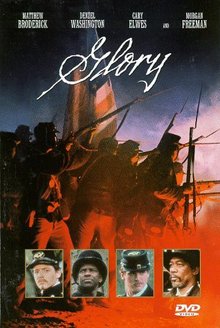
The fourth movie in the series is Glory , the story of the all-black regiment that fought in the Civil War. It had the requisite blood and guts action to get the class’s attention but also some intense lessons. The key points for me were to focus on were personal honor and self-respect mixed in with the dynamics of being part of a larger group and being able to sublimate yourself in order to function as a team, even to the point of extreme sacrifice.

Matthew Broderick plays Robert Gould Shaw, a young, idealistic white officer in the Union army. Wounded in his first action, he returns to Massachusetts and is promoted to Colonel and asked to lead a newly-formed, all-black regiment – The Massachusetts 54th Infantry. Assisted by his best friend, Major Cabot Forbes and joined by another friend, Corporal Thomas Searles, a free and well-educated black man who had grown up in Boston who enlisted in the regiment, the men and the rest of the 54th not only have to deal with their own personal challenges and prejudices (even between the black soldiers) but the dismissive attitude of the Army and high command as well.

While some of the racism was ugly and overt, there were also examples of a form of prejudice that was kindly and sensitive (at least on the surface) while having low expectations of the troops. This was best displayed by Major Forbes who was friendly with the men, but didn’t expect them to perform at a high level and often cut them slack. In contrast, Col. Shaw – having seen up close the horror and devastation ahead of them if the 54th – assumed an uncharacteristic harshness in order to drive the men hard in their training, even bringing in a bigoted Irish non-com to drill and berate the men mercilessly to toughen them up.

The movie has interesting character studies of men dealing with their own issues in order to become part of something larger. Col. Shaw is afraid he doesn’t have the courage and ability to lead the men well; Thomas has to face ugly truths about himself after his sheltered upbringing, and Trip (Denzel Washington), a runaway slave, has to deal with his own stubborn independence and rebelliousness. It was an interesting exercise to discuss the movie with the boys as I asked them which character they most identified with, and what they thought were the requirements of giving, earning and receiving respect to and from others, and challenged them on what perceptions and misperceptions of themselves and others they might have in their own lives.

Some discussion questions:

  1. What was the difference between the way Col. Shaw saw the troops and the way Major Forbes saw them? How did this affect the way they acted towards them?
  2. Describe the two ways (both appropriate) that Col. Shaw reacted to the reduced pay and the men’s protest?
  3. Why did Robert bring in Sgt. Mulcahy? Were Sgt. Mulcahy’s methods appropriate and effective?
  4. How did Trip change over the course of the story? What did he have to overcome?
  5. How did Robert change? What did he have to overcome?
  6. Why did Thomas volunteer? What did he learn?
  7. Trip and Col. Shaw maintained eye contact throughout Trip’s flogging. Describe why this was necessary in each man’s eyes?
  8. Which main character changed the least through the course of the story? Why?

Points to Ponder:

  1. Which character in the movie (Col. Shaw, Major Forbes, Thomas, Trip, Sgt. Rawlins) is the most like you? What were his positive and negative attributes?
  2. Is there an issue in our nation today that divides society in the way that slavery did then? If so, what is it and why?
    What was the difference between the way the black “contraband” troops acted and the way the 54th acted? Why?

  3. Robert Shaw, Cabot Forbes, and Thomas Searles were all friends before the war. Did Robert treat his friends unfairly in the army, or did his friends treat him unfairly? Why?
  4. Describe the significance of the worship service the night before the big battle, and the effect it had on both Trip and Thomas.

How I could have been more fervent and effective

Monday morning was the first time I heard the news report on the radio of an American “peace activist” who had been kidnapped in Iraq. I must confess I may have smirked a bit at the thought (I wasn’t in front of a mirror at the time, so I don’t know for sure). The irony was just too rich, and I thought of the old doggerel about the lady that went for a ride on the tiger. I knew my schadenfreude wasn’t very noble, but I didn’t dwell on it then or later in the day when I heard there were four people missing and presumed kidnapped.

That evening, however, Ben from Hammerswing (see here and here) called to say that a long-time friend of his family’s is the British citizen in the group that has been kidnapped. I felt compassion for Ben and for his family and the family of the hostage, and we prayed together for his friend Norman’s safety and for a powerful testimony. I used the scriptures that occurred to me as I prayed that fit the situation, but felt I was missing something. It took a little while for it to sink in, but I eventually realized I had made an important omission.

Here’s the deal: I’m pretty sure I don’t agree politically with the actions of Norman and the others and spiritually I might also disagree with their approach (it’s hard to tell for sure at this distance with only the MSM and its penchant for labels to go by). On the other hand, I know that I wouldn’t have embarked on what they are doing without a lot of prayer and without first seeking God’s direction to be sure I was doing what he wanted me to be doing and in his timing. I wasn’t privy to the conversations these men had with God, and it’s not my job to judge it because I’ve certainly made my own mistakes. This is something I should have realized even before I found out I knew someone with a personal connection to the situation, and I should have guarded against my own hardness of heart in the first place. Having failed in that, I should have repented before or during my prayer with Ben.

As Jesus said in Matthew 5:21-22 (New Living Translation):

“You have heard that the law of Moses says, `Do not murder. If you commit murder, you are subject to judgment.’ But I say, if you are angry with someone, you are subject to judgment! If you call someone an idiot, you are in danger of being brought before the high council. And if you curse someone, you are in danger of the fires of hell.”

If, as James tells us, “the effective, fervent prayer of a righteous man avails much,” I may have been hindering my prayers because I didn’t address my attitude, and I know how important this can be. According to Mark 11:22-25 (NLT):

Then Jesus said to the disciples, “Have faith in God. I assure you that you can say to this mountain, `May God lift you up and throw you into the sea,’ and your command will be obeyed. All that’s required is that you really believe and do not doubt in your heart. Listen to me! You can pray for anything, and if you believe, you will have it. But when you are praying, first forgive anyone you are holding a grudge against, so that your Father in heaven will forgive your sins, too.”

There is something more important than politics or spiritual doctrine at stake with the lives of these men, and with God’s forgiveness (and, I hope, Ben’s), I can now do what I should have been doing all along.