Friday Fundamentals in Film: Chariots of Fire

The movie Chariots of Fire tells the story of the tests and trials faced by two men competing for two kinds of glory at the 1924 Olympic Games. In this movie, our class left the showdowns of the Old West and the horrors of war to confront the challenges of will and character in athletic competition.

At the same time, however, the decimation and sacrifice of a generation shadows the story, especially early on when the incoming class of Cambridge freshmen have their attention directed to a wall listing the names of Cambridge students and graduates who died in the recently concluded conflict. The new young men are reminded that they now have the privilege of pursuing dreams and goals no longer available to those who have died, and they are challenged to live up to the opportunity before them.

Both the talented and driven Jew, Harold Abrams, and the devout Scotsman, Eric Liddell, end up ignoring convention and even antagonizing society, but from different perspectives. Harold competes for his own glory and rejects the standards of a society that has rejected him. Though he is an amateur, he hires a professional coach – something that was strongly frowned upon at the time. While generally polite to his teammates, his single-mindedness and intensity set him apart from them. Eric runs, so he says, to glorify God and refuses to compete on Sundays out of honor and obedience to the Lord. Yet when it turns out that, once at the Olympics, the qualifying heat in his event falls on a Sunday he must go against the wishes of his teammates, his coaches, and even his Prince and country – as well as personally confront his own desire to compete and his commitment to do what he believes is right.

Key Points

  • Commitment to principle, even in the face of personal objectives, peer pressure – even your government.
  • Sportsmanship
  • Personal discipline and dedication lead to success.
  • Appreciation of the benefits that you enjoy as a result of the sacrifices of others.
  • More examples of how prejudice insinuates itself into our lives.

Discussion questions

  1. Why was Eric’s sister opposed to his running? What was his response to her?
  2. What scriptural reason does Eric have for not competing on Sunday?
  3. What were the negative effects of Eric’s decision? What were the positive ones?
  4. What was the significance of the names on the wall of the dining hall? Why did the faculty draw the attention of the new students to these names?
  5. Who did Eric seek to glorify? Who did Harold seek to glorify?
  6. How did Harold feel leading up to and after the gold medal race? Why?
  7. What was the nature of Lindsey’s (the hurdler) sacrifice? Why did he do it?
  8. What principle(s) – in sports or spiritually – did Jackson Schulz’s note to Eric demonstrate?

Points to Ponder

  • Are you aware of how your personal honor and conduct reflects on, and affects, those around you?
  • Based on the movie, in what ways can a person’s worthy desire for personal excellence be a source of strength and destruction?
  • How do you honor the Sabbath and keep it holy?

Happy Birthday, Bill of Rights!

From the Writer’s Almanac:

It was on this day in 1791 that the Bill of Rights was adopted by the United States. It was the lack of a bill of rights that made the Constitution so controversial a few years before. Many people feared that the adoption of a strong central government could lead to tyranny unless certain rights were guaranteed to the people in writing. Patrick Henry refused to endorse the Constitution for that reason. Thomas Jefferson supported the new constitution, but when he read the first draft in France, he wrote a letter to James Madison saying, “Let me add that a bill of rights is what the people are entitled to against every government on Earth, general or particular, and what no just government should refuse, or rest on inferences.”

It was James Madison who finally realized that bill of rights was essential to passage of the Constitution, and he promised all the states that a Bill of Rights would be immediately adopted upon the Constitution’s ratification. Madison introduced the bill of rights into the first session of congress in 1789, and he used George Mason’s Virginia Bill of Rights as the model for the new federal Bill of Rights. Madison originally supported the adoption of seventeen amendments, which was eventually trimmed to twelve, of which ten were adopted.

The rights that were included in the Bill of Rights were directly related to the recent experiences of the colonists. Many colonists had come to this country to get away from religions oppression, so the Bill of Rights protected the free exercise of religion. During the Revolutionary War, colonists had seen printers and journalists jailed and executed when they had opposed the British king, so the Bill of Rights protected the freedom of speech and the press.

The colonists had seen what ordinary citizens with guns could do when they had to fight a revolution against an oppressive government, and so the Bill of Rights protected the right to bear arms and raise militias. Many colonists had been forced to take British soldiers in their houses during the Revolutionary War, and they had also been subject to random searches and seizures by British police. So the Bill of Rights protected citizens against unreasonable searches and seizures, and against the quartering of soldiers. Colonists had seen people thrown into dungeons for no reason, had seen people tortured into giving confessions, had seen inquisitions go on for months, during which the accused were worn down by lengthy interrogations. And so the Bill of Rights gave citizens the right to due process of law, a speedy trial, the right to call witnesses, and the right to use a lawyer in one’s own defense.

Let’s see; war in 1776, the first Constitutional Congress in 1789, no Bill of Rights until 1791 — my goodness, do you think the Brits back then were saying the situation was too unstable for this democracy experiment to ever take root? We know better now, don’t we?

Christmas Shopping

With the long-awaited arrival of the Chronicles of Narnia flm and the wild popularity of the fantasy books for children and young teens such as Harry Potter and the Eldest series, you might be interested in checking out the Christian-themed grahic novels from Community Comics.

Three new ones are out from Community Comics and Vida Entertainment. The graphics look great and the story excerpts are interesting. Definitely worth checking out. (HT: Cedric’s Blog-o-rama)

Who wrecked Kevin’s server?

The Eckernet has fallen and it can’t get up. According to Kevin:

Ok, the server that EckerNet.Com was hosted crashed real hard. And part of that crash was the actualy harddrive that everything that was EckerNet.Com existed on, is basically gone. No idea how much is recoverable, or if it is.
Right now Moveable Type doesn’t even work. Admins are working on it but it might be awhile….a long while.
Wish me luck. – Kevin Ecker

I thought Kevin was remarkably composed, considering the circumstances. There wasn’t even any swearing and he’s not threatening to jugulate anyone — yet. He didn’t even offer any conspiracy theories. Of course, what good is the blogosphere if we can’t have some good conspiracy theories? Here then is my list of likely suspects:

  • MN Publius
  • A stray shot from the Mall Diva’s Desert Eagle, that Kevin insisted she have.
  • Cathy in the Wright turned the Governor loose in the nerve center, or hit it herself with a snow plow.
  • Dementee, forced to withdraw from the MOB mayoral election, is working his way through Doug’s cabinet (or else he just wanted to be Master of the Hunt.)
  • IMAO; wants his schtick back.
  • Jesse Ventura, after hearing that Kevin used his “action figure” for target practice.
  • Prairie Dogs (similar reason as Jesse “the Target” Ventura).

Let’s see, I’m sure there’s got to be some more. Just a second, I hear a strange noise outside. I’ve got to check it out…

What you can do with a learned foot

Among the other highlights of the last weekend, my daughter and MAWB Squad contributor Tiger Lilly also passed her proficiency test to move up to a gold belt in Tae Kwan Do. This included breaking a board with her fist.

Given the views expressed by Mr. L. Foot about the MAWB Squad during the recent MOB mayoral election controversy, perhaps other objects will be next.

A slice of Night Life: a good day

Sunday mornings in our house typically begin with my wife, Marjorie, bringing a tray with coffee and doughnuts or fresh bread and the Sunday paper upstairs to our bedroom. My daughters soon appear and vie for position next to Mom on the “big, comfy chair” — an armchair nearly the size of a double-bed — while we leisurely eat and take our turns with the comics-section before getting ready for church. Yesterday was quite different, however, because we each had our assignments and personal preparations to make in getting ready for a big day.

Challenging Word of the Week: Jugulate

One of my favorite books to flip through is “1000 Most Challenging Words” by Norman W. Schur, ©1987 by the Ballantine Reference Library, Random House. The author not only defines and describes difficult words, but does so in a humorous way that makes me eager to work the word into conversation (or a blog post). Unfortunately, the book now appears to be out of print (although Amazon was able to eventually find a slightly-used edition for me after I lost my original copy.)

I thought I might start a weekly “Challenging Words” post to call more attention to this delightful book and promote interesting word usage in the blogosphere. I challenge other bloggers to work each word into post sometime in the coming week. If you manage to do so, please drop me a link or trackback so I can be sure to check it out.

This week’s word:

Jugulate
(JOOH gyuh late) verb

To jugulate someone is to cut his throat or strangle him, both rather unpleasant procedures and obviously related (etymologically, not sociologically) to the jugular vein. But the word has a figurative and much more merciful use: to check or suppress by drastic measures, usually applied in medical parlance to the treatment of diseases. One case might be the amputation of an affected part, often the leg. Putting a gag into the mouth of a logorrhea sufferer would be less drastic, but might do the trick. Jugulate comes from Latin jugulatus, past participle of jugulare (to cut the throat of), based on jugulum (throat).

From the book, “1000 Most Challenging Words” by Norman W. Schur, ©1987 by the Ballantine Reference Library, Random House.

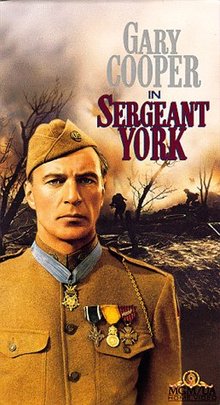
Friday Fundamentals in Film: Sergeant York

Gary Cooper returned to the class as a soldier instead of a marshall (High Noon), but still playing a guy who does what has to be done. In Sergeant York Cooper wrestled with his own faith, not his wife’s, when faced with the possibility of violence. The struggle was not only more real for his character but for us as viewers as well.

The reason I selected this movie wasn’t just because it dealt with the transformation of a drunken, rowdy wild man into a steady hero, but because it is also an excellent dramatization of someone going to the Bible to thoughtfully sort out a conflict as intense (if not as action-packed) as anything he’d meet on an actual battlefield.

Other important details I wanted to get across to the boys was the sense of responsibility Alvin York took on after his conversion; how he sought to walk uprightly in dealing with others and his character in refusing to trifle with the heart of the girl he greatly desired until he had the land and the means to support her. Furthermore, while the movie is a story of courage, it is also a story of humility, restoration and redemption and its tangible benefits. Finally, it provides a last lesson in character as the hero, having overcome persecution and the threat of bodily harm, must deal with the seductive appeal of being a celebrity.

Given these heavy themes and the fact that this movie was the oldest and most archaic in terms of production values, I was somewhat surprised when at the end of the semester the boys said that this was their favorite movie and the one they could most relate to.

Questions to Answer:

  1. What reasons did Mrs. York give for the way Alvin behaved early in the movie? What did she do about it?
  2. What did Rev. Pile mean when he said “Once the furrows get crooked, it’s hard to get them straightened out again”?
  3. Why was getting the piece of bottom land so important to Alvin? Why did he initially fail?
  4. Why did Gracie not want to marry Alvin at first? What did he think was her reason?
  5. What did Rev. Pile mean when he told Alvin, “You’ve got the using kind of religion, not the meeting house kind”?
  6. List the following four things in the proper order (as shown in the movie): redemption, humility, blessing and repentence.
  7. How did Alvin go about resolving the conflict between his belief and his duty?
  8. Why did Alvin think it was wrong to make money off of what he had done in the war?

Points to Ponder:

  1. Why was “the set-up” so important when someone wanted to get married. Is this still important today?
  2. Was Alvin right in believing that he should not kill? Do you think killing in war is permissable?
  3. Alvin told Pastor Pile that “he had prayed ‘til he was blue in the face.” Pastor Pile replied, “It’s not just prayin’ – it’s believing.” Explain.
  4. Which do you think is harder to stand firm in the face of – persecution or seduction?

Does a bear recycle in the woods?

A couple of days ago I posted about the National Center for Public Policy Research distributing toilet paper “emissions credits” at the UN’s Climate Change Conference in Montreal. As might be expected, the National Center position is getting more than just a cold shoulder and frosty looks from the UN and the Agence France-Presse.

The National Center was probably being insensitive, given that these other organizations were grieving the death (sort of) of the Kyoto Treaty.

According to the photos from the event, however, the toilet paper emission credits appeared to be well-received by the Greenpeace Polar Bear and the UN’s Climate Change Recycle Bear. Go figure.