In My Father’s House, Part 3

1989 was my first Father’s Day as a dad myself (thanks, Mall Diva). As a first-timer that June I wrote a letter to my father that included the following:

There are things about growing up that can’t be explained to — or understood by — the emerging adult. At those times the elders can only say “Wait until you have kids of your own” to indicate the unseen forces and emotions that will one day come into play. It is an enigmatic, somewhat ominous, prophecy born of instinct, experience and intuition. Given enough words, it can be described but not experienced. Given enough experience, it no longer needs to be described.

The revelation of being a Father, to accept the title that has always belonged to someone else, is almost dizzying. The family armor, passed on for generations, has been taken off the wall and handed to you with your banner. It is your turn.

Some find their armor rusty and decrepit. Corroded by years of venom, its surface has been marred by each coat of blame and accusation they have applied over the years. These men will always find their armor ill-fitting and uncomfortable. Never having learned or cared where the weak points are, they don’t know what parts need to be reinforced, what parts need extra care, what parts need to be protected the most. They clank and creak into battle already spiritually defeated, blaming the previous owner, and scarcely able to defend themselves, let alone carry out their sacred charge. Some even abandon the field completely, leaving it (and the next generation) to the enemy!

Others will be blessed and even surprised to find their armor in good shape, and not nearly as big on them as they thought it would be. Oh, there’s a scratch here, a small dent there, but these only serve to reinforce the necessity of such gear. These men are properly outfitted and equipped, and where necessary they have taken it upon themselves to repair or replace whatever they see missing. Respect, and a good teacher, have kept the pieces oiled and in good working order.

I have been thinking about armor lately; thinking about how it’s something worn on the outside as protection against the things that would pierce or cut us, the mortal thrust to our vitals from an external foe. But what about the poisoned blade that comes from inside?

Think about the wonderful design of our bodies; how they easily and automatically handle the vital chores of our survival: respiration, digestion, circulation, even healing and restoration. From the time we’re in the womb our bodies perform countless tasks dedicated to our survival, including resisting infections and toxic interlopers. In today’s vernacular, you could say our bodies “have our back.” How cruel and crushing, then, for our closest friend and ally to turn on us, for our very own cells to go rogue, even to the point of using our own defenses against us.

And how quickly it can happen! The doctors estimate that from the time my father’s mutinous lymphocytes first went over the wall to the time he was diagnosed with Stage 4 lymphoma (lymphoma in multiple locations above and below the diaphragm) was only about two months; this in a person who was undergoing nearly constant check-ups and monitoring due to a previous bout with prostate cancer and a heart-valve replacement a couple of years ago. What can you do?

Then again, maybe there is an internal armor and a toughness after all. Cancer is an insidious foe that, along with the measures used to combat it, strips away virtually every visible vestige of one’s dignity. I know heart attacks can be devastating and life-changing and leave you weak as a baby, but at least they leave you with your hair. The chemo takes your hair and your appetite and nearly every illusion you have about being in control of your own body. When I was down to see my dad in June he still pretty much looked like himself, but the stress of the pain and the effects of the pain-killing medication caused him to throw up — much to his dismay. “I haven’t thrown up in more than 30 years,” he said. At one point when I went to see him in September he was throwing up every 30 minutes. Rather than lurching into the bathroom each time he had fashioned a bucket from a one-gallon plastic milk jug and used that. The first time I went in to assist my mother he was sitting up in bed, spitting up into the bucket. He was well past the point of feeling embarrassed, he just gave me a matter-of-fact look over the lip of the jug and went about his business.

He’s lost his hair, and more that 40 pounds from a frame that can barely spare it. He’s been poked with needles and IVs so many times the nurses can barely find a vein that won’t collapse and there’s scarcely a bodily function he can perform without an audience, yet he still jokes with the nurses even if his voice sometimes sounds more like his 100-year-old mother’s than his own. He struggles to swallow his food, and to keep it down even when he does, yet he’s drawing sustenance from his will and a determination not to give up no matter what fresh hell the day brings, and doing it with a grace that I never would have expected in him.

We think of armor as being made of metal. Apparently, it has more to do with mettle.

It was 20 years ago today…

…No, this isn’t a Beatles/Sergeant Pepper reference (though I have to admit it’s getting better all the time)…

…And I’m not jealous of Mitch Berg’s ongoing saga (though he might have reason to be)…

…And I’m not going to say “Score!” because some people, you know, just wouldn’t take it in the right way…

…So I’ll just say, “Happy Anniversary, Mrs. Stewart!”

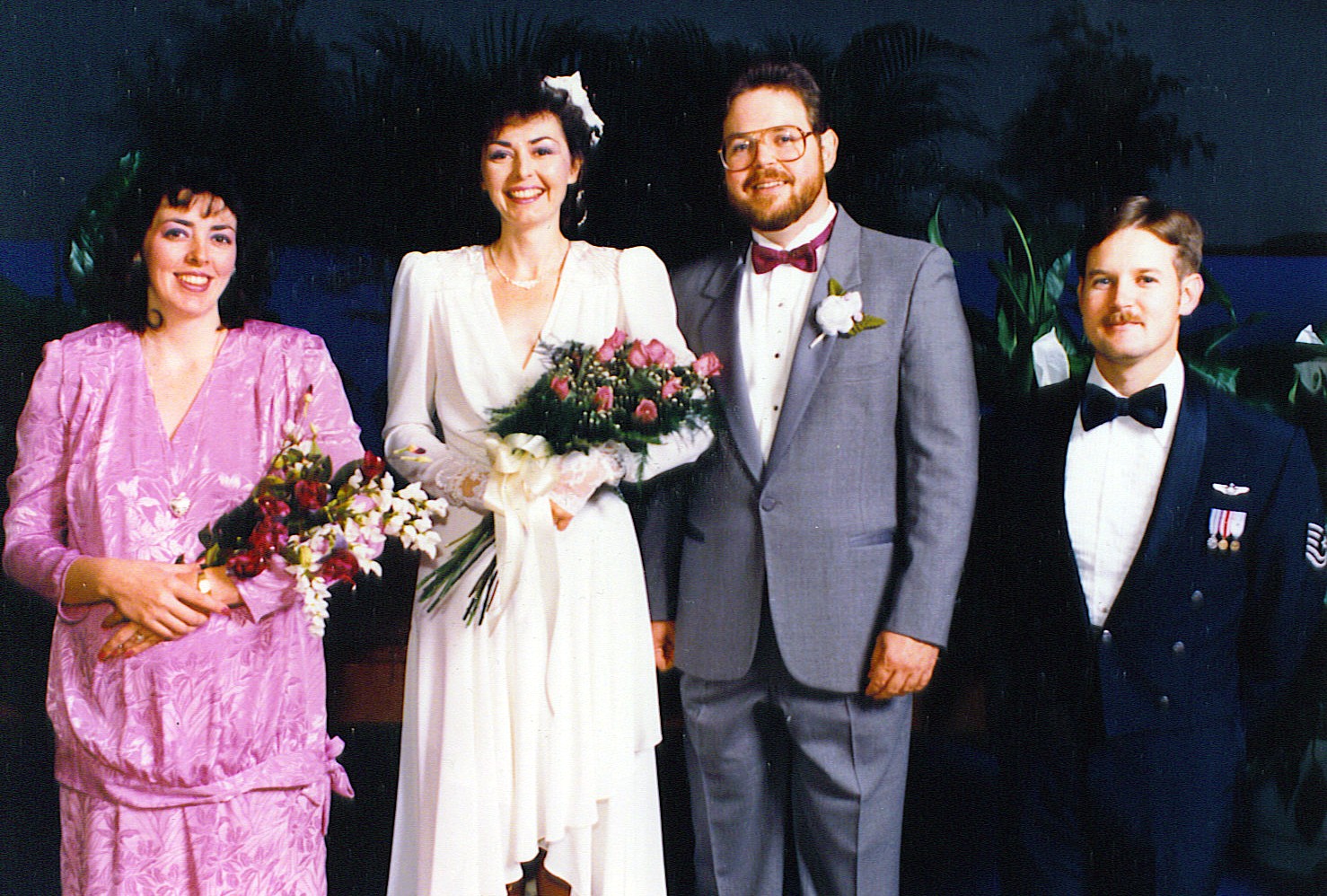
Let’s see, it was a pretty small bridal party. One Maid of Honor (pregnant with the future Miss Inver Grove Heights), and my Best Man, aka Heathen Brother. He was on a special training cycle at the time and didn’t think the Air Force would let him out for the weekend, but Someone higher up intervened and there he was in his dress blues.

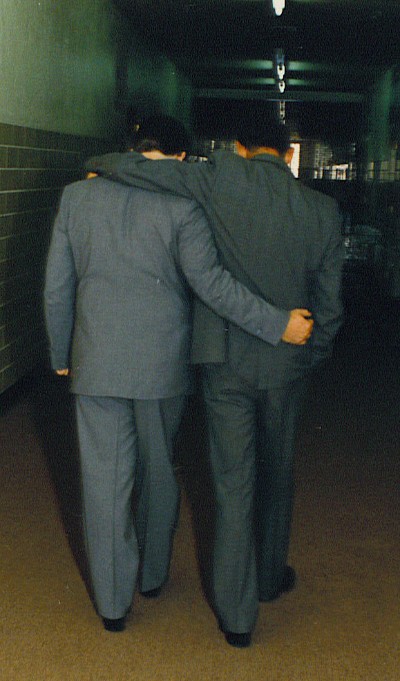
Some last minute words of advice from my dad. Sorry, can’t remember a thing…

In My Father’s House, Part 2

A childhood memory: waking up in the pre-dawn winter hours to the muffled thrumming of my father’s car warming up in the driveway. In my mind I can picture the clouds of crystalline exhaust illuminated by the back porch light. I would lie snug in my bed and listen to the sounds of my father preparing to go to work: his step (the heaviest in the house) in the hallway, the jingle of the dozen or so keys on the big ring on his belt, the clink of a coffee cup being set down on the counter; finally the closing of the back door to mark his passing. It was familiar and unremarkable, and I would go back to sleep.

When I awoke again my mind was filled with my own thoughts and plans for the day. In this time my father owned his own business and was rarely home for supper. My brother and sister and I would eat with our mother, and go about our evening routine. I would often be in bed again when I heard him return. There would be the sounds of my mother frying him a steak, and of talking; their voices distinct, but not the words. Sometimes the tone was obviously my mother reciting the sins of the day, and if they were heinous enough, we would be summoned from our beds for the promised retribution of When Our Father Gets Home.

As a father now myself, I understand how this had to have been as unpleasant for him as it was for us.

During this time our father was a seldom seen force in our lives, operating outside our understanding, toward ends unknown. We would see him mostly on Sundays, and there was a feeling of awkwardness as if none of us were quite certain about how we should act. And yet there was always food on the table, a comfortable house, and clothes for every season, even though we gave little thought, or saw little connection, to how these things came to be.

It wasn’t until I was 11 or 12 and old enough to go to work with my father that I really started to get to know him, and learn what a just and wonderful man he was. I admit he never seemed to be at a loss for things for me to do: pick up rocks and litter, sweep the drive, clean the restrooms for the rest of the workers and the guests. As I learned more about how to please him, my responsibilities and privileges grew. I came to know the special feeling of joining him in the early morning while everyone else was asleep as we got ready to go to “our” work.

In My Father’s House, Part 1

The day before Father’s Day this year I happened to be parked at the far pumps at a BP gas station and convenience store in Ottumwa, Iowa, filling up. As I squeegeed my windshield I heard a commotion behind me and turned to see a large pickup rock to a sudden stop in front of the convenience store. It wasn’t the sound of the approaching truck that had caught my attention, however, but the not-so-muffled shouting coming from inside the cab.

A man was yelling at a boy, waving his arms and perhaps throwing some litter around. Outside of several f-bombs it was hard to make out what was being said, but it was a one-sided exposition. I casually and automatically looked away as the man got out of the truck, continuing the barrage. “Happy Father’s Day,” I thought, as he stalked off into the convenience store, my own thoughts suddenly dizzy in my head. A couple of minutes later I hung the nozzle back on the pump, and made my way toward the store as well. I had to walk in front of the truck on my way. Not wanting to embarrass the young man further I glanced sideways at him through the windshield and was impressed to see that, though tears were rolling down his cheeks, he had his head up. I turned my head fully toward him, made eye-contact, and winked.

I hope what was communicated was encouragement, a friendly contact and a silent assurance that things will get better.

Yeah, I’ve been there. My own father’s temper has been known to be … expressive. I absorbed my share of it growing up, though I can’t remember now any particular incident or cause, no more than I remember a particular thunderstorm. I mean, I know there were thunderstorms when I was growing up but I don’t remember any specific ones. What does come back to me now, however, is a time when I was in second or third grade and my dad was trying to get his business launched, working long hours away from the house. He must have felt some need to spend some time with me, however, and out of the blue one Sunday afternoon he took me for a special treat: to play miniature golf. I don’t remember where my brother and sister were, but I’m sure I was delighted that I was the only one to get this attention. The problem was, it was an especially hot day and the putt-putt course was laid out on what seemed like acres of cement, none of which could have been very far from my head given my height then.

I don’t know how long we played, but at some point I started to feel dizzy and nauseous. I didn’t know heat stroke from heat rash then but I was definitely sick and my dad was definitely scared. He got me off of the premises, carrying me to his car and laying me down with a wet handkerchief on my face. We went home and he put me in front of the window a/c unit until I recovered. I’m sure he felt bad that his great plan to spend some time with his son had almost ended in disaster; I know I did, though for different reasons. I remember the concern on his face, however, at a time when I might have expected him to be angry.

Another time when he could have gotten angry and didn’t was when I was 16 or 17 and we were anchoring a mobile home. He was steadying the 4-foot anchoring rods in their crosspiece while I swung the 8-lb. sledge to drive them in. At one point I accidentally clipped the upper part of his ear with the handle of the hammer as I repositioned myself for another swing. It drew blood but no explosion, though I’m sure he didn’t like it. (Which also reminds me of a time when we were trying to level and anchor a trailer on the side of a steep hill near Steelville, Missouri. He wouldn’t let me get under the unit as he delicately worked with hydraulic jacks, concrete blocks and wooden shims along the underframe. Just as he was placing a shim and lightly tapping it into place with a hammer a sonic-boom rocked the valley. I had heard of greased lightning up until that time, but I had never seen it until I saw him crab sideways out from under that trailer!)

Family lore has it that my father’s father was known for a volatile temper. I saw a little of it growing up, but other than a couple of years when he lived near us I wasn’t around him that much. Most of the accounts are from stories my uncles would tell at family gatherings. Most folks today will accept that a temper can be passed on to each generation whether by nature or nurture or a spiritual manifestation. Whichever, my father received his inheritance and passed it on. My brother and I heat up about as quickly as he did, though expressing it is an indulgence that I have tried hard to limit and thankfully haven’t seen it in my children.

Anyway, I survived with minimal trauma and with greater memories such as the ones I’ve just described taking precedence. I don’t know what the future holds for the young man and father I saw in Iowa, but I hope the incident was an isolated one that one day will be acknowledged yet set aside in favor of ones happier and more plentiful, for both their sakes.

As I entered the store I tried to think of something to say to the father; something encouraging, in just a few words, that might give him a different perspective. I could come up with nothing in the moment and even now, months later, I still can’t think of the perfect sentence to calm the situation and allay my own fears. My fears were not for the future of that family, or that whatever I said might provoke an additional outburst. My concern was that in speaking to that father I might end up telling him why I was in Iowa that day and telling him where I was going and why, and that neither of us would want to hear that outloud.

You see, the reason I was standing in that gas-station was because my daughters and I were on our way to Missouri to see my dad as a Father’s Day surprise. He had been feeling sick for weeks and experiencing a lot of back pain. Though we could barely breathe the word, our family was concerned that cancer had returned. Thoughts of the past and the future had been folding themselves constantly in my mind during the drive. If it was cancer, would he need chemo? If he needed chemo, would he put himself through that ordeal or — after what had happened to friends of his — say, “To hell with that”?

He was surprised and pleased to see us when we got there, twisting stiffly in his swivel chair to see what the dog was barking at. He got up for hugs all around, his golf shirt stretching a little around the bit of gut his cardiologist had been after him to lose. He didn’t look much different since I had seen him back in December, but I could tell he was in pain from a fractured vertebrae and the subsequent bone biopsy he’d had the day before. We talked some over the weekend about the pain and the possible implications, but tried to keep things light and positive. The test results would be back on Tuesday, I was heading back on Monday.

The girls and I stood around him and prayed before we left. He acquiesced, but it felt to me as if I was throwing a saddle on a newly busted bronco for the first time. I have personally seen and experienced great, even miraculous, results from prayer, and have prayed many times for people, standing on scripture and faith, the words usually come easily as I follow the leading that comes. This was harder, though; so much I wanted to pour into it, so little that seemed to want to come out. Through the long drive home I took some comfort from the knowledge that it is the power in the words, not the eloquence that makes the difference. We arrived home Monday night.

Tuesday brought the word. Lymphoma, stage four. He would start chemo on Wednesday, no fuss. “Let’s get it done.”

Loving your neighbor in Inver Grove Heights

Last week the Inver Grove Heights City Council met to hear from the public regarding a new property maintenance ordinance aimed at instituting certain appearance, maintenance and lawn-care standards for private homes. As with many laws, especially those regarding private property, this ordinance wasn’t aimed at defining or protecting an owner’s property rights, but at criminalizing poor or indifferent citizenship. Of course, it’s all for a good cause: “It’s for the children,” one of the proponents said.

Apparently, it’s more harmful for children to see a messy yard than it is for them to see adults taking their neighbors to court to resolve a problem instead of pitching in to help.

As a property-owner I know how discouraging and aggravating it can be to share a neighborhood — or even a property-line — with an “eye-sore” home and lot. I am much more concerned, however, with the ever-increasing encroachments on property rights, typically in the name of “doing good.” From Kelo, to smoking bans, to how high you let the grass grow, it’s an ever-expanding power-grab passed off as being for the common good without any real examination of how much good — or how much harm — is actually being done. (On a side-note, I heard one news-reader on KFAN this a.m. referring to the new state-wide smoking ban in bars and restaurants, say the ban “does not apply to private homes at this time” — suggesting, what?)

In this particular case, this issue for me is not just a legal or conservative one about rights and what you can get people to go along with, it is a moral and Biblical one as well. Usually it seems that if you raise a moral issue these days it’s assumed that you want to impose some narrow-minded “thou shalt not” on other people. In this case the “thou shalt nots” being imposed are coming from the larger public and what’s being missed is the “thou shall” Biblical instruction. You know, the one that “thou shall love thy neighbor as thyself.” Note, that doesn’t say “love they neighbor only if thy neighbor is a believer,” nor does it say “if you are a believer, thou shall love thy neighbor.”

What if that neighbor with the dilapidated house or junky yard is someone struggling just to make ends meet and can’t afford to make the improvements to the paint or siding that the community deems to be necessary? What if that neighbor is working two or three jobs and might skip mowing the lawn from time to time? What if your neighbors are an elderly couple who don’t have the physical, let alone financial, resources to maintain the property but are trying to live independently? Shall we just have our pubic servants, the police, march up to the door and slap a citation on it? Certainly it would be “legal.” Or, alternatively, shall we walk up to the door in person, knock on it and say, “Hi, you may not know me but I’m your next-door neighbor and I was wondering if there was something I could do to help?”

Ok, so what if that neighbor is a lazy bum who’s perfectly capable of maintaining his house or yard, or is someone who just likes to use old washing machines as lawn statuary? Well, it could be that your offer might not be well-received, or that your neighbor might think that you’re the nutjob. But if a succession of people approached him or her over time and offered to help (as opposed to demanding that he or she “straighten up”) what effect could that have? The neighbor would know that people are paying attention, that they care about the neighborhood and their property values, and that they’re willing to try to help first rather than condemn. He may not change his attitude completely but he may be motivated to try to make some improvements (even grudgingly) or even accept an offer of help. Which approach do you think ultimately contributes to a better neighborhood?

If that is starting to sound like a good idea to you, but you’re thinking, “yeah, why can’t the government do something to help that guy?” then you’re still missing the point. A lot of the problems we’re facing in our communities come from the fact that we’ve allocated to the government the responsibility of looking out for the well-being of those around us, of loving our neighbors. Sure, we mean to “do good” by passing new laws and taxes but we’re merely passing off our personal responsibility to do good to another, impersonal (and usually less efficient) entity.

Now it could be that your neighbor is a loser with no conscience or sense of shame who will readily accept help from you and your neighbor and just sit back and figure someone will always bail him out and never lift a finger himself. There’s certainly precedent for that happening when the help comes from a faceless government, but may not be so common when there are real faces involved. It’s worth a try at least to see if you can make a difference, and if someone is totally resistant or irresponsible there are other Biblical examples of how to deal with an unrepentent individual (and no, they don’t involve stoning — I’m thinking Matthew 18:15-17).

Furthermore, do we know how many people might fall into this latter category, and might it be worthwhile to figure it out before writing an ordinance or passing a law? At the Inver Grove Heights meeting, one person asked the Council how many complaints had been filed regarding nuisance properties. The answer was 160. The questioner then asked how many private homes were in Inver Grove Heights. The Council and the proponents of the ordinance didn’t know.

How many of the complaints referred to the same property? They didn’t know.

How many complaints had been filed by the same person? They didn’t know.

For the time being, the Council has decided to proceed with a stripped down version of the ordinance that regulates junk, open storage, woodpiles and similar eyesores but not the outside condition of houses and other buildings. It was much less than ordinance proponents were hoping for, and the issue is still alive. A second reading of the ordinance is scheduled for the next Council meeting on October 8.

If I had my druthers

Sadie Hawkins Day. The Shmoo. Lower Slobovia. Joe Bfstplk, Evil Eye Fleegle and General Bullmoose. Lonesome Polecat and Hairless Joe. Stupyfyin’ Jones and Moonbeam McSwine. Marryin’ Sam, Fearless Fosdick and Kickapoo Joy Juice.

If you still don’t know what I’m talking about, here are the final clues: Dogpatch, U.S.A; Daisy Mae and Li’l Abner.

Today is the birthday of Al Capp, creator of the classic comic strip “Li’l Abner” that was the model for bringing entertainment and political commentary to the masses via daily syndication. (Don’t worry, “Pogo” fans — I’m with you there, too.)

I read Li’l Abner daily in the Indianapolis Star when I was growing up (though I probably understood maybe 20% of it) and whenever I could until Capp shut the strip dowin in 1977. A highlight of my teen years was appearing in a stage production of Li’l Abner in my high school play. The director/drama teacher wanted me to be Li’l Abner or Marryin’ Sam, but I could not sing. A lick. So what else was there to do with all this talent, imposing, broad shoulders and no vocal talent but to take on the role of Earthquake McGoon, who’s singing was supposed to be awful. And I nailed it. Every night.

(And a happy, one-day-late birthday to you, Stupyfyin’ Jones. And Mr. Fleegle, there might still be a need for your services in regards to the Mall Diva.)

If’n I had my druthers, I’d still be reading Li’l Abner. Natcherly!

Hot and fuzzy

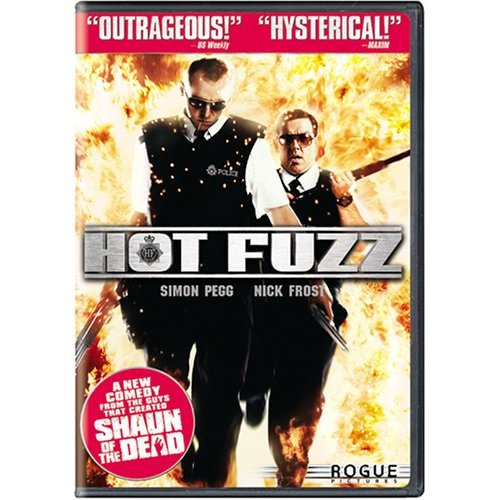
Let’s see, I laughed out loud several times at the over-the-top antics; smiled frequently at the clever movie parodies; giggled when the lads turned a tired cliché inside out; and had a great “aha!” moment at an especially subtle inside joke, so I guess you can say I found Hot Fuzz amusing.

Hot Fuzz is the latest collaboration from the team that brought us the comic zombie homage/thriller Shaun of the Dead. This time, instead of re-animating the undead genre, director Edgar Wright and actors Simon Pegg and Nick Frost (from a screenplay written by Wright and Pegg) buddy-up to the high-explosive Bad Boys-style cop action films, playing the mis-matched partners investigating a series of extreme murders in a quiet English village that is, of course, more than it seems.

Pegg is the no-nonsense super cop, Nicholas Angel, banished to the sticks from London because his high-performance record and capabilities were making the rest of the police force look bad. His persona is nearly the exact opposite of the character Pegg played in Shaun. Frost, meanwhile, is Danny Butterman, the bumbling, lightly-regarded local constable who yearns to be like his heroes from the hundreds of action DVDs he owns. As with Shaun, the send-up is as much a homage as a parody as you can tell the team knows its source material well and is having a blast playing fast and loose with the touchstones.

There’s a lot of violence and blood in the film, but it’s more in the style of Monty Python and the Holy Grail rather than Friday the 13th. The language is too strong at times for it to be family fare, but it’s a lively and fun film with enough mystery to keep you guessing and a never-ending series of jokes and references to keep you laughing without turning into a farce like Police Academy. Pegg and Frost are great together, and the success of their previous film allowed them to bring in some familiar names and faces to play supporting roles (such as Jim Broadbent and the wolfish Timothy Dalton) or perform cameos (Cate Blanchett). One of the best moves was casting veteran Brit actor Edward Woodward (from the old The Equalizer TV series). I remember seeing Woodward in the ’79 version of The Wicker Man where he plays a by-the-book investigator contending with a very creepy group of pagans (one of the most disturbing movies I’ve ever seen). In Hot Fuzz, however, Woodward gets to turn the tables on his earlier role — and seems to be having an excellent time while doing so.

As will you, I think, if you rent this movie.

1, 2, 3, 4 …

Huzzah, it’s football season again! That means I’m spending more time in front of the tube watching a game…and all of the commercials that go with it. By this point in my life I can pretty much tune these out (though I can’t explain these strange cravings for cheese puffs, fast food and big screen TVs), but I make note of commercials I like and those that drive me crazy.

Of the latter, what’s really bugging me lately are the commercials for Ford trucks. Now I like Mike Rowe a lot and his “Dirty Jobs” show is something the kids and I like to catch. He’s a likable enough pitchman for Ford, but if he’s getting paid for every time those commercials run he’s going to have more than enough to tell someone else to do those dirty jobs. Every TV timeout this last weekend featured one of two different Ford truck commercials. I mean it, I started to count on them: a commercial break would occur and I’d think, “Let’s see, last break they showed the one with the truck stopping the cargo plane so that means that this break it will be the one with the truck going through the road course backwards” — and I’d be right! And I hate it when I’m right! (About things like this anyway.) The repetition is enough to make me reject the Flomax commercials because suddenly having to go to the bathroom at every commercial break doesn’t seem like such a bad thing.

This year’s crop of Coors Light commercials with the hokey coach interviews (which I ripped last year) are still annoying, though I’m glad they’ve let poor Bill Walsh rest in peace. The only interest I’ve taken in these is that they fulfilled my prediction of using Denny Green’s infamous “they are who we thought they were” meltdown from last year, but even that just makes me mad to think that he’s still getting paid.

On the “like” side, though, I have to admit to being beguiled by the iPod Nano commercial that features a series of the little video-playing Nanos being lifted off the table like playing cards while showing a music video of a woman in an electric blue jumpsuit. Now I’m not an iPod kind of guy. My lifestyle is not such that I need to have my ears tickled non-stop by some form of musical entertainment. But the little song the woman is singing keeps growing on me, or perhaps it’s the almost laughably simplistic choreography in the video that somehow reminds me of the dance scene in the Charlie Brown Christmas program. I don’t know just what it was, but it drove me to find out who the singer is and the name of the song.

I succeeded:

(If the video doesn’t play on your monitor you can also check it out at this link.)

Her name is Leslie Feist, a Canadian indie-fave and I’ve found a lot of her music on iTunes that I think I’ll be downloading (but for CDs, not an iPod).

Mmmm, catchy. “1,2,3,4, tell me why you love me more…”

Update:

My first impression of the choreography for this video was based on what I could see in the Nano screen in the TV commercial. Looking at it more closely, while the dance moves are simple, the camera-work is very creative and cleverly makes use of perspective – and apparently it’s done in one amazing, continuous take!

What I did on my “summer” vacation

I awoke easily last Sunday morning to the tramping sound of Lake Superior shoving repeatedly against the shore just 80 feet from the screened door of the cottage. It had been the same sound I had fallen asleep to the night before, and I looked at the clock and was half-stunned to realize that for the first time in months I had just spent eight glorious, uninterrupted hours dead to the world.

I also noted with some relief that the mental checklist of the day’s chores, challenges and deadlines was not, for the first time in months, floating just behind my eyes, trying to push them open. Instead the invisible slate was hanging back, humble and nearly bare like the marquis of a Dairy Queen closed for the season, the only lettering in my head a casual scrawl: Grand Marais, On Vacation.

Without much urgency I chalked the most pressing agenda item for the day: Breakfast.

On Saturday my family and I had driven up to the North Shore from the Cities. I hadn’t been able to get away much this past summer and had had to miss some of the picnics and canoe trips my wife and daughters had already taken, so I was really ready for this trip. By coming this late in the season, and before the fall leaves were at their peak, we had enjoyed a less crowded road, though the cars were still packed as thick as flies around a sweet roll at Tobies in Hinckley. Instead we had a picnic lunch outside the Hinckley Fire Museum and then kept bearing north to Duluth and the southwestern tip of the great lake, whereupon we hugged its sprawling shore as we passed the familiar totems of our trip: Two Harbors, Castle Danger, Gooseberry Falls, the Split Rock Lighthouse. We turned off at Palisade Head in order to walk along the the towering cliffs that for so long have told the mighty lake, “This far and no further” (a testament that even a natural balance isn’t necessarily an easy one). Driving up the steep, narrow road up to the parking lot at the rocky edge of Palisade, the “I ride ATVs and I Vote” bumper sticker on our borrowed mini-van contrasted nicely with the many “Wellstone!” stickers already there. After some clambering around and the usual jelly-kneed sensations we were back on Hwy. 61, with the hills, woods and great root beer rivers of the Superior National Forest on our left, the lake always on our right, past the Tettegouche State Park, and the Temperance and Cascade Rivers, crashing down the gorges and over the rocks in a great foamy rush to keep their standing appointments with Gitchee-Gumee. Then we were at last into Grand Marais, and still a bit further, past 5-Mile Rock and to the Croftville Road Cottages.

After that my wife prepared some lamb stew in our kitchen for dinner. Then, in the gathering twilight, a campfire and toasted marshmallows as we watched the bats chase down the remaining insects of the season and finally into bed, the tramping sound in my ears of Superior shoving against the shore, just 80 feet from the screened door of my cottage.


Our cottage. It was beautifully remodeled and very comfortable with two gas fireplaces, and at a great price.

Sunday, when breakfast had been duly scratched off of the to-do list, we went back into Grand Marais, parking in a lot beside the harbor where I could see a yellow sailboat moored 50 yards from shore, crisp in the morning sun and nodding to us on the gentle waves. We walked through the small town, browsing at the many gift shops and quaint attractions. I’m sure that the Indians, and later the first explorers, trappers and lumbermen through this area, would be stupefied at the many opportunities available today to partake of the comforts of pie and caffeine.

While the girls admired jewelry and scarves, beneath rustically-lettered signs informing them that they were under video surveillance, I scouted around and discovered the apparently sole location where that afternoon’s Vikings-Lions football game could be seen. That was still several hours away, however, so we got back in the van and headed north to the Devil’s Kettle Falls and State Park. We “tail-gated” with chicken- and egg-salad sandwiches from our cooler before setting off on the somewhat stiff 1.4 mile hike to the falls. The path is relatively wide and well-maintained, but persistently uphill and even in the mild temperatures we got pretty warm. There are some very nice look-outs along the way, however, and we admired the cascading river and the vistas of trees still mostly green but already seasoned with explosive swathes of red and orange.

After steady climbing we were then at a series of wooden steps and railings leading us down to the titular “Devil’s Kettle.” The relief in the descent was greatly mitigated by the knowledge that every one of the 179 steps would have to be negotiated in reverse order and direction on our way back. On the way back up, however, we did get to see an eagle circling directly above us (though at first I thought it might be a buzzard). The girls dropped me back at the bar in time for the game and then they headed for the bay with their sketch books.

I thought the bar would have more than a few tourists inside to catch the game, but it was all locals who knew each other and didn’t seem to mind my presence. It was a congenial, cozy group. One of the patrons sitting at the bar, who was wearing open-toed flip-flop sandals, apparently felt so at home that he started picking at his toenails, dropping his scrapings on the carpet. Well, I wasn’t planning on eating anyway, as I only wanted to watch the game, but I ordered a draft Bock for medicinal purposes. The pedicurist and one of the female customers were soon intent on a discussion about why the TV kept showing a “DET 6, MIN 3” score from time to time in the upper corner of the screen, especially when the current score was Lions 7, Vikings 0. I cautiously submitted for their consideration that the strange score might, in fact, be the score of the Tigers-Twins game that was also going on that afternoon. Their reaction gave credence to the adage that the definition of “expert” means someone who lives more than 50 miles away. A little later I felt comfortable enough to take sides between two groups disputing the interpretation of a certain play. One of the members of the “other” group, an older gentleman, loudly insisted his version was correct because he “used to play this game.” To which I replied, “And did they wear helmets back then?” Fortunately, this was well received by the group as a whole and the gentleman in particular, and while I was on a “one-beer-per-half” pace, a third Bock appeared in front of me in the fourth quarter.

I’d nursed my way through about a third of it with about a minute and a half to go in the game, when my wife pulled up in the parking lot and sent the kids in to get me. “Paw,” they said, “Ma says it’s time to come home!” Well, actually, they didn’t say anything like that, but they did let me know that they and my supper were waiting for me down the street a little ways at a place called the Crooked Spoon. Therefore, even though the game looked to be heading for overtime, I settled my tab and left after Longwell’s kick clanked off the upright. Besides, with two 16-oz. glasses of beer, plus a little bit more, in me I was starting to feel a little tingly in my extremities. A brisk walk in the cool evening air was the perfect remedy, however, and I arrived at the restaurant hungry and invigorated. The Crooked Spoon had been recommended to us by friends who admired its sophisticated menu. I believe I acquitted myself with grace and aplomb while dining — an opinion that the Mall Diva threatens to dispute in a post of her very own if I’m not careful (or she gets the slightest encouragement from anyone).

Whatever. The food was absolutely delicious, from the melted cheese and spinach appetizer, through the pulled pork with beans and greens soup and the barbequed ribs, and including two delectable pieces of carrot cake — each the size of some of the boulders we’d seen along the shore earlier — that my family fell upon with flashing cutlery like ninjas. We left the restaurant well satisfied with the meal and the day, but even more “dessert” was in store: an enormous crescent moon, looking so perfect that if you saw it in a movie you’d think it was a painted backdrop for sure, had risen over the bay and was reflecting a golden beam across the still waters directly at us, and the beam followed us nearly all the way to the car.

Yep, it had been a great day.

Six years

Night Writer 

For the Falling Man
by Annie Farnsworth

I see you again and again
tumbling out of the sky,
in your slate-grey suit and pressed white shirt.
At first I thought you were debris
from the explosion, maybe gray plaster wall
or fuselage but then I realized
that people were leaping.
I know who you are, I know
there’s more to you than just this image
on the news, this ragdoll plummeting—
I know you were someone’s lover, husband,
daddy. Last night you read stories
to your children, tucked them in, then curled into sleep
next to your wife. Perhaps there was small
sleepy talk of the future. Then,
before your morning coffee had cooled
you’d come to this; a choice between fire
or falling.
How feeble these words, billowing
in this aftermath, how ineffectual
this utterance of sorrow. We can see plainly
it’s hopeless, even as the words trail from our mouths
—but we can’t help ourselves—how I wish
we could trade them for something
that could really have caught you.

“For the Falling Man” by Annie Farnsworth from Bodies of Water, Bodies of Light. © Annie Farnsworth.