Atlas shrugged, and smiled a knowing smile

I was talking to my sister-in-law the other day and she said her husband, who’s been at his job for more than 20 years, has been bumped back to the night shift by someone with even more seniority. “I’m trying to keep a good attitude about it,” she said, “because, after all, at least it’s a job.”

“You’re right,” I replied. “Jobs are important; only 9 out of 10 Americans have one.”

All right, I can be an incorrigible smart ass, especially around family, and that’s a trait that has barely mellowed over the years. Even I’ll acknowledge, however, the gathering economic storm building overhead as if the country were one large trailer park. My sense is that things are going to get worse before they get better and that this is no mere hiccup but more like a full-on bulimic purge. To keep mixing my metaphors, Dylan once said “You don’t have to be a weatherman to know which way the wind blows,” and my “forecast” doesn’t require a special degree or even a Doppler. In fact, if you’d spent time in college reading “Atlas Shrugged” by Ayn Rand you could probably do the same. As the current winds increase it might be interesting, if not all that helpful at this point, to head for the basement with a copy of her book.

Stephen Moore made a similar point last week in an opinion piece in the Wall Street Journal entitled “Atlas Shrugged: From Fiction to Fact in 52 Years”. In it he points out frightening prescience of this all-time classic.

For the uninitiated, the moral of the story is simply this: Politicians invariably respond to crises — that in most cases they themselves created — by spawning new government programs, laws and regulations. These, in turn, generate more havoc and poverty, which inspires the politicians to create more programs . . . and the downward spiral repeats itself until the productive sectors of the economy collapse under the collective weight of taxes and other burdens imposed in the name of fairness, equality and do-goodism.

In the book, these relentless wealth redistributionists and their programs are disparaged as “the looters and their laws.” Every new act of government futility and stupidity carries with it a benevolent-sounding title. These include the “Anti-Greed Act” to redistribute income (sounds like Charlie Rangel’s promises soak-the-rich tax bill) and the “Equalization of Opportunity Act” to prevent people from starting more than one business (to give other people a chance). My personal favorite, the “Anti Dog-Eat-Dog Act,” aims to restrict cut-throat competition between firms and thus slow the wave of business bankruptcies. Why didn’t Hank Paulson think of that?

These acts and edicts sound farcical, yes, but no more so than the actual events in Washington, circa 2008. We already have been served up the $700 billion “Emergency Economic Stabilization Act” and the “Auto Industry Financing and Restructuring Act.” Now that Barack Obama is in town, he will soon sign into law with great urgency the “American Recovery and Reinvestment Plan.” This latest Hail Mary pass will increase the federal budget (which has already expanded by $1.5 trillion in eight years under George Bush) by an additional $1 trillion — in roughly his first 100 days in office.

The current economic strategy is right out of “Atlas Shrugged”: The more incompetent you are in business, the more handouts the politicians will bestow on you. That’s the justification for the $2 trillion of subsidies doled out already to keep afloat distressed insurance companies, banks, Wall Street investment houses, and auto companies — while standing next in line for their share of the booty are real-estate developers, the steel industry, chemical companies, airlines, ethanol producers, construction firms and even catfish farmers. With each successive bailout to “calm the markets,” another trillion of national wealth is subsequently lost. Yet, as “Atlas” grimly foretold, we now treat the incompetent who wreck their companies as victims, while those resourceful business owners who manage to make a profit are portrayed as recipients of illegitimate “windfalls.”

I’ve been thinking about re-reading the book, especially since I’m sure I’ll understand it a lot more than I did 30-some years ago, but I’m concerned that I’ll get too angry (again) over the treatment of the individual in the story … and by the creeping sense that there’s nothing one can do to keep it from happening in real life. Of course, in the book, one man — the right man — can make a difference.

Ultimately, “Atlas Shrugged” is a celebration of the entrepreneur, the risk taker and the cultivator of wealth through human intellect. Critics dismissed the novel as simple-minded, and even some of Rand’s political admirers complained that she lacked compassion. Yet one pertinent warning resounds throughout the book: When profits and wealth and creativity are denigrated in society, they start to disappear — leaving everyone the poorer.

One memorable moment in “Atlas” occurs near the very end, when the economy has been rendered comatose by all the great economic minds in Washington. Finally, and out of desperation, the politicians come to the heroic businessman John Galt (who has resisted their assault on capitalism) and beg him to help them get the economy back on track. The discussion sounds much like what would happen today:

Galt: “You want me to be Economic Dictator?”

Mr. Thompson: “Yes!”

“And you’ll obey any order I give?”

“Implicitly!”

“Then start by abolishing all income taxes.”

“Oh no!” screamed Mr. Thompson, leaping to his feet. “We couldn’t do that . . . How would we pay government employees?”

“Fire your government employees.”

“Oh, no!”

Abolishing the income tax. Now that really would be a genuine economic stimulus. But Mr. Obama and the Democrats in Washington want to do the opposite: to raise the income tax “for purposes of fairness” as Barack Obama puts it.

David Kelley, the president of the Atlas Society, which is dedicated to promoting Rand’s ideas, explains that “the older the book gets, the more timely its message.” He tells me that there are plans to make “Atlas Shrugged” into a major motion picture [A younger Glenn Close would make a dynamite Dagny Taggart, IMHO. NW.] — it is the only classic novel of recent decades that was never made into a movie. “We don’t need to make a movie out of the book,” Mr. Kelley jokes. “We are living it right now.”

Catching the Ghost Train to Hawaii

It’s six fargin’ degrees below zero as I trundle to the light rail station tonight. I’m bundled up in “Big Blue”, my below-the-knee length parka lined with down, thinsulate and cashmere, and a collar that zips up under my nose, and I’ve got on ear-muffs and a woolen hackers cap from Ireland. Big Blue also has a hood which I seldom use because I think hoods on coats make you look like you’re in third grade, or like you’re a dork, or a third-grade dork, which may be the dorkiest of all. In this cold, however, I have no shame and I also figure no one can recognize me with the hood pulled up over my cap and ear-muffs and fastened in front of my face anyway.

In this kind of weather I board at the LRT’s terminus in the Warehouse District because there’s almost always a train waiting there to start its run and it’s nicer to wait in the train car rather than waiting for it a couple of blocks farther down the line. Tonight there is a train waiting, but when I try to get on the doors won’t open. Then the driver speaks over the PA: “This train is not in service.” It looks plenty serviceable to me, especially when it departs — empty — a few moments later. There is no other train in sight at the moment as the lights of the Ghost Train disappear toward the Nicollet Mall where it will no doubt tantalize other commuters before leaving them in the cold as well.

With the train’s departure, however, I now have an unobstructed view of the front of a bar called Sneaky Pete’s, immediately on the other side of the track. The front of the establishment features large plate glass windows and on one of the windows, positioned immediately under a neon Blue Moon Brewing Co. sign and hard up against the window, is a large flat-screen TV, facing the tracks. No one in the bar could possibly watch this TV, but people outside can. The TV is tuned to The Golf Channel, and it is showing scenes of PGA pros in their short-sleeve golf shirts practicing at Waialea Country Club in Hawaii for this week’s Sony Open. I watch slack-jawed, with frost from my moustache thawing and dripping onto my lips, as Anthony Kim and Geoff Ogilvy and others roll puts across a High-Def green that could be called emerald green if emeralds took steroids, and just looking at it makes me wiggle my toes deep inside my mukluks.

Somehow the January wind starts to feel softer and, I swear, I think I can smell coconut oil wafting toward me on it. The angle of my shoulders, until now hunched up against my neck, drops by about six degrees and I loosen the hood and lower the zipper at my neck a couple of inches as I eye a bunker shot from a beautiful white sand hazard. No, wait, it’s really a snow bank as the clanging bells of the approaching train take me out of my reverie.

Is it too early to get my clubs down out of the garage attic?

Ozymandias Shrugged

Back when Dennis Miller was one of the undefined on Monday Night Football, ABC found it necessary after games to post explanations of the eclectic comedian’s erudite references on the MNF website. I was reminded of this after yesterday’s Day by Day cartoon featured a lonely statue of Al Gore in a snowy wasteland, with the words etched on the pedestal mostly obscured by snow drifts. Nevertheless, the words that were visible may have rang a bell in a seldom-used hallway of my mind. Ah, yes … Shelley’s “Ozymandius”, the sonnet dedicated to the hubris of Man, though Ozymandius’s statue was located in a desert waste instead of a snowy one. Oh well, with a high temperature forecast for tomorrow of -2F here in Minnesota, the comic gave me a warm feeling.

Here’s the unobscured text of “Ozymandius”:

Ozymandias
I met a traveller from an antique land,
Who said: Two vast and trunkless legs of stone
Stand in the desert. Near them, on the sand,
Half sunk, a shattered visage lies, whose frown
And wrinkled lip and sneer of cold command,
Tell that its sculptor well those passions read,
Which yet survive stamped on these lifeless things,
The hand that mocked them, and the heart that fed;
And on the pedestal these words appear:
‘My name is Ozymandias, King of Kings;
Look on my works. Ye Mighty, and despair!’
Nothing beside remains. Round the decay
Of that colossal wreck, boundless and bare
The lone and level sands stretch far away.

Reasons for blogging

I think the poem below pretty well sums up why I write — blogging or otherwise. From The Writer’s Alamanc today:

VII
I would not have been a poet
except that I have been in love
alive in this mortal world,
or an essayist except that I
have been bewildered and afraid,
or a storyteller had I not heard
stories passing to me through the air,
or a writer at all except
I have been wakeful at night
and words have come to me
out of their deep caves
needing to be remembered.
But on the days I am lucky
or blessed, I am silent.
I go into the one body
that two make in making marriage
that for all our trying, all
our deaf-and-dumb of speech,
has no tongue. Or I give myself
to gravity, light, and air
and am carried back
to solitary work in fields
and woods, where my hands
rest upon a world unnamed,
complete, unanswerable, and final
as our daily bread and meat.
The way of love leads all ways
to life beyond words, silent
and secret. To serve that triumph
I have done all the rest.

“VII” from the poem “1994” by Wendell Berry, from A Timbered Choir: The Sabbath Poems 1979–1997. © Counterpoint, 1998.

Please, don’t anyone tell Richard Simmons

While my passion for the NFL and Fantasy Football have waned a bit, my love for golf remains strong and I’m looking forward to warmer weather and being able to play again.

I’ll still enjoy it even now that I know it’s good for me.

I came across this story the other day about a study that showed some surprising results in the amount of calories a golfer burns over nine holes.

Among the top findings: Given the number of calories burned, it’s certainly fine to call golf a sport.

“One of the more interesting things I found was that the actual act of swinging a golf club takes significant energy,” said Neil Wolkodoff, director of the Rose Center for Health and Sports Sciences in Denver.

Maybe more energy than many people might think for a motion that takes a grand total of about three seconds.

Wolkodoff found eight male volunteers, ages 26 to 61 with handicaps between two and 17, strapped them into some state-of-the-art equipment and took them out for a few rounds of golf on the hilly front nine of Inverness Golf Club in suburban Denver.

Wolkodoff discovered the subjects burned more calories when they walked and carried their clubs (721) than when they rode in a cart (411). When they walked, they traversed about four kilometres, compared to a kilometre when they rode, but the 400 per cent increase corresponded to only a 75 per cent increase in calories burned.

The conclusion was that the act of swinging the golf club could actually be considered good exercise – a theory many on the “not a sport” side of the golf debate have long questioned.

“As far as physical exertion, it’s not the same as boxing, but it’s definitely more than people thought,” Wolkodoff said.

Wolkodoff’s golfers played four, nine-hole rounds; one round each of carrying their clubs, pushing a cart, using a caddie and riding a motorized cart. Among the interesting findings was that there is virtually no difference in the number of calories burned when carrying your clubs (721) or using a push-cart (718). I like that since I use a push-cart myself.

“The study shows there’s significant energy expenditure in golf, more than bowling and some other sports it’s been compared to,” Wolkodoff said. “There are a lot of sports that don’t have this level of energy expenditure.”

Of course, whatever benefit I get is likely offset by whatever I choose to guzzle while “re-hydrating” after a round, but at least now I can see there’s a big difference when “grabbing a quick nine” refers to golf holes instead of doughnut holes.

Hey, Mr. Fantasy…

Well, the Vikings are through for the year — only one week later than expected — and I watched 15 1/2 of their games this season. Not a bad percentage for a football fan, I suppose, but what I find somewhat amazing is all the non-Viking games I didn’t watch this year.

I used to catch about half of each Sunday night game and most of the Monday night games, while also intently following NFL news via ESPN, Sports Illustrated and several websites. This year I don’t think I tuned into a single non-Viking Sunday night game and saw maybe one half of one Monday night game. Meanwhile my Sports Illustrateds would lie around for a couple of weeks before I got to them and I never used my ESPN Insider access.

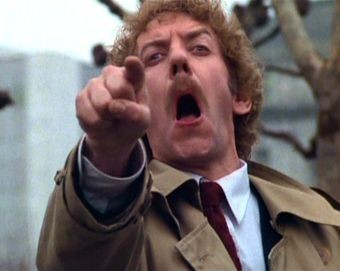
Time to cue the Invasion of the Body Snatchers music?


“Come on, ref, he was out of bounds!”

Not really. It’s just that a little more than a year ago I decided that I was going to “retire” from Fantasy Football after 23 years as an owner and Commissioner. I felt a few mental twinges during the NFL pre-season this year when I felt like there was something I was supposed to be doing, but that wasn’t unexpected. Hey, there’re still times when late summer/early fall roll around where a certain smell in the air or texture of the earth makes me think I should be at football practice, and that’s been more than 30 years!

So, this year, there was no draft to prepare for, no off-season free-agent transactions to review, no clever team name to develop (I came up with a new name every season; my all-time favorite was Weapons of Mass Distraction, though the Rush Limbos was up there as well). The would-be draft week came and went and the NFL season started. The first shock of revelation came to me when I was discussing the season with someone at work and I said that we were only a couple of weeks into the season and it was too soon to panic. To which my friend replied, “Uh, it’s week eight.” Oopsie.

Weeks 13-16 went by like any other for me this year, though this was typically the fantasy play-off season. Today was the first day back at work after the Christmas/New Year’s break and the day I’d usually be collecting outstanding league fees from the slow-payers, or passing out cash to the winners — or looking forward to taking my own winnings down to Best Buy.

And you know what, I don’t miss it a bit. It was strange how easily my quest for knowledge regarding rookies, injuries, sleepers, busts and dark horses melted away. I still enjoy watching the game, but most of the games don’t interest me enough to re-arrange my life appreciably. Now when I see that some player has scored four touchdowns in one game — or suffered a season-ending injury — I don’t exult or scream (if it was one of “my” players) or think of sending a gloating “sympathy” email to my fellow-owner who’s starting wide receiver just shot himself in the leg.

Well, maybe I do miss that part a little bit.

A proper cup of coffee


Brrr. On these cold days we’ve been having I really appreciate a nice, hot cup of coffee. I will also admit that my coffee tastes have become more refined in my latter years. I actually didn’t become a coffee drinker until I was in my 20s and a girlfriend got me started. She also gave me my first gravity filter for brewing coffee, which is still my generally preferred method. Our all-time favorite method is using a French press, but this is for special cups or occasions as it’s a bit messier to clean up after — ah, but the taste! There’s simply no way to get a richer tasting cup of coffee.


I tend to favor the darker roasts though my wife likes to mix in the lighter roasts as well. The Mall Diva goes for the much lighter blends, or “wienie” roasts as I call them. Nevertheless, we all love “A Proper Cup of Coffee” as performed by Trout Fishing in America in the video below (don’t worry, the Abba album is just one of the visuals and not part of the performance).


Enjoy!


Return to Sderot


The latest situation in Gaza reminded me of a post by Yaacov Ben Moshe from Breath of the Beast entitled Welcome to Sderot that I wrote about back in June. In it he described the constant, dripping, pressure of Hamas attacks on Israeli villages in range of rockets launched from Gaza, and how both Hamas and the Israeli government appeared to use a macabre calculus on how much violence could be tolerated. At the time I compared this to the grim irony of the West being willing “to trade blood for peace, to cut off fingers and feed them to dogs under the table so as not to upset the place-settings.”


As it now appears that the Israeli government has decided enough is enough, and is prepared to shrug off the ignorant pressure of “world opinion” in the same way they have been shrugging off the random missile attacks, it is worth revisting Yaacov’s penetrating essay:


Sderot is an Israeli town within range of Hamas rockets and the victim of the leadership policies of both the Israeli government and that of Hamas that requires a macabre calculus of acceptable losses that keeps both groups of leaders in power … while killing Jewish civilians. Hamas knows that launching rockets on a slow but steady basis, but killing only a few at a time will maintain its political power base with the jihadis, satisfy its foreign sponsors, while not seriously exposing itself to all out countermeasures from Israel.


Simultaneously, Israel’s government tacitly accepts a handful of deaths as being below the threshold of requiring dramatic and deadly response, knowing that it will be pilloried by foreign public opinion and seen as the aggressor if it does so. Ben Moshe cites JINSA (Jewish Institute for National Security Affairs) Report 781:


“For Hamas, the key is to keep the rocket attacks below an understood threshold and Israel’s response will be tolerable, precise and produce minimal collateral (Palestinian) damage. The Hamas pattern is to fire one, two or three rockets at Sderot. Wait a few days and do it again. Injure two, three, four Israelis. Kill one or two, but not more than that – this week. Increase the range and accuracy of the rockets incrementally. Hit Ashkelon, but just once. Then wait. Hit a shopping center, but if no one is killed, the Israeli response is unlikely to threaten Hamas rule. If Israel does retaliate, the world will probably be more annoyed by the “disproportionate response” than the original rocket attack.”


As I was reading, though, something was bothering me. I was still stuck on the seemingly more limited issue of the terror involved. Who are these people who are being killed by the rockets? How do they live knowing that, only if some, unspecified number of them of them are killed and maimed, will their government be moved to do something about the terror under which they live? This dangerous and painful situation is only partially a product of the Arab/Islamist dream of annihilation of Israel. It is made possible by a combination of ruthless internal enemies (e.g. the far left peace movement), clueless dupes (e.g. Olmert, Livni, et al) and shortsighted erstwhile foreign “friends” who do not understand the reality of the threat. This motley assortment of fools and instigators hold Israel’s defense establishment, her regard for her own citizens and, indeed, her very moral, civic, ethical and intellectual integrity hostage.


The people of Sderot listen for the sirens all day and all night 365 days a year and all must wonder if today is the day that a rocket will come through the ceiling in a busy dining hall or a kindergarten classroom or a high school auditorium and finally be “enough” to force the government to use the power it has always had- but may not always retain- to eliminate the threat. They wait for the government to act. They pray for the rest of the world to recoil in horror. They face each day with bravery and hope. Just like the people in Jackson’s story, they are hostages.


Do you believe that it is about The Nakba or The Occupation or The Settlements? Do you allow yourself the fantasy that there is a way to stop the madness- a sacrifice big enough to satisfy this ravenous cult?


Then what did the innocent victims die for on 9/11- or Madrid- or London- the Darfur? This is part of the same grotesque lottery that has been going on for 1500 years. In spite of the sacrifice of the innocent victims of 9/11, it is all too easy for us to deny that we are hostages too, but those “zero beings” from the Islamist void will not be happy to delete only Israel. They have “selected” them for annihilation first but it is nothing personal, you understand, just a sacrifice to prove there is no value to human life. There is no value to anything that does not affirm the spiritual vacuum of Islamism. It is not because they worship Allah, nor is it is that they believe Mohammed was a prophet. It is that they believe that he was the only prophet, that they know the absolute truth and that it is their mission to ignore (and destroy) all evidence to the contrary. If you believe in life, liberty and the pursuit of happiness, they will not rest until they destroy you too.


The Jihadists are not interested in cease-fires or peace. They are happy to tell you what they want. They want the world to live under Shari’a law. They believe that anyone that doesn’t want that is sub-human and deserves to be killed. This is nothing less than another confrontation with the evil of fascist, totalitarianism, and that is a beast whose hunger cannot be sated with souls, nor can its thirst be slaked with blood. The lottery they are holding is to determine not if you will be destroyed but when you will be destroyed. We are all citizens of Sderot — its just that most of us don’t know it yet.


For your pleasure

An interesting excerpt from the foreward of the book Amusing Ourselves To Death.

What Orwell feared were those who would ban books. What Huxley feared was that there would be no reason to ban a book, for there would be no one who wanted to read one. Orwell feared those who would deprive us of information. Huxley feared those who would give us so much that we would be reduced to passivity and egoism. Orwell feared that the truth would be concealed from us. Huxley feared the truth would be drowned in a sea of irrelevance. Orwell feared we would become a captive culture. Huxley feared we would become a trivial culture, preoccupied with some equivalent of the feelies, the orgy porgy, and the centrifugal bumblepuppy. As Huxley remarked in Brave New World Revisited, the civil libertarians and rationalists who are ever on the alert to oppose tyranny “failed to take into account man’s almost infinite appetite for distractions”. In 1984, Huxley added, people are controlled by inflicting pain. In Brave New World, they are controlled by inflicting pleasure. In short, Orwell feared that what we hate will ruin us. Huxley feared that what we love will ruin us.

This hits on part of what I was getting at in my post earlier this month Just Desserts in an Appetizer World.

HT: TechnoChitlins, via American Digest.

Escalation

So we come home from church the Sunday before Christmas and Boy #1 is standing out in the street in the sub-zero cold, waiting for us. Tiger Lilly is pleased; dad is more ambivalent. Nevertheless, we bring the frozen dude-sicle in for lunch and it looks as if he’s going to stay for awhile. The Mall Diva, Ben and I have plans, however, to go out and shoot the new .45; fortunately the Reverend Mother is now home as well to keep an eye on things — and it doesn’t hurt for me to make a big show of packing up the gun as we get ready to leave.

While we’re at the range, Boy #2 shows up as well. Boy #1 and Boy #2 proceed to try and kill each other — on the x-box, however. The delighted Tiger Lilly tries to kill them as well. (That’s my girl!) Eventually it’s time for Boy #1 to go home and the Reverend Mother graciously offers to drive him since it’s still arctic-like outside. Tiger Lilly goes along, of course, while Boy #2 waits for them to return. He’s sitting patiently in the kitchen by himself when the Diva, Ben and I return. Ok, when I left Boy #1 was at the house and now it’s Boy #2; I don’t even bat an eye. I greet him and then let everyone know I’m going downstairs to clean the GUN. An uneventful afternoon follows.


“Boys? What boys? I don’t see any boys.”

Still, I don’t know if I’m ready to have boys stacked up around the house like airplanes circling O’Hare during the holiday rush. I’ve already been through the drill with just one guy, thanks to the assistance of Haggar slacks. If there’s going to be two or even more boys, however, it may be time to escalate. Fortunately, I was exchanging a sweater for my wife at Macy’s after Christmas and passed through the Men’s Department. Lo and behold, Haggar cords for $14.50 and dress chinos for $17.50. Usually these cost $38 to $60, depending on the store. I considered the situation and bought three pairs.

Bring it on.